-
Carl Haub, Behind the Numbers
Republic of Congo Demographic and Health Survey Shows High Maternal Health, But No Fertility Decline
›June 5, 2012 // By Wilson Center StaffThe original version of this article, by Carl Haub, appeared on the Population Reference Bureau’s Behind the Numbers blog.
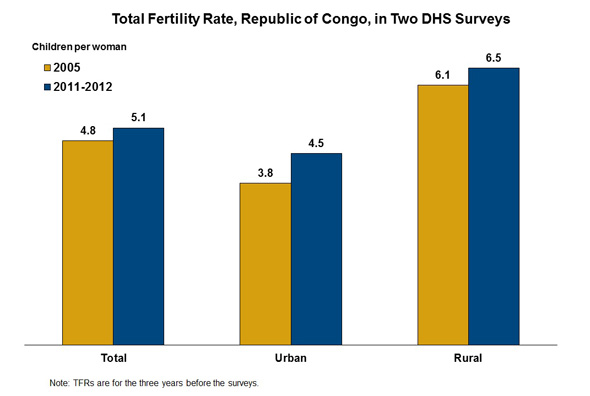
The Congo (Brazzaville) 2011-2012 Demographic and Health Survey (DHS) is the second DHS taken in the country and the preliminary report has just been released. The survey interviewed 10,819 women ages 15-49 and 5,145 men ages 15-59 from September 2011 to February 2012. A major finding of the survey was that fertility has not declined in the country since the previous DHS in 2005. The total fertility rate (TFR) report in the recent DHS for the three year period before the survey was 5.1 children per woman, 4.5 in urban areas, and 6.5 in rural areas. This appears to represent an increase in the TFR since 2005 but the survey report cautions that there is likely to have been some understatement of the actual level of childbearing in the 2005 survey, particularly among women ages 25-29.
Rural women accounted for two-thirds of those interviewed in the most recent survey. The rather high TFR is reflected in the desire for large families. Among women with five living children, only 37.3 percent said they did not wish to have additional children. An additional 9.8 percent of that group said they were incapable of conceiving, however.
In the survey, 44.7 percent of currently married or in-union women said that they were using some form of family planning and 20 percent were using a modern method. The most common type of modern method was the male condom at 12.3 percent, a rather unusual pattern of contraceptive use in Africa. That was followed by the pill at 2.9 percent and injectables at 2.8 percent. This continues the often-observed preference in sub-Saharan Africa for methods to space births, not necessarily to limit them. The use of modern contraception was 24.6 percent in urban areas and 11.7 percent in rural areas. Modern contraception rose since the 2005 DHS when it was reported at 12.7 percent and the condom was also the most frequently used method at that time. The prevalence of HIV was reported in the 2009 AIDS Indicator Survey at 4.1 percent for women ages 15-49 and 2.1 percent of men of the same age group.
Continue reading on Behind the Numbers.
Sources: MEASURE DHS.
Image Credit: Carl Haub/Population Reference Bureau. -
USAID’s New Global Health Framework and Delivering Equity in Health Interventions
›USAID’s new Global Health Strategic Framework, Better Health for Development, lays out the agency’s major health priorities for the next five years. “Core global health priorities” include reducing maternal mortality, ensuring child survival and nutrition, fostering an “AIDS free generation,” and fighting infectious diseases. Family planning and reproductive health is listed as a key area for bilateral engagement. In particular, the strategy hopes to continue to “graduate” countries from the agency’s family planning program, which since the 1980s has transitioned 21 countries into local ownership of family planning support. The strategy also takes stock of the shifting global health environment, noting the rise of the “BRICS” countries as new donors and the need to strengthen public health systems in developing countries. “Already, private payments account for 50-80 percent of total health spending in Africa and Asia, leading to system inefficiencies, inequitable access, and health costs that prove catastrophic to individuals and families,” the report reads. In order to achieve its priorities within this context, the document sets out a number of strategies, including a focus on program sustainability, the empowerment of women, and integrated approaches to development. Health, it says, “cannot be isolated from other development challenges.”Speaking of health interventions, a team of researchers led by Aluisio Barros of the Federal University of Pelotas, Brazil, recently compared coverage data from more than 50 countries against an index of household wealth to estimate the most and least equitable interventions. The study, “Equity in Maternal, Newborn, and Child Health Interventions in Countdown to 2015: A Retrospective Review of Survey Data From 54 Countries,” published in The Lancet, found that “interventions with similar levels of overall coverage often have very different degrees of inequality.” According to the data, “the most inequitable indicator was skilled birth attendant, followed by four or more antenatal care visits, whereas the most equitable was early initiation of breastfeeding.” For example, though the average for attendance by a skilled birth attendant was 53.6 percent across the entire sample, the wealthiest fifth had an 84.4 percent coverage rate and the poorest stood at 32.3 percent. “Interventions that are usually delivered in fixed health facilities…tend to be the most inequitably distributed,” write the authors, with geographical access, financial barriers, and discrimination appearing as likely obstacles for the poor. The authors conclude that, although “concern about inequalities in maternal and child health in poor countries was conspicuously absent from the global agenda in the past,” the availability of new, intervention-specific data provides a means of targeting equity issues in health delivery more successfully. -
Full Extent of Africa’s Groundwater Resources Visualized for the First Time
›“In Africa, groundwater is the major source of drinking water and its use for irrigation is forecast to increase substantially to combat growing food insecurity,” yet, a lack of quantitative data has meant that “groundwater storage is consequently omitted from assessments of freshwater availability,” according Alan Macdonald, Helen Bonsor, and Brighid Dochartaigh of the British Geological Survey, and Richard Taylor of University College London, writing in Environmental Research Letters.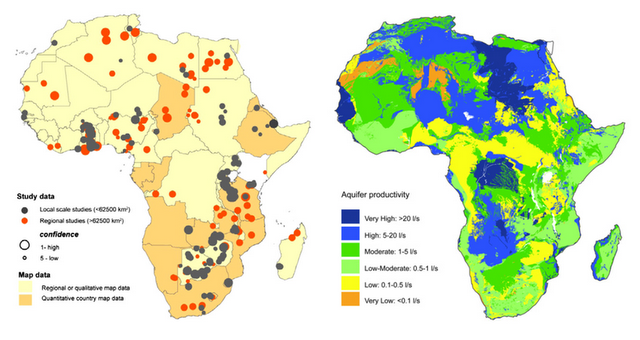
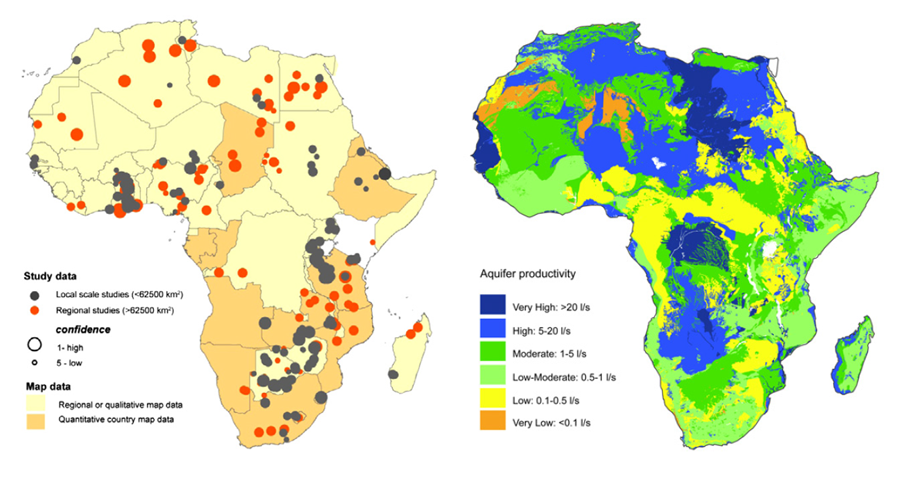
The authors hope to remedy this with new research presented in “Quantitative Maps of Groundwater Resources in Africa.” They used estimates compiled from geologic data and 283 aquifer summaries from 152 different publications to quantitatively visualize, for the first time, the full extent of Africa’s groundwater resources.
Tapping a Hidden Resource
The study estimates the scale of the continent’s groundwater resources at around 0.66 million km3. This volume, the authors explain, is “more than 100 times the annual renewable freshwater resources, and 20 times the freshwater stored in African lakes.”
Tapping into this massive resource is not always straightforward, however. The largest aquifers, and those most able to support high yielding bores, are concentrated in the arid regions of North Africa. The depth of these aquifers and their distance from major populations creates substantial economic challenges for extraction.
The geographic distribution of aquifers across sub-Saharan Africa is also quite variable, and local geology can determine not just the availability and accessibility of water but also its quality. For instance, geologic specificities can result in elevated levels of arsenic and other undesirable chemicals. Furthermore, “contamination…is common in urban areas from widespread and dispersed faecal effluent from on-site sanitation and leaking sewers.”
Tempering Expectations
Throughout Africa, “groundwater provides an important buffer to climate variability and change,” say the authors. But these buffers are not a singular solution to the threat of future water scarcity.
As the analysis shows, most aquifers, especially south of the Sahara, are unlikely to sustain boreholes of a higher capacity than that required by community-level hand pumps (one liter per second of flow at minimum). Yet, commercial irrigations schemes and urban towns typically demand boreholes greater than five liters per second, according to the study.
So, groundwater extraction may help communities and some small-scale farmers maintain access to water, particularly because many aquifers are found to possess the storage capacity required “to sustain abstraction through inter-annual variations in recharge,” however, “strategies for increasing irrigation or supplying water to rapidly urbanizing cities that are predicted on the widespread drilling of high yielding boreholes are likely to be unsuccessful.” Especially, the authors assert, where drilling precedes detailed local scale mapping of the available resources.
Sources: Environmental Research Letters.
Image Credit: Figures 1 and 3, courtesy of Environmental Research Letters. -
Sex and World Peace: How the Treatment of Women Affects Development and Security
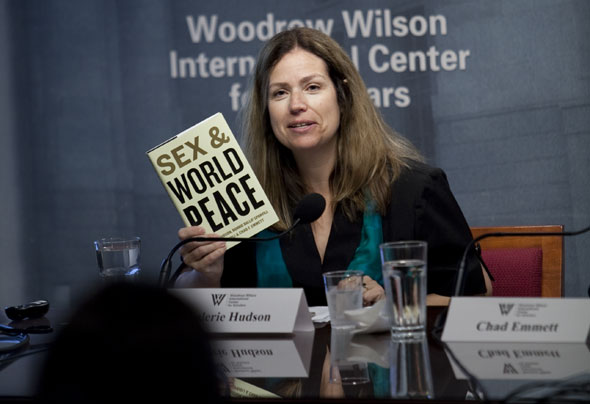
›“What we have discovered is that the very best predictor of how insecure and unstable a nation is not its level of democracy, it’s not its level of wealth, it’s not what ‘Huntington civilization’ it belongs to, but is in fact best predicted by the level of violence against women in the society,” said Valerie Hudson, co-author of Sex and World Peace, at an April 26 book launch at the Wilson Center. [Video Below]
-
New Surveys Generate Mixed Demographic Signals for East and Southern Africa
›May 8, 2012 // By Elizabeth Leahy MadsenThe pace of fertility decline in sub-Saharan Africa will be the single most important factor in whether the global population reaches the UN’s high projection of nearly 11 billion in 2050, or remains closer to the low projection of 8 billion. In recent years, the high projection has seemed more likely, as sub-Saharan Africa has been marked by stalled fertility declines and stagnant rates of contraceptive use. Survey results released over the past year showing dramatic increases in contraceptive use in Ethiopia, Malawi, and Rwanda therefore set demographers and the family planning community abuzz, signaling that concerted efforts to improve health services had paid off and fertility rates were on the decline. But in recent months, additional surveys from Mozambique, Uganda, and Zimbabwe have shown that those positive trends are not universal.
-
Jack Goldstone on Post-Cold War Trends in Armed Conflict and Challenges for the World’s Youth
›“Global trends in armed conflict have really come down since the end of the Cold War,” said George Mason University’s Jack Goldstone in this talk adapted from a presentation at the Wilson Center last fall. This drop is a reflection of decreased proxy conflicts between the Soviet Union and United States and increased interventionism from the international community. But another thing we can point to is that the world’s youth population has also declined, he said.“Global trends in armed conflict have really come down since the end of the Cold War,” said George Mason University’s Jack Goldstone in this talk adapted from a presentation at the Wilson Center last fall. This drop is a reflection of decreased proxy conflicts between the Soviet Union and United States and increased interventionism from the international community. But another thing we can point to is that the world’s youth population has also declined, he said.
“There seems to be a reasonably strong connection, between the drop-off in post-Cold War conflicts” and a decline in the proportion of youth in global population. This ageing, however, has been uneven across the globe and risks remain, said Goldstone.
“Ninety percent of all children under the age of 15 in the world today are growing up outside of North America, Europe, and the wealthy countries of East Asia,” he said, and in four or five decades time, “90 percent of the workforce of the world will be workers that have grown up outside of the rich countries.” It is this population’s “future productivity [that] will go far to determining whether quality of life gets better or worse.”
Demography and State Fragility
States across sub-Saharan Africa, South Asia, and the Middle East that perform poorly in indexes of state fragility also tend to have the youngest populations. “This could be just an unhappy coincidence,” said Goldstone, “but I don’t think that’s what’s going on. I think what we’re seeing is a kind of virtuous and vicious circle.”
“Where government is weak, ineffective, doesn’t provide education, doesn’t provide security, it’s advantageous both for individuals and for groups to have larger families,” he said. “However, as population grows, it’s more difficult for the government to provide adequate education and security for the larger, more youthful population.”
“On the other hand, if you can get on the track for a stronger, more legitimate government – a government that’s able to provide education, provide security of property, [and] encourage investment…fertility tends to drop quickly.” “This in turn re-enforces the ability of governments to direct resources to education and economic growth,” said Goldstone.
Critical Role of Governance
“Mobilization for political conflict draws heavily on youthful populations,” said Goldstone. As research by Henrik Urdal has shown, a bulge in the population of youth does appear to increase the risk of conflict. However, this relationship is strongly mediated by regime type. While strong democracies and autocracies are considered relatively stable, there is a “risk zone” in between, where instability is more likely.
“We live in a world where the countries with weak, fragile governments [are] about a third of the global population. But in another 30 years, if things remain as they are in terms of governance, you’re looking at closer to half the world’s population living in those more difficult circumstances,” he said.
“If the democracy is not well established, if rule of law is not well regulated, than people don’t necessary trust the outcome of peaceful electoral competition,” said Goldstone. “If people don’t like the outcome of an election, or they feel they’re being excluded, or things are one sided, they may mobilize.” This lack of political trust can result in instability and violence such as the recent protests by Thailand’s “red shirts.”
Although many Latin American and Asian states are heading towards “voluntary reduced fertility, strong economic growth, and stronger and more stable governments,” a real risk remains, he asserted. Africa, for instance, is “liable to gain a billion out of the next two billion in global population growth.”
Challenges for the Future
“For me, there are two big challenges posed by global demography,” opined Goldstone.
First, “given that 90 percent of today’s youth are in developing nations, providing them with opportunities to become productive adults through education, stable environment, [and] socialization is crucial.”
And second, in order to deliver those services, “strengthening governance in the countries where those youth live, in order for those education, security, and social services to be provided,” is absolutely necessary for economic development and reducing political instability.
While incidences of conflict have declined, the effects of those intractable conflicts that remain – in particular the sharp increase in the number of refugees and displaced populations uprooted by conflict – are solid arguments for continuing to address this risk. -
Updates to African Conflict Database Give Researchers Access to Comprehensive, Near Real-Time Information
›Despite the end of Cold War-era civil wars, political violence rates in Africa remain remarkably high. However, this broad statement hides an important qualification: the types of violence that have persisted in recent years have changed significantly, shifting from rebel and government activity towards violence against civilians, riots, protests, and battles by armed groups other than rebels.
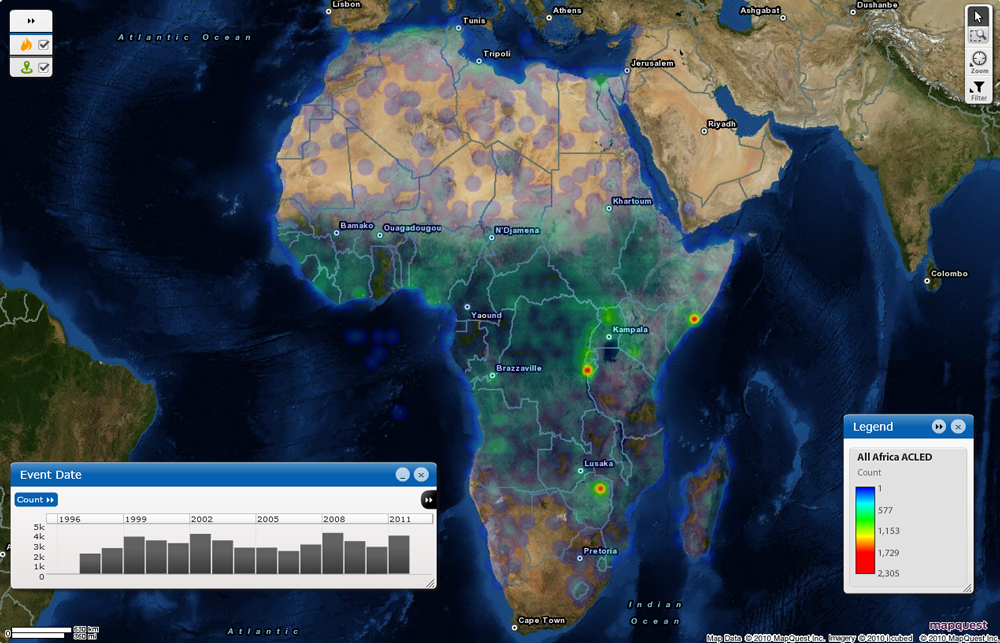
The only way researchers can track this activity is through political violence data disaggregated by type, location, and time. The Armed Conflict Location and Event Dataset (ACLED) project aims to provide that service. We recently released updated information on political violence across Africa from January 1997 to December 2011 (see above for a hotspot map and timeline of violence over this period).
New to the ACLED project are real time data and trend reports on monthly conflict patterns throughout the continent. It is now perhaps the comprehensive and representative depiction of political violence as it occurs throughout Africa.
The data captures an array of actions including battles, looting, rioting, protesting, violence against civilians, and non-violent activity (such as arrests, recruitment drives, troop movements) by a variety of actors such as governments, rebels, militias, rioters and protestors.
Each event is geo-referenced by location and time-stamped by day. In our recently released version, we also included fatalities by event; distinguished conflict groups by their type (government, rebel, political militia, communal militia, rioters, protesters, civilians etc.); and specified the type of interaction between actors (e.g. government-rebel battle; rebel-civilian attack). These changes make ACLED data flexible for multiple uses.
Several new findings on conflict patterns are found using ACLED data:- Violence against civilians accounts for approximately half of all conflict events.
- Generally, where they occur, civil wars intensely affect 19 percent of a state’s territory, yet rebel actions have drastically decreased since 2005.
- Militia activity has significantly increased since 2005 and is especially high during election periods in new democracies.
- Communal violence patterns are more widespread but affect fewer people than civil war violence.
- Civil war patterns are not strongly affected by climate changes, but communal conflict decreases during periods of local scarcity and increases on the cusp of rainy seasons.
- Political violence increases in the period from peace talk announcements to negotiations. This violence is directed towards overtaking territory and civilians are frequently the main victims.
Fine-grained data on the range of political violence in the developing world is important as it provides the opportunity to ask and potentially answer certain questions about a range of issues related to governance, economic development, and conflict dynamics themselves.
For example, ACLED data shows that violence is increasingly occurring in villages, towns, and cities across Africa. In other words, political violence may be “urbanizing.” This has important implications for how we understand the practice of politics, the geography of marginalization, and the role of trigger patterns in explaining conflict. But there are many competing theories that could explain this trend.
Using data that disaggregates by violence type allows us to probe deeper: If the environmental security framework is correct, political violence in towns may be a response to high in-migration from rural areas to cities. Violence therefore is due to competition between urban people and migrant populations.
An alternative explanation is that the poor conditions of African urban life, high rates of informal employment, and under-representation of urban communities in government might explain an increase in violence. In this case, violence is a populist response, in that civilians riot and protest in favor of government reform.
Finally, the advantages of densely populated urban areas – easier access to resources, recruits, infrastructure, and power – may attract more organized groups to contest these spaces. If this explanation were correct, we would expect higher rates of rebel activity against government forces in cities, with a clear drive to overtaking the capital.
We have not been able to address these questions before with credible and comprehensive data, but now we can. Indeed, such data is crucial for interrogating the climate-security debate.
For example, Clionadh recently co-authored an article in the Journal of Peace Research’s special issue on climate and conflict, which used ACLED data for East Africa. In that piece, she and her co-author argued that different conflict groups use their environment in accordance with their overall goals. While much of the conflict activity studied had an environmental signal, the climate signal was much weaker.
We hope that these studies and other work with disaggregated data spur more theories and explanations of conflict patterns in developing states, and that the breadth and form of the data allows for new directions within conflict research.
Clionadh Raleigh is an assistant professor in the Department of Geography at Trinity College, Dublin, external researcher at the Peace Research Institute Oslo (PRIO), and director of the ACLED project. Caitriona Dowd of Trinity College and Andrew Linke of the University of Colorado are senior researchers for ACLED.
Image Credit: ACLED. -
Women’s Rights and Voices Belong at Rio+20
›This summer, world leaders will gather in Rio de Janeiro for the 20th anniversary of the first UN Earth Summit to hammer out a new set of agreements on what sustainable development means and, more importantly, how both rich and developing nations can get there before it’s too late. However, for the scores of women who will be attending (and just importantly for those who aren’t), there are glaring omissions: reproductive health, gender equality, and girls education are nowhere to be found on the Rio+20 agenda.
Women offer many of the most promising levers for the transformation to sustainable development. My experience with the Global Fund for Women tells me that women are full of creative and strategic solutions to the problems facing their communities around the world. Their voices must be included in critical decisions affecting our world. And the fact is, sustainable development isn’t sustainable if it doesn’t include empowering women to plan their families, educate themselves, and their children, and have a voice in government at all levels. Rio+20 must have human rights – and women’s rights – at its core. Earth summit planners haven’t yet done that, but women can make it happen.
Women are 51 percent of the world’s population, yet own only one percent of its assets, are two-thirds of the world’s workers but earn a mere 10 percent of wages. Rio+20 must not become another forum in which women’s issues are not heard. Instead, the summit must demonstrate that women’s voices are integral to all development. Environmental sustainability simply can’t happen without women’s inclusion.
For example, in West Africa, women make up 70 percent of workers in agriculture. In Burkina Faso, deforestation, water scarcity, and soil erosion show us that climate change is already impacting women farmers. Women tend to “sacrifice themselves” in order to care for their families – feeding themselves last. And women are most likely to suffer and die in environmental disasters – particularly in the Asian countries most at risk from climate change.
So how do we support women while supporting the environment that sustains us all?
Simply meeting women’s needs for family planning is one inexpensive and powerful development strategy with a host of environmental benefits. Over 200 million women around the world want the ability to choose the spacing and number of children but don’t have access to, or accurate information about, basic contraceptives like condoms, pills, and IUDs. One-hundred and seventy-nine nations already agree that meeting this need is a top priority, and the Millennium Development Goals (MDGs) reflect a goal of universal access to family planning as well.
Satisfying this demand would dramatically reduce maternal and child mortality and enhance human rights. What’s more, two recent studies show that a reduction of 8 to 15 percent of essential carbon emissions can be obtained by meeting women’s needs for family planning. This reduction would be equivalent to stopping all deforestation or increasing the world’s use of wind power fortyfold.
The Earth Summit presents a major opportunity to ensure that women’s needs and rights are given top priority in plans for sustainable development. In a time of multiple, interlinked human and environmental crises and a very tight funding environment, investing in women is a clear winner.
A greater understanding of the impact of environmental degradation, pollution, and climate change on women, coupled with solid public policy that respects and protects women’s reproductive rights, is essential to the “Sustainable Development Goals” that many believe will emerge from Rio+20 to replace the MDGs, which expire in 2015.
As the summit approaches, it’s time to reflect on why women’s full participation and inclusion is so important and call for world leaders to harness the power of women as we launch the era of sustainable development.
Musimbi Kanyoro is president and CEO of the Global Fund for Women, which advances women’s human rights by investing in women-led organizations worldwide.
Sources: Food and Agriculture Organization, Guttmacher Institute, Moreland et al. (2010), O’Neill et al. (2010), Princeton Environmental Institute, UN, UNEP, World Bank, World Health Organization.
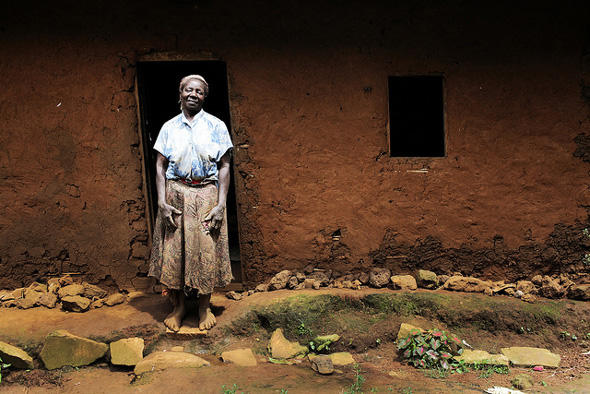
Photo Credit: “Reokadia Nakaweesa Nalongo,” courtesy of Jason Taylor/Friends of Earth International.
Showing posts from category Africa.