

-
PODCAST – Sharing the Forest: Protecting Gorillas and Helping Families in Uganda
›October 9, 2008 // By Wilson Center Staff<href=”https://d3i11i4ld2ygwb.cloudfront.net/uploads/2012/07/Kalema-Zikusoka1.png”>
 Gladys Kalema-Zikusoka is founder and CEO of Conservation Through Public Health (CTPH), an NGO that seeks to save the endangered mountain gorillas of Uganda’s Bwindi Impenetrable National Park and improve the health and livelihoods of people living on the outskirts of Bwindi. Close proximity of humans and gorillas has resulted in the transfer of a number of diseases, including tuberculosis and scabies. In this podcast, Kalema-Zikusoka describes CTPH’s success providing integrated health services, educating people about family planning methods, reducing human–wildlife conflict, and improving local livelihoods. In “Sharing the Forest: Protecting Gorillas and Helping Families in Uganda,” the latest issue in ECSP’s Focus series, Kalema-Zikusoka and coauthor Lynne Gaffikan write that “members of these communities have the potential to serve as model stewards of the country’s natural resource wealth”–if their health needs are met and livelihoods improved. Kalema-Zikusoka recently spoke at the Wilson Center on human, animal, and ecosystem health and population-health-environment lessons from East Africa.
Sharing the Forest-Protecting Gorillas and Helping Families in Uganda: Download
Photo: Gladys Kalema-Zikusoka. Courtesy of Heidi Fancher and the Woodrow Wilson Center. -
Niger Delta Militants Escalate Attacks, Days After Government Establishes Ministry to Aid Delta’s Development
›September 19, 2008 // By Rachel WeisshaarNiger Delta militants destroyed Royal Dutch Shell’s Orubiri flow station on Tuesday and blew up a major oil pipeline near Rumuekpe on Wednesday, according to statements from the Movement for the Emancipation of the Niger Delta (MEND), the main insurgent group. On Monday, militants attacked other Shell oil facilities, killing a guard and forcing nearly 100 workers to evacuate. Clashes between the militants—who demand a larger share of the oil revenue and greater political autonomy for Niger Delta residents—and the Nigerian army have reduced the country’s crude oil output by more than 20 percent since 2006. The conflict is “perhaps the most significant, most volatile, and potentially dangerous in that part of the world,” says Wilson Center Africa Program Director Howard Wolpe, who is part of a working group formed to advise policymakers on the issue.
On Wednesday, MEND announced it was broadening the scope of its land attacks beyond Rivers state, the heart of the Niger Delta, and would also seek to target offshore oil rigs. On September 14, MEND declared an all-out war on the Nigerian government for the first time—only three days after its declaration of a cease-fire. The cease-fire came in response to the Nigerian government’s announcement of the creation of a new ministry to accelerate infrastructure development, job creation, and environmental cleanup in the impoverished region.Perhaps the declaration of both cease-fire and war within the space of three days is not so surprising, given the disagreement among Niger Delta leaders over the new ministry. In an online statement, MEND said,
The people of the region should receive this latest dish with apprehension and not allow the over five decades of starvation to rule our emotions as this is not the first time such ‘palatable’ offers have been served to the region from the late 50’s to date. Creating a ‘Ministry’ is not the coming of the much awaited messiah. Nigeria has in existence, ministries over 40 years old which have not positively impacted on the people. It will be yet another avenue for corruption and political favoritism.
Yet People’s Democratic Party Chief Okotie-Eboh had a different take: “It is a very good measure and it shows the sincerity of President Yar’Adua to resolving the Niger Delta crisis. We should give him a chance. This ministry will get allocations like other ministries to tackle the problems of the Niger Delta.”
Although views on the new ministry vary widely, all agree that the Niger Delta faces several grave security, economic, and environmental threats. For instance, an International Crisis Group report recently concluded that one “major issue that has to be dealt with in the context of reconciliation [between the Ogoni people and Shell] is environmental clean-up. No significant study has been conducted to determine reliably the precise impact of oil industry-induced environmental degradation on human livelihoods in the area, but there are indications of severe damage.”
Yet the Delta must also contend with the longer-term implications of its demographic challenge. Forty-five percent of Nigeria’s population is younger than 15, which amounts to a serious youth bulge. The government’s chronic inability to provide these young people with education, health care, and jobs is likely contributing to instability in the Delta.
Photo: MEND fighters and hostages. Courtesy of Dulue Mbachu and ISN Security Watch. -
PODCAST – Virunga National Park and Conflict in the DRC
›September 11, 2008 // By Geoffrey D. Dabelko“The resource base is a point of contact for local residents, refugees, rebel groups, park rangers, [and the] military as they struggle to survive,” says Richard Matthew of the University of California, Irvine, in this podcast interview, describing the significance of Virunga National Park to the diverse collection of actors in the eastern Democratic Republic of the Congo. Matthew cites a fundamental tension between the needs of the park—which is home to some of the few remaining mountain gorillas in the world—and the desperate humanitarian needs of the people living in and around it. On a recent assessment trip to the area for the UN Environment Programme (UNEP), Matthew and his colleagues met with many of these groups to help find ways to reduce pressure on the park’s natural resources, while recognizing they are key to the livelihoods of millions of needy people in the region.I also asked Matthew to highlight some of the human security topics he and his colleagues pursue at the Center for Unconventional Security Affairs at UC Irvine. One such topic is microfinance. “Microfinance lending rarely takes into consideration the environmental impact and conflict-inducing impacts,” says Matthew. He and his colleagues are convening practitioners and conducting research on practical ways to “green” and reduce the conflict-generating impacts of this increasingly popular development strategy.
I conducted this interview in a noisy UN cafeteria in New York City. We were both in town to meet with David Jensen and colleagues from UNEP’s Disasters and Conflicts Programme and the UN Peacebuilding Commission. Expect a podcast and article soon from Jensen on the New Security Beat and in the Woodrow Wilson Center’s Environmental Change and Security Program Report, respectively.
Photo: A charcoal checkpoint in Virunga National Park. Courtesy of Richard Matthew. -
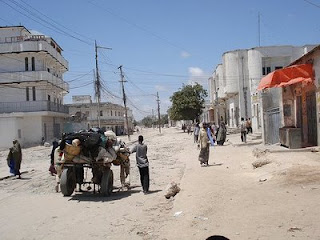
Somalia Battered by Drought, Food Shortages, Worsening Violence
›September 5, 2008 // By Will Rogers“The humanitarian nightmare in Somalia is the result of a lethal cocktail of factors,” writes Ken Menkhaus in a recent ENOUGH strategy paper, Somalia: A Country in Peril, a Policy Nightmare,” launched this week at the Wilson Center (video). Menkhaus was joined by Chris Albin-Lackey, a senior researcher at Human Rights Watch, and Harun M. Hassan, a Somali journalist and writer based in Washington, DC, for a discussion of the political and humanitarian situation in Somalia, which is ranked first on the 2008 Failed States Index.
The country has been plagued by “18 years of state collapse, failed peace talks, violent lawlessness and warlordism, internal displacement and refugee flows, chronic underdevelopment, intermittent famine, piracy, regional proxy wars, and Islamic extremism,” writes Menkhaus. Over the past 18 months, severe drought and increased attacks against relief agencies have left 3.2 million Somalis in dire need of humanitarian assistance. Two-thirds of Mogadishu’s population—700,000 people—has fled the city for Somalia’s harsh countryside, where they lack access to food, clean water, basic health care, livelihoods, and support networks.
Fighting between the Transitional Federal Government (TFG), Ethiopian troops, and regional militias has exacerbated food shortages, as TFG and Ethiopian troops target local markets, including the Bakaara market in Mogadishu, in retaliation for militia attacks. With drought “killing off livestock and reducing harvests in farming areas” and the economy crippled by violence and an outbreak of counterfeiting, food prices have skyrocketed.
Although Menkhaus rightly mentions a few of the situation’s environmental aspects, such as the drought’s role in the food crisis, he neglects the role population growth has played. The 2008 Failed States Index ranked Somalia as the state with the most demographic pressure – a significant indicator of state instability – (tied with Bangladesh). According to the Population Reference Bureau, Somalia has a total fertility rate of 6.7 children per woman and an annual rate of natural increase of 2.7 percent. With 45 percent of the population under 15, Somalia’s youth bulge increases the likelihood of continued violence; in addition, if Somalia ever does find peace and stability, its government will be hard-pressed to meet the needs of all its citizens for jobs, health care, and education.
Humanitarian agencies in Somalia have attempted to provide relief, but they face rampant extortion, corruption, and intimidation. According to Menkhaus, “uncontrolled and predatory TFG security forces, along with opportunistic criminal gangs, have erected over 400 militia roadblocks (each of which demands as much as $500 per truck to pass).” In addition, since May 2008, jihadist cells in Mogadishu operating under al-Shabaab, “a hardline military faction of the Islamist movement,” have stepped up attacks against relief workers and are assassinating “any and all Somalis working for western aid agencies or collaborating with U.N. and Western NGOs.”
Somali piracy has made humanitarian shipments to sea ports a treacherous task. According to Albin-Lackey, Somalia’s second-largest port, Kismaayo, fell to al-Shabaab militants last week after weeks of fighting between the Islamic group and TFG security forces, cutting off a crucial delivery point for humanitarian shipments. According to Menkhaus, with human insecurity worsening, Somalis who would not otherwise support fundamentalism will become more vulnerable to recruitment from criminal gangs and terrorist cells, including al-Qaeda. And although the Djibouti Accord was signed last month between the TFG and a faction of the opposition Alliance for the Re-liberation of Somalia, experts are pessimistic that it will do anything to end the violence.
Photo: Internally displaced people (IDPs) flee the escalating violence in Mogadishu for IDP camps on the outskirts of the city, where newcomers build their own makeshift shelters. Courtesy of Abdurrahman Warsameh and ISN Security Watch. -
Population Growth, Environmental Degradation Threaten Development in Uganda
›August 28, 2008 // By Sonia SchmanskiClimate change, increasing population, and overuse of land, fisheries, and water supplies threaten to undermine development in Uganda, writes Pius Sawa for the Africa Science News Service. Olive Sentumbwe Mugisa, the World Health Organization’s (WHO) population and health advisor in Uganda, warns that Uganda’s economic growth is not keeping pace with its population growth, which is among the fastest in Africa, due to a fertility rate of 6.7 children per woman.
Native Ugandan Gladys Kalema-Zikusoka spoke about the interconnectedness of population, health, and environment issues in Uganda in two events at the Wilson Center in May of this year. Kalema-Zikusoka is the founder and director of Conservation Through Public Health (CTPH), which works to conserve the habitat of the endangered mountain gorilla by strengthening community health services and providing communities with information about the benefits of family planning.
Kalema-Zikusoka is also the author of an upcoming issue of Focus, the Environmental Change and Security Program’s series of occasional papers featuring Wilson Center speakers. Her piece describes CTPH’s work in and around Bwindi Impenetrable National Park, where it has found great success in addressing health, conservation, family planning, and livelihood issues in an integrated fashion.
Photo: Woman and children in southern Uganda. Courtesy of flickr user youngrobv. -
UN Environment Programme to Conduct Post-Conflict Assessment in Rwanda
›August 27, 2008 // By Sonia SchmanskiAlthough it has been 14 years since violence devastated Rwanda, the UN Environment Programme (UNEP) is now preparing to conduct a Post-Conflict Assessment (PCA) of the country. As Rwanda Project Coordinator Hassan Partow explained, “UNEP does not initiate environmental assessment in any country, it only comes in when invited,” and Rwanda only recently requested that a PCA be conducted (see full list of PCAs here).
In a May 2004 presentation at the Wilson Center, Pekka Haavisto, former chairman of UNEP’s Post-Conflict Assessment Unit (PCAU)—now called the Disasters and Conflicts Programme and headed by David Jensen—remarked that “the post-conflict situation is a unique opportunity to create something new.” Just as environmental issues can lead to conflicts, they can also hamper efforts to create lasting peace following conflict, making PCAs invaluable tools in rebuilding nations following conflict. Common post-conflict environmental challenges include hazardous waste, radioactive materials, deforestation, chemical fires, overcrowded refugee camps, and contaminated water supplies. PCAs assess these challenges and offer recommendations for addressing them.
The environment can also provide a platform for dialogue and cooperation, said Haavisto, citing the case of the Palestinian Territories, where water has long been a nexus of tension and where PCAU has worked since 2001. Israeli and Palestinian officials both support PCAU’s operations in the region, where it brokered an agreement on future environmental cooperation and is working toward reestablishing the Joint Environmental Expert Committee to coordinate sustainable development in the area. Haavisto also noted that UNEP’s PCA work in Iraq following the Gulf War resulted in the first official meeting between Iraq and Iran in nearly 30 years.
The 2007 Sudan PCA cautions that “Sudan is unlikely to see a lasting peace unless widespread and rapidly accelerating environmental degradation is urgently addressed.” The PCA underscored how environmental stresses—including desertification, land degradation, and decreasing rainfall—have contributed to economic desperation, which has been a key instigator of the violence plaguing the region. “It is clear,” said UNEP Executive Director Achim Steiner, that “central to keeping the peace will be the way in which Sudan’s environment is rehabilitated and managed.” Sudan’s tragedy, he said, highlights “how issues such as uncontrolled depletion of natural resources like soils and forests allied to impacts like climate change can destabilize communities, even entire nations.” Yet promisingly, Sudan’s government recently established an environmental ministry, demonstrating how PCAs can spur governments to devote resources to environmental concerns by showing that they are integrally related to economic, health, and security issues.
Though PCAU has completed 18 PCAs since 1995 and has aided in the reconstruction of many countries, Haavisto acknowledged continuing difficulties in persuading governments to prioritize the environment. It has been an ongoing challenge, he said, to “convince different stakeholders that the environment is an important issue that needs to be dealt with immediately.” Yet as the above examples demonstrate, UNEP has achieved considerable accomplishments despite these difficulties. -
“New Demography” Drives World Bank Population Policy in Africa
›August 26, 2008 // By Sonia Schmanski“African elites have long had the perception that rapid population growth was not an issue because of the vastness of Africa, abundance of resources, relatively low population densities and, more recently, the threat of HIV/AIDS,” but as rapid population growth becomes a more urgent problem across the continent, that view is increasingly falling out of favor, said World Bank lead demographer John May in a recent interview with the African Press Organization. As governments work to improve their population programs, the World Bank is adopting “new demography” principles that examine age structures, dependency ratios, human capital investments, and the demographic dividend to craft cross-sectoral approaches to population policy.
Current demographic trends, the result of reduced infant and child mortality and slowly falling fertility rates, will double the population of Africa by 2036 if left unaddressed, said May. The security implications of this population growth are readily apparent. Rapid population growth has been identified as a factor in increasing resource scarcity and can help lead to conflict. In Sudan, for example, the pressures of overgrazing, desertification, ongoing drought, and escalating competition between pastoralist and agriculturalist communities have contributed to violence. Kenya presents a similar scenario: Rapid and uneven population growth led to land scarcity in the late 1980s, exacerbating latent political and ethnic tensions. The violent conflict that erupted between 1991 and 1993 was fueled in part by natural resource scarcity. More recently, insecure land tenure, shaky property rights, and competition over natural resources have triggered violence across East Africa. Population pressures also play a part, and some argue that demographically-induced land scarcity was at the heart of violence in Kenya earlier this year.
May lamented that far less attention has been paid to population than to humanitarian crises, good governance, and climate change—despite compelling evidence that population growth is likely to negatively impact the chances for peace. Sexual and reproductive health, for example, form 20 percent of the global disease burden, and there is compelling evidence that good reproductive health leads to poverty reduction. He reminds us that demographic issues are inextricably tied to larger development issues, and must be addressed together.
Some countries have successfully reduced fertility rates, May noted. In the 1960s, the Tunisian government introduced a program to reduce fertility rates through increased education for girls, government provision of family planning services, and legal reforms to increase the economic status of rural women and girls. Today, the country boasts a replacement-level fertility rate. Efforts to improve gender equity are highly effective in reducing unsustainable population growth: “It could be argued that the population issue in sub-Saharan Africa is in essence a gender issue,” said May, who argued that “[e]conomic and social development is of course the best contraceptive.”
“The task ahead is huge and difficult, however some concrete results have already been obtained,” said May. He offered a simple suggestion to governments wondering how to craft population policies: “let people, especially women, decide for themselves and…provide them with the means to exert their choices.”
-
Weekly Reading
›Eighty-two percent of experts surveyed by Foreign Policy and the Center for American Progress for the 2008 Terrorism Index said that the threat posed by competition for scarce resources is growing, a 13 percent increase over last year.
China Environment Forum Director Jennifer Turner maintains that China is facing “multiple water crises” due to pollution and rising demand in an interview with E&ETV;.
The Population Reference Bureau has two new articles examining the nexus between population and environment. One explores the relationship between forest conservation and the growth of indigenous Amazonian populations, while the other provides an excellent examination of population’s role in the current food crisis, with a special emphasis on East Africa.
Ethiopia’s rapid population growth “has accelerated land degradation, as forests are converted to farms and pastures, and households use unsustainable agricultural methods to eke out a living on marginal land,” writes Ruth Ann Wiesenthal-Gold in “Audubon on the World Stage: International Family Planning and Resource Management.” Wiesenthal-Gold attended a November 2007 study tour of integrated population, health, and environment (PHE) development programs in Ethiopia sponsored by the Audubon Society and the Sierra Club.
Showing posts from category Africa.
 Gladys Kalema-Zikusoka is founder and CEO of
 I also asked Matthew to highlight some of the human security topics he and his colleagues pursue at the
  “The humanitarian nightmare in Somalia is the result of a


