• woodrow wilson center
  • ecsp

New Security Beat

Subscribe:
  • rss
  • mail-to
  • Who We Are
  • Topics
    • Population
    • Environment
    • Security
    • Health
    • Development
  • Columns
    • China Environment Forum
    • Choke Point
    • Dot-Mom
    • Friday Podcasts
    • Navigating the Poles
    • Reading Radar
  • Multimedia
    • Water Stories (Podcast Series)
    • Backdraft (Podcast Series)
    • Tracking the Energy Titans (Interactive)
  • Films
    • Water, Conflict, and Peacebuilding (Animated Short)
    • Paving the Way (Ethiopia)
    • Broken Landscape (India)
    • Scaling the Mountain (Nepal)
    • Healthy People, Healthy Environment (Tanzania)
  • Publications
  • Events
  • Contact Us

NewSecurityBeat

The blog of the Wilson Center's Environmental Change and Security Program
Showing posts by Linnea Bennett.
  • Report: Damming of Lake Turkana Could Leave Thousands Without Water, Provoke Tribal Conflict

    ›
    Eye On  //  February 3, 2015  //  By Linnea Bennett

    The damming of a river that feeds the world’s largest desert lake could lead not only to less drinking water for thousands of Kenyans, but international conflict between tribes for what little water remains.

    MORE
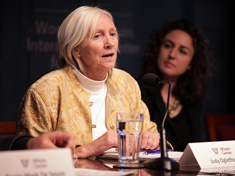
  • Judy Oglethorpe: Fighting Environmental Change in Nepal Through Community Empowerment

    ›
    Friday Podcasts  //  January 23, 2015  //  By Linnea Bennett
    oglethorpe

    “We believe that ecosystems can help people to adapt,” says Judy Oglethorpe in this week’s podcast. “But at the same time, people have to help ecosystems to adapt in order to continue to provide environmental services.”

    MORE
  • The U.S. Military’s Role in Global Health; Motivating Behavioral Change Through Personal Health

    ›
    Reading Radar  //  January 19, 2015  //  By Linnea Bennett

    RR-Global-Health-Picture-CCClimate change mitigation efforts are more broadly supported when they are framed as a public health issue, according to results recently published in Climatic Change. After polling U.S. participants with political identities ranging from very liberal to very conservative, authors Nada Petrovic, Jaime Madrigano, and Lisa Zaval found most participants, except those who identified as very conservative, believed “health” to be the most compelling reason to reduce fossil fuels.

    MORE
Newer Posts  
View full site

Join the Conversation

  • RSS
  • subscribe
  • facebook
  • G+
  • twitter
  • iTunes
  • podomatic
  • youtube
Tweets by NewSecurityBeat

Trending Stories

  • unfccclogo1
  • Pop at COP: Population and Family Planning at the UN Climate Negotiations

Featured Media

Backdraft Podcast

play Backdraft
Podcasts

More »

What You're Saying

  • Volunteers,At,The,Lagos,Food,Bank,Initiative,Outreach,To,Ikotun, Pan-African Response to COVID-19: New Forms of Environmental Peacebuilding Emerge
    Rashida Salifu: Great piece 👍🏾 Africa as a continent has suffered this unfortunate pandemic.But it has also...
  • A desert road near Kuqa An Unholy Trinity: Xinjiang’s Unhealthy Relationship With Coal, Water, and the Quest for Development
    Ismail: It is more historically accurate to refer to Xinjiang as East Turkistan.
  • shutterstock_1779654803 Leverage COVID-19 Data Collection Networks for Environmental Peacebuilding
    Carsten Pran: Thanks for reading! It will be interesting to see how society adapts to droves of new information in...

What We’re Reading

  • Rising rates of food instability in Latin America threaten women and Venezuelan migrants
  • Treetop sensors help Indonesia eavesdrop on forests to cut logging
  • 'Seat at the table': Women's land rights seen as key to climate fight
  • A Surprise in Africa: Air Pollution Falls as Economies Rise
  • Himalayan glacier disaster highlights climate change risks
More »
  • woodrow
  • ecsp
  • RSS Feed
  • YouTube
  • Twitter
  • Facebook
  • Home
  • Who We Are
  • Publications
  • Events
  • Wilson Center
  • Contact Us
  • Print Friendly Page

© Copyright 2007-2021. Environmental Change and Security Program.

Woodrow Wilson International Center for Scholars. All rights reserved.

Developed by Vico Rock Media

Environmental Change and Security Program

Woodrow Wilson International Center for Scholars

Ronald Reagan Building and International Trade Center

  • One Woodrow Wilson Plaza
  • 1300 Pennsylvania Ave., NW
  • Washington, DC 20004-3027

T 202-691-4000