-
Top U.S. Leaders: Global Health Is a Bridge to Security
›November 14, 2012 // By Carolyn Lamere“During my career, my viewpoint changed significantly in the understanding and definition of what security really is,” said retired Admiral William J. Fallon at the Center for Strategic and International Studies (CSIS) on November 2. “My current appreciation of it is that it’s much more fundamental, much more personal, much more at the individual human level than I had thought in earlier years.”
-
Making ‘Beyond Seven Billion’: Reporting on Population, Environment, and Security
›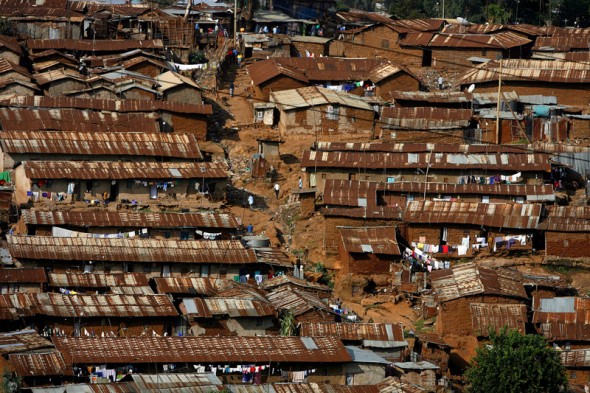
“When I embarked on this series, I approached it as an environmental reporter: What does a growing number of us and growing consumption mean for our planet?” said Los Angeles Times reporter Ken Weiss at the Wilson Center on October 9. Weiss, along with photographer Rick Loomis, recently completed a five-part series and multimedia presentation on global population that was the culmination of a year of research and travel through more than six countries. [Video Below]
-
Linking Biodiversity and WASH Efforts in Africa
›
Sub-Saharan Africa is a key region both for conservationists and those working for improved public health. Nine of the world’s 34 biodiversity hotspots are in sub-Saharan Africa, as are two of the five most important wilderness areas. This hotbed of biodiversity is also home to many of the world’s most rapidly growing populations and swelling urbanization, which is putting increased pressure on natural resources.
-
Kathleen Mogelgaard on How Malawi Shows the Importance of Considering Population, Food, and Climate Together
›October 24, 2012 // By Carolyn LamereQuantifying the role population plays in food security is “an incredibly powerful piece of information,” said Kathleen Mogelgaard in an interview with ECSP. Malawi is a case in point.
Mogelgaard saw the connections between food, population, and climate change firsthand on a recent trip to the southeast African country, whose population of 15 million is largely dependent on subsistence, rain-fed agriculture. “One in five children in Malawi is currently undernourished,” Mogelgaard said, and climate change paints a bleak picture for the future.
-
Who Are the Most Vulnerable to Ocean Acidification and Warming?
›In 2011, a record 34 billion cubic tons of carbon dioxide were emitted from man-made sources. Half the emitted CO2 stays in the atmosphere, about a quarter is absorbed on land (as trees grow, for example), and the remainder is absorbed by the ocean. Unsurprisingly, this incredible amount of carbon dioxide significantly changes the ocean environment. Over time, increased absorption of carbon dioxide in the oceans has led to ocean acidification, and overall warming has also led to warming of ocean waters – both changes impact marine ecosystems and the people who rely on them.
-
The Role of Renewable Natural Resources and Gender in Conflict
›Devesh Kapur, Kishore Gawande, and Shanker Satyanath open their Center for Global Development working paper, “Renewable Resource Shocks and Conflict in India’s Maoist Belt,” with a crucial question: “Is there a causal relationship between shocks to renewable natural resources, such as agricultural and forest lands, and the intensity of conflict?” While the connection between the environment and conflict has been the focus of much study, Kapur et al. say that previous attempts have been plagued with “failure to address reverse causality and a failure to systematically control for alternative explanations for conflict.” Their report analyzes the relationship between the availability of resources and conflict by measuring rainfall, vegetation prevalence, and deaths due to the Maoist conflict in India. They find “a strong and substantively large relationship between adverse renewable resource shocks and the intensity of conflict,” and conclude that protecting the livelihoods of residents of the Maoist belt can help reduce violence. “Giving tribals greater access to forests and a range of forest products, whose consumption is the only available option during times of distress, can provide them with a critical self-insurance mechanism.”
-
Michael Klare on the Race for What’s Left
›Around the world, as the most easily accessible natural resources are depleted, states are beginning to turn to more remote reserves to meet their needs and the shift may spark international tensions or even conflict, said Hampshire College professor Michael Klare in a recent interview with ECSP. “I worry very much about this growing global competition for the remaining resources in those parts of the world,” he said.
-
Tracking This Year’s Extreme Weather
›“Over the past several months, extreme weather and climate events seemed to have become the norm rather than the exception,” writes Kelly Levin for the World Resources Institute (WRI). Indeed, records have been broken around the world as countries experience unprecedented heat, drought, flooding, or other types of severe weather. And people are starting to take notice. A number of recent stories try to make sense of this wild weather and what, if anything, it has to do with climate change.
Showing posts by Carolyn Lamere.