-
Ofir Drori on how EAGLE Confronts the Criminal Networks Driving Africa’s Wildlife Crisis
April 29, 2026 By Environmental Security Staff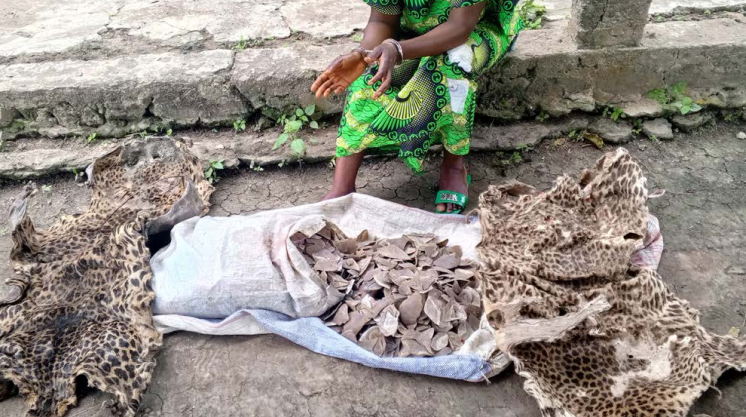
Wildlife trafficking is one of the most lucrative and destructive criminal enterprises in the world. Valued at more than $20 billion annually, these criminal networks impact more than 4,000 plant and animal species across 162 countries and territories. Yet for decades enforcement efforts focused narrowly on poachers, missing the broader criminal foundation that makes the trade resilient: the corrupt officials, armed non-state actors, and agile transnational networks.
Over the past two decades, researchers, governments, and civil society organizations have been working to untangle this web of global wildlife trafficking by tracing the connections between wildlife crime and other illicit economies. In Central and West Africa, Eco Activists for Governance and Law Enforcement (EAGLE) leads the fight against wildlife trafficking. Growing out of the Last Great Ape Organization (LAGA) in Cameroon, the EAGLE Network has formed a broader network of eight non-governmental organizations to implement LAGA’s innovative methods. In its twenty years of operations, the network has jailed more than 3,000 wildlife traffickers while simultaneously fighting corruption to break complicity.
New Security Beat recently spoke with Ofir Drori, founder of LAGA and co-founder of the EAGLE Network, about the scale of wildlife trafficking in Central and West Africa, its links to conflict and radicalization, and the methods his organization uses to bring traffickers and complicit institutions to justice.
Walk us through the nature of wildlife trafficking in Central and West Africa – what are the trends, and what conditions allow wildlife networks to take root and thrive?
Ofir Drori: Central and West Africa play a major role in the illegal wildlife trade. They serve as a base for the transnational criminal networks that are engaging in trans-continental trafficking and managing, employing, bribing and intimidating an entire structure, including large scale poachers. In most of the countries we work in, the baseline of wildlife enforcement and prosecutions has been zero, exposing both the low deterrence to wildlife traffickers as well as their reliance on high level corruption. Our operations have uncovered wildlife traffickers’ associations with other forms of crime like drugs, arms, and human trafficking, as well as with non-state armed groups. The high margins–low risk that characterize wildlife trafficking make it an ever-expanding source of crime with constantly evolving trafficking operations and routes.
EAGLE grew out of LAGA, the NGO you founded in Cameroon, and now operates across multiple countries including Uganda, Cameroon, Congo, Senegal, Guinea, Ivory Coast, and Togo. Tell us about EAGLE’s methodology. How does it work, and how have you adapted it to be successful across such different operating environments?
Drori: While there are some location-specific projects in Africa that address the issue of illegal wildlife trade, the LAGA project offered the first model to establish wildlife law enforcement across an entire country that focused on the traffickers instead of poachers. This shifted Cameroon from a baseline of zero prosecutions to an average of one major trafficker arrested, prosecuted, and imprisoned per week. The innovative model has been refined through trial and error and has gained recognition through seven international awards, providing legitimacy to be replicated to other countries.
Our methodology integrates the fight against corruption in a quantifiable matrix of results to maximize deterrence through: (1) undercover Investigations, (2) management and control of arrest operations, (3) legal follow-up and private prosecution, and (4) media engagement to publicize success and encourage deterrence.
Your work in Senegal has surfaced striking connections between wildlife trafficking and armed groups – rebel factions, weapons manufacturing, and radicalization networks. Can you take us through some of these cases and what they revealed? How common are these links across broader operations?
Drori: Through our investigations and arrests we have learned how complex the nexus is between wildlife trafficking, security, and non-state armed groups. On one occasion, wildlife traffickers operated an arms manufacturing workshop that supplied rebel groups in the Sahel with thousands of assault rifles. In another case, wildlife traffickers linked to an armed group traded their control of a national park for weapons trafficked by another armed group. Malian and Mauritanian armed groups were granted access to the national park, where they carried out large-scale poaching for bushmeat.
A striking example involves the arrest of a Gambian wildlife trafficker who was also affiliated with a rebel group and involved with drug and arms trafficking; our investigation revealed that nine outstanding arrest warrants against him had never been enforced, raising serious concerns about impunity.
The most shocking example from Senegal came from the phones of Malian and Nigerian wildlife traffickers arrested at the Mali border. These traffickers were members of a WhatsApp group spanning North, West, and Central Africa that promoted radicalization, sharing videos and photos of atrocities committed in villages, accompanied by messages that glorified the violence and encouraged its spread. To date, cases addressing the wildlife–security nexus have been too limited relative to the potential scale of the threat. We are therefore pursuing targeted structural changes to strengthen and expand this line of effort.
A core part of EAGLE’s model involves confronting corruption. What have your investigations revealed about how corruption functions within wildlife enforcement? Who are the actors, and what are the incentives? How does your approach at EAGLE work around or directly challenge that?
Drori: Our innovative anti-corruption model has disrupted impunity, putting more than 3,000 major traffickers behind bars. Among the arrested, convicted, and imprisoned are colonels, governors, wildlife directors, police commissioners, politicians, and protected heads of criminal syndicates. We serve as a safeguard against corruption throughout the enforcement and judicial process, from arrest and interrogation through prosecution, and monitor whether convicted individuals remain in custody.
The high level of corruption we intercept and combat is reflected by our statistics: Bribing attempts are documented in 85% of our field arrest operations, and in 80% of all the court cases with which we’ve been involved.
The more common forms of corruption and influence peddling in the enforcement system include: sabotaging arrest; negotiating a bribe; reporting suspects as escaped; intentionally manipulating interrogations, complaints and indictments; or unlawful release of suspects from police holding cells. In the justice system, corruption takes the following shape: suspects using bribes to get their original court file or the contraband evidence, each necessary for their trial to hold; bribing the judge or prosecutor; faking bad health conditions in complicity with the court; and bribing their way out of prison.
In one case, after a Cameroonian drugs and apes trafficker was arrested, we intercepted six corruption attempts during his prosecution. Yet once imprisoned, the prison warden provided him with prison arms, granted him regular unsupervised release, and allowed him to continue running his large ring of poachers, splitting the profits.
Funding has contracted significantly for conservation and anti-trafficking in recent years. What has been the impact on EAGLE’s work and on the broader fight against wildlife crime?
Drori: For the first time, declining investment in conservation law enforcement has put the continuity of our work at risk. Without near-term resolution of this funding gap, we may be forced to significantly reduce operations or cease activities in key countries.
EAGLE plays a unique role as a direct enforcement and accountability mechanism targeting organized wildlife crime. In many of our operating contexts, no comparable structure exists. If this capacity is lost, it will send a clear signal of reduced risk to trafficking networks, likely resulting in a rapid expansion of organized illegal activity.
The broader impact would be severe: erosion of deterrence, increased corruption and impunity, and a real risk of local extinction for elephants, great apes, lions, and other threatened species.
Going forward, we are working to secure bridge funding and build a more resilient financing model. We are also mobilizing a broader, more diversified base of support that recognizes wildlife trafficking as both a conservation and security threat, while strengthening the connections with our security and governance priorities to sustain and scale this work.
Ofir Drori is the Founder of the NGO LAGA and Co-Founder and Director of the Eco Activists for Governance and Law Enforcement (EAGLE) Network.
Sources: EAGLE, UN Office on Drugs and Crime
Photo Credits: Photo courtesy of the EAGLE Network.
 A Publication of the Stimson Center.