-
The Buffalo’s Return: New Partnerships Boost Indigenous-led Conservation in Tribal Lands
March 25, 2026 By Louise Lief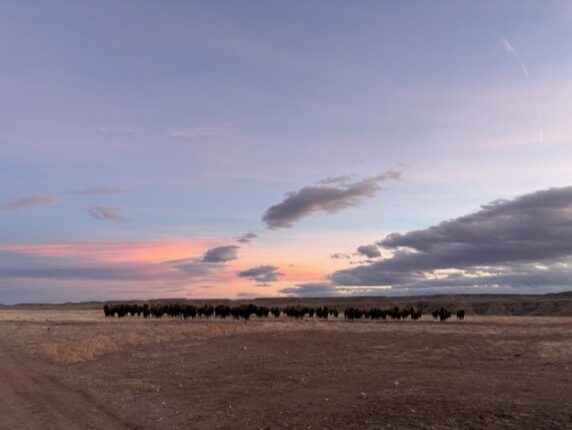
Native nations in the United States have played leading roles in some of the country’s most spectacular conservation success stories. For instance, calls by the Yurok, Karuk and Hoopa Valley tribes resulted in the world’s largest dam-removal and salmon restoration project on the Klamath river in California and Oregon.
Native Americans also helped protect the few hundred American buffalo that survived almost total annihilation in the 19th century. Their campaigns and litigation against government policies that sanctioned killing thousands of wild buffalo each year continued well into the 21st century, creating alternative strategies that helped save them from slaughter.
Yet, until very recently, the federal government, environmental organizations and philanthropy gave minimal support to tribes for conservation of any kind, leading to chronic underfunding of Indigenous conservation efforts.
A 2023 study for the National Association of Tribal Historic Preservation Officers and The Wilderness Society found that between 1965 and 2019, Indian tribes received only $4 million—or .1 percent—of $4.5 billion in grants made by the federal Land and Water Conservation Fund (LWCF), which is one of the main conservation funds for state and local governments. Tribes also were not eligible to apply directly to seven of the ten LWCF grant programs. And, until recently, over 500 federally-recognized tribes competed against each other for $6 million a year in federal US Fish and Wildlife Service funds for tribal conservation efforts.
Underfunded Tribal Initiatives
When the federal government ceased hunting the buffalo to near extinction and began to invest in bison restoration in national parks and wildlife refuges in the early 20th century, it gave almost no support to tribes and indigenous-led groups seeking to return the buffalo to tribal lands.
Quite the opposite, in fact. The first national bison range was created on almost 19,000 acres of tribal land expropriated from the Confederated Salish and Kootenai Tribes’ Flathead Indian Reservation.
Philanthropy also invested little in tribal wildlife conservation. According to Candid’s Native American funding database, foundations gave less than $30 million for all Native-led wildlife biodiversity projects nationwide from 2006 to 2024. This amount covered the total given to 575 federally recognized tribes or tribal entities for all animal species, including buffalo. Of seven grantees that received over $1 million during that same period, only two were Native-led organizations.
A Pivot Towards Partnerships
Around 2020, things began to change. Pushed internally by staff, as well as by federal action and external critiques, some of the nation’s largest environmental organizations, began to increase support for indigenous wildlife conservation and indigenous co-stewardship and co-management of ancestral lands and waters and wildlife conservation.
Since then, a growing number of partnerships between tribal nations and environmental groups, philanthropy, states, and the federal government is transforming the way many organizations think about and practice restoring habitat and endangered species. The National Wildlife Federation, World Wildlife Fund and The Nature Conservancy are among those who have expanded such partnerships.
The move signals an important shift from the “fortress conservation” mindset that dominated the US environmental movement for over 150 years and led to the wide scale removal of indigenous communities to create national parks and wildlife refuges. Buffalo restoration is one of the largest, most culturally and ecologically significant of the new efforts, involving over 100 Native American tribes in at least 22 states, from Alaska to New York, and Wisconsin to Texas.
“There’s been more emphasis from philanthropy on this in the last couple of years than I’ve ever seen,” says Jason Baldes, executive director of the Wind River Tribal Buffalo Initiative (WRTBI) in Wyoming, which has received public and private funding to support Eastern Shoshone and Northern Arapaho tribal buffalo restoration efforts.
Federal Policy Changes Spur Expanded Efforts
The federal government has played an important role in fostering such partnerships. Since 2020, it has signed over 400 new co-stewardship or co-management agreements with Native nations to conserve and restore their ancestral lands and waters.
In 2022, the White House Office of Science and Technology Policy and the Council of Environmental Quality reinforced these efforts by issuing guidance to federal agencies to treat indigenous traditional ecological knowledge (known as TEK) as “an aspect of best available science,” The guidance also encouraged TEK’s incorporation into federal decision-making.
As private and public pursuit of partnerships grew, new coalitions of Native and non-native philanthropy and Native and non-native conservation groups also emerged. The Nature Conservancy began partnering with the InterTribal Buffalo Council and the indigenous-led Tanka Fund in 2022 to transfer surplus buffalo from its preserves to tribes and Native ranchers, ending its longstanding practice of auctioning off the animals. That same year, the National Wildlife Federation expanded its tribal partnership efforts, and Native Americans in Philanthropy and the Biodiversity Funders Group launched a Tribal Nations Conservation Pledge and Funding Collaborative.
In 2023, the First Nations Development Institute established a Tribal Lands Conservation Fund to increase investment in Native-led stewardship and the use of traditional ecological knowledge. And when the World Wildlife Fund created a position for Vice President of Native Nations Conservation and Food Systems in 2024, the group hired Heather Dawn Thompson, a citizen of the Cheyenne River Sioux Tribe and former Director of Tribal Relations at the United States Department of Agriculture, to head it.
Alliances Bring Results
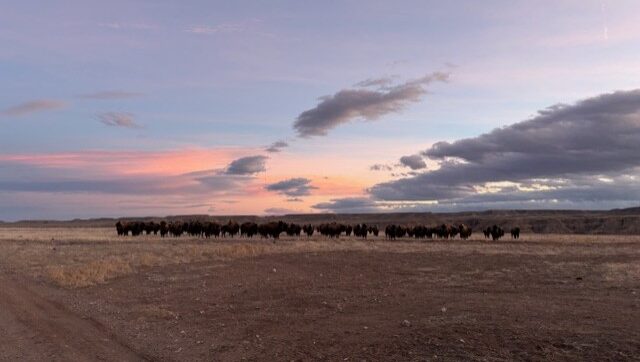
Dozens of tribal projects now underway demonstrate how partnerships with allies are bringing buffalo home. Two particular initiatives offer a good demonstration of how it is working: The Wolakota Buffalo Range on the Rosebud Sioux Reservation in South Dakota and the Wind River Tribal Buffalo Initiative on the Wind River Reservation in Wyoming.
The Rosebud Sioux had long sought to return buffalo to their tribal lands. But partnerships transformed what was an idea in 2019 into the Wolakota Buffalo Range, which today is one of the largest Native-owned and managed buffalo herds in the world.
“We went from zero acres to, within three years, 1200 animals on 28,000 acres,” says Wizipan Little Elk Garriott, former head of the Rosebud Economic Development Corporation. In addition to working with the World Wildlife Fund, which funded a business and conservation plan and some infrastructure costs, REDCO collaborated with other tribal entities, philanthropy and the federal government, raising $7 million in grants and loans for the project.
Access to land on Indian reservations is complex. Many prime tracts within reservation boundaries are owned by non-natives, a continuing legacy of federal legislation that constitutes one of the chief constraints to expanding tribal buffalo herds. When Jason Baldes wrestled with these land issues in Wyoming at WRTBI, he found an ally in Mark Headley, chairman of the Conservation Lands Foundation.
Baldes says Headley’s involvement “changed the game.” Headley introduced Baldes to the Jackson Hole Land Trust, and in 2022, with the Land Trust’s support and fiscal sponsorship, WRTBI launched a campaign to raise funds for land purchases and infrastructure to support more buffalo. By 2024, WRTBI had raised $4.6 million from over a dozen foundations.
Continuing on the Path to Partnerships
Such alliances come at a critical time. Federal funding cuts are affecting tribal conservation projects. A recent Brookings study estimates that Native nations stand to lose $1.5 billion in rescinded IRA funding, including hundreds of millions of dollars for climate resilience and conservation. At the same time, however, the federal government continues to support tribal buffalo restoration.
Despite serious challenges at the federal level, the partnership model continues to grow. More states, foundations and environmental organizations now fund indigenous land stewardship and land return as a conservation strategy.
Co-stewardship and co-management agreements also are taking root at the state and local level. New partnerships between tribal nations or entities and land trusts and the growth of indigenous-led land trusts have led to new concepts like “cultural respect easements.” Indigenous ecological knowledge and Western science are increasingly integrated in ecological restoration in an approach called “braiding.”
Funders like the Doris Duke Foundation also are supporting tribes to help plan for and implement more co-stewardship and co-management agreements and to identify new avenues for land return and land access. Danielle Levoit, the foundation’s senior program officer for the environment says, “We are looking at how to make evolving conservation tools like easements, land acquisition and interim financing more accessible.”
Thanks to multi-generational indigenous efforts and partnerships, more than 25,000 buffalo now live on tribal lands, more than on all federal parks and refuges combined, As these numbers continue to grow, tribes’ buffalo “relatives” are finally coming home.
Louise Lief is a freelance journalist and consultant to philanthropy, media and nonprofits, focusing on civic engagement and collaborative approaches.
Sources: The Bison Range; Brookings Institution; Candid; Conservation Lands Foundation; The Conversation; Dennis Conservation Land Trust; First Nations Development Institute; The Guardian; The Indian Land Tenure Foundation; InterTribal Buffalo Council; Land Trust Alliance / Native Land Conservancy / Tahoma Peak Solutions; Maine Monitor; MDPI; Mongabay; National Wildlife Federation Native American Rights Fund; Native Americans in Philanthropy; Native News Online; The Nature Conservancy; NPR; Tanka Fund; Tribal Business News; White House Office of Science and Technology Policy; The Wilderness Society; World Wildlife Fund; Wyoming Public Media
Photo Credits:Courtesy of Wind River Tribal Buffalo Initiative.
 A Publication of the Stimson Center.