
-
To Address Security in Africa, Focus on the Citizen: Ambassador Phillip Carter III on the Connections between Development and Security
December 6, 2019 By Deekshita Ramanarayanan To address the security challenges facing Sub-Saharan Africa we need to shift the focus from a concept of state security to one of citizen security, says Ambassador Phillip Carter III (ret.), former Ambassador to the Ivory Coast and the Republic of Guinea, in this week’s Friday Podcast. “Our current strategy of a military response to terrorist organizations or criminal networks is inadequate at best, and probably unsustainable at worst,” says Carter. “To me, the greatest security threat in Africa is poor or bad governance.”
To address the security challenges facing Sub-Saharan Africa we need to shift the focus from a concept of state security to one of citizen security, says Ambassador Phillip Carter III (ret.), former Ambassador to the Ivory Coast and the Republic of Guinea, in this week’s Friday Podcast. “Our current strategy of a military response to terrorist organizations or criminal networks is inadequate at best, and probably unsustainable at worst,” says Carter. “To me, the greatest security threat in Africa is poor or bad governance.”
If you ask Africans what they perceive as threats to their security, terrorism isn’t at the top of their list, says Carter. “It’s dealing with corruption, it’s dealing with criminality, it’s making sure that their daughter can go to school without being assaulted, that their son can go to work without paying a bribe to a police officer.” Foreign policy has long operated in the realm of “state security”—investing in government institutions, militaries, and Ministries of Defense to promote security. “That needs to be challenged,” says Carter. “We find that many militaries are there to protect the regime, not necessarily the population.”
In addition to the military interventions focused on countering violent extremist organizations, “we need to look at the softer side of things,” says Carter. “Investing in issues like girls’ education, addressing the issue of gender inequality—these development objectives are actually security objectives. We know that high levels of gender inequality foster violence and we know that investing in girls’ education results in manifold increases with regard to GDP growth and prosperity that is inclusive. We know that when you empower women in a society, you are improving the sustainability of growth, of prosperity, of economic activity, and security.”
Supporting local institutions is critical to strengthening governance, says Carter, and a large part of that is ensuring that local organizations have the data and information to understand what their constituencies need. “I believe that good governance and democracy are social vaccines for a lot of things, but we have to engage in institutions that organizationally represent those values—they’re representative, they’re democratic in their structures, they’re inclusive, and they’re data driven,” said Carter. “If the assistance is driven out of Washington rather than out of the local community, it’s not going to be as effective as it could be.”
Friday Podcasts are also available for download on iTunes and Google Podcasts.
Topics: Africa, Africa in Transition, conflict, development, featured, Friday Podcasts, gender, global health, media, podcast, population, security
 A Publication of the Stimson Center.
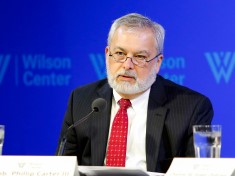 To address the security challenges facing Sub-Saharan Africa we need to shift the focus from a concept of state security to one of citizen security, says Ambassador Phillip Carter III (ret.), former Ambassador to the Ivory Coast and the Republic of Guinea, in this week’s Friday Podcast. “Our current strategy of a military response to terrorist organizations or criminal networks is inadequate at best, and probably unsustainable at worst,” says Carter. “To me, the greatest security threat in Africa is poor or bad governance.”

