• woodrow wilson center
  • ecsp

New Security Beat

Subscribe:
  • rss
  • mail-to
  • Who We Are
  • Topics
    • Population
    • Environment
    • Security
    • Health
    • Development
  • Columns
    • China Environment Forum
    • Choke Point
    • Dot-Mom
    • Friday Podcasts
    • Navigating the Poles
    • Reading Radar
  • Multimedia
    • Water Stories (Podcast Series)
    • Backdraft (Podcast Series)
    • Tracking the Energy Titans (Interactive)
  • Films
    • Water, Conflict, and Peacebuilding (Animated Short)
    • Paving the Way (Ethiopia)
    • Broken Landscape (India)
    • Scaling the Mountain (Nepal)
    • Healthy People, Healthy Environment (Tanzania)
  • Publications
  • Events
  • Contact Us

NewSecurityBeat

The blog of the Wilson Center's Environmental Change and Security Program
  • Lisa Palmer, Yale Environment 360

    Colombian Farmers Adjust to Changing Conditions With “Climate-Smart” Agriculture

    February 10, 2015 By Wilson Center Staff
    CIAT_Colombia

    The original version of this article, by Lisa Palmer, appeared on Yale Environment 360.

    Rice is a thirsty crop. Yet for the past three years, Alberto Mejia has been trying to reduce the amount of water he uses for irrigation on his 1,100-acre farm near Ibague in the tropical, central range of the Colombian Andes.

    He now plants new kinds of rice that require less water. He floods his paddies with greater precision and has installed gauges that measure the moisture content of the soil. On a daily basis he can determine how much nitrogen the plants need, and he relies on more advanced weather forecasting to plan when to fertilize, water, and harvest the grain.

    “We are learning how to manage the crops in terms of water, which will be a very, very good help for us now and in the future,” Mejia says, adding that the current El Niño weather pattern has caused serious drought. “We have very difficult days — hot, with no rain. It’s dry. There are fires in the mountains … Growing crops makes it a complicated time here.” 

    Ever since a drought devastated his yields five years ago, Mejia has been eager to integrate sweeping changes into his rice production. He believes that the weather has become more erratic and is concerned that future climate change will make rice farming even more difficult. As a result, and with the help of his local rice growers association and scientists from the International Center for Tropical Agriculture, he is embracing what has come to be known as “climate-smart agriculture.” These are agricultural techniques that protect farmers from the effects of global warming and improve crop yields, while also limiting greenhouse gas emissions.

    Continue reading on Yale Environment 360.

    Lisa Palmer is a Wilson Center Public Policy Scholar and freelance journalist.

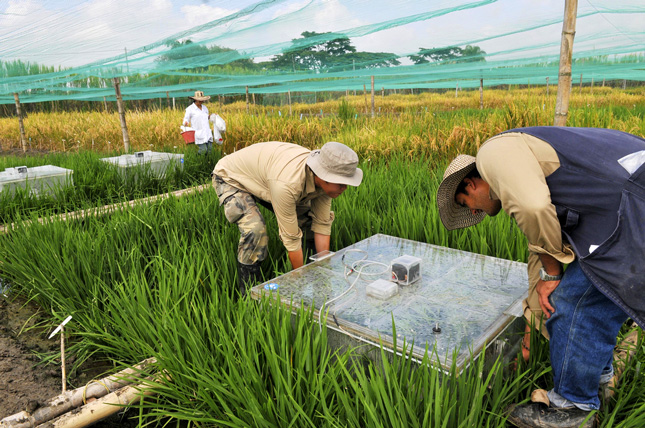
    Photo Credit: CIAT researchers measure greenhouse gas emissions from rice paddies, courtesy of Neil Palmer/CIAT.

    Topics: agriculture, climate change, Colombia, conservation, development, economics, environment, food security, Latin America, livelihoods, Vietnam, water

Join the Conversation

  • RSS
  • subscribe
  • facebook
  • G+
  • twitter
  • iTunes
  • podomatic
  • youtube
Tweets by NewSecurityBeat

Trending Stories

  • unfccclogo1
  • Pop at COP: Population and Family Planning at the UN Climate Negotiations

Featured Media

Backdraft Podcast

play Backdraft
Podcasts

More »

What You're Saying

  • Volunteers,At,The,Lagos,Food,Bank,Initiative,Outreach,To,Ikotun, Pan-African Response to COVID-19: New Forms of Environmental Peacebuilding Emerge
    Rashida Salifu: Great piece 👍🏾 Africa as a continent has suffered this unfortunate pandemic.But it has also...
  • A desert road near Kuqa An Unholy Trinity: Xinjiang’s Unhealthy Relationship With Coal, Water, and the Quest for Development
    Ismail: It is more historically accurate to refer to Xinjiang as East Turkistan.
  • shutterstock_1779654803 Leverage COVID-19 Data Collection Networks for Environmental Peacebuilding
    Carsten Pran: Thanks for reading! It will be interesting to see how society adapts to droves of new information in...

Related Stories

No related stories.

  • woodrow
  • ecsp
  • RSS Feed
  • YouTube
  • Twitter
  • Facebook
  • Home
  • Who We Are
  • Publications
  • Events
  • Wilson Center
  • Contact Us
  • Print Friendly Page

© Copyright 2007-2021. Environmental Change and Security Program.

Woodrow Wilson International Center for Scholars. All rights reserved.

Developed by Vico Rock Media

Environmental Change and Security Program

Woodrow Wilson International Center for Scholars

Ronald Reagan Building and International Trade Center

  • One Woodrow Wilson Plaza
  • 1300 Pennsylvania Ave., NW
  • Washington, DC 20004-3027

T 202-691-4000
