• woodrow wilson center
  • ecsp

New Security Beat

Subscribe:
  • rss
  • mail-to
  • Who We Are
  • Topics
    • Population
    • Environment
    • Security
    • Health
    • Development
  • Columns
    • China Environment Forum
    • Choke Point
    • Dot-Mom
    • Friday Podcasts
    • Navigating the Poles
    • Reading Radar
  • Multimedia
    • Water Stories (Podcast Series)
    • Backdraft (Podcast Series)
    • Tracking the Energy Titans (Interactive)
  • Films
    • Water, Conflict, and Peacebuilding (Animated Short)
    • Paving the Way (Ethiopia)
    • Broken Landscape (India)
    • Scaling the Mountain (Nepal)
    • Healthy People, Healthy Environment (Tanzania)
  • Publications
  • Events
  • Contact Us

NewSecurityBeat

The blog of the Wilson Center's Environmental Change and Security Program
  • Reading Radar

    Demography and Political-Socioeconomic Change

    April 1, 2013 By Graham Norwood
    population_public-policy-sm

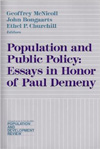
    In “On Demographic and Democratic Transitions,” published in the February edition of Population and Development Review, author Tim Dyson postulates that the so-called “demographic transition” – a two-step process in which diminishing mortality rates are followed by decreases in total fertility – is an important predictor of a society’s transition from autocracy to democracy. Specifically, Dyson suggests that the population surge resulting from a decline in mortality may tend to destabilize pre-democratic regimes, while a subsequent drop in fertility rates may empower women and raise the median age of a population, thus paving the way for democracy to emerge. Dyson demonstrates a statistically significant correlation between population aging and inclination toward democracy, echoing the work of New Security Beat contributor, Richard Cincotta.

    Appearing in the same issue of Population and Development Review, Wolfgang Lutz’s “Demographic Metabolism: A Predictive Theory of Socioeconomic Change,” offers the potential for demographic modeling on an even finer scale. Lutz argues for a “multi-dimensional cohort-component model” that divides populations not just by age and gender, but by region, marital status, highest attained level of education, or other significant factors. By disaggregating these factors, Lutz hopes to measure the impact of “demographic metabolism” – essentially, the gradual replacement of older generations (Lutz employs the statistical term “cohorts”) with younger ones. This kind of analysis can, for instance, tease out the differences between changes that develop within a population over time – the increasing preference for stability that tends to accompany aging, for example – from changes that occur when one cohort’s preferences is crowded out by another’s.

    Topics: aging, democracy and governance, demography, development, family planning, population, Reading Radar, security

Join the Conversation

  • RSS
  • subscribe
  • facebook
  • G+
  • twitter
  • iTunes
  • podomatic
  • youtube
Tweets by NewSecurityBeat

Trending Stories

  • unfccclogo1
  • Pop at COP: Population and Family Planning at the UN Climate Negotiations

Featured Media

Backdraft Podcast

play Backdraft
Podcasts

More »

What You're Saying

  • Volunteers,At,The,Lagos,Food,Bank,Initiative,Outreach,To,Ikotun, Pan-African Response to COVID-19: New Forms of Environmental Peacebuilding Emerge
    Rashida Salifu: Great piece 👍🏾 Africa as a continent has suffered this unfortunate pandemic.But it has also...
  • A desert road near Kuqa An Unholy Trinity: Xinjiang’s Unhealthy Relationship With Coal, Water, and the Quest for Development
    Ismail: It is more historically accurate to refer to Xinjiang as East Turkistan.
  • shutterstock_1779654803 Leverage COVID-19 Data Collection Networks for Environmental Peacebuilding
    Carsten Pran: Thanks for reading! It will be interesting to see how society adapts to droves of new information in...
  • woodrow
  • ecsp
  • RSS Feed
  • YouTube
  • Twitter
  • Facebook
  • Home
  • Who We Are
  • Publications
  • Events
  • Wilson Center
  • Contact Us
  • Print Friendly Page

© Copyright 2007-2021. Environmental Change and Security Program.

Woodrow Wilson International Center for Scholars. All rights reserved.

Developed by Vico Rock Media

Environmental Change and Security Program

Woodrow Wilson International Center for Scholars

Ronald Reagan Building and International Trade Center

  • One Woodrow Wilson Plaza
  • 1300 Pennsylvania Ave., NW
  • Washington, DC 20004-3027

T 202-691-4000