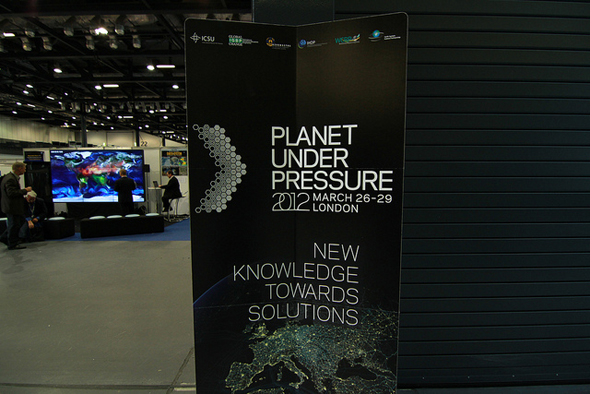
ECSP is at London’s 2012 Planet Under Pressure conference following all of the most pertinent population, health, and security events.“Demography is a science of assumptions,” said Sarah Harper, a demographer at the University Oxford, during a panel at the
Planet Under Pressure conference. Thirty years ago, she said, demographers believed the world would reach 24 billion by 2050, now the latest UN median projections
predict 10 billion. That means a lot of progress has been made for families and development as a whole, but there are some obstacles yet.
Harper stressed that the development community should focus on parts of the world with stubbornly high fertility rates, particularly sub-Saharan Africa. If total fertility rates came down there by 2050, below the expected four children per woman, the region could be home to as many as a billion fewer people than current projections. The earlier we acknowledge this growth, the easier it will be to offer interventions like family planning and reproductive health to hedge it, she said.
Additionally, demographers need worry about important changes in modern population and environment dynamics.
As Harper notes in an interview with ECSP (video below):
There has been so much hype around population growth that I think we’ve ignored the other characteristics of population…that it’s changing in its density – we’re all becoming more urban; it’s changing in its distribution – we’re becoming more mobile; and it’s also changing in its composition – the world is getting older.
I think it’s very clear that these changes are going to interact with the environment and be affected by environmental change but are also going to impact upon future environmental change.
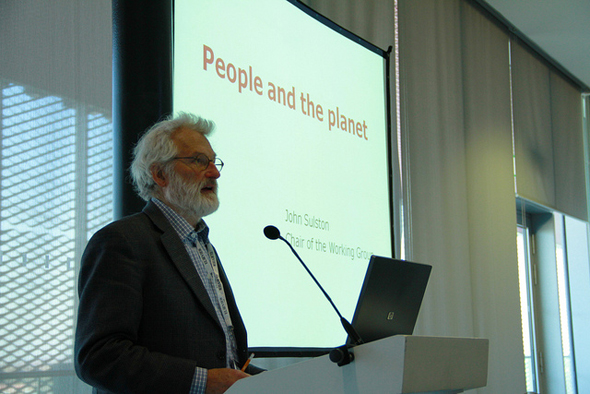
Sir John Sulston of the Royal Society agreed: population is a more-nuanced subject than many can digest. “Population has been much too ignored because it’s difficult,” he said.
Sulston urged us to look not just at the diversity of the world, but also the inequity. Today, there is “inequity in countries, between countries, and between generations.”
There is no silver bullet – the international community need to look at three components in concert if we want to make a difference, he said: first, bring down infant mortality; second, invest in family planning; and third, emphasize education for women.
“It’s not about surviving, it’s about flourishing,” Sulston said.
When the ECSP delegation isn’t attending plenary and breakout sessions here at the conference, we’re manning our Wilson Center information booth. And over the last few days, we’ve had the pleasure of introducing our work to a number of new faces, including curious faculty, energetic students, and hopeful doctoral candidates. If you’re attending please feel free to stop by.
Expect more updates from East London, including more short video interviews, in the next three days as ECSP highlights the unique perspectives coming out of the Planet Under Pressure conference.
Pictures from the event are available on our Facebook and Flickr pages, and you can join the conversation on Twitter (#Planet2012) or watch the livestream here.
Photo Credit: Sean Peoples/Woodrow Wilson Center,


 A Publication of the Stimson Center.