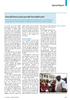
In
The Lancet’s “
How Did Sierra Leone Provide Free Health Care?,” author
John Donnelly of the
Ministerial Leadership Initiative attributes the unanticipated success of a free health care program for women and children in Sierra Leone to good organization, transparency, and a high degree of cooperation between the government, donors, and development partners. One distinctive factor that has contributed to the health system’s turnaround is the unusually high level of political will on the part of President Ernest Bai Koroma, writes Donnelly. Similar to
Egypt’s health and population initiatives, Sierra Leone’s marked commitment, accountability, and investment as a host country has contributed highly to the success of its program and triggered further investment from donors.
 In “Systematic Violence: A Barrier to Achieving the Millennium Development Goals for Women,” from the Journal of Women’s Health, authors Joia S. Mukherjee, Donna J. Barry, Hind Satti, Maxi Raymonville, Sarah Marsh, and Mary Kay Smith-Fawzi assert that the elevation of women is integral to the achievement of the Millennium Development Goals, to which structural violence serves as a significant barrier. Murkherjee et al. recommend community-based programs to combat structural violence and prevent disease, such as the Partners in Health (PIH) program in Haiti. PIH trains community health workers, expands health care as a public good, and bolsters social determinants, which include increasing access to family planning and education, providing compensation for medical workers, and improving health infrastructure.

 A Publication of the Stimson Center.