Measurements of “human population density and growth can be used to identify changes in the viability of native species, and more directly, in changes in ecological systems or habitat quality,” said Richard Cincotta, consultant at the Environmental Change and Security Program and demographer-in-residence at the Stimson Center, speaking at the book launch of Human Population: Its Influence on Biological Diversity.
Cincotta was joined by coeditor L.J. Gorenflo, associate professor of landscape architecture at Penn State University, and contributing author Christopher Small, research professor at the Lamont-Doherty Earth Observatory and adjunct professor at Columbia University, to discuss the book’s objectives, its diverse and multidisciplinary contributors, and its policy implications. [Video Below]
Establishing a Handbook for the Field
“Human Population: Its Influence on Biological Diversity establishes a handbook for the field,” said Cincotta. While the scientific volume is specifically geared towards researchers and conservation managers rather than policymakers, “there are a few Washington-type policy messages that are useful,” he added.
Human population affects biological diversity in multiple ways. While population density alone can be strongly indicative of the viability of different populations of native species, human activities and their chemical and energetic byproducts can also have a strong impact, even when human population density is low, said Cincotta.
“Population density seems to be a reasonably good indicator of biodiversity loss,” said Gorenflo. Data from the Apache Highland Ecoregion (a 12 million-hectare area located along the U.S.-Mexico border) indicate that biodiversity tends to drop off at population densities of more than 10 people per square kilometer. Conservation efforts in areas within the ecoregion that are at, or close to, this density threshold will likely encounter challenges to maintaining biodiversity, he said.
Human mobility is a major consideration, said Gorenflo: “Whereas high fertility can create population growth over generations, high mobility can create population growth in a matter of months or years.” In the Apache Highlands, for example, the 40 percent increase in population between 1990 and 2000 was largely caused by migration into U.S. cities in the region.
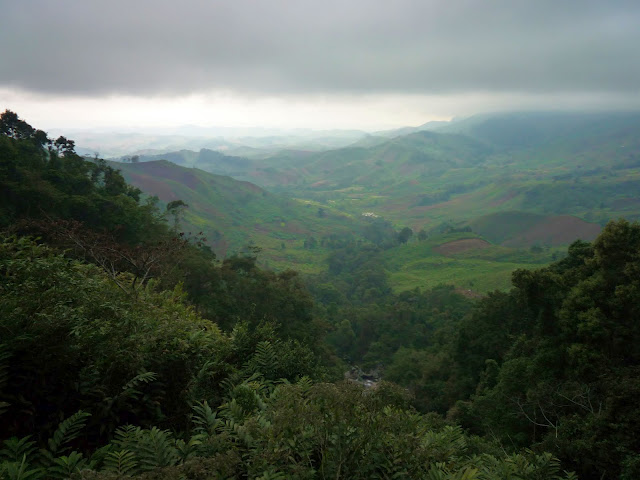
In Madagascar, Gorenflo and colleagues examined whether population growth and poverty were systematically driving deforestation and loss of biodiversity. Using data from the 1990s, they found that higher population density only slightly raises rates of deforestation and large increases in income only modestly decrease deforestation.
Not surprisingly, they found that the likelihood of deforestation decreased dramatically in protected areas. In addition, proximity to roads or footpaths was associated with significantly higher rates of deforestation. “Roads, footpaths, and protected areas are all policy decisions,” Gorenflo pointed out. “So when bilateral or multilateral organizations decide to invest in development in a place like Madagascar, they can look at these sorts of investments as being important.”
While there are some similarities to be drawn between regions’ experience with population and biodiversity, said Gorenflo, “every locality likely has a slightly different story; you need to do context-specific studies to get a real handle on what is going on.”
The Human Habitat
In his chapter, “The Human Habitat,” Christopher Small of the Lamont-Doherty Earth Observatory said his goal was “to set the stage for some of the more detailed studies by taking a look at the global distribution of human population.”
Using census data and satellite-derived maps of night lights to serve as a “proxy for development,” Small found that “people are everywhere, but they are not evenly distributed.”
At least half the world’s population lives on less than three percent of the inhabitable land, and most people live at densities between 100 and 1000 people per square kilometer. At both local and global scales, population density and city size are dominated by extremes: There are large numbers of small groups of people, and small numbers of large groups of people, he said.
“The environments where people live are more strongly correlated with features of the landscape than they are with climatic parameters,” said Small. While humans have effectively adapted to a range of climates, the majority of people tend to cluster close to rivers, at low elevations, and close to coastlines. Although it was once thought that three-quarters of the world’s population lived in coastal regions, Small’s results show that the actual number is close to half of these previous assumptions.
Understanding the spatial and environmental distribution of population and managing population growth may therefore help minimize negative impacts on specific habitats and biomes, said Small.


 A Publication of the Stimson Center.