The original version of this article, by Rosemarie Calvert, appeared in the Center for a Better Life’s livebetter magazine.Few people understand “smart” power as well as Chief Naval Officer (CNO) Admiral Gary Roughead. To this ingenious, adept leader of the world’s largest and most powerful navy, it’s not just about military strategy or political science; it’s about heart. It’s about the measure of a man with regard to honor, courage and commitment. And, it’s about appreciation and respect for the natural world. As one of the U.S. Defense Department’s most powerful decision-makers, Roughead has helped mold a new breed of sailor who understands that
preventing war is just as important as winning war – that creating partners is more important than creating opponents. Add mission mandates such as humanitarian assistance,
disaster relief, and
environmental stewardship, and it’s clear why Roughead and his brand of smart power are having a profound impact on international peace, national security, and natural security.
Engendering Environmental Advocacy
“You don’t live on the ocean and not love it. My appreciation for the environment came from a very early age – from just loving to be on the water. It’s something that’s had a very strong impact on me,” explains Roughead, who grew up in North Africa where his father worked in the oil business. He and his family lived along an uninhabited area of coastline where his father’s company built a power plant and refinery to process and transport Libya’s huge oil field finds to offshore tankers.
“We were the first people to move there; I was still in grammar school. The beauty in being the first was that the coastline was absolutely pristine. Even before school, I would get up and go skin diving. There were beautiful reefs, and fish were everywhere. The vegetation was just incredible. The company built an offshore loading area a few miles off the beach with 36-inch pipes pumping crude oil out to where these big supertankers would come in. Back then, there wasn’t a high regard for the environment, so when storms would kick-up and ships got underway in a hurry, they would just cast them off and all that oil would go into the ocean.
“Fast forward about five years, and the last time I went skin diving I didn’t see a living thing. The vegetation was dead. At that time I was visiting my folks on summer leave from the Naval Academy. There were periods when I would skin dive and then surface after being down about 35-40 feet, and my lungs would be ready to burst. I’d look up, having moved from my original location, and see this massive oil slick. And, I’d go, ‘Oh gosh…no!’ But, you didn’t have any choice. I would come home and actually have to clean the oil off with kerosene because it was caked on me.
“I saw and experienced environmental devastation, and it had an effect on me. Being at sea all the time – I love going to sea and seeing everything about it – drove me to the views I have. I really do think there’s compatibility between the Navy and the environment. We have things we must accomplish, but we can do them cleanly and responsibly. That’s what we’ve tried to demonstrate to those who have different views – that there has to be compatibility between the two.”
Continue reading on the Center for a Better Life.
Rosemarie Calvert is the publisher and editorial director of livebetter magazine and director of the Center for a Better Life.
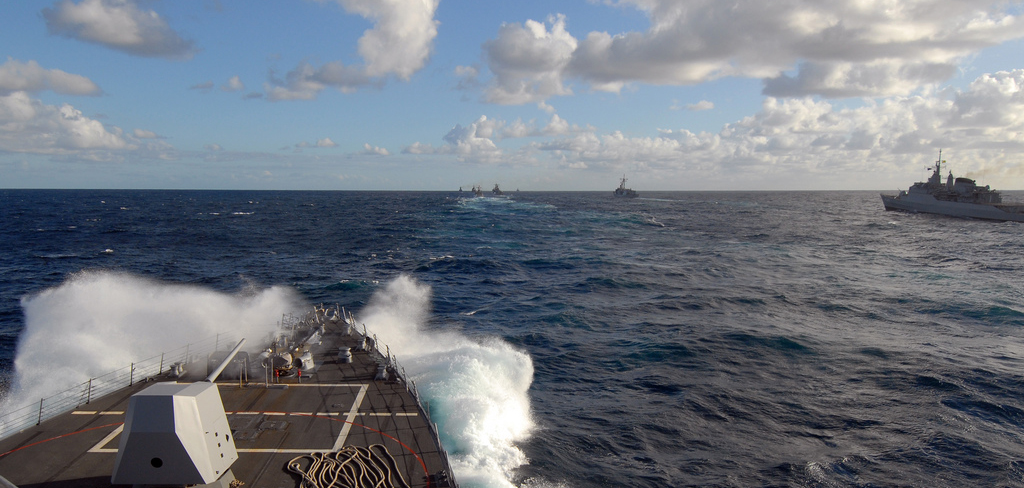
Photo Credit: Adapted from “USS Nitze underway with ships from U.S. Navy, Coast Guard and foreign navies,” courtesy of flickr user Official U.S. Navy Imagery.

 A Publication of the Stimson Center.