The original version of this article, by Carl Haub, appeared on PRB’s Behind the Numbers blog.The
Rwanda 2010 Demographic Health Survey is the latest in a regular series of DHS surveys that began in 1992, although hostilities had delayed the next survey until 2000. The 2010 survey interviewed 13,671 women ages 15 to 49 and 6,329 men ages 15 to 59 from September 2010 to March 2011. The
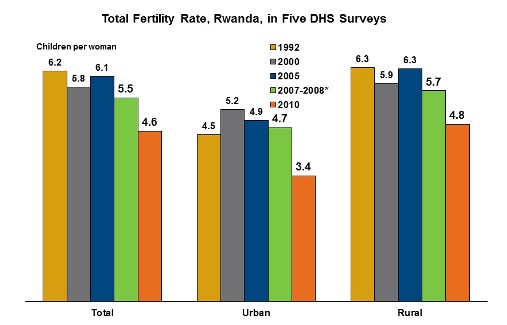
total fertility rate (TFR – the average number of children would bear in her lifetime if the birth rate of a particular year were to remain constant) obtained in the survey was 4.6 for the three-year period preceding the survey. For urban women, the TFR was 3.4 and for rural women, who were 85 percent of the sample, 4.8.
Rwanda’s TFR saw its fastest decline in the 2010 DHS. From the 2007-08 Interim DHS to the 2010 survey, the TFR fell by 1.1 children nationwide – by 1.3 in urban areas and 0.9 in rural areas in a period of only four and a half years. This is sharpest drop in a sub-Saharan TFR I can ever remember seeing. As an indicator of future fertility plans, 56.2 percent of women with three living children said that they not wish to have any more children as did 76 percent of those with four living children. It is clear that the large family size of eight children per woman is truly a thing of the past.
In the survey, 51.5 percent of currently married women said that they were using some form of family planning, 45.1 percent a modern method. Injectables were by far the most frequently used, as such “spacing” methods are in much of Africa, with 23.1 percent of women saying that they used them. That method increased from 15.2 percent in the 2007-08 survey. The next two methods were implants (6.3 percent) and the pill (7.1 percent).
Continue reading on Behind the Numbers.
Image Credit: Arranged by Population Reference Bureau; data from the National Institute of Statistics of Rwanda, Ministry of Finance and Economic Planning, Ministry of Health Rwanda, MEASURE DHS, ICF Macro, Demographic and Health Survey 2010, Preliminary Report.


 A Publication of the Stimson Center.