
-
PODCAST – A Discussion on Climate Change and Security: Arctic Links and U.S. Intelligence Community Responses
›February 24, 2009 // By Wilson Center Staff“The climate issue also very clearly illustrates the whole complexity of the security issue,” says Henrik Selin. “Arctic melting is a national security issue in the traditional national security kind of way.” In this podcast from the Environmental Change and Security Program, Selin, assistant professor of international relations at Boston University, and Stacy VanDeveer, associate professor of political science at the University of New Hampshire, sat down with ECSP Director Geoff Dabelko to discuss the resonance of climate change in the U.S. security community.
VanDeveer and Selin were in Washington to speak at a January 12 event, “Governing the Climate: Lessons From the National Conference on Climate Governance.” VanDeveer has frequently coauthored articles with Dabelko, including “It’s Capacity, Stupid: International Assistance and National Implementation” in Global Governance, “European Insecurities: Can’t Live With ’Em, Can’t Shoot ‘Em” in Security Dialogue, and “Environmental Cooperation and Regional Peace: Baltic Politics, Programs, and Prospects” in Environmental Peacemaking. -
Hot Water: High Levels of Radioactivity Found in Jordan’s Groundwater
›February 23, 2009 // By Geoffrey D. DabelkoStartling new research in the peer-reviewed Environmental Science & Technology shows that fossil groundwater in southern Jordan is radioactive at levels up to 2000% higher than the international drinking water standard. That the radioactivity is naturally occurring is little consolation for Jordanians—and perhaps for residents of Saudi Arabia, Egypt, and Libya, who sit atop the same sandstone Nubian aquifer system.
The shocking findings in “High Naturally Occurring Radioactivity in Fossil Groundwater from the Middle East” by Duke University’s Avner Vengosh and colleagues should be cause for major concern. As Vengosh, a geo-chemistry professor with long-standing research collaborations with Jordanian, Israeli, and Palestinian colleagues, wrote in an email: “Most of the Jordanian population is not using the fossil water for drinking—for now. Only few thousand people in Aqaba and Karak might be currently exposed to this water. However, Jordan has launched a huge water project to transfer the water from the aquifer in the south to the capital Amman, which would expose a large population to this water.”
According to Vengosh, although these specific findings are limited to the water groundwater under in Jordan, Saudi Arabia is using groundwater from the same aquifer (the Saq) extensively, mostly for agriculture but also for drinking. In this arid part of the world, countries have turned to nonrenewable fossil groundwater as one of the few remaining options. As stated in the article’s abstract, “These findings raise concerns about the safety of this and similar nonrenewable groundwater reservoirs, exacerbating the already severe water crisis in the Middle East.”
Vengosh shared the findings with Jordanian authorities ahead of publication. While it is hard to predict the social, economic, and political reactions to this news, it is easier to anticipate the effects of sustained consumption of water contaminated with radium isotopes. Vengosh says exposure to much lower levels of radium resulted in higher frequencies of bone cancer in a New Jersey community.
Photo: Avner Vengosh. Copyright Duke University Photography. -
East Africa Population-Health-Environment Conference Kicks Off in Kigali
›February 23, 2009 // By Rachel WeisshaarRwandan Minister of Natural Resources Stanislas Kamanzi officially launched the meeting of the East Africa PHE Network this morning, stating that Rwanda’s highest-in-Africa population density of 365 people per square kilometer—which he argued leads to environmental degradation and poor human health in both rural and urban areas—compels an integrated approach to development. Kamanzi said that Rwanda’s National Environment Policy and national development plan, Vision 2020, both recognize population-health-environment (PHE) links, and he expressed Rwanda’s commitment to implementing the recommendations of the First Inter-ministerial Conference on Health and Environment in Africa, which was co-hosted by the World Health Programme and the UN Environment Programme in Gabon in August 2008. -
Weekly Reading
›From Conflict to Peacebuilding: The Role of Natural Resources and the Environment, based on the work of the UN Environment Programme’s Expert Advisory Group on Environment, Conflict and Peacebuilding, summarizes the links between the environment, conflict, and peacebuilding, and includes 14 case studies of how natural resources affect—or are affected by—conflict.
The authors of “On Population Growth Near Protected Areas” come to an opposite conclusion from Wittemyer et al., who found a pattern of higher population growth near protected areas in Africa and Latin America. “To understand the disagreement, we re-analyzed the protected areas in Wittemyer et al.’s paper. Their results are simply artifacts of mixing two incompatible datasets,” write the authors. “Protected areas may experience unusual population pressures near their edges; indeed, individual case studies provide examples. There is no evidence, however, of a general pattern of disproportionate population growth near protected areas.”
“The President and I agreed to a new initiative that will further cross-border cooperation on environmental protection and environmental security,” said Canadian Prime Minister Stephen Harper yesterday, announcing plans for a U.S.-Canada Clean Energy Dialogue.
Scientists at Purdue University have teamed up with Google Earth to create an interactive map of U.S. CO2 emissions.
Mark Weston, who writes for the Global Dashboard blog, posted an edited version of a recent talk he gave on West African demography and security. -
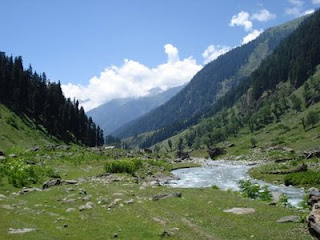
In Kashmir, No Refuge for Wildlife
›February 20, 2009 // By Will Rogers“Human-animal conflicts have assumed alarming proportions in the region,” Asghar Inayati, a regional wildlife warden in Kashmir, recently told Inter Press Service (IPS) News. Since India and Pakistan gained independence in 1949, both sides have fought for control of the territory. Not only has the decades-long conflict claimed 100,000 lives (by some estimates), it has also displaced animals from their natural habitats, sparking violent encounters with local people and threatening many species’ survival. -
New Director of National Intelligence Assesses Climate, Energy, Food, Water, Health
›February 18, 2009 // By Rachel WeisshaarIn the annual threat assessment he presented last week to the Senate Select Committee on Intelligence, new Director of National Intelligence Dennis Blair named the global economic crisis—not terrorism—the primary near-term threat to U.S. national security, prompting accusations of partisanship from the Washington Times. Yet as the U.S. Naval War College’s Derek Reveron notes, “the economic turmoil of the early 20th century fueled global instability and war,” and today’s economic collapse could strengthen extremists and deprive U.S. allies of the funds they need to deploy troops or increase foreign assistance to vulnerable regions.
Further down the list of potential catastrophes—after terrorism, cybersecurity, and the “arc of instability” that stretches from the Middle East to South Asia—the assessment tackles environmental security threats. The four-page section, which likely draws on sections of the recent National Intelligence Council report Global Trends 2025: A Transformed World, summarizes the interrelated natural-resource and population challenges—including energy, food, water, demography, climate change, and global health—the U.S. intelligence community is tracking.
The world will face mounting resource scarcity, warns Blair. “Access to relatively secure and clean energy sources and management of chronic food and water shortages will assume increasing importance for a growing number of countries. Adding well over a billion people to the world’s population by 2025 will itself put pressure on these vital resources,” he writes.
Drawing on the conclusions of the 2008 National Intelligence Assessment on the impacts of global climate change to 2030, Blair portrays climate change as a variable that could place additional strain on already-stressed agricultural, energy, and water systems: “We assess climate change alone is unlikely to trigger state failure in any state out to 2030, but the impacts will worsen existing problems such as poverty, social tensions, environmental degradation, ineffectual leadership, and weak political institutions.” Direct impacts to the United States include “warming temperatures, changes in precipitation patterns, and possible increases in the severity of storms in the Gulf, increased demand for energy resources, disruptions in US and Arctic infrastructure, and increases in immigration from resource-scarce regions of the world,” writes Blair.
Africa, as usual, is the last of the world’s regions to be analyzed in the assessment. Blair notes that “a shortage of skilled medical personnel, deteriorating health systems, and inadequate budgets to deal with diseases like HIV/AIDS, malaria, and tuberculosis” is threatening stability in sub-Saharan Africa, and explains that agriculture, which he rightly calls “the foundation of most African economies,” is not yet self-sufficient, although some countries have made significant improvements in infrastructure and technology. He highlights ongoing conflicts in the Democratic Republic of the Congo, Nigeria, Sudan, and Somalia as the most serious security challenges in Africa. He fails to note, however, that all four have environmental/natural resource dimensions (see above links for details). -
Weekly Reading
›An article in Conservation Letters examining the effect of war on wildlife in Cambodia finds that “the legacy of conflict for wildlife can be profound and destructive. To address post-conflict challenges more effectively, conservation must be integrated within broader peacebuilding processes, including disarmament, demobilization, and reintegration of combatants.”
New York Times environmental reporter Andrew Revkin shares a recent nightmare on his blog, Dot Earth: If human beings achieve inexpensive, renewable energy, will this spur environmentally destructive population growth and consumption?
“Today, one-third of the world’s population has to contend with water scarcity, and there are ominous signs that this proportion could quickly increase,” writes the International Water Management Institute’s David Molden in the BBC’s Green Room. “Up to twice as much water will be required to provide enough food to eliminate hunger and feed the additional 2.5 billion people that will soon join our ranks. The demands will be particularly overwhelming as a wealthier, urbanised population demands a richer diet of more meat, fish, and milk.”
“Climate Wars” is a three-part podcast series by the Canadian Broadcasting Corporation.
Circle of Blue has launched the online radio series “5 in 15”; one episode features water expert Peter Gleick, head of the Pacific Institute, while another highlights Mark Turrell, CEO of technology company Imaginatik. -
Pacific Institute’s Peter Gleick Piques Interest With “Peak Water”
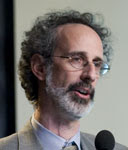
›February 12, 2009 // By Rachel WeisshaarBringing clean water and improved sanitation to the billions who lack them is “not a question of money, it’s not a question of technology, it’s a question of governance, of commitment, will—all of those things. And that, in many ways, is the worst part of the world’s water crisis,” said Peter Gleick, president of the Pacific Institute, at the February 4, 2009, launch of The World’s Water 2008-2009: The Biennial Report on Freshwater Resources. Gleick began by showing No Reason, a short video produced by the Pacific Institute and Circle of Blue for this year’s World Economic Forum in Davos, Switzerland, which examined water issues in several sessions.
What is the Water Crisis?
According to Gleick, the global water crisis comprises many problems, including:- The failure to meet basic human needs for water, which leads to diseases like cholera and typhoid;
- Local water scarcity and resource depletion;
- Contamination by industrial and human wastes;
- The effects of climate change and extreme events;
- Reduced production of food, goods, and services caused by water scarcity, poor water quality, or inequitable water allocation;
- Ecosystem degradation and destruction; and
- Threats to international, national, and subnational security posed by conflict over water.
Because water is a largely renewable resource, we will not completely run out of water. However, Gleick warned that non-renewable water sources such as fossil aquifers are limited. Thus, “peak non-renewable water” could occur if we use fossil groundwater faster than it is recharged; by some estimates, 30-40 percent of today’s global agricultural production comes from non-renewable water, which will become increasingly difficult to extract, said Gleick. “That’s a real challenge from a food point of view, especially in a world that is going from 6.5 billion to 7 billion to 9 billion people.”
Eventually, we will also run up against the ecological and economic flow limits of renewable water sources, which include streams and rivers, Gleick said. And before either non-renewable or renewable peak water, we could reach “peak ecological water,” which occurs when using additional water “causes more ecological damage than it provides human benefit, and the total value of using more water starts to decline,” he explained.
China: Water Challenges Writ Large
China’s stunning economic growth in recent years has come “at an enormous environmental cost…to their air quality, to human health, and especially to water resources,” said Gleick. China’s water is over-allocated, poorly managed, and severely polluted by industrial and human wastes. Desertification in northern China is increasing rapidly, due to deforestation and the excessive withdrawal of groundwater. According to Gleick, some companies have cancelled plans to build plants in China because they cannot obtain sufficient water of high enough quality.
Public protests over environmental degradation in China are becoming increasingly common. According to Gleick, there have been as many as 50,000 protests over environmental issues in a single year, with the majority of these relating to water quality or allocations.
Solutions to the Water Crisis
Gleick recommended a series of actions:- Develop more water sources, while ensuring that environmental and community concerns are addressed;
- Improve water infrastructure, including the installation of low-flow toilets and efficient drip-irrigation systems;
- Improve water-use efficiency;
- Update the Clean Water Act and the Safe Drinking Water Act to include new contaminants, and actively enforce the standards already in place;
- Price water more accurately, with the understanding that water is a human right and should be subsidized for basic human needs;
- Improve and expand public participation in environmental decision-making; and
- Strengthen water institutions and improve communication between them.
For more information, including a webcast of this event, visit ECSP’s website. To receive invitations to future events, e-mail ecsp@wilsoncenter.org.
 A Publication of the Stimson Center.

 Rwandan Minister of Natural Resources
  “
“ Bringing clean water and improved sanitation to the billions who lack them is “not a question of money, it’s not a question of technology, it’s a question of governance, of commitment, will—all of those things. And that, in many ways, is the worst part of the world’s water crisis,” said Peter Gleick, president of the

