
-
Climate Engineering is Untested and Dangerous
› The famous mathematician John von Neumann called climate engineering a “thoroughly ‘abnormal’ industry,” arguing that large-scale interventions, including solar radiation management, were not necessarily rational undertakings and could have “rather fantastic effects” on a scale difficult to imagine. Tinkering with the Earth’s heat budget or the atmosphere’s general circulation, he said, “will merge each nation’s affairs with those of every other, more thoroughly than the threat of a nuclear or any other war may already have done”—and possibly leading to “forms of climatic warfare as yet unimagined.”
 -
A Response to Will Rogers’ “Budgeting for Climate”
›I have a few responses to Will Rogers’ thoughtful critique of my report, “Military vs. Climate Security: Mapping the Shift from the Bush Years to the Obama Era.”
Rogers says that “the report could be read as inferring that the Department of Defense (DoD) has an unnecessarily oversized budget”: that’s true. I think a single country that spends 43 percent of the world’s total military budget—more than the next 14 countries put together—and whose spending has nearly doubled since FY 2000 to the highest level in real terms since World War II, could find some ways to provide for the common defense with less money.
-
Video: Roger-Mark De Souza on The Integration Imperative
›August 18, 2009 // By Geoffrey D. Dabelko“I have had a woman say to me, ‘This PHE [population-health-environment approach] makes sense to me because I do not live my life in silos. I live my life in a way that all these things are integrated, and what you are saying to me makes sense, because my life is one of integration,’” said the Sierra Club’s Roger-Mark De Souza, in his lilting Trinidadian baritone.
De Souza, whom I interviewed recently about his contribution to ECSP’s Focus series, is a great storyteller. Whether recounting his conversations with a tsunami survivor in Thailand, a mayor of a small Filipino community, or a Tanzanian journalist, De Souza brings to life their daily struggles to meet basic needs. His tales are packed with lessons for development practitioners tackling multiple and overlapping challenges in poor rural communities.
“When I see communities have a better understanding of how these issues interact and have an impact on their lives, they become very energized, and very enthusiastic and want to make a difference,” De Souza told me.
His latest article, “The Integration Imperative: How to Improve Development Programs by Linking Population, Health, and Environment,” summarizes the advantages of integration. “PHE offers a step in the right direction—a flexible, innovative way for policies and programs to keep pace with today’s rapidly changing world—and lays the foundation for empowering our children to manage these changes for generations to come.” -
How Family Planning Meets Development Goals
›“Knowing is not enough; you must act and let your government know that family planning is a right and saves lives,” said Maurice Middleberg of the Global Health Council at a recent event in Chapel Hill.
The other panelists at “How Can Family Planning Efforts Help Us Achieve the Millennium Development Goals?” (Dr. Martha Carlough of UNC, Dr. Ward Cates of Family Health International, and Pape Gaye of IntraHealth International) all provided compelling statistics demonstrating the effectiveness of family planning as an intervention that addresses the Millennium Development Goals (MDGs).
MDGs 4, 5, and 6 – reducing child mortality; improving maternal health; and combating HIV/AIDS, malaria, and other diseases, respectively – all have obvious connections to health and woman’s reproductive health. An unmet need for family planning, which is measured as the percentage of women of reproductive age who desire to space or limit their births but are not using contraception, can undermine the achievement of these goals.
For example, very early motherhood not only increases the risk of dying in childbirth, it also jeopardizes the well-being of surviving mothers—and their children, too. A child born to an adolescent mother has a greater risk of dying in infancy or childhood.
“Contraception is the best-kept secret in HIV prevention,” said Dr. Cates, who cited research that found that “current contraceptive use in sub-Saharan Africa prevents an estimated 577,200 unplanned births to HIV-infected mothers” and thus prevents the birth of an estimated 173,000 HIV-infected infants each year.
Family planning can help meet the other MDGs, including ending poverty and hunger (Goal 1); providing universal primary education (Goal 2); and promoting gender equity (Goal 3). Young mothers frequently miss out on education and socio-economic opportunities. Being able to make their own decisions about family planning and reproductive health can empower women and improve gender equity. When women are given equal opportunities for education, health, and employment, they are more likely to invest in the education and care of their children. This helps them break the cycle of poverty, hunger, and disease.
Although the MDGS don’t include any formal targets for sexual and reproductive health, the UN Millennium Project has stated that the MDGs cannot be achieved in low-income countries without access to sexual and reproductive health services, including family planning. The panelists agreed that family planning is a cost-effective intervention that provides broader positive benefits for development.
But the real strength of their presentations lay in the personal stories behind the statistics. Middleberg closed the discussion with a story about a woman in Latin America who told him that she loves her husband but was afraid of him every time he touched her. Now, after having undergone sterilization, she no longer worries and can love her husband with no fear of becoming pregnant.
A mother of six interviewed in a 2009 news article about the Philippines’ new family planning bill said, “How can one keep on having children? We don’t earn enough to feed them, much less send them to school.” New York Times columnist Nicholas Kristof interviews a Haitian woman with 10 children in a dramatic video interview, “Saving Lives with Family Planning.”
Underlying all of these facts and stories is the belief that one’s health and well-being, including access to family planning, is a right. But as Middleberg said, believing is not enough.
EngenderHealth, an international reproductive health organization working to improve the quality of health care in the world’s poorest communities, is asking Americans to create a video explaining why we should care about international family planning. Contribute your thoughts on YouTube’s Video Volunteers project.
Lisa Basalla, MPH, is a research associate with the Carolina Population Center. She graduated from Case Western Reserve University with a MPH focusing on reproductive and adolescent health. She has worked with Johns Hopkins University’s Center for Communications Programs on its reproductive health knowledge management project as well as a HIV-prevention behavior change communication project in Malawi.
Photo: A billboard promoting family planning in Phnom Pehn, Cambodia. Courtesy flickr user olerousing. -
Weekly Reading
›The Population Reference Bureau’s 2009 World Population Data Sheet shows that global population numbers will reach 7 billion in 2011. Among its key findings, PRB notes that “population growth is one root cause of increases in global greenhouse gas emissions. But the complexity of the mechanisms through which demographic factors affect emissions is not fully taken into consideration in many analyses that influence governments’ climate change mitigation efforts.”
The Guardian reports that U.S. marines have launched an energy audit of American military operations in Afghanistan, the first such assessment to take place in a war zone. “Some 80% of US military casualties in Afghanistan are due to improvised explosive devices (IEDS),” the article elaborates, “and many of those placed in the path of supply convoys.” DoD’s Alan Shaffer recently told ClimateWire, “nearly three-quarters of what convoys move in Afghanistan’s treacherous terrain is fuel or water.”
The Department of State released an inspection of the operations of the Bureau of African Affairs that identifies a rift between U.S. diplomats and the U.S. military’s recently established African Command (AFRICOM). As the Wilson Center’s Steve McDonald told Bloomberg.com, “It got off to a hugely bad start…Part of it was tied up with policies of the Bush era, where our own security concerns far overrode any sensitivities to local considerations.”
T. Paul Shultz of Yale University’s Economic Growth Center evaluates population and health policies, looking specifically at “the causal relationships between economic development, health outcomes, and reproductive behavior.”
Oxfam’s “The Future is Here: Climate Change in the Pacific” includes recommendations for adapting and mitigating climate change in Australia, New Zealand, and the Pacific island nations—a region “where half the population lives within 1.5 kilometers of the sea.” -
Budgeting for Climate
›Update: Read a response by Miriam Pemberton“The Obama administration…has identified the task of substantially reducing greenhouse gas emissions as one of its top priorities,” writes Miriam Pemberton in a new report from the Institute for Policy Studies, “Military vs. Climate Security: Mapping the Shift from the Bush Years to the Obama Era.”
-
Demography and Democracy in Iran
›August 12, 2009 // By Brian KleinPresident Mahmoud Ahmadinejad might have blamed sinister “foreign powers” for fomenting post-election civil unrest in Iran, but some analysts have fingered another culprit: demography. According to Farzaneh (Nazy) Roudi, program director for the Middle East and North Africa at the Population Reference Bureau, two phenomena “provide a backdrop for understanding Iran’s current instability.” First is the country’s youthful population age structure, or “youth bulge”; over 30 percent of Iranians are between the ages of 15 and 29, and 60 percent are under the age of 30. Second is Iran’s surprisingly comprehensive family planning program, which has empowered women to make their own reproductive choices and enter higher education en masse. -
Copenhagen’s Chance to Reduce Poverty and Improve Human Security
›The climate community is under increasing pressure to help the developing world, especially those at the “bottom of the pyramid.” The people who did the least to cause climate change will suffer its effects the most.
A critical part of the solution to this problem will be enhancing market-based incentives for climate-friendly behavior. The projects that generate credits for sale in the carbon markets vary widely in scale. However, the most successful have focused on large, localized sites, such as the smoke stack of a single plant. These “centimeter-wide, kilometer-deep” projects are easy to monitor and verify.
In contrast, most projects that benefit the poor are “a kilometer wide, a centimeter deep,” with each family across a large territory producing a small emissions reduction. Monitoring and tracking these community-based projects is usually cost-prohibitive.
DRC: Reducing Emissions and Improving Security
A Mercy Corps project in the refugee camps in the eastern Democratic Republic of the Congo (DRC) seeks to improve the security of women and children while simultaneously reducing carbon emissions.
In the war-ravaged province of North Kivu, the total number of Internally Displaced Persons (IDPs) exceeds 850,000. Demand for resources, particularly fuel wood, vastly exceeds the available supply. To collect wood, women and children have to leave the relative safety of the refugee camps, making them vulnerable to sexual assault and child abduction by rebel groups and the army. Mercy Corps surveys indicate that nine percent of women in camps have been raped or otherwise assaulted.
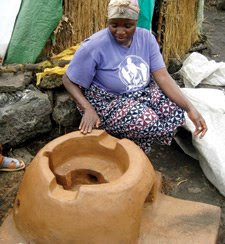
Mercy Corps installs fuel-efficient stoves that reduce the need for dangerous trips into the forest. A commercial carbon broker develops carbon credits from the reduction in emissions that arises from the use of stoves instead of open fires. The upfront funding from the broker supplements a UNHCR grant supporting the project, and serves to help more than 20,000 families in one of the most dangerous places on Earth.
This extreme example is one of relatively few carbon projects generating revenue that benefits vulnerable people. Yet if this kind of project can be successful in the DRC, larger projects in safer countries may be able to generate massive emissions reductions. The Copenhagen conference needs to set the stage for these types of market incentives for better climate behavior.
Raising a REDD Flag
A relatively new, UN-backed initiative known as Reduced Emissions from Deforestation and Forest Degradation (REDD) seeks to compensate forest-rich countries for protecting or regenerating their forests. However, REDD may have the unintended consequences that further erode the human rights of marginalized people dependent on those forests.
For decades, tropical forests have been logged legally and illegally by states and private companies, without any input from or compensation to indigenous forest communities, who, in many cases, were displaced or worse.
REDD thus raises a troubling question: If countries can generate carbon revenues through REDD, to whom do the revenues belong, and how will they be allocated? Many forestry ministries have a long history of corruption and mismanagement. There are already signs of ministries competing over putative REDD funds. And high-level discussions in only a few countries have included the role of communities and civil society in implementing REDD and distributing revenues.
The Copenhagen conference will be a critical milestone in the global fight to address climate change. Yet it raises significant and far-reaching questions concerning economic development and human rights of the world’s most vulnerable citizens that must not be swept under the rug.
Jim Jarvie is director of climate change, environment, and natural resources at Mercy Corps. In a recent video interview, he spoke to ECSP about how humanitarian groups are responding to new climate challenges.
Photo: Stoves that are more fuel-efficient not only help curb rapid deforestation, but help women spend less time gathering wood in dangerous areas. Courtesy Dee Goluba/Mercy Corps.
 A Publication of the Stimson Center.
 The famous mathematician
  “Knowing is not enough; you must act and let your government know that family planning is a right and saves lives,” said Maurice Middleberg of the Global Health Council at a recent
 President Mahmoud Ahmadinejad might have blamed sinister “
 The climate community is under increasing pressure to help the developing world, especially those at the

