-
Population Reference Bureau Releases New Projections
Seven Billion and Counting
›August 6, 2010 // By Russell SticklorThe Population Reference Bureau recently released its annual World Population Data Sheet, and lo and behold, the world is getting more crowded. By next year, the global total is expected to top seven billion, as we march toward upwards of nine billion by mid-century.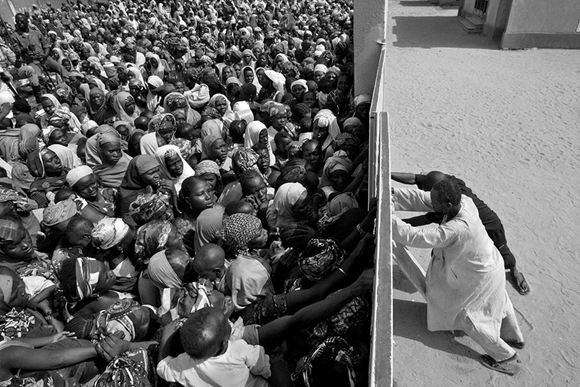
Much of that growth, of course, will be unfolding across Asia — China and India already account for more than 35 percent of the world’s population, and the two countries will continue to drive global demographic change. But the PRB report emphasized that Africa will also contribute significantly to world’s shifting demographics in the coming decades. By 2050, the continent’s population is slated to double, reaching the neighborhood of two billion. In that time span, the Democratic Republic of Congo and Ethiopia are expected to knock Russia and Japan off the list of the world’s top 10 most populous nations.
The Young Continent
Africa’s population growth through 2050 could actually be even greater than PRB predicts, since current projections assume that total fertility rate in sub-Saharan Africa will drop from 5.2 to 2.5 in that time span. The assumption is that as the region’s countries travel farther down the path to economic modernization, access to family planning services will become more widespread, resulting in smaller average family sizes—a trend well-documented in other parts of the developing world.
A slower than expected decrease in total fertility rate (TFR) across sub-Saharan Africa over the next 40 years could render current predictions inaccurate, however. While TFR has dropped significantly over the past 50 years in countries like Ghana (where it is now 4.0), just 17 percent of married women in sub-Saharan African utilize a modern type of family planning. That is one of the reasons Africa as a whole maintains a high average TFR of 4.7 children per woman, and why countries like Niger and Uganda sport some of the highest TFRs in the world (at 7.4 and 6.5, respectively).
According to the 2010 PRB Data Sheet, Africa is also notable for its demographic youth bulge. Of the world’s 10 countries with the highest percentage of their populations aged 15 or younger, nine of them—Niger, Uganda, Burkina Faso, the DRC, Zambia, Malawi, Chad, Somalia, and Tanzania—are on the continent. The question facing these countries is whether their young populations will yield a “demographic dividend” during the coming decades, whereby the large youth bulges translate into a sizeable and productive workforce. Harnessing the economic potential of the younger generation could help accelerate the development process in many of the region’s nations, but it will require significant investment in health and education infrastructure—funding that may prove hard to come by for many cash-strapped governments.
Persistent Divides
Other findings featured in the report involved sanitation and wastewater treatment, where some headway is being made at the global level. The PRB Data Sheet reveals that 43 percent of urban populations in sub-Saharan Africa (and 24 percent of the region’s rural populations) now have access to improved sanitation, while 86 percent of urban populations (and 55 percent of rural populations) have better sanitation services in Latin America and the Caribbean. The figures highlight progress, but reveal the significant divide that persists between urban and rural areas in terms of access to quality sanitation. According to the PRB, some 2.7 billion people—40 percent of the world’s total—still do not enjoy adequate sanitation facilities, and most live in rural areas of the developing world.
Finally, an interesting trend that will impact developed and developing nations alike involves elderly support ratios, or the number of active workforce members between the ages of 15 and 64 available to support a nation’s non-working, 65-and-older population. While rapidly growing countries in the developing world will continue to enjoy high elderly support ratios, a number of countries across the developed world will face a potential financial crisis, as comparatively low support ratios combine with rapidly aging populations to strain available financial resources earmarked for covering pension payments and healthcare infrastructure costs. To make up for the shortfall over the coming decades, the PRB report predicts that some developed nations may be inclined to further throw open the doors to immigration to bolster workforce ranks—a step recommended by Jack Goldstone in ECSP Report 13.
Sources: New York Times, Population Reference Bureau, Population Council, PR Newswire, United Nations Population Division, WHO/UNICEF Jointing Monitoring Programme for Water Supply and Sanitation
Photo Credit: “Famine in Niger, Africa,” courtesy of flickr user liquidslave. -
Reform Aid to Pakistan’s Health Sector, Says Former Wilson Center Scholar
›August 5, 2010 // By Wilson Center StaffExcerpt from op-ed by Samia Altaf and Anjum Altaf in Dawn:
WE must state at the outset that we have been wary of, if not actually opposed to, the prospect of further economic assistance to Pakistan because of the callous misuse and abuse of aid that has marked the past across all elected and non-elected regimes.
We are convinced that such aid, driven by political imperatives and deliberately blind to the well-recognised holes in the system, has been a disservice to the Pakistani people by destroying all incentives for self-reliance, good governance and accountability to either the ultimate donors or recipients.
Even without the holes in the system the kind of aid flows being proposed are likely to prove problematic. Over half a century ago, Jane Jacobs, in a brilliant chapter (Gradual and Cataclysmic Money) in a brilliant book (The Death and Life of Great American Cities), showed convincingly how ‘cataclysmic’ money (money that arrives in huge amounts in short periods of time) is a surefire way of destroying all possibilities of improvement. What is needed, she argued, is ‘gradual’ money in the control of the residents themselves. While Jacobs was writing in the context of aid to impoverished communities within the US, she concluded with a remarkably prescient concern: “I hope we disburse foreign aid abroad more intelligently than we disburse it at home.”
Continue reading on Dawn.
For more on U.S. aid to Pakistan, see New Security Beat‘s coverage of the recent U.S.-Pakistani Strategic Dialogue.
Photo Credit: A U.S. Army Soldier with 32nd Infantry Regiment, 10th Mountain Division, hands out medical supplies to Pakistani refugees outside an International Committee of the Red Crescent aid station in Afghanistan’s Kunar province, October 23, 2009. Courtesy of flickr user isafmedia. -
The Conflict Potential of Climate Adaptation and Mitigation
›August 4, 2010 // By Schuyler Null“Climate change and our energy future are issues that are really front and center in our policy debates and public debates,” said ECSP Director Geoff Dabelko in this collection of interviews from New Security Beat’s Backdraft series. “One specific set of questions within this larger debate is about how climate change connects to a broader security set of questions. In that context we have a lot of questions and a lot of concerns – [and] potentially some opportunities.”
-
Boosting the U.S. Role in the Global Health Arena
›A new video from the Commission on Smart Global Health Policy, which was established by the Center for Strategic & International Studies, reviews the commission’s progress towards its goal of encouraging the U.S. government to embrace global health as a pillar of U.S. foreign policy.
The video reviews the recommendations from the commission’s March 2010 report, A Healthier, Safer and More Prosperous World: 1) Maintain robust U.S. support for the fight against HIV/AIDS, malaria, and tuberculosis; 2) Prioritize maternal and child health, especially in sub-Saharan Africa and South Asia; 3) Help other nations improve their capacity to prevent and respond to outbreaks of contagious disease; 4) Expand U.S. capacity to fund future global health initiatives by securing long-term investments for such efforts; and 5) Step up U.S. funding for multilaterals engaged in the global health field, including the World Health Organization, Global Fund, UNICEF, the World Bank, and the GAVI Alliance.
In the months ahead, commission members will be participating in public forums throughout the United States to discuss and promote the recommendations included in the report, before gathering in January to review the Obama administration’s progress on global health as the administration begins its third year. To date, the centerpiece of the administration’s health outreach efforts has been the six-year, $63 billion Global Health Initiative, designed to promote an enhanced U.S. role in addressing public health issues overseas.
The CSIS Global Health Policy Center will also be launching a year-long debate series called “Fault Lines in Global Health,” focusing on controversial topics in the global health field. The series’ kick-off event will center on U.S. AIDS funding, and is scheduled for Friday, August 6, 2010, from 9:30-11:00 a.m. -
Top 10 Posts for July 2010
›The new conflict minerals law, Yemen, and the “4 Degree” map top the list this month:
1. DRC’s Conflict Minerals: Can U.S. Law Impact the Violence?
2. Demographics, Depleted Resources, and Al Qaeda Inflame Tensions in Yemen
3. Eye on Environmental Security: Guest Contributor Rear Admiral Morisetti Launches the UK’s “4 Degree Map” on Google Earth
4. Time to Give a Dam: Alternative Energy as Source of Cooperation or Conflict?
5. Copper in Afghanistan: Chinese Investment In Aynak
6. India’s Maoists: South Asia’s “Other” Insurgency
7. A Backdraft Video: Stacy VanDeveer: Will Using Less Oil Affect Petro State Stability?
8. VIDEO: Peter Gleick on Peak Water
9. Is the Third Pole the Next Site for Water Crisis?
10. Interview: Educate Girls, Boys, To Meet the Population Challenge, Say Pakistan’s Leading Demographers -
‘Restrepo’: Inside Afghanistan’s Korengal Valley
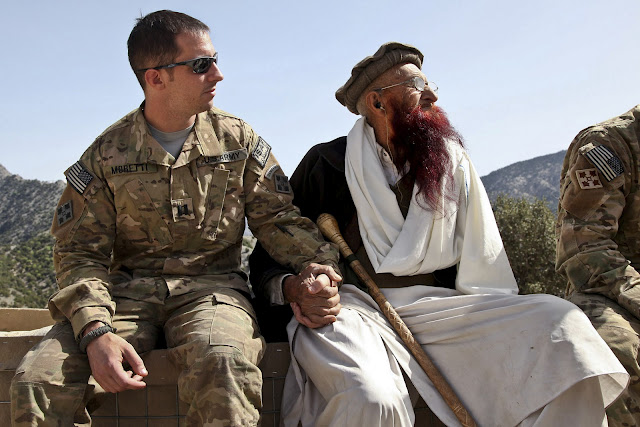
›August 2, 2010 // By Marie HokensonRestrepo, the riveting new documentary film from Tim Hetherington and Sebastian Junger, follows a platoon of U.S. soldiers deployed in the dangerous Korengal Valley of Afghanistan. As a cadet at West Point majoring in human geography, I was fascinated to watch the ways the soldiers confronted and adapted to the challenges posed by the local culture of the remote Afghan community surrounding their outpost.
West Point’s human geography program delves into the relationships between facets of society and geography that may also have potentially significant security implications. In the wars in Iraq and Afghanistan, U.S. troops fight insurgents in difficult environments – from heavily urbanized cities to extremely remote valleys – while interacting with civilian populations with radically different languages and cultures.
Restrepo: Culture in Action and Under Fire
At the remote outpost Restrepo, named in memory of a medic killed in action, the platoon receives daily fire from insurgents as they seek to improve security enough to allow the construction of a road through the valley.
At a weekly shura, the company commander explains the benefits of the road to the village elders, yet they are either unconvinced or uninterested. This frustrating meeting reveals a cultural disconnect: the Americans see the road as the way to win Afghan “hearts and minds” by facilitating progress and bringing more revenue to the community, but the Afghans are suspicious of the Americans’ motives and promises, and not convinced of the benefits.
Another culture clash arises when a cow is caught in the outpost’s concertina wire. The soldiers kill the seriously injured cow, but this proves to be a continual source of tension in negotiations between the soldiers and the locals. Killing the cow was illegal, say the Afghan elders, who seek financial compensation that the Army is not willing to provide. Perhaps better understanding of regional culture could have prevented this relatively minor incident from souring relations.
On the other hand, by attending the traditional shura gatherings with village elders, the U.S. soldiers are showing their respect for Afghan culture while facilitating negotiations and, potentially, the sharing of useful intelligence.
Although not shown in the film, the U.S. military also demonstrates its understanding of Afghan culture through the growing use of female soldiers to reach out to Afghan women. As many women in Afghanistan are not allowed to be seen by unrelated men, female soldiers are tasked with searching houses and Afghan women, as well as assessing their need for aid and gathering intelligence from them.
West Point: Culture in Theory and Practice
Dealing with the problems faced by today’s soldiers, like those in Restrepo, requires understanding the current conflict landscape and its security implications. Understanding the influence of religion, language, development, and people on the world’s geography is vital to mapping the combat terrain.
Human geography instruction at West Point provides cadets with more perceptive views of other countries and the complex problems they face. Military geography analyzes urban and natural environments, as well as related interactions, such as the impact of population dynamics and nature resources on military operations. Land-use planning and management addresses conflicts over land use and environmental strategies. Other opportunities, such as study-abroad programs and interactions with foreign cadets, increase our exposure to other cultures and geographies.
Through my study of human geography, I have gained a much greater understanding of the people and countries where I travel and work today – and where I will go in the future as a commissioned officer in the U.S. Army.
Marie Hokenson is a cadet at the United States Military Academy at West Point and an intern with the Woodrow Wilson Center’s Environmental Change and Security Program.
Photo Credit: “Mutual support,” courtesy of flickr user The U.S. Army. -
PRB Maps the PHE World
›The Population Reference Bureau (PRB) has created an interactive Google map that highlights population, health, and environmental programs in Africa, Asia, and Latin America. The Population, Health, and Environment (PHE) Map shows the locations of projects that combine improved health services, sustainable natural resource management, and ecosystem conservation.
According to PRB’s Maura Graff and Jason Bremner, “the map aims to give viewers both a sense of the scale of current PHE integration efforts, and specific information about individual organizations, projects, and their location.”
Clicking on a marker will reveal the title of a PHE program, a short description of its goals and outcomes, a link to its website, and the occasional picture of the project in action. A list on the left alphabetically catalogs all the projects based on region.
The map also provides the opportunity for those working on PHE projects in the field to find nearby projects in order to share experiences. For example, in Ethiopia, Population Media Center and DSW’s Youth to Youth could share lessons learned about disseminating information on the reduction of female genital mutilation, the importance of providing family planning services to young married couples, and the linkage between reduced family size and enhanced stewardship of social and natural resources.
Communities that understand how population, health, and environment are intertwined are more engaged and energized to make a difference. In a video interview with ECSP, Roger-Mark De Souza, director of foundation and corporate relations at the Sierra Club, explains that PHE projects are so effective because solutions to a community’s liked problems demand this logical integration. For example, while learning about the health benefits of birth spacing, father and mothers also learn how their family planning decisions can improve the economic and environmental prospects of the community.
Just like PHE projects themselves, the map is a work in progress; PRB is seeking to add PHE projects that are still active or ended after 2005. Please contact Maura Graff if you would like to add a project.
Josephine Kim is a cadet at the United States Military Academy at West Point, and an intern with the Woodrow Wilson Center’s Environmental Change and Security Program. -
Ban Ki-moon: Natural Resources Should Be Part of Peacebuilding
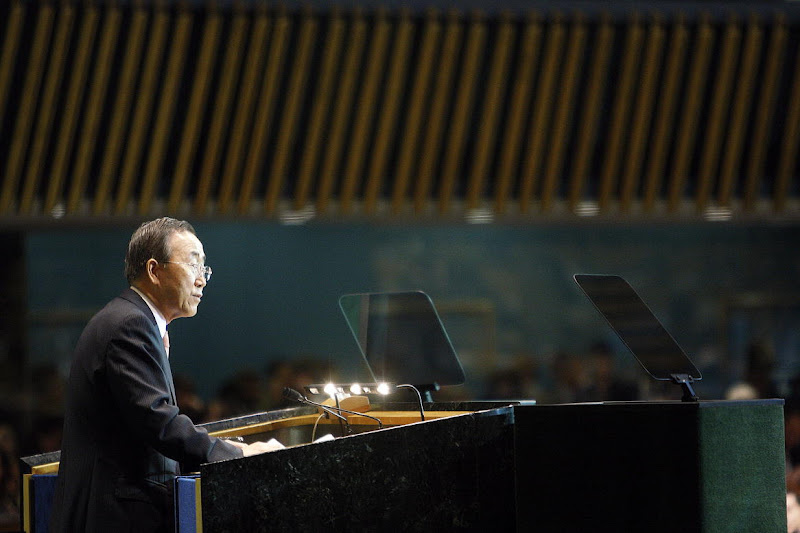
›July 30, 2010 // By Schuyler NullNatural resource management is a critical component of the peacebuilding process according to a new report from UN Secretary-General Ban Ki-moon. The report, presented to the UN Security Council and General Assembly this month, is a follow-up to last year’s presentation by the Secretary-General’s office on peacebuilding in the immediate aftermath of conflict.
The Secretary-General singles out the 2009 UN Environment Programme (UNEP) study “From Conflict to Peacebuilding: The Role of Environment and Natural Resources” for demonstrating the recent links between land use, natural resources, frequency of conflict, and conflict relapse. The Secretary-General writes:44. I wish to highlight two areas of increasing concern where greater efforts will be needed to deliver a more effective United Nations response. First, natural resources: a recent study by the United Nations Environment Programme concluded that 40 per cent of internal conflicts over a 60-year period were associated with land and natural resources, and that this link doubles the risk of conflict relapse in the first five years. Efforts have been made to draw early attention to these risks and to improve inter-agency coordination to address them, including by strengthening national capacity to prevent disputes over land and natural resources, as described in paragraph 31 above. Examples include programmes in Afghanistan, Timor-Leste and the Sudan, where coordination among several United Nations entities addressing land and natural resource management has demonstrated the importance of an inclusive approach. In order to further deliver on the ground I call on Member States and the United Nations system to make questions of natural resource allocation, ownership and access an integral part of peacebuilding strategies.
ECSP Director Geoff Dabelko calls the inclusion of this language “an important step towards integrating environmental issues into broader UN peacebuilding efforts and providing critical top-level political support for this integration effort.”
UNEP’s Post-Conflict and Disaster Management Branch (PCDMB) has been working to support a variety of UN bodies on integrating environment and natural resources into the peacebuilding process. Recent PCDMB efforts have been based in Afghanistan, Iraq, Lebanon, Sierra Leone, the DRC, and Sudan. New Security Beat asked UNEP PCDMB’s Director of Policy and Planning David Jensen to reflect on the new report via email:I’m thrilled to finally see that after over 10 years of work by UNEP and a variety of other organizations and scholars, these issues have finally been recognized at the highest political level. There is no longer any doubt that the mismanagement of natural resources can be a key factor in contributing to violent conflict. At the same time, the very recognition that environmental issues and natural resources can contribute to violent conflict underscores their potential significance as pathways for cooperation, transformation, and the consolidation of peace in war-torn societies.
As Jensen writes in ECSP Report 13, “If people cannot find clean water for drinking, wood for shelter and energy, or land for crops, what are the chances that peace will be successful and durable? Very slim.”
Last fall, Jensen predicted the UN was finally approaching a fundamental tipping point for inclusion of natural resource issues in the broader peacebuilding process, and the Secretary-General appears to have proven him right.
Photo Credit: “Secretary-General Addresses General Assembly,” courtesy of flickr user United Nations Photo.
 A Publication of the Stimson Center.