-
Save the Date: “Maternal Health Challenges in Kenya: What Research Evidence Shows”
›June 8, 2011 // By Ramona GodboleThe Woodrow Wilson Center’s Global Health Initiative, Africa Program, and Environmental Change and Security Program, in coordination with the Maternal Health Task Force and UNFPA, invite you to a livestreamed discussion of:
Maternal Health Challenges in Kenya: What Research Evidence Shows
Tuesday, July 12, 2011, 10:00 a.m. – 12:00 a.m
Woodrow Wilson Center, Washington DC
6th Floor Flom Auditorium
Please RSVP to globalhealth@wilsoncenter.org with your name and affiliation.
The Wilson Center’s Global Health Initiative is traveling to Nairobi to co-host a two-day workshop on July 12-13 with Kenyan policymakers, community health workers, program managers, media, and donors who will discuss Kenya’s maternal health challenges and identify solutions for moving the maternal health agenda forward.Concurrent with the event in Kenya, the Wilson Center will also be holding a meeting with participants livestreaming in from the Nairobi workshop to present new research and highlight lessons learned from the in-country event. Washington-based participants will also have the unique opportunity to interact with the Nairobi workshop and provide feedback to policymakers via live video conference. A full agenda will follow shortly.
About the 2011 Maternal Health Policy Series
As one of the few forums dedicated to maternal health, the Woodrow Wilson Center’s 2011 Advancing Policy Dialogue on Maternal Health series brings together senior-level policymakers, academic researchers, media, and civil servants from the U.S. government and foreign consuls to identify challenges and discuss strategies for advancing the maternal health agenda.
In order to promote greater voices from the field, the 2011 dialogue is partnering with the African Population Health Research Center in Kenya to co-host a two-part dialogue series with local, regional, and national decision-makers on effective maternal health policies and programs. These in-country dialogue meetings will create a platform for field workers, policymakers, program managers, media, and donors to share research, disseminate lessons learned, and address concerns related to policy, institutional, and organizational capacity building.
The Wilson Center’s Global Health Initiative is pleased to present this series with its co-conveners, the Maternal Health Task Force and the United Nations Population Fund (UNFPA), and is grateful to USAID’s Bureau for Global Health for further technical assistance.
Photo Credit: Mother and Child, courtesy of flickr user The.Rohit. -
One in Three People Will Live in Sub-Saharan Africa in 2100, Says UN
›June 8, 2011 // By Schuyler Null
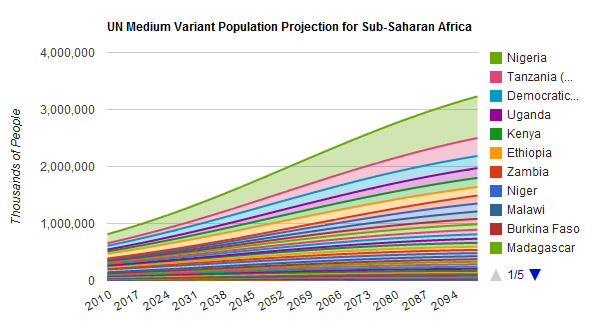
Between now and 2100, three out of every four people added to world population will live in sub-Saharan Africa. That’s what the medium variant of the UN’s world population projections estimates.* As we noted in our previous post on the latest UN numbers, Nigeria leads sub-Saharan growth, but other countries will also grow by major multiples: Tanzania and Somalia will be 7 times larger; Malawi more than 8 times; and Niger, to grow to more than 10 times its current population.
-
Michael Kugelman, Dawn
Aquaculture’s Promise for Food-Insecure Pakistan
›June 7, 2011 // By Wilson Center StaffThe original version of this article, by Michael Kugelman, appeared on Dawn.
“Give a man a fish and you feed him for a day,” the ancient Chinese philosopher Lao Tzu famously said. “Teach a man to fish and you feed him for a lifetime.”
For years, this adage has helped frame debates across a variety of disciplines. However, while globally influential, it is by no means universally applicable – as the sad realities of Sindh make painfully clear. In this parched, food-insecure region flush with fishermen and farmers, people have long known how to fish. The problem is that with water bodies shriveling up, there are increasingly fewer fish to catch. Many impoverished residents would be grateful for a single fish, given their struggles to secure a day’s worth of food.
Pakistan’s natural resource constraints know no provincial borders, yet they are notably severe in Sindh. Water tables are plummeting, with great volumes of Indus River flows diverted upstream to satiate agricultural and urban demand in Punjab.
Sindh’s water security is further threatened by population growth and global warming, and by the water-intensive, large-scale farming envisioned by foreign investors jockeying for agricultural land.
With surface water supplies threatened, users are increasingly tapping groundwater resources – yet according to the Pakistan Council of Research in Water Resources, a staggering 95 percent of the province’s shallow groundwater supplies are bacteriologically contaminated. This is unsurprising, given the technical deficiencies and inefficiency that characterize Sindh’s water treatment facilities.
In a province where so many livelihoods are tied to water availability and food production, water stress aggravates food insecurity and threatens economic well-being. A recent World Bank report concludes that Pakistan’s poorest spend at least 70 percent of their meager incomes on food – and undoubtedly many of them hail from Sindh. According to data from the Pakistan Agricultural Research Council, some of the province’s small farmers spend a whopping 87 percent of their incomes on food.
Continue reading on Dawn.
Michael Kugelman is a program associate for the Asia Program at the Woodrow Wilson Center.
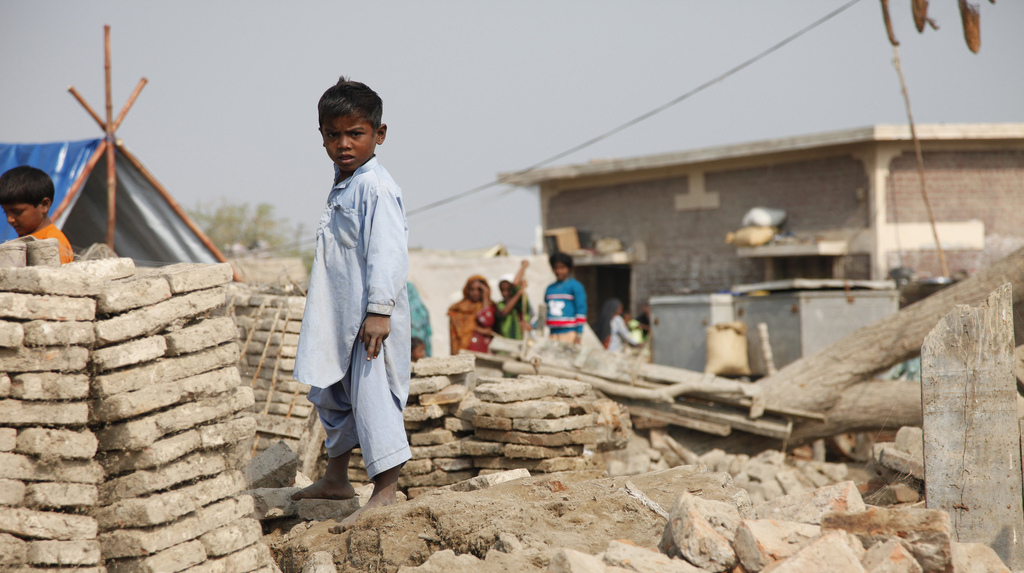
Photo Credit: A child stands amongst buildings destroyed by the floods in Sindh province, courtesy of flickr user DFID – UK Department for International Development. -
Watch: Younger Generation Will Prioritize Health, Education, Human Rights, Says Frederick Burkle
›June 7, 2011 // By Schuyler Null“Unfortunately, in the last two decades, when globalization became the mantra, it was primarily an economic mantra,” said Frederick Burkle, a senior fellow with the Harvard Humanitarian Initiative, visiting scientist at the Harvard School of Public Health, and senior public policy scholar at the Wilson Center. “The mantra was, ‘if you can improve the economy,” he said, “health, education, everything will follow.’”
“With the financial crisis, that proved not to be true,” Burkle said, and as a result, net expenditures in health and education have declined and the private sector, unfortunately, has not filled the gap.
“We really need to redefine globalization,” Burkle said. “And certainly economics will be there…but health, education, and human rights need to be just as dominant as the economics.”
Burke said he expects a gradual realignment of global priorities to come as younger generations come into decision-making roles. “They don’t have political clout right now,” he said, “but when they do…I think we’re going to see all these aspects that I mentioned – even the humanitarian profession becoming a career – accelerated.” -
The Future of Women in the MENA Region: A Tunisian and Egyptian Perspective
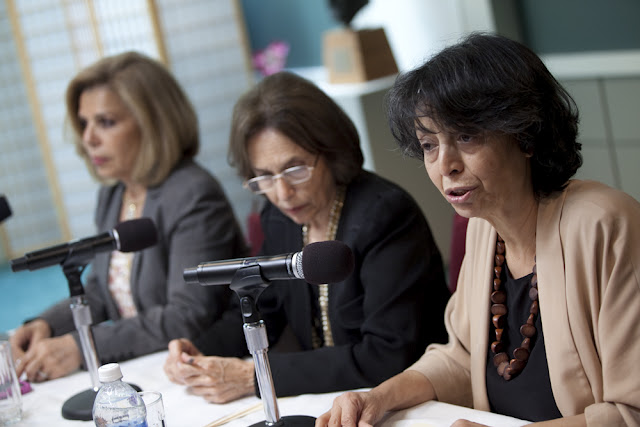
›Lilia Labidi, minister of women’s affairs for the Republic of Tunisia and former Wilson Center fellow, joined Moushira Khattab, former minister of family and population for Egypt, on June 2 at the Wilson Center to discuss the role and expectations of women in the Egyptian and Tunisian revolutions, as well as issues to consider as these two countries move forward. Haleh Esfandiari, director of the Middle East Program at the Wilson Center, moderated the event.
Labidi focused on the participation of women in the protests in Tunisia and their aftermath. She emphasized that these developments give hope, as they attest to the mixed nature of the demonstrations in which women were not sidelined but marched amongst men. (Editor’s note: The gender balance of the protests was a feature demographer Richard Cincotta also observed in his post about Tunisia’s age structure.) She pointed to the way that Tunisian women have entered the public space and played vital roles in spreading images and information about the protests around the world. Labidi said that although the future of women in Tunisia remains uncertain, it is unlikely that they will cease to be active and retreat to the private sphere. She commented on the new parity resolution calling for an equal number of male and female candidates for each party in Tunisia’s July elections and the opportunities afforded by an increase in political pluralism and media outlets.
Labidi also elaborated on her efforts as Tunisia’s minister of women’s affairs, discussing the ministry’s results and future goals. She stressed the importance of aiding women living in poverty, changing the cultural role of women, and boosting confidence in the government’s ability to address women’s needs. In particular, Labidi spoke of the work to expand the ministry’s regional offices to become more accessible to rural and non-elite sectors of Tunisian society. She hoped that recent events will encourage recognition of women as regional political actors and that the United States will expand intellectual and political ties with Tunisia.
Khattab pointed out the numerous similarities between the role of women in Tunisia and in Egypt, saying that women’s participation in public demonstrations and disseminating information to the media “has set the stage for a paradigm shift in the rights of citizens.” She noted that there are many advances yet to be made for women, youth, and other groups but that the protests have begun a change towards “a democratic, rights-based Egypt.”
Although she sees women’s involvement as a part of continuing progress in women’s rights, Khattab made note of the various obstacles to freedom that women in Egypt still face. She expressed concern that the politics of revenge against the previous regime might sideline women in politics, who already have less representation in the government than they did under Mubarak and have been excluded from the committee drawing up a new Egyptian constitution. She noted the need to change social perceptions that “women already enjoy all their rights.” She also discussed how the new media freedom gives fundamentalist groups a platform to propagate narrow interpretations of faith that call for the repeal of some of the existing women’s rights laws. She posed the question of what interpretations of the faith would allow for a greater harmonization with domestic laws based on the ideals of human rights.
Laura Rostad is an intern with the Middle East Program at the Woodrow Wilson Center.
Photo Credit: David Hawxhurst/Wilson Center. -
Measuring Ecosystem Vitality and Public Health With the Environmental Performance Index
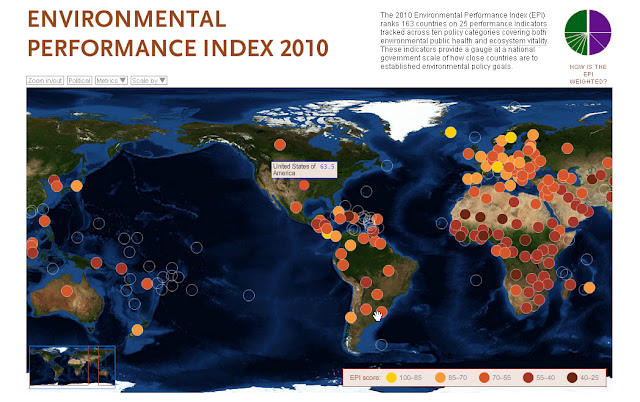
›The Environmental Performance Index (EPI) is a comparative analytic tool for policymakers created jointly by Yale and Columbia Universities in collaboration with the World Economic Forum and Joint Research Centre of the European Commission. The EPI was created in 2006 and is updated biannually. Data is drawn from 25 performance indicators that fall under 10 well-established policy categories, including the environmental burden of disease, the effects of water on human health, and agriculture. The indicators serve as a “gauge at a national government scale of how close countries are to established environmental [and health] policy goals,” write the authors.
The EPI draws data from a diverse array of sources, such as the World Health Organization, Food and Agriculture Organization, University of New Hampshire, and World Resources Institute. Users can view visualizations of the compiled data via an interactive map and the data is also available in the form of rankings charts, individual country profiles, and country group comparisons. The interactive map also allows users to isolate performance indicators or policy categories in order to compare an individual country’s performance with global trends. Furthermore, indicators may be scaled to visually reflect a country’s performance in relation to drivers of environmental performance, like gross domestic product, level of corruption, and government effectiveness.
This tool is particularly useful because users can effectively leverage points for policy change by identifying linkages between environmental policy and other issue areas, such as public health or sanitation. The EPI enables policymakers to visually conceptualize problematic regions, optimize investments in environmental protection, and identify best practices.
The index’s greatest weakness is its inability to track changes in performance over time. A pilot project was launched last year that tracks whether a country has progressed or deteriorated in an area of environmental performance, but the authors note that the project has “raised more questions than answers,” particularly concerning data availability and interpretation. Additionally, there are gaps in the data. Although these gaps signify a data quality weakness, they also support the continued calls for increased data collection by governments and other organizations to better inform environmental decision-making. -
Yemen Beyond the Headlines: Losing the Battle to Balance Water Supply and Population Growth
›Part three of the “Yemen Beyond the Headlines: Population, Health, Natural Resources, and Institutions” event, held at the Wilson Center on May 18.
Overlooked in most news coverage of Yemen’s crisis is the country’s struggle to manage its limited natural resources – particularly its rapidly depleting groundwater – in the face of soaring population growth. At the recent Wilson Center event, “Yemen: Beyond the Headlines,” Yemen’s ambassador to Germany, Mohammed Al-Eryani, and Daniel Egel of the RAND Corporation outlined Yemen’s shaky prospects for economic development without more sustainable agricultural practices and more efficient water management. [Video Below]
With a population of more than 24 million and a total fertility rate (TFR) of 5.5 – nearly double the average TFR for the region – Yemen’s population is projected to grow to 36.7 million by 2025 and jump further to 61.6 million by mid-century, according to the latest UN projections. While those figures may not seem large by global standards, given Yemen’s already limited stocks of arable land and groundwater, the country’s rapid rate of growth may quickly outpace its resources.
“Already in a Crisis”: The Groundwater Deficit
Yemen’s per capita water supply is falling fast in the face of booming population growth and agricultural consumption, said Al-Eryani, a water engineer who founded Yemen’s Ministry of Water and the Environment. While the commonly accepted threshold for water scarcity is 1700 cubic meters or less per capita, Yemen’s per capita renewable water availability is now in the neighborhood of 120 cubic meters, he said.
Meanwhile, water scarcity has been exacerbated by erratic precipitation that has hit rainfall-dependent farmers especially hard. In a country with no real rivers or perennial streams, rainfall harvesting has long enabled agricultural production, as evidenced by the country’s many intricately terraced hillsides – “the food baskets of Yemen,” said Al-Eryani.
Yemenis have coped with shifting precipitation patterns by drawing more groundwater for irrigation and other domestic uses. While drilling wells has provided some short-term relief, the practice is unsustainable in the long term, creating a “water deficit,” Al-Eryani said, that continues to grow each year.
In the populous Sanaa basin, home to the Yemeni capital, consumption outweighs the aquifer’s natural rate of recharge by a factor of five to one and groundwater levels have been plummeting at six meters per year, he said. With only minimal government regulation of drilling, the country’s groundwater situation is poised to worsen, one of the reasons Al-Eryani declared his country is “already in a crisis.”
Stalled Economic Development
Yemen’s stalled economic development is particularly pronounced outside of urban areas, “where the resources are,” said Daniel Egel, citing the country’s failure to build modern transportation infrastructure and develop other economic activities besides farming. He called for the international development community to focus on creating jobs in rural areas, particularly by increasing the financing available for non-agricultural businesses and by improving secondary roads. In addition, he warned development actors to be aware of how gender inequality and local social structures, such as tribes, affect development efforts.
Given the country’s dependence on agriculture, water scarcity poses a threat to Yemen’s food security and its economic development. Three out of every four Yemeni villages depend on rainfall for irrigation, Egel said, making them highly vulnerable to unexpected climate change-induced shifts in precipitation patterns. Water scarcity also weakens the financial stability of Yemeni households, with the cost of water “accounting for about 10 percent of income during the dry season,” he said.
Averting a “Domino Effect”
Al-Eryani asserted that water management policies will “have to be designed in piecemeal fashion,” as no one single action will avert a catastrophe. He suggested a number of steps to alleviate the country’s growing water crunch, including:- Focus on the rural population, which makes up 70 percent of the population, has the highest fertility rates, and are the most reliant on agriculture;
- Move development efforts outside of Sanaa to other regions of the country;
- Increase investment in desalination technology for coastal areas;
- Increase water conservation in the agricultural sector; and,
- Exploit fossil groundwater aquifers in Yemen’s sparsely populated eastern reaches.
“The battle to strike a sustainable balance between population growth and sustainable water supplies was lost many years ago,” Al-Eryani said. “But maybe we can still win the war if we can undertake some of these measures.”
See parts one and two of “Yemen Beyond the Headlines: Population, Health, Natural Resources, and Institutions” for more from this Wilson Center event.
Sources: UN Population Division, World Bank.
Photo Credit: “At the fountain,” courtesy of flickr user Alexbip. -
Watch: Janani Vivekananda on Climate Change and Stability in Fragile States
›At International Alert, the starting point for thinking about how climate change affects stability is recognizing that climate change will interact with and amplify existing social, economic, and political stressors in fragile communities, said Janani Vivekananda in this interview with the ECSP.
“Rather than climate change being this single, direct causal factor which will spark conflict at the national level,” Vivekananda said, these stressors “will shift the tipping point at which conflict might ignite.” In places that are already weakened by instability and conflict, climate change will simply be an additional challenge.
To address this additional challenge, Vivekananda said two things must be understood about the effects of climate change on fragile states: 1) Environmental, social, economic, and political stressors will be most evident at the household and community level; and 2) Those stressors are interrelated.
“You can’t address one of these things in isolation from the others. You have to understand how they all interact together to be able to respond appropriately,” she said. “We can’t think about food security, for example, without thinking about land degradation.” In addition, responses need to be relevant to their context, and that context “can only be understood through very sub-national, context-specific evidence.” Vivekanada explained that this kind of evidence can only come from a “bottom-up” approach, which should be coordinated as part of a broader effort.
For more on the connections between climate change and stability, see The New Security Beat’s summary of “Connections Between Climate and Stability: Lessons From Asia and Africa,” with Janani Vivekanada, Jeffrey Stark of the Foundation for Environmental Security and Sustainability, and Cynthia Brady of USAID speaking at the Woodrow Wilson Center on May 10.
 A Publication of the Stimson Center.