-
Watch: Scott Wallace on the Amazon’s Last Uncontacted Tribes and the Intersection Between Human Rights and Conservation
›October 19, 2011 // By Wilson Center StaffIn the far west of the Amazon, some of the last uncontacted indigenous tribes on Earth live untouched by modern society. Scott Wallace, frequent contributor to National Geographic and former public policy scholar at the Wilson Center, spoke to New Security Beat about his new book, The Unconquered: In Search of the Amazon’s Last Uncontacted Tribes, which chronicles his harrowing trip through the Javari Valley Indigenous Land. Wallace accompanies former sertanista (“agent of contact”)-turned-native rights advocate Sydney Possuelo as he attempts to map and protect the territory of the flecheiros, or Arrow People, named for the poison-tipped arrows they use.
The Brazilian government and activists are trying to protect the areas where these native groups live and allow them to choose for themselves if they want contact. “It’s not that hard to find us,” Wallace said. For the moment, however, “it’s clear that they do not want that contact.”
By protecting these people, the government is also protecting thousands, if not millions, of acres of virgin rainforest, said Wallace, creating a mutually beneficial intersection between human rights and environmental conservation.
“The assumption is that there is now a global village, everyone’s connected…no one of us is separated from anyone else on the planet by more than six degrees of separation,” said Wallace. But that assumption breaks down in the face of these people who live in complete isolation from the rest of the world.
We have to decide whether to leave them alone and let them live their lives or try to make lasting contact, said Wallace. Contact would open up the tribe’s land and resources to development but come at great risk to their society, their lives (due to vulnerability to disease), and the Amazonian ecosystem, as the example of India’s Adavasi tribes demonstrates. -
Health and Harmony: Population, Health, and Environment in Indonesia
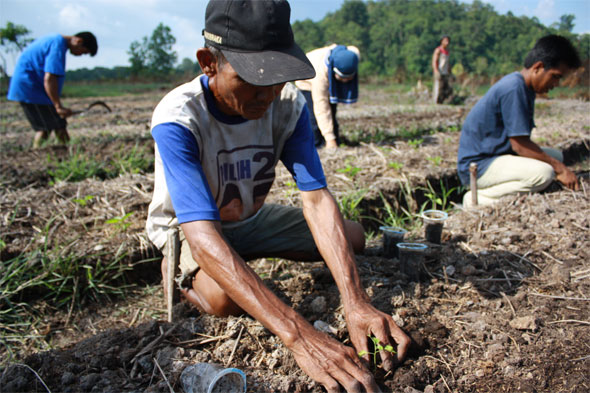
›Borneo’s Gunung Palung National Park is a microcosm of both the island’s ecological wealth and vulnerability. More than half of the park is undisturbed forest; the remainder, however, “is being torn down day after day” at an alarming rate, said Health in Harmony’s Nichol Simpson at an event on integrated approaches to population, health, and environment (PHE) programs in Indonesia. Alene Gelbard of the Public Health Institute’s Company-Community Partnerships for Health Indonesia (CCPHI) program joined Simpson on September 29 at the Wilson Center. Both speakers emphasized that no matter what issue a group works on, engaging local communities is essential for success.
The Destructive Cycle: Poor Health, Poor Environment
For Simpson, “the intersection between human and environmental health” is at the heart of Health in Harmony’s work. Health in Harmony opened Clinic ASRI in 2007, aiming to provide improved healthcare to villagers throughout Gunung Palung National Park while ending their dependence on illegal logging as a means of financial survival.
The area’s inhabitants were all too easily trapped in what Simpson called “the destructive cycle.” When faced by an unexpected medical emergency, families would go into debt to pay their medical bills. Health in Harmony found that of 232 local households surveyed, 13 percent had recently experienced a major medical emergency, at an average cost of $360. Most households in the area only hold around $260 in emergency savings, so to make up the difference, about a third turned to illegal logging to pay down their debt.
By deforesting the park, illegal logging worsens the health of nearby communities. For example, Simpson said that Clinic ASRI has seen a rise in cases of malaria and tuberculosis in the surrounding communities, in part because deforestation has increased the level of mosquito activity. The link between human and environmental health is clear, said Simpson: the people ASRI serves are “living it every day. They know the cause of this. And…they want it to stop.”
Protecting Natural Resources By Improving Health
The Health in Harmony clinic located in Sukadana, a small village sandwiched between Borneo’s coast and Gunung Palung Park, helps break the destructive cycle by treating patients regardless of their ability to pay. If patients do not have cash, they can barter for their care. In one case, a girl named Yani came to ASRI after her family incurred $500 over two months of visiting hospitals and traditional healers, none of whom could treat her condition. ASRI diagnosed and treated Yani for scabies. In exchange, her mother signed a pledge to protect Gunung Palung from logging and made the clinic a floor mat to cover the $1.50 bill.
By providing affordable, high-quality healthcare that is contingent upon pledging to protect the environment, Clinic ASRI improves human and environmental health in one fell swoop, said Simpson. “Because the infant mortality rate has decreased and you’re not overcompensating,” said Simpson, families can choose to have fewer children, using free birth control provided by ASRI.
“When you have fewer and healthier children, you’re investing in your education,” said Simpson. “When you’re investing in your education, you’re investing in your country and your community. This is the virtuous cycle. I didn’t invent it, but we are proving it in Sukadana.”
The communities around the clinic have embraced ASRI’s work, partnering with them to expand their services to address additional community needs, like training farmers in more productive organic methods and providing mated pairs of goats for widows, who pay ASRI back with kid goats and manure for fertilizer.
All but one of the 23 villages that ASRI services have been consistently free of illegal logging, according to monitors who visit them on a regular basis. “We’re proving the theory that we can protect natural resources by improving health,” Simpson said.
“Health Is Key to Sustainable Development”
Gelbard took a step back to talk about CCPHI’s experience establishing multi-sector partnerships among NGOs and corporations by building trust and enabling dialogue between the communities.
With corporate responsibility becoming more popular, “everyone’s talking about partnerships these days, and everybody’s partnering with everyone,” said Gelbard. “I don’t care what they call it – I care what they’re doing” and what results they achieve, she said. A successful partnership involves “all partners doing something more than just giving money.”
Gelbard said the 2004 tsunami reinforced the notion of corporate responsibility for a lot of companies operating in Indonesia. They saw that unless they branched out beyond their own walls and “did things to help strengthen communities,” efforts at corporate responsibility simply “would not benefit them in the long-run,” she said.
Through CCPHI, companies and NGOs have partnered on a wide range of efforts, including improving access to and funding for reproductive health services, improving sanitation by increasing access to water, and combating human trafficking by empowering girls and women.
Achieving the Millennium Development Goals will require increasing access to health care in a manner that reflects the needs of communities, she said. At its core, CCPHI’s work and the partnerships it facilitates are “based on the knowledge that health is key to sustainable development,” said Gelbard.
Event Resources
Sources: Alam Sehat Lestari, American Journal of Tropical Medicine and Hygiene, Company-Community Partnerships for Health Indonesia, ExxonMobil, The Guardian, Health in Harmony, National Geographic, PBS News Hour, Public Health Institute, Republic of Indonesia Ministry of Forestry, United Nations, World Wildlife Fund
Photo Credit: Used with permission courtesy of ASRI and Nikki See, Under-told Stories. -
Carl Haub, Behind the Numbers
Rwanda’s 2010 Demographic and Health Survey Shows Remarkable Drop in Fertility and Child Mortality
›October 18, 2011 // By Wilson Center StaffThe original version of this article, by Carl Haub, appeared on PRB’s Behind the Numbers blog.
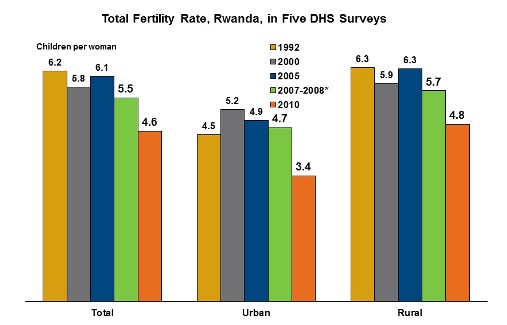
The Rwanda 2010 Demographic Health Survey is the latest in a regular series of DHS surveys that began in 1992, although hostilities had delayed the next survey until 2000. The 2010 survey interviewed 13,671 women ages 15 to 49 and 6,329 men ages 15 to 59 from September 2010 to March 2011. The total fertility rate (TFR – the average number of children would bear in her lifetime if the birth rate of a particular year were to remain constant) obtained in the survey was 4.6 for the three-year period preceding the survey. For urban women, the TFR was 3.4 and for rural women, who were 85 percent of the sample, 4.8.
Rwanda’s TFR saw its fastest decline in the 2010 DHS. From the 2007-08 Interim DHS to the 2010 survey, the TFR fell by 1.1 children nationwide – by 1.3 in urban areas and 0.9 in rural areas in a period of only four and a half years. This is sharpest drop in a sub-Saharan TFR I can ever remember seeing. As an indicator of future fertility plans, 56.2 percent of women with three living children said that they not wish to have any more children as did 76 percent of those with four living children. It is clear that the large family size of eight children per woman is truly a thing of the past.
In the survey, 51.5 percent of currently married women said that they were using some form of family planning, 45.1 percent a modern method. Injectables were by far the most frequently used, as such “spacing” methods are in much of Africa, with 23.1 percent of women saying that they used them. That method increased from 15.2 percent in the 2007-08 survey. The next two methods were implants (6.3 percent) and the pill (7.1 percent).
Continue reading on Behind the Numbers.
Image Credit: Arranged by Population Reference Bureau; data from the National Institute of Statistics of Rwanda, Ministry of Finance and Economic Planning, Ministry of Health Rwanda, MEASURE DHS, ICF Macro, Demographic and Health Survey 2010, Preliminary Report. -
PHE Is One Great Idea That Won’t Be On the Rio Agenda, Says Roger-Mark De Souza
›October 17, 2011 // By Sean Peoples“I am now serving as an example to other women in the community because I am not having any more children. I have received training in sustainable agricultural practices, I’m generating income, and I’m educating others,” said Berhane Ferkade, an Ethiopian farmer, to Population Action International’s Roger-Mark De Souza earlier this year. The 39-year-old mother of 11 become one of the community’s model farmers after working with LEM Ethiopia – a local population, health, and environment (PHE) development organization.
-
Minority Youth Bulges and the Future of Intrastate Conflict
›October 13, 2011 // By Richard CincottaFrom a demographic perspective, the global distribution of intrastate conflicts is not what it used to be. During the latter half of the 20th century, the states with the most youthful populations (median age of 25.0 years or less) were consistently the most at risk of being engaged in civil or ethnoreligious conflict (circumstances where either ethnic or religious factors, or both, come into play). However, this tight relationship has loosened over the past decade, with the propensity of conflict rising significantly for countries with intermediate age structures (median age 25.1 to 35.0 years) and actually dipping for those with youthful age structures (see Figure 1 below).
-
Panetta: Diplomacy and Development Part of Wider Strategy to Achieve Security; Will They Survive Budget Environment?
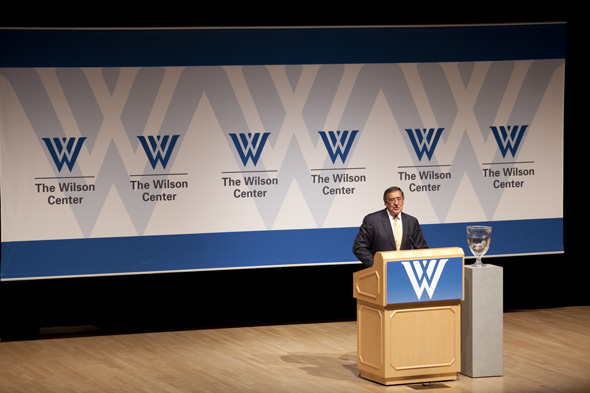
›Leon Panetta – newly minted secretary of defense and former director of the CIA – gave one of his first public policy addresses yesterday at the Woodrow Wilson Center addressing national security priorities amidst a constrained budgeting environment (see video here). Under the debt ceiling agreement recently agreed to by Congress, the Pentagon is expected to achieve around $450 billion in spending cuts over the next 10 years.
Most of Secretary Panetta’s speech focused on “preserving essential capabilities,” including the ability to project power and respond to future crises, a strong military industrial base, and most importantly, a core of highly trained and experienced personnel.
But he also touched on the other two “D” s besides defense – diplomacy and development: “The reality is that it isn’t just the defense cuts; it’s the cuts on the State Department budget that will impact as well on our ability to try to be able to promote our interests in the world,” Panetta said in response to a question from ECSP Director Geoff Dabelko:National security is a word I know that we oftentimes use just when it comes to the military, and there’s no question that we carry a large part of the burden. But national security is something that is dependent on a number of factors. It’s dependent on strong diplomacy. It’s dependent on our ability to reach out and try to help other countries. It’s dependent on our ability to try to do what we can to inspire development.
Panetta’s backing of diplomacy and foreign aid as an extension of U.S. national security strategy is a continuation of vocal support by former Chairman of the Joint Chiefs of Staff Mike Mullen, former Secretary of Defense Bob Gates, and others at the Pentagon, but the bigger issue remains convincing Congress, where the State Department has become a popular target for budget cutters.
If we’re dealing with Al Qaeda and dealing with the message that Al Qaeda sends, one of the effective ways to undermine that message is to be able to reach out to the Muslim world and try to be able to advance their ability to find opportunity and to be able to seek…a better quality of life. That only happens if we bring all of these tools to bear in the effort to try to promote national security.
We’ve learned the lessons of the old Soviet Union and others that if they fail to invest in their people, if they fail to promote the quality of life in their country, they – no matter how much they spend on the military, no matter how much they spend on defense, their national security will be undermined. We have to remember that lesson: that for us to maintain a strong national security in this country, we’ve got to be aware that we have to invest not only in strong defense, but we have to invest in the quality of life in this country.
Perhaps the more useful question going forward is one of priorities. Clearly there will be (and already is) less money to go around, and the Defense Department is one of the largest outlays, while State is much smaller – the military’s FY 2012 budget request was $670.9 billion; the State Department’s, $50.9 billion. So the question is: when push comes to shove, will Secretary Panetta be able to sustain his support for diplomacy and development budgets if it means larger cuts at DOD?
Sources: Government Executive, Politico, U.S. Department of Defense, U.S. Department of State.
Photo Credit: David Hawxhurst/Wilson Center. -
Jon Foley: How to Feed Nine Billion and Keep the Planet Too
›October 12, 2011 // By Geoffrey D. DabelkoJon Foley of the University of Minnesota’s Institute on the Environment is a food security rock star, plain and simple. And he deserves that lofty status in part because he explains our complex 21st century agriculture challenges in such a clear and accessible fashion. See him present (like in the TEDx video above), and you are left wishing all scientists would drop in on the “how to make your work understandable” class that Foley must have aced.
Foley brought that clarity of presentation, mixed with self-deprecating humor, to this past week’s inaugural South by Southwest (SXSW) Eco conference in Austin, Texas. Foley said we must meet three big challenges in the realm of agriculture:- Feeding the population today: One in seven of the world’s seven billion people do not know where their next meal is coming from.
- Feeding the future population: The planet is expected to reach more than nine billion people in just 39 years (and may still continue to grow beyond nine billion, rather than leveling off as expected until recently).
- Farming the planet sustainably: We are a long way from achieving sustainable agriculture, given overuse of fertilizers, soil erosion and degradation, deforestation (leading to loss of biodiversity), and energy-intensive practices (producing excessive carbon emissions).
But Foley and his colleagues retain their scientific union cards while suggesting specific ways the world might meet the three food security goals listed above. In what must be considered the academic equivalent of a walk-off grand slam, they will be featured as next week’s cover story in Nature and a more accessible derivative in the November issue of Scientific American.
“Today, humans are farming more of the planet than ever, with higher resource intensity and staggering environmental impacts, while diverting an increasing fraction of crops to animals, biofuels and other nonfood uses,” Foley et al. write in Nature. “Meanwhile, almost a billion people are chronically hungry. This must not continue: the requirements of current and future generations demand that we transform agriculture to meet the twin challenges of food security and environmental sustainability.”
Their four-step plan in brief:- Slow agricultural expansion to stop deforestation and the huge ecological cost that stems from expanding into new lands, often to grow animal feed rather than food for direct human consumption.
- Grow more food on the acres currently under cultivation. The attention, resources, and innovation applied to the best-producing farms need to also be turned on the least productive farms, where rates as low as 20 percent of potential yields are the norm.
- Improve the resource efficiency of agriculture, through better water use, for example. Places like India, where the energy to pump groundwater is effectively free, are very inefficient in the use of water per calorie grown.
- Close “diet gaps,” where only 60 percent of what is grown is actually for human consumption (the rest for animals and fuel), and reduce food waste, whether it is spoilage on the way to market or the excesses of a food industry that leaves so much uneaten.
Sources: Nature.
Video Credit: “TEDxTC – Jonathan Foley – The Other Inconvenient Truth,” courtesy of Youtube user TEDxTalks. -
Lisa Hymas on Envisioning a Different Future With Family Planning in Ethiopia
›ECSP caught up with Lisa Hymas, senior editor at Grist, last week during the first South by Southwest (SXSW) Eco conference and she spoke about her recent visit to Ethiopia to see the country’s community health extension program in action. “Ethiopia has a big challenge around population,” Hymas said, “but the government is committed to bringing that down.”
The government extension program places health-workers – young women, for the most part, who have received basic training – directly into each community, where they are able to give out immunizations, provide advice on nutrition, teach families how to properly hang bed nets to prevent mosquito-borne illnesses, and provide family planning services and advice.
Thanks to the program, these health workers and those in the communities they service can “envision very different lives for themselves than their mothers had,” Hymas explained. For instance, one woman recounted that her mother gave birth to 10 children, “and almost died giving birth to the last one, because there was no access to birth control, and there was no good access to health care.” In contrast, she is now able to have a career and to use family planning to delay and space her own childbearing.
For more on Ethiopia’s health extension program, see Schuyler Null’s report on visiting a village health clinic near the town of Fiche last spring.
 A Publication of the Stimson Center.