-
Reaching Out to Environmentalists About Population Growth and Family Planning
›“Promoting women’s empowerment is an effective strategy for looking at climate and the environment but also is important in its own right,” said the Sierra Club’s Kim Lovell at the Wilson Center on February 22. “Increasing access to family planning for women around the world is a climate adaptation and climate mitigation solution.” [Video Below] Drawing on research by Brian O’Neill (National Center for Atmospheric Research) and others Lovell explained that meeting the unmet need for family planning around the world could provide up to 16 to 29 percent of the emissions reductions required by 2050 in order to avoid more than two degrees of warming (the target set by nations to prevent the most damaging effects of climate change).
For environmentalists and those concerned with climate change, “sometimes the idea has been that population is toxic, that we can’t talk about population growth,” said Nancy Belden of Belden Russonello and Stewart Consulting, but the results of a recent survey and several focus groups conducted in association with Americans for UNFPA demonstrate that there is great potential for engaging the environmental community in such a discussion.
Belden and Lovell were joined by Kate Sheppard from Mother Jones to discuss how the population and environment communities can come together in the lead-up to the Rio+20 UN sustainable development conference.
Besides providing a basic health commodity, empowering women through access to family planning also improves adaptation outcomes, said Lovell. “Climate change is already happening and women and families around the world are suffering from the effects of water scarcity [and] of erratic weather patterns,” she said. But “when women have the ability to plan their family size and have more choices about their families and about their reproductive health and rights, that makes it easier to adapt to those climate change effects that are already taking place.”
Resonating With Environmental Priorities
“The people who really care about the environment are generally the same people who care about access to contraception and birth control and family planning…they’re a ready audience to hear about these connections and they’re a ready audience to take action about them,” said Kate Sheppard. Reproductive rights issues are something that people can really connect with, she said; “most women, most men too…understand why it’s an important issue and they’ve understood it in their own life and they have [a] very strong response to it.”
When we approach the linkages between environment and population, said Sheppard, it is important to recognize the role of empowering language – language about access to services, education, and resources for women.
The aim of the Americans for UNFPA survey was to find out whether environmentalists can be engaged in discussions of population issues such as family planning and international voluntary contraception, and if so, how?
The results show that “environmentalists are ready to talk about population, they’re ready to listen – it’s not toxic,” said Belden. She outlined three key findings:
First, environmentalists prioritize the environment but they also give a high priority to empowering women, said Belden. “Population pressures are seen as an environmental problem…they don’t dismiss it,” yet the “strongest framework that we could come up with…for engaging people on the issues around voluntary family planning and contraception focuses on women.”
Second, the environmental community is relatively optimistic about the potential outcomes of family planning programs and of foreign aid in general. When queried, half of the environmentalists strongly supported the idea of U.S. contributions to UN programs that provide voluntary access to contraception in developing countries, said Belden.
When asked to mark their top priority among a list of possible outcomes of providing voluntary access to contraception, 47 percent of the environmentalists selected either “improving living conditions for women and their families” or “ensuring women have options and can make reproductive decisions” as their top priority. While a significant number are also concerned about stalling population growth, this integrative focus on improving the lives of women and their families is heartening, said Belden.
In the Run-Up to Rio+20, More Than Pop
One point that all three speakers stressed is the need to integrate consumption into the integrated population message. In her survey work, Belden found that “if you don’t talk about consumption in the same breath, [environmentalists] start wanting to put it in there because otherwise…this is someone blaming others.”
Lovell similarly highlighted that “if we’re working to ensure a sustainable planet for future generations to come, we have to think about consumption and population.” For instance, “the United States makes up five percent of the world’s population but consumes 25 percent of the world’s resources,” she said.
Said Sheppard: “It’s not simply a problem that the numbers of people here on the Earth are going up, it’s a problem of how people, especially here in the U.S., live.”
It is imperative – especially from a sustainable development standpoint – that while working towards integrating environment and population we remain focused on a message that includes “using less but still having a high quality of life” here at home, said Sheppard.
Event ResourcesSources: Proceedings of the National Academy of Sciences.
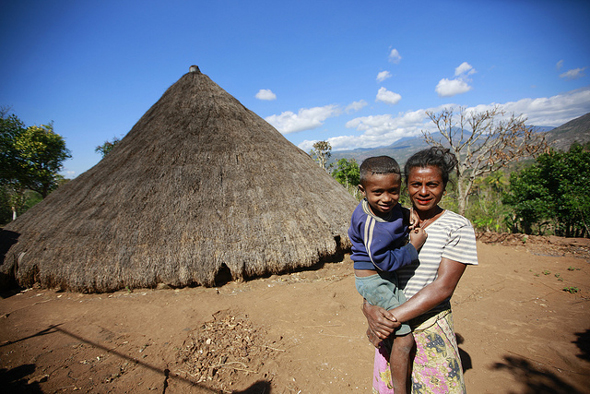
Photo Credit: “Timorese Traditional Home,” courtesy of United Nations Photo. -
Military-to-Military Environmental Cooperation: Still a Good Idea for China and the United States
›March 1, 2012 // By Geoffrey D. DabelkoAs Washington begins to assess the recent visit of Chinese Vice President Xi Jinping, who is expected to become president of China early next year, the search for ways to build confidence between the two powers is on the table yet again.
-
USAID’s Donald Steinberg on Futures Analysis for International Development
›February 28, 2012 // By Stuart KentJust as the science fiction writer Isaac Asimov explored the idea of predicting the future to influence the world towards a more prosperous, democratic, and peaceful track, so too must USAID try to better understand the challenges of tomorrow, said Donald Steinberg, deputy administrator for the U.S. Agency for International Development, during an address at USAID’s “Future of Development” symposium at the Wilson Center late last year. “Development now is too important to the United States to be left to actions that occur over 1, or 2, or 5, or even 10 years,” he continued. Looking beyond budgetary cycles, Steinberg asserted that “we have to prepare for future development patterns” by analyzing the present.
Why Aid Matters
Drawing on the President’s remarks during the UN’s 2010 Millennium Development Goals Summit in New York, Steinberg outlined three reasons why development aid is central to U.S. foreign policy.
First, we all stand to benefit from living “in a world that’s peaceful, that’s democratic, that’s prosperous, that’s respectful of human rights and respectful of human dignity,” he argued.
Second, “a world that is developing is in our economic interest,” he said. “Developing nations are our fastest growing markets abroad,” providing lucrative outlets for U.S. trade and investment. Eighty-five percent of new U.S. exports over the next two decades will find their way to recipients of U.S. foreign aid, he said.
Third, aid impacts national security. Countries that are developing and prospering “don’t spew out large numbers of refugees across borders or across oceans,” he said, “they don’t transmit pandemic diseases, they don’t harbor terrorists, or now even pirates” – in short, “they don’t require American forces.”
Looking to the Future
According to Steinberg, we can take hold of the future by being prepared to grasp opportunities, even if they come in the midst of challenges.
“We’re seeing demographic shifts that are complicating once steady development patterns,” he said, “and we’re seeing more uneven distribution of wealth within countries and between countries.” But “maternal and infant mortality have plummeted [and] literacy rates are skyrocketing.”
“We still see rampant corruption and we still see crackdowns on civil society all around the world,” however Steinberg pointed out that 17 new democracies have emerged in Africa in the last 15 years alone.
On climate change, he drew from recent events in the Horn of Africa. “A changing rain pattern – from a drought every 10 years to what is now basically a drought every year – has brought together a perfect storm of famine, war, and drought,” he said. Yet across the border from Somalia, the situation is markedly different – in part because “USAID has had the capability to work with eight million Ethiopians over the past decade to strengthen their resiliency.”
Each of these shows the opportunity for positive change amidst difficult challenges, if we are prepared.
“We went through a period where we had eliminated our office of policy and planning,” said Steinberg, but over the last few years the newly established Policy, Planning, and Learning Bureau at USAID has brought back an emphasis on futures analysis. “We are now seeking to become…the thought leader in the development field,” he said.
Overall, the total amount of official government aid is small compared to other sources from the United States, said Steinberg – around $30 billion a year (compared to $36 billion in private giving, $100 billion in remittance flows, and $1 trillion in private capital flows). To make the most of that, USAID should be “a catalyst for development,” he said, working in partnership, encouraging technological innovation, and advancing cross-sectoral understanding.
“We at AID like to think in terms of budget cycles,” said Steinberg. “We’re starting to think about fiscal year [20]14, but I want you to start thinking about fiscal year 25 and fiscal year 30. I won’t challenge you to think 30,000 years ahead like Isaac Asimov did, but I think we do have to consider what the lessons of today are teaching us about the future.”
Sources: The White House. -
Political Demography: How Population Changes Are Reshaping International Security and National Politics (Book Launch)
›“The world’s population is changing in ways that are historically unprecedented,” said Jack Goldstone, George Mason University professor and co-editor of the new book, Political Demography: How Population Changes Are Reshaping International Security and National Politics. [Video Below]
-
Kim Lovell, Sierra Club
Pop at COP: Population and Family Planning at the UN Climate Negotiations
›February 8, 2012 // By Wilson Center StaffThe original version of this article, by Kim Lovell, appeared on the Sierra Club’s activist network.
“Population, development, and climate should be a single discussion,” explained Jacques van Zuydam of South Africa’s National Population Unit. Van Zuydam, speaking to a sparsely filled room at the United Nations Framework Convention on Climate Change (UNFCCC) in Durban last month, centers his work around the concept that climate matters because people matter.
Given the focus on the Green Climate Fund, climate change adaptation, and the effects of sea-level rise and changing weather patterns on some of the world’s most vulnerable populations, it would have made sense for discussions about population to play a central role at the 17th Conference of Parties (COP-17). Yet despite these obvious links – and lead negotiator Jonathan Pershing’s admission to the U.S. youth delegation that population plays a central role when discussing climate impacts – the issue gained little traction in the formal negotiations.
Pershing said he considers population “too controversial” to play a role in the international climate talks, and recommended raising the issue elsewhere. But where better to talk about the need for increased access to voluntary family planning services than among a group of world leaders considering solutions to mitigate and adapt to climate change?
As Brian O’Neill and his colleagues at the National Center for Atmospheric Research explained in a 2010 paper, meeting the unmet need for contraceptive services worldwide could reduce emissions in 2050 by 1.4 to 2.5 billion tons of carbon per year, or 16 to 29 percent of the emissions reductions necessary to avoid dangerous changes to our climate. And beyond the potential effects on carbon, increasing access to education and family planning resources will have a huge impact on the ability of women and families to adapt to the effects of climate change that are already altering weather patterns, water availability, and agricultural production around the globe.
Continue reading at Sierra Club.
Sources: Amplify.
Image Credit: UNFCCC/Climate Change Information Center of Armenia. -
Is Foreign Aid Worth the Cost?
›“Is foreign aid worth the cost? That’s not really the question unless you’re Ron Paul,” quipped Carol J. Lancaster, dean of the School of Foreign Service at Georgetown University, at the Wilson Center on January 23. “The real questions are: What do we want to accomplish with our foreign aid? Where should it go? And in what form?” [Video Below]
Lancaster noted that following World War II, foreign aid became “a two-pronged instrument – one as an instrument of the Cold War and the other as an extension of American values.” It has been a very “intense marriage” between the two, he said, “with one side up and the other side down at different times, as any marriage tends to be.” Truman convinced Congress to provide aid to Greece and Turkey in 1948 to combat communism, and he was able to gain approval for the Marshall Plan by “scaring the wits out of Congress” about the communist threat.
Aid Under Fire
Congressman Donald Payne (N.J.), who is the ranking Democrat on the House Foreign Affairs Committee’s Subcommittee on Africa, agreed that the Cold War was the principal reason for our foreign aid programs after World War II, as we provided hundreds of billions of dollars in aid to our supporters around the world. But, “It’s different today,” he added. “Since the end of the Cold War, more funds are going for humanitarian and development assistance, but it is still directly linked to our national interests. One in five American jobs are tied to U.S. trade, and the growth of our trading partners is our growth as well.”
Payne cautioned that there is “a new group in the House of Representatives who think we should step out of the world. They’ve told their constituents they are going to cut the budget, and foreign aid is an easy target.” Payne noted that polls show the American people think one-quarter or more of the federal budget goes to foreign aid when it is little more than one percent.
Nevertheless, there has been bipartisan support for former President Bush’s HIV/AIDS initiative in Africa which is showing remarkable results in reducing deaths from the disease. Payne added that aid to Africa is showing results in the number of economies that are doing well despite the global economic downturn.
Payne expressed frustration with the inability to enact a foreign aid authorization bill in the last several Congresses because the measures became weighted down with all manner of policy riders that were both partisan and controversial. Consequently, our foreign relations operations are solely dependent on the annual appropriations bills which tend to become encumbered as well with troublesome riders.
The Dangers of “Nation Building”
Charles O. Flickner, Jr., a 28-year Republican staff member on the Senate Budget Committee and then the Foreign Operations Appropriations Subcommittee in the House, presented a more skeptical view, saying foreign aid is not worth the $35 billion it is costing us each year, even though some of the programs have been successful and should be continued. The biggest problem in recent years, he said, has been the amount of money wasted on projects in Iraq and Afghanistan without adequate planning or execution. Money was being virtually shoveled out the door in amounts the host countries did not have the capacity to absorb, said Flickner, and as a consequence we have witnessed a lot of failed projects and corruption.
Smaller projects, which the U.S. government and private aid donors are better at, have a greater chance for success because they do not overwhelm the capacities of host countries. He cited some of the scholarships and technical training programs available for foreign nationals as being among the most worthwhile in building internal leadership capacity for the future in developing countries.
Rajiv Chandrasekaran agreed on the amount of wasted aid dollars being spent in Iraq and Afghanistan, which he has covered as a foreign correspondent for The Washington Post. He told the story of a small, dirt-poor town in Afghanistan he visited in where the bazaar was bustling with new shops and goods, and people were freely spending money on modern electronics, motor bikes, and clothes. The town was the beneficiary of a massive U.S. aid program that provided seed money for farmers to grow crops and created day labor jobs for the residents of the area. A contractor was authorized to spend $30 million on the economic development of the town during the U.S. counterinsurgency surge and that came to roughly $300 per person. It was clear to the USAID official on the ground and to the reporter that the experiment would not be sustainable over the long-term, even though there was a temporary sense of economic activity and prosperity.
Future Vulnerabilities
The panel seemed to agree that it was unfair to blame USAID for these failures since they were thrown into situations overnight they were not prepared to manage in countries that were not capable of absorbing the assistance being directed at them – all in the midst of ongoing conflict. The real test of whether the new directions being charted by the Obama Administration will work will be on the smaller, more manageable projects in which the host countries have a greater role in shaping and implementing.
Lancaster listed four vulnerabilities in the future course of U.S. foreign aid that should be avoided, including trying to merge our various interests through the State and Defense Departments with our aid programs in countries like Pakistan, where the institutions are weak and corrupt; the danger of creating an entitlement dependency through funding of HIV/AIDS drugs, where we will be guilty of causing deaths if we reduce funding; the danger of attempting to undertake too many initiatives at once, such as food aid, global health, climate change, and science and technology innovations, while simultaneously trying to reform the infrastructure of USAID; and trying too hard to demonstrate results from aid given the difficulty of disentangling causes and effects and gauging success over too short a time frame.
Event Resources:
Don Wolfensberger is director of the Congress Project at the Wilson Center. -
Move Beyond “Water Wars” to Fulfill Water’s Peacebuilding Potential, Says NCSE Panel
›January 26, 2012 // By Schuyler Null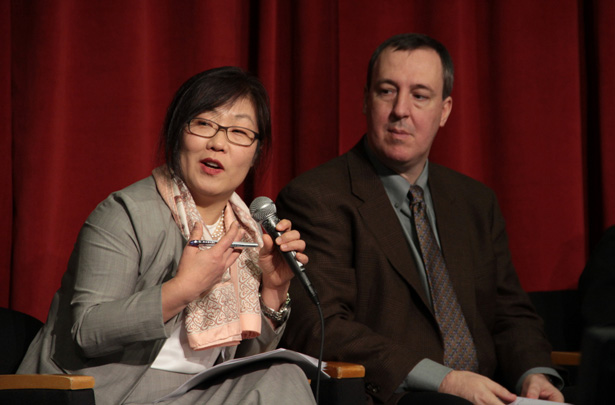
One of the best talks of last week’s NCSE Environment and Security Conference was thewater security plenary on Friday. Moderator Aaron Salzberg, who is the special coordinator for water resources at the Department of State, led with a provocative question: how many in attendance think there will be war over water in the future?
-
Ethan Goffman, SSPP Blog
Securing a Sustainable Future: The Military Takes On a New Mission
›January 25, 2012 // By Wilson Center StaffThe original version of this article, by Ethan Goffman, appeared on the Sustainability: Science, Practice, and Policy blog.
In a time of polarized politics in the United States, over the environment and just about everything else, an overlooked development is how much the military, as well as the national security apparatus, has taken on climate change and other environmental challenges. “Environment and Security” was thus a profoundly important choice of theme for the 2012 National Conference on Science, Policy, and the Environment, held last week in Washington, DC. With the early effects of climate change apparently already occurring, notably in an increase in natural disasters and in a new northwest passage through the Arctic, those responsible for our security can’t afford to sit around and engage in speculation that climate change is caused by sunspots or isn’t really occurring. It is the military’s job, after all, to take action against potential threats rather than getting immersed in domestic politics.
The concern with climate change is the next step in a widening of the concept of security from strict military matters, to include such interrelated strands as food and water access, public health, and the environment. Much of the military has already acknowledged that armed force alone won’t make us safe. “Energy security, economic security, environmental security, and national security are all inextricably linked. Address one and you need to think of the others,” explained Vice-Admiral Dennis McGinn at the conference.
One obvious linkage is the connection of our oil dependency with security risks that can easily draw us into conflict in politically unstable parts of the world. Just how much the recent wars in the Middle East are about oil, and how much about a clash of civilizations, is a matter of considerable debate, although undoubtedly both factors play a part. The Iranian threat to close the Strait of Hormuz, choking outgoing oil deliveries, underscores vulnerability on the energy issue. From another angle, in Afghanistan, the military experienced the fragility of supply lines for a force strongly dependent on large quantities of oil. The Air Force, in particular, is working on algal jet fuel to free us from such reliance. And the Navy’s need for more icebreakers and other capacity shows concern regarding shipping and resource exploitation enabled by the melting of Arctic ice and the new passage.
Continue reading on the SSPP blog.
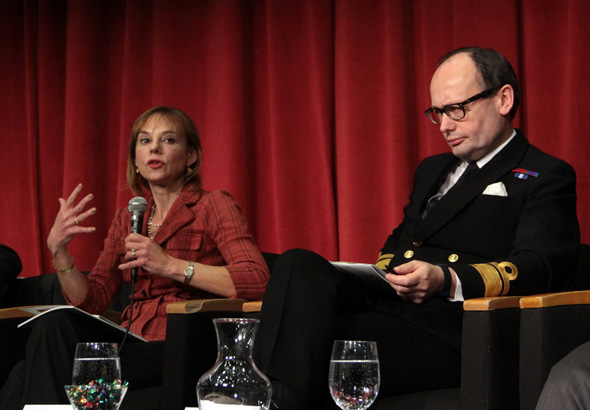
Photo Credit: Sherri Goodman and Rear Admiral Neil Morisetti, courtesy of Sean Peoples/Wilson Center.
Showing posts from category U.S..