-
The Missing Links in the Demographic Dividend
›March 9, 2012 // By Elizabeth Leahy Madsen
The “demographic dividend,” a concept that marries population dynamics and development economics, is on the rise in policy circles – Rajiv Shah, Melinda Gates, and African government ministers have all discussed it recently in high-level forums. Most notably for demographers, World Bank Chief Economist Justin Yifu Lin wrote a blog post that focuses on the demographic dividend’s potential to give developing countries a powerful economic boost through declining dependency ratios and a proportionately large working-age population.
-
Ten Billion: UN Updates Population Projections, Assumptions on Peak Growth Shattered
›May 12, 2011 // By Schuyler Null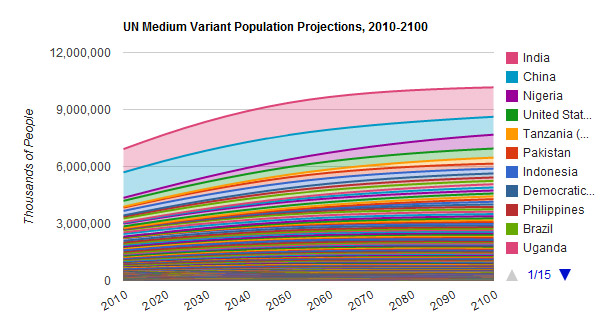
The numbers are up: The latest projections from the UN Population Division estimate that world population will reach 9.3 billion by 2050 – a slight bump up from the previous estimate of 9.1 billion. The most interesting change however is that the UN has extended its projection timeline to 2100, and the picture at the end of the century is of a very different world. As opposed to previous estimates, the world’s population is not expected to stabilize in the 2050s, instead rising past 10.1 billion by the end of the century, using the UN’s medium variant model.
-
Food and Environmental Insecurity a Factor in North Korean Shelling?
›November 24, 2010 // By Schuyler NullJust two days before dozens of North Korean artillery shells fell on the island of Yeonpyeong off the west coast of Korea, a UN study reported that the DPRK was facing acute food shortages heading into the winter.
In a New York Times report, Choi Jin-wook, of the Korea Institute for National Unification in Seoul, called food “the number one issue.” While Choi just last month praised the resumption of food aid from the South to the North as a “starting point of a new chapter in inter-Korean relations,” she told the Times Wednesday that the North is “in a desperate situation, and they want food immediately, not next year.”
North Korea’s motives are notoriously indecipherable and this latest incident is no exception, but the regime has in the past sought to distract from domestic problems by inciting the international community (the sinking of the Cheonan being the other latest prominent example).
Infrastructure has always been primitive in the North under the DPRK regime, but the country’s tenuous food security situation was made worse this last year by an unusually long and severe winter followed by heavy flooding in the summer. Flooding was so bad during August and September, that the normally silent regime publically announced details of rescue operations around the northern city of Sinuiju. The joint FAO/WFP report put out by the UN does not predicate production will significantly recover in the next year and estimates an uncovered food deficit of 542,000 tons for 2010/11.
“A small shock in the future could trigger a severe negative impact and will be difficult to contain if these chronic deficits are not effectively managed,” Joyce Luma of the World Food Program told The New York Times.
For more on the severe weather events of this summer, including the flooding that impacted the DPRK and pushed the Three Gorge Dam to its stress limits in China, the impact of scarcity and climate change on the potential for conflict, and the intersection of food security and conflict elsewhere, see our previous coverage on The New Security Beat.
Sources: Christian Science Monitor, Food and Agriculture Organization, Los Angeles Times, The New York Times, UN, Washington Post, World Food Program.
Image Credit: Google Maps.
Showing posts from category Korea.