Showing posts from category Jordan.
-
Sanitation and Water MDGs in the Middle East and North Africa: Missing the Target?
›Goal 7, Target 10 of the United Nations Millennium Development Goals (MDGs) is to “halve, by 2015, the proportion of people without sustainable access to safe drinking water and basic sanitation.” The Joint Monitoring Programme (JMP), established by the UN to monitor progress towards this goal, has twice concluded (in 2008 and 2010) that the Middle East and North Africa (MENA) are in good shape to meet this target. However, a new article in Development and Change, “The Politics of Assessment: Water and Sanitation MDGs in the Middle East,” by Neda Zawahri, Jeannie Sowers, and Erika Weinthal, argues that the JMP’s “reliance on classifying ‘improved’ and ‘unimproved’ water and sanitation infrastructure, through infrequent household surveys, has produced misleading assessments that fail to capture the extensive water quality and sanitation problems plaguing the MENA.”
The authors compared the findings of the JMP with a variety of data sources – participatory assessments, reports from other UN agencies, donor projects, domestic ministries and agencies, and academic research – and found major contradictions between the progress reported by the JMP and the situation on the ground. In one example, the authors write that “while the JMP considers piped household water as an improvement in water coverage, it fails to differentiate between ‘full’ coverage and ‘partial’ coverage, that is, household water supplies available only a few hours a week.” And the authors point out that according to UN-Habitat, “the availability of piped water does not necessarily translate into safe drinking water, as water may become contaminated before it reaches the tap.”
As a result of the weakness of the indicators used by the JMP, household surveys conducted by the JMP in the MENA region “[do] not adequately capture the quality of drinking water,” the authors write, and efforts to address this inadequacy through more comprehensive testing of municipal water samples were deemed “too complex to be routinely employed through the world” and “prohibitively expensive.”
“International organizations and national leaderships in the MENA lack substantial incentives to adopt more accurate assessments for safe water and sanitation,” Zawahri et al. conclude. The need to generate comparable data across time and space has trumped the importance of “gauging access, quality, and affordability of water and sanitation.” -
Watch: Gidon Bromberg Gives an Update on Jordan River Rehabilitation Efforts
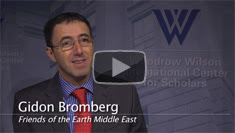
›October 27, 2011 // By Kate DiamondGidon Bromberg, co-director of Friends of the Earth Middle East (FOEME), says in this short interview with ECSP that his outlook on rehabilitating the Jordan River has changed completely over the last five years. We had been “laughed at” for trying to restore the waterway, he said; now though, “we are very confident that the Jordan River south of the Galilee down to the Dead Sea will be rehabilitated.”
By building a cross-border peace park and encouraging collaboration between Israelis, Palestinians, and Jordanians on water scarcity and quality issues, FOEME aims to improve environmental and security problems that bind the three groups together.
The Jordan River has become so polluted that visitors, many of whom are devout Christians making a pilgrimage to one of the religion’s most sacred sites, have been barred from its waters due to health concerns. Furthermore, more than 98 percent of its fresh water is diverted for agricultural work, meaning that the pollutants that end up in the river are highly concentrated.
But today, Bromberg said, sewerage is being removed on both the Israeli and Jordanian sides and there is a commitment to do the same from the Palestinians. For the first time in 60 years, there are concrete plans to return fresh water to a river that is “so holy to half of humanity.”
Sources: The Age, Friends of the Earth Middle East, The Guardian, U.S. Environmental Protection Agency -
Mapping the Hot Spots of the 2010/11 Food Crisis
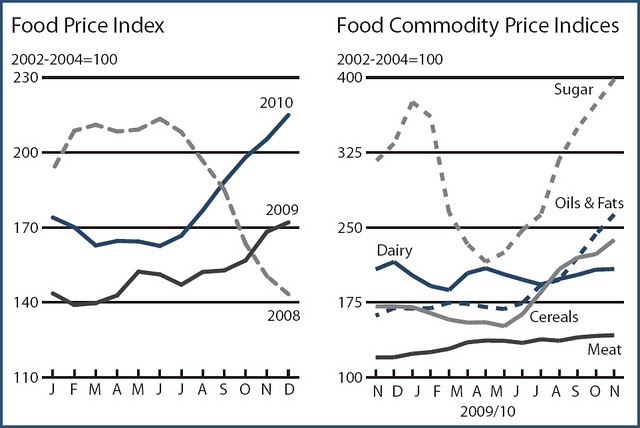
›If you’ve taken a trip to the supermarket lately or scanned the headlines you may have noticed something: Food prices are on the rise. Worldwide, food prices are on track to reach their highest point since their peak in 2008. Using data from the Food and Agriculture Organization (FAO), the International Food Policy Research Institute (IFPRI), and the World Bank, the Environmental Working Group (EWG) and ActionAid have collaborated to create an interactive world map called, “Hot Spots in the Emerging Global Food Crisis.”
The focus of the map is to highlight the 52 most at-risk countries where increases in staple food prices could tip the scales of stability. There are three variants of the map to choose from: countries at risk which depend on imported cereals, countries where prices are already increasing (featured above), and countries with vulnerable economies and high rates of hunger.Food prices have become a hot topic of conversation lately for their alleged role in the instability that is rocking the Middle East/North Africa region. But the Middle East is not the only area affected: Besides in Algeria, Tunisia, Morocco, Jordan, and Egypt, food-related riots and protests have also broken out in Mozambique, Bolivia, and India. As the map’s accompanying text puts it, these food riots “feed deeper discontent about economic inequalities and hunger and help give rise to revolutions that can topple governments, as in Tunisia and Egypt.”
Scrolling over a country reveals more information, like, for example, the specific percentage increases in the price of wheat or rice over the past year (wheat prices have risen 15.9 percent in China vs. 54 percent in Kyrgyzstan) or the amounts of corn, soybean, and wheat annually imported and exported (Afghanistan exported 908 million metric tons of wheat in 2010 while Egypt imported 4,978).
Users can also click on vulnerable countries to see how many people are malnourished and their per capita income per day. In the Democratic Republic of the Congo, for example, an estimated 42 million people were undernourished between 2005 and 2007, and the average person lives on $0.28 per day. According to EWG and ActionAid, the total number of people living in extreme poverty rose by 25 million in 2008 during the last global food crisis. Since June 2010, the start of the current upward trend in prices, the World Bank estimates that 44 million people have fallen into extreme poverty.
One recommendation from EWG and ActionAid for developed countries and the United States in particular: Stop looking to biofuels as an energy option. In their view, “spending scarce taxpayer dollars to shift crops from food to biofuels at the expense of hungry people and already stressed resources like soil, water, and air is unsustainable.”
Image Credit: Map courtesy of the Environmental Working Group and ActionAid, and Food Price Index and Food Commodity Indices, extracted from Global Food Price Monitor, January 2011, courtesy of the Food and Agriculture Organization.
Sources: ActionAid International, BBC News, CNN, the Environmental Working Group, The European Union Times, Time, Voice of America, World Bank. -
The Middle East’s Demographic Destiny
›February 25, 2011 // By Jennifer Dabbs SciubbaThe original version of this article, by Jennifer Dabbs Sciubba, appeared on her blog. Sciubba will be speaking at the Wilson Center on March 14 about her newest book The Future Faces of War: Population and National Security.
The so-called “arc of revolution” sweeping across the Middle East and North Africa has some demographers feeling smug. In Egypt, Tunisia, Algeria, Jordan, and Lebanon the population ages 15-29 – a key group for demographers – is very large, about 41-50 percent of all adults ages 15-59. No matter where you’re born, this life period is significant because during this time young adults expect to finish their education, get a job, get married, maybe start a family, and have some say in the way they are governed. As many have noted, the problem in each of these countries is that the desires of young adults are being dashed as they are shut out of economic, political, and even social opportunities. The result is all over the headlines.
Aside from structural failures like corruption and inattention of politicians to creating jobs, why are young people so disadvantaged? The answer lies in demography. Opportunities for young adults are limited in these countries because of what demographers refer to as “cohort crowding,” a situation that results when an age group, in Tunisia’s case those aged 25-29, is significantly larger than the preceding age group. Generally, jobs cannot be created fast enough to keep pace with this demographic bump, so those in the large cohorts are “crowded” out of the labor market. This situation turns into protest and violence when youth from large cohorts fall short of the living standards of preceding generations, which are smaller. In a 2009 Pew Global Attitudes survey, 50 percent of respondents ages 18-29 in Egypt said they thought children born today would be worse off than their parents. In Jordan and Lebanon, 38 and 40 percent, respectively, of respondents had a similarly depressed attitude.
Continue reading on The Future Faces of War: Population and National Security blog.
Sources: Pew Research Center, U.S. Census Bureau.
Photo Credit: “DS-RY028 World Bank,” courtesy of flickr user World Bank Photo Collection (Dana Smillie). -
Water as a Strategic Resource in the Middle East
‘Clear Gold’ Report From CSIS
›“The real wild-card for political and social unrest in the Middle East over the next 20 years is not war, terrorism, or revolution – it is water,” begins the CSIS Middle East Program’s latest report, Clear Gold: Water as a Strategic Resource in the Middle East, by Jon B. Alterman and Michael Dziuban.
The authors contend that with growing populations, groundwater depletion, not the more traditional questions about transboundary river governance, poses a “more immediate and strategically consequential challenge,” particularly because many Middle Eastern governments have deflated the true cost of water to help spur growth and garner popularity.
In the accompanying video feature above, much-troubled Yemen is outlined as one of the most at-risk countries for water-induced instability. The narrator notes that “with Yemen’s population growing fast and almost half of agricultural water going towards the narcotic leaf qat instead of food, experts think that Sanaa [the capital] could run out of water in seven years or less and the rest of the country may not be far behind.”
In an interview with Reuters in 2008, Yemeni Water and Environment Minister Abdul-Rahman al-Iryani said the country’s burgeoning water crisis is “almost inevitable because of the geography and climate of Yemen, coupled with uncontrolled population growth and very low capacity for managing resources.”
Yemen is a particularly abject example because water availability is only one contributor in a long list of domestic problems, including a large youth population, gender inequity, immigration from the Horn of Africa, corruption, ethnic tensions, and terrorism.
The narrator concludes that “Yemen is the most worrisome example but clearly not the only one.” Alterman and Dziuban also point to Jordan and Saudi Arabia as states vulnerable to groundwater depletion.
For more on the Middle East’s current and future environmental security issues, be sure to check out The New Security Beat’s “Crossroads” series, with features on Iraq, Israel, Jordan, Lebanon, Syria, and Yemen.
Video Credit: “Clear Gold: Water as a Strategic Resource in the Middle East,” courtesy of CSIS. -
Paradise Beneath Her Feet: How Women Are Transforming the Middle East
›Isobel Coleman, senior fellow for U.S. foreign policy at the Council on Foreign Relations, said she believes demographic changes are intensifying the notion that women’s empowerment is key to the growth and prosperity of the economies of Arab and Muslim-majority countries.
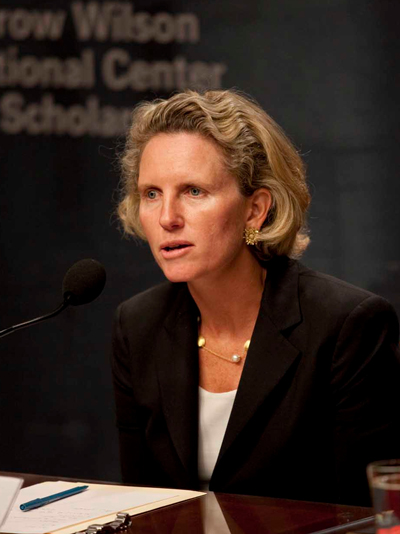
Coleman, author of the book Paradise Beneath Her Feet: How Women Are Transforming the Middle East, spoke at the Wilson Center in October, with Haleh Esfandiari moderating.
In addition to the Middle East’s demographics, Coleman also discussed how women in these traditional societies face challenges expanding their roles because women’s rights are often seen in a negative light. Coleman noted that things are changing, however, because women in the Muslim world are turning towards an Islamic discourse, which allows them to expand their rights within society’s religious framework. With this tactical shift and gradual gains in education, Coleman explained how women are slowly yet steadily transforming their societies.Coleman began her talk by focusing on the demographic changes in the region, noting that 50 percent of the Arab world’s population is under the age of 22. Furthermore, education was once the exclusive preserve of men in many Arab and Muslim states (in some cases, only decades ago). Today, however, women often constitute the majority of those enrolled in these countries’ educational institutions: Females outnumber males in Jordan’s secondary schools and constitute 70 percent of all university students in Iran. While the levels of educational attainment and achievement among women are increasing, normative and legal restrictions on their socioeconomic mobility remain. Coleman indicated that this contradictory scenario has led to greater opposition to impediments to women’s equality.
Coleman went on to address the tactics being used by the latest generation of reform-minded women in the Muslim world. She said today’s reformist women are more cognizant of the religious conservatism in their societies and are taking on religion in a way earlier feminists did not. By making feminist arguments from an Islamic perspective they avoid being “slandered” by conservatives and traditionalists as pro-Western or anti-Islamic. Coleman noted that some women adopt such a stance out of deep religious conviction, while others do it in the name of expediency. She indicated this new strategy of compromise has given more women influence in social affairs and led to significant engagement with governments.
With the advent of new social media and technology, women have become more visible and able to express their opinions about previously taboo gender-related issues. Female journalists and bloggers are more stridently supporting feminist discourses. Coleman mentioned Sweet Talk, the Arabic language equivalent of the American television show, The View, on which the female co-hosts have addressed topics such as polygamy, rape, incest, and the Saudi prohibition on women driving.
According to Coleman, these factors of change – demographic transitions, the role of media, and an awareness of growing extremism in society – are contributing to women making strides in the region and a “wearing away” of gender inequality in the Muslim world. Given the gains women have made so far, Coleman said she is “cautiously optimistic” for the future.
Luke Hagberg is an intern with the Middle East Program at the Wilson Center; Haleh Esfandiari is the director of the Middle East Program.
Photo Credit: Yemeni women in computer class, courtesy of flickr user World Bank Photo Collection, and David Hawxhurt/Wilson Center. -
Demography and Women’s Empowerment: Urgency for Action?
›Why do Middle Eastern women participate in economic life at a rate lower than that of female citizens of other regions? According to Nadereh Chamlou, a senior advisor at the World Bank, restrictive social norms are to blame. At the Middle East and Environmental Change and Security Programs’ “Demography and Women’s Empowerment: Urgency for Action?” event, Chamlou argued that the region’s women must be empowered to participate in a more significant way if their countries are to effectively exploit, instead of squander, the current economic “window of opportunity.”According to Chamlou, the region is facing a “demographic window of opportunity” where its relatively high numbers of working-age people create the potential for rapid economic growth. However, Middle Eastern countries also have the highest dependency rates in the world. Without opening more economic opportunities for women, the region’s demographic window of opportunity will not be exploited to its full advantage.
Chamlou disputed the commonly held assumptions regarding the historic lack of female participation in the Middle East’s economic sphere, such as the belief that women abstain from joining the workforce because they do not possess the necessary education and skills. She cited statistics showing that the region’s women are represented at a near-equal level as men in secondary school, and to an even greater degree at the university level. They are also studying in marketable fields, disproving the theory that they are not acquiring employable skills.
A survey conducted by the World Bank in three Middle Eastern capital cities — Amman, Jordan; Cairo, Egypt; and Sana’a, Yemen — showed that negative male attitudes regarding women working outside the home were the most significant reason for poor female representation in the workforce. Notably, negative male attitudes restricted women’s participation far more than child-rearing duties. Despite the successful efforts of most Middle Eastern states to improve female education, conservative social norms that pose a barrier to female empowerment remain in place.
Chamlou concluded her remarks with three policy recommendations: 1) Focus on medium-educated, middle-class women; 2) Undertake more efforts to bring married women into the workforce; and 3) Place a greater emphasis on changing attitudes, particularly among conservative younger men, towards women working outside the home. Such changes could more effectively utilize the Middle East’s demographic window of opportunity.
Luke Hagberg is an intern and Haleh Esfandiari is director of the Middle East Program at the Wilson Center.
Sources: Population Reference Bureau.
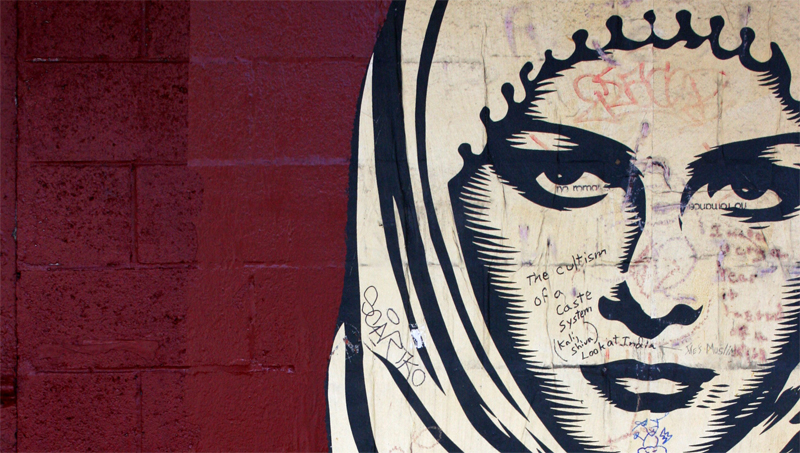
Photo Credit: Adapted from “Obey Stikman,” courtesy of flickr user sabeth718. -
Saleem Ali at TEDxUVM on Environmental Peacemaking
›“The use of the term ‘peace’ is in many circles still considered taboo, because immediately people think you are talking about something that is utopian,” said University of Vermont Professor Saleem Ali at a recent TEDx event on sustainability. “But I’m here to tell you that peace is pragmatic. Peace is possible.”
Ali points out the value of peace to every sector of society and, using an example from Ecuador and Peru, argues for the utility of the environment as a peacemaker. Other longstanding conflict areas like Cyprus, Iraq, Israel, and Korea are also ripe for environmental peacebuilding efforts, he says.
Professor Ali has written for The New Security Beat before on the strengths and weaknesses of viewing conservation and sustainability efforts through a strictly security lens. He points out that environmentalists must tread a fine line when assigning causality between the environment and conflict, but even when natural resources or climate are not central to a conflict, environmental peacebuilding can still play a role in creating shared ground (sometimes literally) between combatants.
“Treasures of the Earth,” Ali’s latest book, examines the thorny subject of how best to balance resource extraction in developing countries with long-term sustainability. Recent examples, such as Angola and Liberia’s blood diamonds, the DRC’s conflict minerals, and concerns over Afghanistan’s potential reserves have shown the difficulty in striking that balance.
“Ultimately, conflict trumps everything else” in terms of what we ought to be concerned with, Ali argues, and therefore, anyone, no matter their profession or capacity, should keep the pursuit of peace in mind – and all options on the table – when making decisions that affect others.