

-
PODCAST – Forests for the Future: Family Planning in Nepal’s Terai Arc Landscape
›April 3, 2009 // By Wilson Center Staff“The Terai Arc Landscape has a very high population growth rate; people are very much dependent on the natural resources,” says Sabita Thapa in this podcast from the Environmental Change and Security Program.“We are especially working through the population, health, and environment project to address the issues of forest conversion, forest encroachment, and fuel extraction,” explains Thapa
 .
. In this podcast, Thapa, now an environmental advisor with the United Nations Development Programme in the Solomon Islands, and Dhan Rai, senior project manager with World Wildlife Fund-Nepal, discuss WWF’s PHE program in Nepal’s Terai region.
To learn more about PHE in Nepal, read FOCUS Issue 18, “Forests for the Future: Family Planning in Nepal’s Terai Region.”
And for additional resources, please visit our PHE webpage.
Photo: Sabita Thapa. Courtesy of Meaghan Parker. -
Grassroots Efforts Help Achieve Population, Health, and Environment Goals in Nepal
›April 1, 2009 // By Will Rogers“If you want to bring about conservation of these big, iconic species that need lots of area to roam, you have to work with the people that are living there,” said Jon Miceler at a March 19, 2009, event, “Population, Health, and Environment in Nepal.” Miceler, managing director for the World Wildlife Fund’s (WWF) Eastern Himalayas program, and Rishi Bastakoti, director and co-founder of Resource Identification and Management Society Nepal (RIMS Nepal), discussed their ongoing work on population, health, and environment (PHE) programs in Nepal.
Protecting Tigers in the Terai
To protect endangered Bengal tigers in Nepal, WWF seeks to simultaneously protect the ecosystem and support sustainable livelihoods in the Terai Arc Landscape (TAL), a biodiverse region that spans the India-Nepal border. Environmental threats to the Terai include:- Conversion of forest into farmland;
- Overgrazing;
- Forest fires;
- Excessive extraction of timber and fuelwood;
- Poaching;
- Human-wildlife conflict; and
- Population growth.
“By protecting a tiger—which is what we call an ‘umbrella species’—you’re actually protecting a whole host of species below that, and a whole host of ecosystems that are connected with the tigers,” said Miceler.
Piloting PHE in Khata
In the Khata corridor, a region of the TAL, WWF worked with local leaders and community forest user groups to create a “permanent community-managed health clinic with basic clinical tools,” Miceler said. In addition, the program:- Distributed 172 arsenic filters to remove naturally occurring arsenic from the groundwater, as well as 44 hand pumps to provide clean drinking water;
- Improved access to family planning services and increased the contraceptive prevalence rate from 43 percent to 73 percent in two years; and
- Provided 136 biogas plants with attached toilets and 100 improved cookstoves, reducing the need for fuelwood, which in turn decreased deforestation and the number of acute respiratory infections.
WWF will be “taking results from the successes we’ve had in the Khata corridor and lessons learned from other PHE projects in other countries to scale them up in other areas of the Terai,” said Miceler.
PHE at the Grassroots Level
“The average fertility rate in Nepal is 3.1,” said Bastakoti of the Nepalese NGO RIMS Nepal. “But it is much higher among the ethnic communities living in the remote areas with low education.”
RIMS Nepal works with 82 community forest user groups in Dhading to improve livelihoods, health, and environmental conservation. Since 2006, the project has:- Increased the contraceptive prevalence rate from 44 percent to 63.1 percent; and
- Distributed biogas and other improved cookstoves, helping reduce the incidence of acute respiratory illness from 55.5 percent to 5 percent and saving 1,178 metric tons of firewood each year.
RIMS Nepal trained 375 people to be peer educators and community-based distributors of contraceptives. “Local volunteers are key for the success of PHE,” Bastakoti explained. “They become role models for behavioral change.”
In addition, with RIMS Nepal’s help, 24 community forest user groups incorporated PHE activities, including family planning, into their operational plans. The “integration of family planning and health brings added value to conservation, poverty reduction, and livelihood improvement,” said Bastakoti, calling community forest user groups “one of the greatest grassroots-level institutions”—and key to advocating for the PHE approach at the national level.Photo: Rishi Bastakoti. Courtesy of the Woodrow Wilson Center.
-
In Land Grab, Food Is Not the Only Consideration
›March 3, 2009 // By Will RogersGlobal cereal production – including stable items like wheat, coarse grains, and rice – is projected to shrink in 2009 due to drought and adverse weather in the world’s major producers. With shrinking food stocks, a growing demand for biofuels, and a need for cheaper sources of raw materials like rubber and other natural resources, governments and corporations in many developed countries are seeking to secure access to these coveted commodities by leasing large tracts of land in developing countries.
In Indonesia, PT Daewoo Logistics Indonesia, a subsidiary of South Korea’s Daewoo Logistics Corporation, and Cheil Jedang Samsung recently announced a partnership to invest US $50 million to grow and process energy crops on the islands of Buru and Samba. The two companies will produce 30,000 tons of corn grain a year on 24,000 hectares and will export their entire production back to South Korea. The announcement comes on the heels of a report from the International Food Policy Research Institute, The Challenge of Hunger: The 2008 Global Hunger Index, that raises concerns about Indonesia’s already precarious food security.
Meanwhile, Saudi investors have been lobbying government officials in the Philippines to grow and export “basmati rice, corn, cassava, sugar, animal fodder, fisheries, red meat, Philippine bananas and mangoes,” reports Neil Morales in BusinessWorld. Philippine officials are hoping to leverage Saudi Arabia’s growing demand for food against the harsh economic climate to boost much-needed foreign direct investment. “Tell me an item that the whole world needs regardless of the economic situation, it is food,” said Peter Favila, the Philippine Trade Secretary, in an interview with BusinessWorld.
But securing food stocks is not the only motive behind the massive leasing of land in developing countries. A surging demand for biofuels to meet energy needs, as well as access to new sources of raw materials for manufacturing goods, appears to be driving recent land grabs. Recently, Sinopec and The Chinese National Overseas Oil Corporation, two state-owned oil giants, made investments of US $5 billion and $5.5 billion, respectively, in Indonesia to grow and process corn into biofuel to be exported to China.
Meanwhile, several Chinese companies have secured deals in Southeast Asia to grow rubber trees so that they can process and export the sap to meet China’s rising manufacturing demands (China is expected to consume 30 percent of the world’s rubber by 2020). In Cambodia, domestic rice fields have been cleared to make way for rubber trees, with nearly all the sap to be exported to China. And in Burma – which according to the UN’s Food and Agriculture Organization is plagued by severe localized food insecurity – concessions have been made to lease land to two Chinese companies to establish rubber plantations. According to Agweek, Burmese “troops are forcibly evicting farmers to make way for rubber plantations.”
Governments in these developing countries should exercise caution when granting land concessions to foreign governments and corporations. Despite the short-term investments, most – if not all – of the production will be exported, making the long-term food security situation even worse in these host countries. And according to a recent report from the U.N. Environment Programme, From Conflict to Peacebuilding: The Role Natural Resources and the Environment, environmental conditions – like severe food insecurity – linked with these poor government policies and claims of “neo-colonialism” could exacerbate existing trends and tensions in the host countries and spark violent conflict.
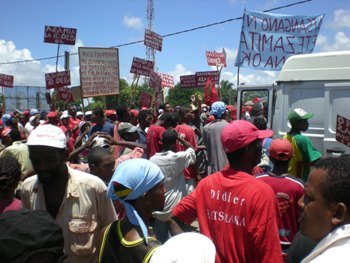
A recent attempt by South Korea’s Daewoo Logistics Corporation to negotiate a 99-year lease on 3.2 million hectares of farmland in Madagascar has stalled due to severe domestic outcry. Since mid-January, the country has been in a state of emergency; riots have erupted throughout the capital city of Antananarivo, killing, by some estimates, close to 100 and injuring more than 200; and Madagascar’s President Marc Ravalomanana is struggling to maintain power amidst fierce criticism by opposition leaders like Antananarivo Mayor Andry Rajoelina for even considering the deal.
Even with the prospect of political unrest, however, current economic woes will likely dictate policymaking in these developing countries, with short-term payoffs eclipsing the long-term political, social, economic and security consequences.
Photo: In the northeastern coastal city of Tamatave, political unrest has stirred since mid-January over negotiations between the Malagasy government and South Korea’s Daewoo Logistics Corporation to lease nearly half the country’s arable farmland to the company to grow and export food to South Korea. Courtesy of flickr user foko_madagascar.
-
Reading Radar — A Weekly Roundup
›February 27, 2009 // By Wilson Center StaffA new study published in Conservation Biology (abstract) calculates that more than 80 percent of major armed conflicts from 1950-2000 have taken place in one of the world’s 34 biodiversity hotspots. “The fact that so many conflicts have occurred in areas of high biodiversity loss and natural resource degradation warrants much further investigation as to the underlying causes, and strongly highlights the importance of these areas for global security,” says coauthor Russell A. Mittermeier. He and lead author Thor Hansen argue that protecting nature during war can help recovery, and call for integrating conservation “into military, reconstruction and humanitarian programs in the world’s conflict zones.”
The Bixby Forum, “World in 2050: A Scientific Investigation of the Impact of Global Population Changes on a Divided Planet” included panels on population’s links to war, climate change, and the environment. Malcolm Potts, the chair of the University of California, Berkeley’s Bixby Center for Population Health and Sustainability recently spoke at the Wilson Center about his latest book, Sex and War.
In Troubled Waters: Climate Change, Hydropolitics, and Transboundary Resources from the Henry L. Stimson Center, experts from South Asia, Southeast Asia, and the Middle East “examine the environmental dangers and policy dilemmas confronting the sustainable management of shared water resources in a warming world”—including the potential for conflict. In the concluding chapter, David Micheli finds that climate change is unlikely to lead to full-scale “water wars,” but warns that “rising climatic stresses on common waters will put new and perhaps unprecedented strains on cooperative governance institutions at the local, national, and international levels.”
Rampant logging fueled Cambodia’s decades-long civil war. Now a new report from transparency watchdogs Global Witness, Country for Sale, claims that the country’s emerging oil and mineral sectors may pose a similar threat. Says Gavin Hayman, “The same political elite that pillaged the country’s timber resources has now gained control of its mineral and petroleum wealth. Unless this is changed, there is a real risk that the opportunity to lift a whole generation out of poverty will be squandered.”
Thirty-three countries have been named “highly vulnerable” to the impact of climate change on their fisheries by a new study published in Fish and Fisheries. In these countries, two-thirds of which are in tropical Africa, fish accounts for 27 percent or more of daily protein intake, compared to 13 percent in non-vulnerable nations. InterPress examines the impact of acidification and rising surface temperatures on the fish stocks of coastal South Africa.
Photo: Fish-dependent people of Bangladesh could see their coastal catch reduced as a result of predicted increases in the frequency and intensity of tropical storms. Bangladesh is one of the nations identified as highly dependent on fisheries along with Cambodia, DR Congo, Madagascar, Sierra Leone, Tanzania, and Uganda. Photo credit: Mark Prein, courtesy of WorldFish Center. -
In Kashmir, No Refuge for Wildlife
›February 20, 2009 // By Will Rogers“Human-animal conflicts have assumed alarming proportions in the region,” Asghar Inayati, a regional wildlife warden in Kashmir, recently told Inter Press Service (IPS) News. Since India and Pakistan gained independence in 1949, both sides have fought for control of the territory. Not only has the decades-long conflict claimed 100,000 lives (by some estimates), it has also displaced animals from their natural habitats, sparking violent encounters with local people and threatening many species’ survival. -
Weekly Reading
›An article in Conservation Letters examining the effect of war on wildlife in Cambodia finds that “the legacy of conflict for wildlife can be profound and destructive. To address post-conflict challenges more effectively, conservation must be integrated within broader peacebuilding processes, including disarmament, demobilization, and reintegration of combatants.”
New York Times environmental reporter Andrew Revkin shares a recent nightmare on his blog, Dot Earth: If human beings achieve inexpensive, renewable energy, will this spur environmentally destructive population growth and consumption?
“Today, one-third of the world’s population has to contend with water scarcity, and there are ominous signs that this proportion could quickly increase,” writes the International Water Management Institute’s David Molden in the BBC’s Green Room. “Up to twice as much water will be required to provide enough food to eliminate hunger and feed the additional 2.5 billion people that will soon join our ranks. The demands will be particularly overwhelming as a wealthier, urbanised population demands a richer diet of more meat, fish, and milk.”
“Climate Wars” is a three-part podcast series by the Canadian Broadcasting Corporation.
Circle of Blue has launched the online radio series “5 in 15”; one episode features water expert Peter Gleick, head of the Pacific Institute, while another highlights Mark Turrell, CEO of technology company Imaginatik. -
Man vs. Wildlife: Now Playing in Southeast Asia
›January 22, 2009 // By Will Rogers“There are no winners when elephants and humans compete for the same resources,” writes Amirtharaj Christy Williams, a biologist with the World Wildlife Federation (WWF), in the BBC’s Green Room. As urban sprawl and deforestation across Southeast Asia shrink elephants’ natural habitat, they are increasingly forced to compete with humans for access to freshwater and vegetation. And when elephants and humans compete for natural resources, elephants are no match for the “destructive power of humans.”
According to Williams, elephants need roughly 200 square kilometers of forest to roam. When their habitats become fragmented by roads, canals, dams, and mines—as in Nepal, India, and Bangladesh—or are destroyed to create palm oil, coffee, tea, and other plantations—as in Indonesia—they cross roads and trample through fields with awesome destructive power, sometimes taking human lives in their search for food and water. Angered and frightened, the villagers, “lacking technical help and access to effective and humane mitigation methods, retaliate by throwing burning tyres, shooting at the beasts with sharpened nails, even by laying out foods laced with killer pesticides,” Williams writes.
But it would be too easy to blame people for their destructive reaction to the elephants. “Imagine the psychological impact of elephant raids on villagers living in fragile mud and bamboo huts,” and the subsequent loss of a loved one, and you can begin to understand the human side of this conflict, Williams observes.
To be sure, those in illegal settlements and plantations in protected parks are partly to blame for encroaching on elephant habitat with little regard for the consequences. According to an October 2007 WWF report, Gone in an Instant, Indonesia’s illegal Sumatran coffee plantations were responsible for a decline in the elephant population in the Bukit Barisan Selatan National Park (BBSNP) between 2000 and 2004. The report found that 45 “problem” elephants were killed in the BBSNP during that time as a result of human-elephant conflict. Most alarmingly, the report discovered that the conflict between illegal coffee farmers and wildlife was not limited to elephants, but that the Sumatran rhino and tiger—both listed as critically endangered by the International Union for the Conservation of Nature—were also victims of human displacement and poaching.
At the same time, “more wholesale damage is caused by sanctioned habitat clearing at the hands of short-sighted government officials who encourage large areas to be set aside for monoculture cash-crop plantations or infrastructural and development projects” than by the retaliatory acts of villagers and farmers, Williams argues. Environmental impact assessments written by corrupt officials and narrow-minded politicians with their own interests in mind often neglect elephants (and other species) altogether. The sad truth is that “elephants are virtually led to the slaughter by the very governments mandated to protect them.”
Yet solutions to human-wildlife conflict do exist. “Sharing the Forest: Protecting Gorillas and Helping Families in Uganda,” outlines how a holistic approach—encompassing environmental conservation, family planning, basic health care, and support for alternative livelihoods—can lessen human-wildlife conflict. It is possible to reduce the rate of human-wildlife conflict—while boosting endangered species’ populations and helping communities escape poverty—but it takes creativity, patience, and a comprehensive approach.
Photo: Elephants in the wild near Habarana, Sri Lanka. Across East and Southeast Asia, urban sprawl and deforestation threaten wild elephants by displacing them from their natural habitats, forcing them to compete with humans for access to vital natural resources. Courtesy of flickr user Jungle Boy. -
The 10 Most Popular Posts of 2008
›From climate change to coltan, poverty to population, and water to war: These are the 10 most popular New Security Beat stories of the year. Thanks for your clicks, and we’ll see you in 2009!
1. Desertification Threatening China’s Human, Economic Health
2. PODCAST – Climate Change and National Security: A Discussion with Joshua Busby, Part 1
3. In the Philippines, High Birth Rates, Pervasive Poverty Are Linked
4. Climate Change Threatens Middle East, Warns Report
5. Population, Health, Environment in Ethiopia: “Now I know my family is too big”
6. Guest Contributor Colin Kahl on Kenya’s Ethnic Land Strife
7. Coltan, Cell Phones, and Conflict: The War Economy of the DRC
8. “Bahala na”? Population Growth Brings Water Crisis to the Philippines
9. Population Reference Bureau Releases 2008 World Population Data Sheet
10. Guest Contributor Sharon Burke on Climate Change and Security
Showing posts from category Asia.
 .
.  “If you want to bring about conservation of these big, iconic species that need lots of area to roam, you have to work with the people that are living there,” said Jon Miceler at a March 19, 2009, event, “
 Global cereal production – including stable items like wheat, coarse grains, and rice – is
 “
“


