-
‘Frontlines’ Interviews John Sewell: “Promoting Development Is a Risky Business”
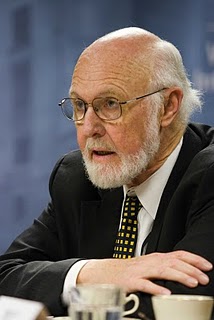
›May 31, 2010 // By Wilson Center Staff Q: Foreign assistance has had major achievements over the past 50 years. What are some examples?
SEWELL: There have been many but off the top of my head I can think of three. First, the Green Revolution where the combined efforts of American aid and private foundations revolutionized agriculture in Asia. As a result, many more people lived a much longer time. Second, the efforts put into improving education, particularly of women and girls. The third is population growth. When I started working on development, the best predictions said that global population would rise to over 20 billion at the end of the 20th century. Now we know it will not go much above 9 billion and perhaps lower. That wouldn’t have happened without American leadership and funding.
Q: What are the major failures of foreign assistance?
SEWELL: Failures have occurred either because countries were not committed to development, or because aid agencies designed ineffective programs. But most major failures came about because aid was provided for political reasons— for Cold War purposes in Southeast Asia or the Middle East, not for economic and social development. And we should remember that promoting development is a risky business. If there were no failures, development agencies were being too cautious.
But the more important failures are at the strategic level. Assistance really is only effective when governments and leaders want to speed economic growth, improve health and education, and address poverty. When the government isn’t committed to development, a lot of aid is wasted.
That’s why the choice of countries is so important. Korea is one example. Korean leaders knew how to use foreign aid effectively to build agriculture and industry. Part of that assistance funded investments in health and education. We all know the result.
Egypt, on the other hand, also has received large amounts of American assistance since 1979. But its growth rates are low and they still have one of the highest rates of adult illiteracy in the world.
Perhaps the largest failure has been in Africa. Except for a small number of countries, Africa lags far behind other regions. The blame lies not just with African leaders but also with aid donors who have continued to provide assistance in ways that hinder development.
Q: In what ways can global poverty be reduced quickly in the next three to four years?
SEWELL: In the short term, it won’t happen. The global financial crisis makes that a certainty.
The best estimates are that up to 90 million people will fall back into poverty because they will have lost jobs and livelihoods. The most important thing the U.S. can do in the near term is to continue to lead the reform of the international financial systems that are essential to restarting global economic growth, particularly in the developing world.
Q: That’s the way to reduce poverty?
SEWELL: In the short term, yes. But the U.S. can target aid to build poor peoples’ capacities and can make a great difference. That means aid for education, especially women, and to enable poor people to improve their health. And jobs are critical.
I think the right goal is to empower people to move into the middle class.
That means helping to provide technical assistance and in making low-cost credits for both farmers and small scale entrepreneurs. They will be the generators of jobs that enable men and women to move out of poverty.
Q: Why do you say in one of your papers that economic growth alone will not eliminate poverty?
SEWELL: Because it’s true. Growth does not automatically diminish poverty; it has to be complemented by government actions to share the gains from growth by investing in better health and education. For this you also need a competent state. That’s how the East Asian countries managed to develop so successfully. On the other hand, many Latin American countries have grown at decent rates but have lousy income distribution. But now countries like Brazil are starting to change. For instance, the Brazilian government now pays mothers to keep their children in school where they can get education and health care.
Q: USAID has restrictions that inhibit advertising. How can the public and Congress be informed about the successes and importance of development assistance?
SEWELL: USAID has been very timid about educating the public and Congress. I am not even sure that the earlier successful programs of development education exist anymore. Some steps are easy.
USAID staff knows a lot about development. Why not send them out to talk to public groups around the country? USAID staff doesn’t even participate actively in the yeasty dialogue on development that goes on in the Washington policy community and they should be encouraged to do so. Other changes may require funding and perhaps legislation and the administration should work with the Congress to get them.
Informing the public is particularly important now when there are two major processes underway to modernize U.S. development programs and Congress is rewriting the development assistance legislation.
Q: Since China and Vietnam have both developed without democracy, how important is it to push for democracy and good governance? Are they really necessary?
SEWELL: We need to separate democracy and governance. Very few of the successful developing countries have started out as democracies; India is the big exception. On the other hand, all of the successful countries have had effective governments to do what governments should do: provide security and public goods like health and education, establish the rule of law, and encourage entrepreneurship.
We need to face the fact that no outsider, including the U.S., can “democratize” a country. But it can play an important role in helping to improve governance in committed poor countries. And one of the important parts of successful development is what a Harvard economist calls “conflict mediating institutions” that allow people to deal with the inevitable conflicts that arise within successful development.
Q: You have said that we need to make markets work. How can we help poor people begin to trade when Europe, Japan, and the United States either block imports or subsidize exports?
SEWELL: If you are serious about development, you have to give high priority to trade policy. Unfortunately, USAID seems to have very little voice in trade decisions.
The U.S. needs to focus its development trade policy on the poorest countries. The highest priority should be dropping the remaining subsidies for U.S. production of highly subsidized agricultural products like cotton that can be produced very competitively in very poor countries.
But many of these countries have difficulty selling goods in the U.S., not only because of subsidies, but also because they are not equipped to export. Transport costs are high as are the costs of meeting U.S. health and quality standards, and knowledge of marketing in America is scarce.
Here’s where USAID can play an important complementary role. U.S. companies are already providing technical assistance, some with USAID support. But USAID can expand its trade capacity building programs and focus them on the poorer countries.
Q: What about microcredit?
SEWELL: Microcredit is a very important innovation, especially for empowering poor people, particularly poor women. It’s part of the solution to ending poverty.
But there are other needs. In most poor countries, there are large groups of poor entrepreneurs who are not poor enough to get microcredit but who can’t get commercial banks to lend to them. These are people who produce products for sale— handbags, for instance—that employ 10 to 20 people, but they need capital and advice in order to grow. In the U.S., small businessmen used to borrow money from local banks.That’s how America grew. But similar institutions don’t exist in many poor countries.
Q: We are involved in so many different programs—20 or 30 different federal agencies do some sort of foreign assistance— why not just invest in education and health and let each country figure out what their own development plan should be?
SEWELL: A very good idea. I have long advocated that the U.S. should focus its programs on a few major development issues but I would go beyond just health and education. I add climate change and dealing with global health threats. We dodged the bullet on SARS [severe acute respiratory syndrome] and avian flu but we may not be so lucky in the future. And strengthening governance and strengthening weak states is essential.
The real need now is for some mechanism that oversees and coordinates the multiplicity of agencies that have programs and expertise on these critical issues. Let’s hope that emerges from the current administration’s reviews of development policy
John Sewell a senior scholar at the Woodrow Wilson International Center for Scholars, was interviewed by FrontLines Editorial Director Ben Barber. Originally published in USAID FrontLines, April 2010.Can Food Security Stop Terrorism?
›May 28, 2010 // By Schuyler Null
USAID’s “Feed the Future” initiative is being touted for its potential to help stabilize failing states and dampen simmering civil conflicts. Speaking at a packed symposium on food security hosted by the Chicago Council last week, USAID Administrator Rajiv Shah called food security “the foundation for peace and opportunity – and therefore a foundation for our own national security.”
USAID’s Shah Focuses on Women, Innovation, Integration
›May 20, 2010 // By Wilson Center StaffWomen in developing countries are “core to success and failure” of USAID’s plan to fight hunger and poverty, and “we will be focusing on women in everything we do,” said USAID Administrator Rajiv Shah at today’s launch of the “Feed the Future” guide.
But to solve the “tough problem” of how to best serve women farmers, USAID needs to “take risks and be more entrepreneurial,” said Shah, as it implements the Global Hunger and Food Security Initiative.
“A lot of this is going to fail and that’s OK,” Shah said, calling for a “culture of experimentation” at the agency. He welcomed input from the private sector, which was represented at the launch by Des Moines-based Pioneer Hi-Bred.
In one “huge change in our assistance model,” Feed the Future will be “country-led and country-owned,” said Shah, who asked NGOs and USAID implementing partners to “align that expertise behind country priorities” and redirect money away from Washington towards “building real local capacity.” USAID will “work in partnership, not patronage,” with its 20 target countries, he said.
To insure that the administration’s agricultural development efforts are aligned to the same goals, Shah said USAID will collect baseline data from the start on three metrics: women’s incomes, child malnutrition, and agricultural production.
“Whether it is finance, land tenure, public extension, or training efforts, it does not matter whether it is an ‘agricultural development’ category of program,” said Shah. All programs will “provide targeted services to women farmers.”
While Shah briefly mentioned integrating these efforts with the administration’s Global Health Initiative, he only gave one example. Nutrition programs would be tied to health “platforms that already exist at scale” in country, such as HIV, malaria, vaccination, and breastfeeding promotion programs, he said.
Targeting Food Security: The Wilson Center’s Africa Program Takes Aim
If “food supplies in Africa cannot be assured, then Africa’s future remains dismal, no matter how efforts of conflict resolution pan out or how sustained international humanitarian assistance becomes,” says Steve McDonald, director of the Wilson Center’s Africa Program, in the current issue of the Wilson Center’s newsletter, Centerpoint. “It sounds sophomoric, but food is essential to population health and happiness—its very survival—but also to productivity and creativity.”
The May 2010 edition of Centerpoint highlights regional integration, a key focus of U.S. policy, as a mechanism for assuring greater continuity and availability of food supplies. Drawing on proceedings from the Africa Program’s “Promoting Regional Integration and Food Security in Africa” event held in March, Centerpoint accentuates key conclusions on building infrastructure and facilitating trade.
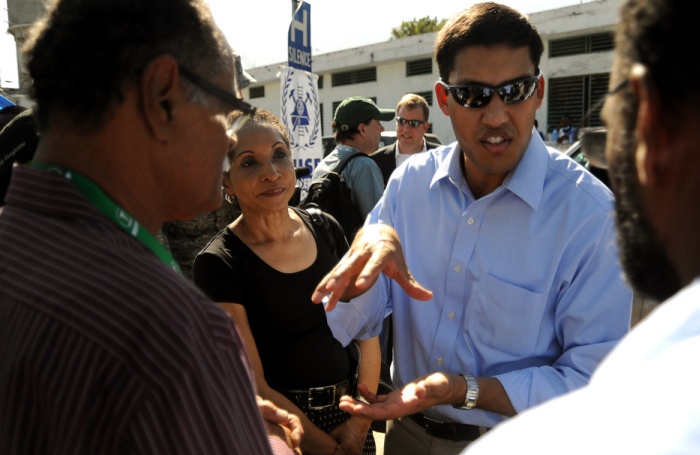
Photo Credit: “USAID Administrator Shah visits a hospital in Haiti” courtesy Flickr user USAID_Images.Coffee and Contraception: Combining Agribusiness and Community Health Projects in Rwanda
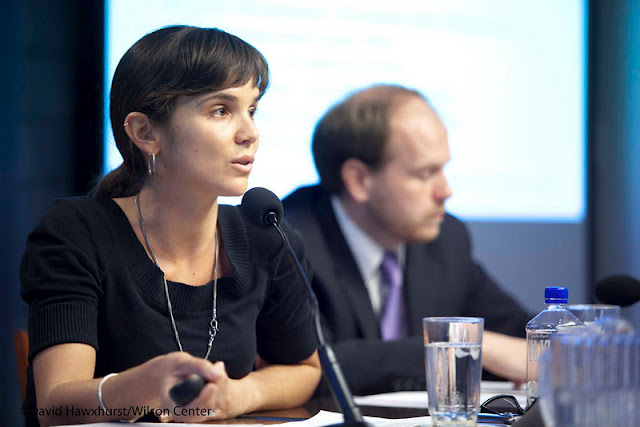
›“Population pressures and diminishing land holdings – due to high fertility rates, war and genocide, and subsequent migration – have caused a rapid decrease in the forested and protected areas and increased soil infertility and food insecurity” in Rwanda, USAID’s Irene Kitzantides told a Wilson Center audience.
Kitzantides, a population, health, and environment advisor and global health fellow, said “the population is projected to reach over 14 million by 2025” – nearly one-third more than today, due to the country’s high fertility rate of nearly 5.5 children per women–which could continue to negatively impact forests and food supplies.
In response to these challenges, USAID supported the Sustaining Partnerships to Enhance Rural Enterprise and Agribusiness Development (SPREAD) Project. SPREAD uses an integrated population-health-environment (PHE) approach to develop the coffee agribusiness and bring family planning, HIV/AIDS, and reproductive health services to coffee workers.
Combining income generation with health services was thought an effective way to “fulfill the overall SPREAD goal of improving lives and livelihoods,” said Kitzantides.
A SPREADing Mandate: Integrating Health and Agribusiness
SPREAD follows USAID’s PEARL I and II Projects, which focused exclusively on agricultural development. Coffee is still at the center of SPREAD’s activities, with $5 million of the project’s $6 million USAID budget earmarked for agricultural development.
However, a broader mandate to include health services emerged after recognition that greater income alone does not ensure greater quality of life. The additional health funding leverages SPREAD’s already established relationships with farming cooperatives to bring health services to traditionally underserved rural communities.
“We really tried to build on the existing assets of the cooperative,” said Kitzantides. “We also really tried to complement local and national public health policy and partners.”
The integration of health with agricultural goals, and the use of already established in-country health programs, has made SPREAD extremely cost-effective, with HIV/AIDS prevention education costing less than $2 per person.
Examples of SPREAD’s integrated work include:Combined health and agricultural lessons: Kitzantides and her colleagues trained nearly 400 animateurs de café, cooperative employees running the agricultural education programs, to incorporate public health objectives into their activities. Combining health and agricultural education into one session takes advantage of workers already trained during previous USAID programs. The combination also attracts more male participants, who traditionally shunned HIV/AIDS, family planning, and reproductive health campaigns and services.
Radio programming: SPREAD worked with the agricultural radio program Imbere Heza (“Bright Future”) to incorporate health messaging at the end of each program.
- Mobile clinics: SPREAD works with cooperatives and local health centers to bring convenient services to farmers when they gather at sales or processing stations during harvests.
Community theater: SPREAD hires local theater groups to perform skits on health. The farming communities “really love community theater and always ask for it,” said Kitzantides.
In its relatively short existence, SPREAD’s health activities have reached over 120,000 people with HIV/AIDS prevention messages; nearly 90,000 with messages discussing family planning/reproductive health; and almost 40,000 about maternal and child health. The project counts 347 women as new users of family planning services.
Lessons learned – which will be examined in more detail in an upcoming issue of Focus – include the importance of using community-based approaches to overcome perceived social barriers; the advantages of integrating cross-cutting activities at the outset of a program; and the need for strong monitoring and evaluation systems to measure the effort’s outcomes.Jason Bremner of the Population Research Bureau said PHE projects such as SPREAD go “beyond what the health sector itself can do and find new ways of reaching underserved remote populations.” He presented a soon-to-be-released PRB map plotting the location of more than 40 PHE projects in Africa.
The success of SPREAD and similar projects demonstrates the potential for PHE approaches to bring reproductive health and family planning services to rural areas, Bremner noted, but there is still much work to be done to scale up this integrated approach – and to document its successes.
Sustaining SPREAD
Kitzantides said it took several years to integrate health activities with the already established agricultural programs. Since USAID funding for the program is scheduled to end in 2011, she is uncertain that the time remaining will be enough for SPREAD’s health partners to develop the logistical and financial capacities to become self-sustaining. But SPREAD has changed attitudes and beliefs, two key objectives that do not require sustained funding.
“We used to talk about growing coffee, making money, buying material things like bikes – not about problems like malaria, HIV/AIDS, etc.,” said one SPREAD agricultural business manager during the program’s evaluation. “Someone could have 5 million Rwandan francs in the house but could suffer from malaria where medicine costs 500 Rwandan francs, due to ignorance. You have to teach people about production, you have to also think of their health to improve their lives.”
Photo Credits: Irene Kitzantides, courtesy David Hawxhurst; condom demonstration, courtesy Nick Fraser; community theater group, courtesy SPREAD Health Program; Jason Bremner, courtesy David Hawxhurst.As Somalia Sinks, Neighbors Face a Fight to Stay Afloat
›May 14, 2010 // By Schuyler NullThe week before the international Istanbul conference on aid to Somalia, the UN’s embattled envoy to the country, Ahmedou Ould-Abdallah, warned the Security Council that if the global community “did not take the right action in Somalia now, the situation will, sooner or later, force us to act and at a much higher price.”
The UN High Commission for Refugees (UNHCR) also issued strong warnings this week. Deputy High Commissioner Alexander Aleinikoff said in Geneva, “The displacement crisis is worsening with the deterioration of the situation inside Somalia and we need to prepare fast for new and possibly large-scale displacement.”
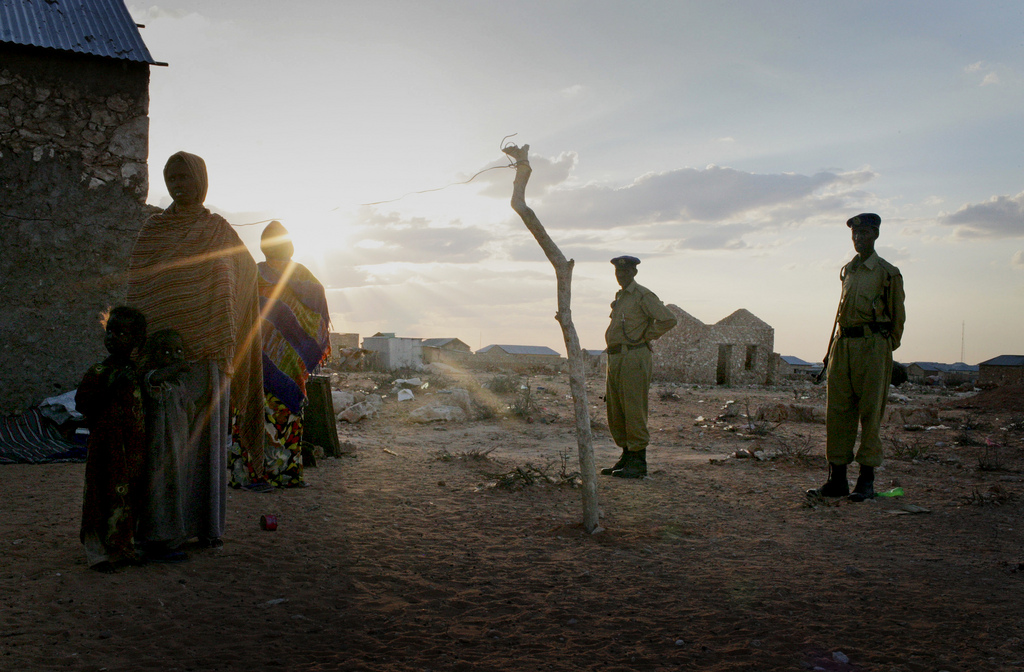
But the danger is not limited to Somalia. The war-torn country’s cascading set of problems – criminal, health, humanitarian, food, and environmental – threaten to spill over into neighboring countries.
A Horrendous Humanitarian Crisis
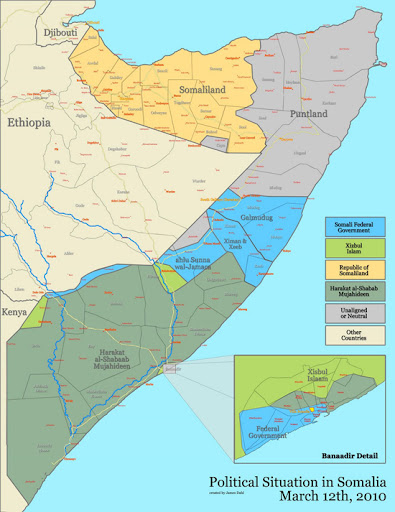
The UN- and U.S.-backed Transitional Federal Government (TFG) controls only parts of Mogadishu and small portions of central Somalia, while insurgent group Al Shabab controls nearly the entire south. The northern area is divided into semi-autonomous Somaliland and Puntland, which also fall outside of the transitional government’s control.
But the civil war is only one part of what Ould-Abdallah called a “horrendous” humanitarian crisis.
According to the UN, 3.2 million Somalis rely on foreign assistance for food – 43 percent of the population – and 1.4 million have been internally displaced by war. Another UN-backed study finds that approximately 50 percent of women and 60 percent of children under five are anemic. Most distressing, the UN Security Council reported in March that up to half of all food aid sent to Somalia is diverted from people in need by militants and corrupt officials, including UN and government employees.
Because of the country’s large youth bulge – 45 percent of Somalia’s population is under the age of 15 – food and health conditions are expected to get much worse before they get better. In the 2009 Failed States Index, Somalia ranks as the least stable state in the world and, along with Zimbabwe, has the highest demographic pressures.
Islamic Militants and the Battle for the High Seas
Yet the West continues to focus on the sensational pirate attacks on Somalia’s coast. The root cause of these attacks is not simply lawlessness say Somali officials, instead, they began partly as desperate attempts to stop foreign commercial fleets from depleting Somalia’s tuna-rich, lawless shores. A 2006 High Seas Task Force reported that at any given time, “some 700 foreign-owned vessels are engaged in unlicensed and unregulated fishing in Somali waters, exploiting high value species such as tuna, shark, lobster and deep-water shrimp.”
The transitional government opposes the fishermen-turned-pirates, but can do little to stop them. Al Shabab has thus far allowed pirates to operate freely in their territory. Their tacit approval may be tied to reports that the group has received portions of ransoms in the past.
Another hardline Islamist group, Hizbul Islam, recently took over the pirate safe haven of Haradhere, allegedly in response to local pleas for better security, but the move may simply have been part of an ongoing struggle with Al Shabab for control of pirate ransoms and port taxes – one of the few sectors of the economy that has remained lucrative.
“I can say to you, they are not different from pirates — they also want money,” Yusuf Mohamed Siad, defense minister with Somalia’s TFG, told Time Magazine.
A Toxic ThreatInitially the pirates claimed one of their goals was to ward off “mysterious European ships” that were allegedly dumping barrels of toxic waste offshore. UN envoy Ould-Abdallah told Johann Hari of The Independent in 2009 that “somebody is dumping nuclear material here. There is also lead, and heavy metals such as cadmium and mercury – you name it.” After the 2005 tsunami, “hundreds of the dumped and leaking barrels washed up on shore. People began to suffer from radiation sickness, and more than 300 died,” Hari reports.
Finnish Minister of Parliament Pekka Haavisto, speaking to ECSP last year, urged UN investigation of the claims. “If there are rumors, we should go check them out,” said the former head of the UN Environment Program’s Post-Conflict Assessment Unit:I think it is possible to send an international scientific assessment team in to take samples and find out whether there are environmental contamination and health threats. Residents of these communities, including the pirate villages, want to know if they are being poisoned, just like any other community would.
To date, there has been no action to address these claims.
Drought, Deforestation, and Migration
While foreign entities may have been exploiting Somalia’s oceans, the climate has played havoc with the rest of the country. Reuters and IRIN report that the worst drought in a decade has stricken some parts of the interior, while others parts of the country face heavy flooding from rainfall further upstream in Ethiopia.
Land management has also broken down. A 2006 Academy for Peace and Development study estimated that the province of Somaliland alone consumes up 2.5 million trees each year for charcoal, which is used as a cheaper alternative to gas for cooking and heating. A 2004 Somaliland ministry study on charcoal called the issue of deforestation for charcoal production “the most critical issue that might lead to a national environmental disaster.”
West of Mogadishu, Al Shabab has begun playing the role of environmental steward, instituting a strict ban on all tree-cutting – a remarkable decree from a group best known for their brutal application of Sharia law rather than sound governance.
The result of this turmoil is an ever-increasing flow of displaced people – nearly 170,000 alone so far this year, according to the Washington Post – driven by war, poverty, and environmental problems. The burden is beginning to weigh on Somalia’s neighbors, says the UNHCR.
The Neighborhood Effect
One of the largest flows of displaced Somalis is into the Arabian peninsula country of Yemen – itself a failing state, with 3.4 million in need of food aid, 35 percent unemployment, a massive youth bulge, dwindling water and oil resources, and a burgeoning Al Qaeda presence.
In testimony on Yemen earlier this year, Assistant Secretary of State Jeffrey Feltman said that the country’s demographics were simply unsustainable:Water resources are fast being depleted. With over half of its people living in poverty and the population growing at an unsustainable 3.2 percent per year, economic conditions threaten to worsen and further tax the government’s already limited capacity to ensure basic levels of support and opportunity for its citizens.
Other neighboring countries face similar crises of drought, food shortage, and overpopulation – Ethiopia has 12 million short of food, Kenya, 3.5 million, says Reuters. UNHCR reports that in Djibouti, a common first choice for fleeing Somalis, the number of new arrivals has more than doubled since last year, and the country’s main refugee camp is facing a serious water crisis.
A Case Study in Collapse
The ballooning crises of Somalia encompass a worst-case scenario for the intersection of environmental, demographic, and conventional security concerns. Civil war, rapid population growth, drought, and resource depletion have not only contributed to the complete collapse of a sovereign state, but could also lead to similar problems for Somalia’s neighbors – threatening a domino effect of destabilization that no military force alone will be able to prevent.
Speaking at a naval conference in Abu Dhabi this week, Australian Vice Admiral Russell Crane told ASD News that, “The symptoms (piracy) we’re seeing now off Somalia, in the Gulf of Aden, are clearly an outcome of what’s going on on the ground there. As sailors, we’re really just treating the symptoms.”
Sources: Academy for Peace and Development, AP, ASD News, Carnegie Endowment for International Peace, Christian Science Monitor, Foreign Policy, High Seas Task Force, Independent, IRIN, New York Times, Population Action, Population Reference Bureau, Reuters, Telegraph, Time, UN, US State Department, War is Boring, Washington Post.
Photo Credits: “Don’t Swim in Somalia (It’s Toxic)” courtesy of Flickr user craynol and “Somalia map states regions districts” courtesy of Wikimedia Commons.Population and Environmental Challenges in Rwanda
›“Population, Health and Human Settlements” is the second chapter in the Rwandan government’s Rwanda State of Environment and Outlook. The chapter highlights the Rwandan government’s recognition of the interconnections between population, health, and environment, noting that population “can influence the state of the environment” and pose strains “on available public infrastructure, limited land, and natural resources.” The chapter examines Rwanda’s population growth and distribution, the state of “environmental health” in rural and urban areas, and health indicators relating to child and maternal health and HIV/AIDS. It goes on to describe government strategies to “improve settlements and human welfare.” “As population pressure is one of the key drivers of environmental degradation and poverty,” the chapter’s authors write, “the implementation of the population policy, especially aspects that address high fertility rates, gender and reproductive health, migration and human settlements” is increasingly important.The Des Moines Register‘s “Renewal in Rwanda” site hosts a series of articles by IRP Fellow and former Wilson Center Public Policy Scholar Perry Beeman “examining Rwanda’s efforts to build an eco-friendly economy.” Accompanied with interactive maps, photos, and videos, the materials highlight government efforts, share the country’s successes, and describe the vast challenges that lay ahead.
“Renewal in Rwanda” is particularly focused on Gishwati Forest, an area Beeman visited while in Rwanda, and the impacts of its ongoing conservation program on local communities. “Gishwati Area Conservation Program has as much to do with saving the lives of villagers—by sparing them from deadly mudslides and providing them jobs—as it does restoring a once-mighty forest,” writes Beeman in the article “Fighting for an African Forest.” Beeman also calls attention to the program’s more controversial aspects, noting that reforestation efforts would require relocating an estimated 5,000 families.Pop-Up Video: Cable News Covers PHE Connections
›It was a bit of a shock to hear population-environment connections being discussed on television, including the Most Trusted Name in News (aka Jon Stewart’s Daily Show), as well as CNN’s Amanpour, late last month.
Population and Sustainability
›“The MAHB, the Culture Gap, and Some Really Inconvenient Truths,” authored by Paul Ehrlich and appearing in the most recent edition of PLoS Biology, is a call for greater participation in the Millennium Assessment of Human Behavior (MAHB). MAHB was created, he writes, because societies understand the magnitude of environmental challenges, yet often still fail to act. “The urgent need now is clearly not for more natural science…but rather for better understanding of human behaviors and how they can be altered to direct Homo sapiens onto a course toward a sustainable society.” MAHB aims to create an inclusive global discussion of “the human predicament, what people desire, and what goals are possible to achieve in a sustainable society” in the hopes of encouraging a “rapid modification” in human behavior.The BALANCED Project, lead by the Coastal Resource Center at the University of Rhode Island, released its first “BALANCED Newsletter.” To be published biannually, the newsletter highlights recent PHE fieldwork, unpacks aspects of particular PHE projects, and shares best practices in an effort to advance the BALANCED Project’s goal: promoting PHE approaches to safeguard areas of high biodiversity threatened by population pressures. The current edition examines the integration of family planning and reproductive health projects into marine conservation projects in Kenya and Madagascar, a theater-based youth education program in the Philippines, and the combining of family planning services with gorilla conservation work in Uganda. The newsletter also profiles two “PHE Champions,” Gezahegh Guedta Shana of Ethiopia and Ramadhani Zuberi of Tanzania.“Human population growth is perhaps the most significant cause of the complex problems the world faces,” write authors Jason Collodi and Freida M’Cormack in “Population Growth, Environment and Food Security: What Does the Future Hold?,” the first issue of the Institute of Development Studies‘ Horizon series. The impacts of climate change, poverty, and resource scarcity, they write, are not far behind. Collodi and M’Cormack highlight trends in, and projections for, population growth, the environment, and food security, and offer bulleted policy recommendations for each. Offering greater access to family planning; levying global taxes on carbon; introducing selective water pricing; and removing subsidies for first-generation biofuels are each examples of suggestions advanced by the authors to meet the interrelated challenges.
Showing posts from category Africa.