-
How Did We Arrive at 7 Billion – and Where Do We Go From Here? [Part One]
›October 26, 2011 // By Elizabeth Leahy MadsenThe United Nations Population Division has estimated world population will reach seven billion on Monday. Which changes in demographic trends led us to this milestone? What do the past and present tell us about how human numbers will change in the future?
The “Day of Seven Billion” was announced this spring following the release of the latest revision of UN population projections. Although the seven billionth person will not be precisely identified, this estimate is based on careful demographic modeling. Every two years, the UN revises its projections to incorporate the latest trend data and modify its assumptions, as seemingly small changes can make a huge difference demographically.The UN estimates that the seven billionth person alive today will be born on October 31. Demographer Elizabeth Leahy Madsen explains how we got to that number, its significance, and where our demographic path might take us from here. Read part two here.
The United Nations Population Division has estimated world population will reach seven billion on Monday. Which changes in demographic trends led us to this milestone? What do the past and present tell us about how human numbers will change in the future?
The “Day of Seven Billion” was announced this spring following the release of the latest revision of UN population projections. Although the seven billionth person will not be precisely identified, this estimate is based on careful demographic modeling. Every two years, the UN revises its projections to incorporate the latest trend data and modify its assumptions, as seemingly small changes can make a huge difference demographically.
Demography Is Driven by Fertility and Population Momentum
Since world population reached three billion in 1959, the rate of growth has increased, peaked, and begun to slow. Each succeeding milestone was reached more quickly than the last: It took 15 years to reach four billion, 13 years to hit five billion, and only 11 years to get to six billion at the end of 1998. The interval leading to seven billion was slightly longer, at 13 years, as the global rate of population growth has slowed.
Although mortality and migration also affect population trends, the factor with the greatest influence by far is fertility – the average number of children born to each woman. The decline in the global fertility rate from an average of nearly 5 children per woman in the early 1960s to 2.5 children today has in turn slowed the pace of world population growth. However, demographic momentum from previous generations of high fertility can drive population growth for decades to come. Even if Nigeria reached replacement-level fertility today, its population would still grow by one-third by 2050 as the number of births continued to exceed the number of deaths.
Assumptions Matter
Population projections consider: 1) current data about fertility and 2) assumptions about the ways fertility will change in the future. These assumptions vary depending on the source, so how much of a difference do they make? As it turns out, quite a lot.
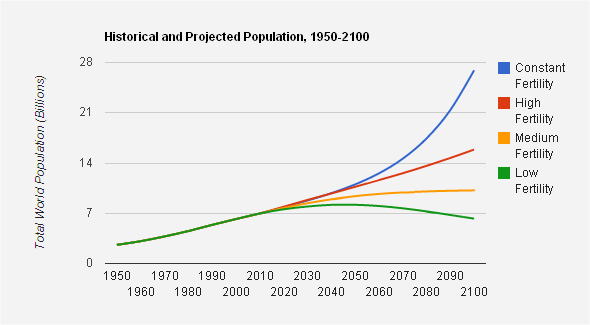
Projections of world population in 2050 range from 8.1 billion (if fertility rates fall to a global average of 1.7 children per woman) to 10.9 billion (if they remain unchanged). The gap of nearly three billion between those possibilities is greater than the combined populations of China and India today.
Estimates vary even more widely for the end of the century, with the UN projecting that by 2100 world population could total anywhere between 6 billion (if total fertility falls to an average of 1.55 children per woman) and 27 billion (if every country’s fertility rates remain constant at today’s levels).
While demographers parse the details of the projections, policymakers would like to know which of these scenarios is more likely. After all, the economic, environmental, and political consequences of a population of 8 or 11 billion two generations hence are not the same, and a world of 27 billion is difficult for anyone to fathom.
If we simply projected past trends into the future at a steady rate, the population estimates on the low end of the fertility spectrum seem more likely. The global fertility rate has fallen from 4.5 children per woman in the early 1970s to 2.5 today, a decline of 43 percent, so the 14 percent decline projected in the medium-fertility variant between now and 2050 seems reasonable at first glance, perhaps even conservative. The medium-fertility variant assumes that all countries’ fertility rates will begin moving towards replacement level, around 2.1 children per woman, regardless of whether they are currently above or below that number.
However, even a 14 percent decline in fertility assumes that areas where fertility rates remain stalled at high levels will soon begin rapid declines, paralleling the past experience of other regions. As Population Reference Bureau demographer Carl Haub writes, “the assumption that the developing world will necessarily follow the path of the industrialized world…is far from a sure bet.”
In the last 40 years, fertility rates in the Caribbean, northern and southern Africa, Latin America, and all of Asia declined by 50 percent or more. The pace of decline in sub-Saharan Africa, while still notable, was much slower, at 23 percent. In order to meet the UN medium-variant projections, the region’s fertility rate would need to fall by nearly 40 percent by mid-century.
Some of the largest, fastest-growing populations in the developing world would need to experience a major acceleration from recent trends. In Nigeria, fertility edged down by 15 percent between 1970 and 2010, but the medium variant projection depends on a decline of 37 percent over the next four decades; Ethiopia’s fertility rate will need to fall by half.
Gender Matters, Too
The great irony of fertility trends is that gender inequities play an important role at both ends of the scale. In countries with the highest fertility rates, women tend to have less education than men and less autonomy. Their fertility choices may be greatly affected by the preferences of their husbands or other family members. In Niger, which has the highest fertility rate in the world, married men would, on average, like three more children than married women. In Uganda, where women average more than six children each, 60 percent of men report that domestic violence is justified.
By contrast, in countries with the lowest fertility rates, women have achieved equal access to education and the labor market, with more autonomy about how to earn income and what to do with it. Yet cultural expectations that place the burden for child and elder care and housework almost entirely on women can make marriage an unappealing option. In Japan, which is among the 10 lowest fertility countries in the world, more women are choosing to stay single: The marriage rate has fallen by almost half since the 1970s. Japanese women who do marry are waiting until their late 20s and tend not to give birth until they are 30, both of which result in lower average family size.
Even at this end of the demographic spectrum, the assumptions embedded within population projections seem optimistic. Japan’s fertility rate was last above replacement level in the early 1970s; it has fallen steadily to 1.3 children per woman today. The UN projections assume that fertility will immediately reverse track and begin rising to over 1.8 children per woman in 2050, rebounding above two children per woman before the end of the century.
The stalled high fertility rates in much of sub-Saharan Africa and parts of the Middle East, together with unprecedented low fertility in Eastern Europe and parts of East Asia, indicate that we are currently in an era of remarkable demographic diversity, despite the UN’s projection of future convergence.
Continue reading part two here.
Elizabeth Leahy Madsen is a consultant on political demography for the Wilson Center’s Environmental Change and Security Program and former senior research associate at Population Action International.
Sources: Boling (2008), Haub (2011), Japan Statistics Bureau, Measure DHS, UN Population Division, UN Population Fund, Washington Post.
Image Credit: Chart data from UN Population Division, arranged by Elizabeth Leahy Madsen. -
Panetta: Diplomacy and Development Part of Wider Strategy to Achieve Security; Will They Survive Budget Environment?
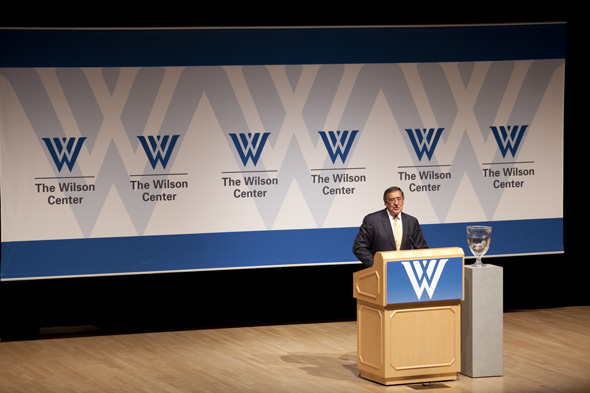
›Leon Panetta – newly minted secretary of defense and former director of the CIA – gave one of his first public policy addresses yesterday at the Woodrow Wilson Center addressing national security priorities amidst a constrained budgeting environment (see video here). Under the debt ceiling agreement recently agreed to by Congress, the Pentagon is expected to achieve around $450 billion in spending cuts over the next 10 years.
Most of Secretary Panetta’s speech focused on “preserving essential capabilities,” including the ability to project power and respond to future crises, a strong military industrial base, and most importantly, a core of highly trained and experienced personnel.
But he also touched on the other two “D” s besides defense – diplomacy and development: “The reality is that it isn’t just the defense cuts; it’s the cuts on the State Department budget that will impact as well on our ability to try to be able to promote our interests in the world,” Panetta said in response to a question from ECSP Director Geoff Dabelko:National security is a word I know that we oftentimes use just when it comes to the military, and there’s no question that we carry a large part of the burden. But national security is something that is dependent on a number of factors. It’s dependent on strong diplomacy. It’s dependent on our ability to reach out and try to help other countries. It’s dependent on our ability to try to do what we can to inspire development.
Panetta’s backing of diplomacy and foreign aid as an extension of U.S. national security strategy is a continuation of vocal support by former Chairman of the Joint Chiefs of Staff Mike Mullen, former Secretary of Defense Bob Gates, and others at the Pentagon, but the bigger issue remains convincing Congress, where the State Department has become a popular target for budget cutters.
If we’re dealing with Al Qaeda and dealing with the message that Al Qaeda sends, one of the effective ways to undermine that message is to be able to reach out to the Muslim world and try to be able to advance their ability to find opportunity and to be able to seek…a better quality of life. That only happens if we bring all of these tools to bear in the effort to try to promote national security.
We’ve learned the lessons of the old Soviet Union and others that if they fail to invest in their people, if they fail to promote the quality of life in their country, they – no matter how much they spend on the military, no matter how much they spend on defense, their national security will be undermined. We have to remember that lesson: that for us to maintain a strong national security in this country, we’ve got to be aware that we have to invest not only in strong defense, but we have to invest in the quality of life in this country.
Perhaps the more useful question going forward is one of priorities. Clearly there will be (and already is) less money to go around, and the Defense Department is one of the largest outlays, while State is much smaller – the military’s FY 2012 budget request was $670.9 billion; the State Department’s, $50.9 billion. So the question is: when push comes to shove, will Secretary Panetta be able to sustain his support for diplomacy and development budgets if it means larger cuts at DOD?
Sources: Government Executive, Politico, U.S. Department of Defense, U.S. Department of State.
Photo Credit: David Hawxhurst/Wilson Center. -
Watch: Dennis Taenzler on Four Key Steps for REDD+ to Avoid Becoming a Source of Conflict
›The UN Program on Reducing Emissions from Deforestation and Forest Degradation (REDD) provides financial incentives to developing countries to conserve their forests and invest in low-carbon pathways to sustainable development. However, it may also be a potential new source of conflict, says Dennis Taenzler, a senior project manager at adelphi in Berlin, who works on climate and energy policies as well as peace and conflict issues.
-
Weathering Change: New Film Links Climate Adaptation and Family Planning
›“Our planet is changing. Our population is growing. Each one of us is impacting the environment…but not equally. Each one of us will be affected…but not equally,” asserts the new documentary, Weathering Change, launched at the Wilson Center on September 22. The film, produced by Population Action International (PAI), explores the devastating impacts of climate change on the lives of women in developing countries through personal stories from Ethiopia, Nepal, and Peru. Family planning, argue the filmmakers, is part of the solution.
-
Gates and Winnefeld: Development a Fundamental Part of National Security
› “As we’ve learned in Iraq and Afghanistan, reconstruction, development, and governance are crucial to any long-term success – it is a lesson we forget at our peril,” said Former Secretary of Defense Robert Gates in a video address commemorating the U.S. Agency for International Development’s 50th anniversary this fall. Gates was joined by Admiral James Winnefeld, Jr., the vice chairman of the Joint Chiefs of Staff, in a post on USAID’s Impact blog to reinforce the importance of development and USAID in particular to U.S. national security.
USAID was created on November 3, 1961 as part of a total overhaul of U.S. foreign assistance by President Kennedy. From the start, President Kennedy understood that the agency would play a role not just in development abroad but in improving U.S. security as well.
The agency is marking its 50th anniversary in an environment where development and security are seen as perhaps more linked than ever.
Winnefeld described the work that USAID and the military do as going hand-in-hand, saying that “together, we play a critical role in America’s effort to stabilize countries and build responsive local governance.”
In country after country, Winnefeld said, “USAID’s development efforts are critical to our objective of creating peace and security around the world.” He added that “instability in any corner of today’s highly interconnected world can impact everyone. Development efforts prevent conflicts from occurring by helping countries become more stable and less prone to extremism.”
“For 50 years,” Gates said, “USAID has embodied our nation’s compassion, generosity, and commitment to advance our ideals and interests around the globe. It’s a commitment demonstrated every time this agency works hand-in-hand with communities worldwide to cure a child, build a road, or train a judge.”
“By improving global stability,” Winnefeld concluded, “USAID helps keep America safe.”
Sources: USAID.
Video Credit: USaidVideo. -
Development or Security: Which Comes First?
›“Let’s take an area of conflict of great concern to us: Afghanistan. One of the very concrete questions is, do you invest your development efforts predominantly in the relatively secure parts of Afghanistan, which gives you more security gains in terms of holding them, or in the relatively insecure parts, where you’re most concerned with winning against the Taliban and the battle seems most in the balance?” With that question, Richard Danzig, the chairman of the board for the Center for a New American Security (CNAS), got to the heart of the issues being debated at a recent panel on development assistance and national security.
The discussion, hosted on September 5 by the Aspen Institute in conjunction with the Brookings Blum Roundtable on Global Poverty, brought together Rajiv Shah, the administrator of the U.S. Agency for International Development; Susan Schwab, professor at the University of Maryland and former U.S. trade representative; Sylvia Mathews Burwell, president of the Bill and Melinda Gates Foundation’s Global Development Program; and CNAS’ Danzig. Most of the hour-long discussion was spent debating whether assistance could be successful in insecure situations (like Afghanistan), or if a place has to have some kind of stability before assistance can really take root and successfully spur development.
Short vs. Long term
Administrator Shah, not surprisingly, made the argument that development assistance is valuable in either instance. That said, he also strongly cautioned against overpromising what aid in a place like Afghanistan can accomplish, saying that “one big mistake we’ve made is to oversell what any civilian agency can do in an environment where there’s an active military campaign.” He pointed out that “it not only raises the cost of doing the work…but it also puts people at real risk.”
Danzig took a more aggressive tone, saying that “in the great majority of cases I think it is misleading and distortive to argue for development on the grounds that it will predominantly enhance security.” He argued that more often than not, security should be a prerequisite for development: “You need to distinguish cart and horse here…in most instances…the security needs to precede the development.”
Shah and Danzig, who dominated the panel, were more in sync about what development assistance can accomplish in longer-term scenarios, when security and stability are assured. Shah in particular spoke forcefully about development assistance over time, stressing that “in the long view, in the medium term, the development priorities are national security priorities.”
Enabling Success
However, Shah did warn that aid could fall short of our goals if it not carried out in a reliable way. “Stability and predictability of finance is the single thing that’s most highly correlated with good outcomes,” he said. When our aid to a country comes and goes unreliably, flowing one year and stopping abruptly the next, it’s much harder to have the kind of positive impact we want it to have, he explained.
“Through the years, where these questions have been debated back and forth, there has been one constant,” said moderator Jessica Tuchman Mathews, president of the Carnegie Endowment for International Peace. “We have always multiplied the objectives vastly beyond the resources – always.”
Video Credit: Aspen Institute. -
Debts, Deficits, and Development
›The debates surrounding the U.S. national debt and deficit bring with them implications for both overall U.S. development policy and the budgets of USAID and the Department of State. These implications were the focus of the Wilson Center on the Hill event that took place on August 2, “Debts, Deficits, and Development,” moderated by Wilson Center Senior Scholar John Sewell. Sewell said that Congressional action on deficit reduction could potentially reduce funding for development-related initiatives just as the U.S. government “for the first time…is taking development and the notion of development very seriously.”
After an introduction from Sewell, Gordon Adams, distinguished fellow at the Henry L. Stimson Center, began by talking about the lack of attention that international affairs and the civilian side of U.S. international engagement usually receive in the government budget. He noted the growth in personnel and funding at USAID and the Department of State over the past ten years as a success, adding that a fair amount of this growth was related to the conflicts in Iraq and Afghanistan and the global effort against terrorist organizations.
“Foreign policy, development, foreign assistance, [and] diplomacy have increasingly been viewed as a key part of a broadly defined security budget,” said Adams. The first Quadrennial Diplomacy and Development Review had the potential to restructure the Department of State and USAID in line with these goals, he said, but lacked the force to prioritize programs and allocate funds effectively.
In post-conflict environments, Adams emphasized the need to build the capacity to govern effectively, efficiently, and accountably first. “Where we fall down,” added George Ingram, co-chair of the Modernizing Foreign Assistance Network, “is in rushing too much money in right as the conflict ends for two or three years and then getting distracted by other crises from year five to ten; when the country’s built up a capacity and probably could use the assistance, our interest falls off.” In his opinion, that sequencing should be reversed.
Focus on Priorities
Adams continued to emphasize the need for goals and priorities when he addressed the topic of belt-tightening at USAID or the Department of State. According to Adams, the four categories to consider in allocating resources are: security assistance; the individual priorities of foreign assistance and development funds; conflict prevention and resolution; and better preparation and training of personnel. He lauded the military’s commitment to training its servicemen and women throughout their careers and suggested a similar program for members of the Foreign Service. To coordinate these priorities, however, a coherent U.S. development strategy (currently lacking) is essential, said Ingram.
Focusing on how the current budget environment is impacting development, Ingram said that the decade of growth in the international affairs budget for development may have just hit a brick wall. He described the FY 2012 budget as “skewed heavily toward reducing the development accounts and protecting the security accounts,” resulting in an 11 percent overall cut from 2011 levels and some development accounts being reduced by 20 or 30 percent.
Ingram noted that USAID’s overall operating expenses were cut by 27 percent from FY 2011 levels. This operating expense reduction will likely halt planned increases in USAID staff and may ultimately lead to staff cuts. The failure to build up staff at USAID will reduce its ability to manage key development programs and slow the Department of Defense’s efforts to shift responsibilities for development work to civilian hands.
Adams added that in light of shrinking resources, legislators will probably ask supporters of development about the tangible outcomes of investment in development and about the link between development and American interests, so they should be prepared with answers. Ingram cited the successes of U.S. aid over the last decades – such as the Green Revolution and oral rehydration – and noted how they benefited from a long-term perspective rather than approaching development on a project-by-project basis.
Given the tumult in the Middle East since the start of the Arab Spring, the need for expertise in governance is high, said Adams. “The problem of governance in failing, fragile, weak, brittle authoritarian states,” he said, “is a great risk to stability.”
Event Resources:Erica Pincus is an intern at the Wilson Center’s Program on America and the Global Economy.
Image Credit: “Foreign Aid Spending,” courtesy of visual.ly user maggie, published by USAID. -
John Donnelly, Global Post
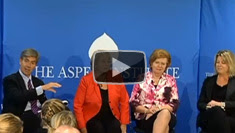
Family Planning and Seven Billion at the Aspen Institute
›September 9, 2011 // By Wilson Center Staff
The original version of this article, by John Donnelly, appeared on Global Post.
Sometime this fall, the world’s population will reach 7 billion people. Experts now forecast that by 2050, the population could be 10 billion.
Those numbers, said the former presidents of Chile and Latvia at an event in Washington D.C., Wednesday night, should force policy makers to focus more intently on making family planning much more widely available in the developing world.
“When we are 9, 10 billion people, what are we going to do? Go to Mars? Go to the moon?” said Michelle Bachelet, the former president of Chile and now the Under Secretary-General and Executive Director of UN Women, the latest agency created by the United Nations. “We are really going to have huge problems. Family planning is a huge issue.”
Her comments came during a series of discussions organized by Aspen Global Health and Development called “7 Billion: Conversations that Matter.” The talks, funded in part by the U.S. Agency for International Development, have often centered on global health issues, and Wednesday’s event was no different.
Continue reading on Global Post.
Video Credit: The Aspen Institute.
Showing posts from category zz Organizations.