-
Call for Papers: Reducing Urban Poverty
›The Woodrow Wilson Center’s Comparative Urban Studies Project, USAID, the International Housing Coalition, the World Bank, and Cities Alliance are teaming up a third time to co-sponsor an academic paper competition for graduate- and PhD-level students focused on challenges facing urban centers in the developing world.
The themes of this year’s competition are land markets, global climate change, and youth.
Land Markets: The absence of efficient land and housing markets and lack of secure tenure for both renters and owners are impediments to urban and economic development in developing cities. Papers on this topic should explore strategies and approaches that would enable property markets to function better and would provide increased security of tenure and strengthened property ownership rights.
Global Climate Change: Papers should examine how urban populations, especially the poor, are coping with the impacts of climate change, and provide strategic policy analysis to better understand how cities can become more resilient to climate change impacts.
Youth: Most of the youth of the developing world are now or will soon be living in urban areas. Unfortunately, they are often growing up in the poorest urban areas – informal settlements and slum communities where their opportunities for advancement are limited by a variety of negative factors. Papers focused on youth should explore ways to build capacity so that you can develop knowledge and skills, find gainful employment, and participate more fully in society to advance economic growth and social development.
Winning papers from each category will be published and the authors invited to Washington, D.C. in the fall of 2012 for a policy workshop with subject matter experts. Additionally, one grand prize winner will be asked to present his or her work at the World Urban Forum (WUF). WUF was established by the United Nations to examine rapid urbanization and its impact on communities, cities, economies, climate change, and policies. The sixth WUF will be held from September 1-7, 2012 in Naples, Italy and will be focused on “The Urban Future.” In addition to the Washington conference and publication of his or her paper, the grand-prize winner will be invited to present his or her winning paper on a panel at the World Urban Youth Assembly at WUF on September 1st and 2nd.
The deadline for the submission of abstracts is February 20, 2012.
For detailed competition guidelines and requirements, and further information on the sub-topics, please see the full call for papers.
Image Credit: “Split by yelowcap,” courtesy of flickr user yelowcap (Vladimir Kaštier). -
UNEP Maps Conflict, Migration, Environmental Vulnerability in the Sahel
›A new set of maps from the United Nations Environment Programme (UNEP) identifies “climate hotspots” – areas vulnerable to instability exacerbated by climate change – in 17 sub-Saharan countries in and bordering the Sahel region. The maps reflect the fact that, more often than not, the impact of climate change on local populations is compounded by changes in migration, conflict, or both. According to Livelihood Security: Climate Change, Migration and Conflict in the Sahel, the UNEP report accompanying the maps, understanding “the exacerbating effect of changes in climate on population dynamics and conflict in the region” will be essential to developing successful adaptation strategies throughout the region.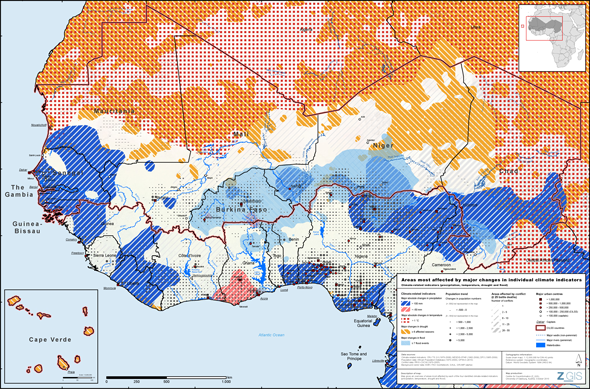
UNEP’s maps analyze 40 years of data to pinpoint where the region’s most at-risk populations are located based on environmental, population, and conflict trends dating back to 1970. In a single map pinpointing the Sahel’s 19 hotspots, UNEP synthesizes subnational data from four environmental indicators over time – rainfall (from 1970 to 2006), temperature changes (1970 to 2006), drought (1982 to 2009), and flooding (1985 to 2009) – which are then layered on top of population trends (1970 to 2010) and conflict data (1970 to 2005) in order to identify the region’s most insecure areas.
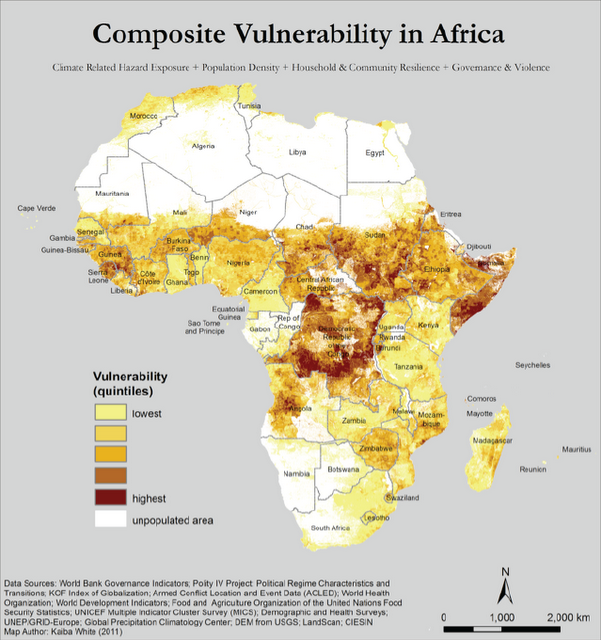
Composite Vulnerability
At first glance, the map can appear hard to decipher; it is flooded with different colors and symbols, each indicating something different about the extent of climate change, migration, and conflict in the region. A Google Earth version of the map (available for download here) makes all this information easier to process by allowing users to select which indicators they want to see mapped out, cutting back on the number of lines, dots, colors, and pie charts the user has to decode.
Given the vast amount of the information being condensed into these maps, the report is a helpful and worthwhile read. For instance, eight hotspots are in places with growing populations and another seven are located in places that have experienced conflict; altogether, 4 of the 19 hotspots have both past conflict and growing populations. The report digs deeper into the confluence of climate, conflict, and migration by discussing case studies that highlight how the three intersect in local communities (at the same time, the report is careful to avoid suggesting that there is a causal relationship between the three issues.). In Niger, Nigeria, and Chad, for example, tensions have been mounting between northern pastoralists and southern farmers as each group has moved further and further afield in search of water and arable land to sustain their livelihoods.
Holes In the Data
While the hotspot maps include a wealth of information, the report makes clear that it is by no means exhaustive. Rising sea levels are, for instance, a major impending threat to coastal populations in the Sahel, but only the downloadable Google Earth map – not the hotspot map in the report or the Google Earth map as presented online – incorporates this factor. Compounded with a skyrocketing population in the coastal areas – the coast between Accra and the Niger delta is expected to be “an urban megalopolis of 50 million people” by 2020, according to the report – an increase in sea levels could have a huge impact on the region’s stability.
The report also readily admits that the datasets for population trends and conflict have shortcomings. Population data is largely based on censuses, which both the report and its data sources (UNEP’s African Population Database and the Gridded Population of the World, version 3) acknowledge can be inconsistent in their accuracy. Additionally, after 2000, population data is based on projections rather than estimates, which, as last year’s update from the UN Population Division showed, have often proven inaccurate, particularly in sub-Saharan Africa.
Regarding conflict, the UNEP report is straightforward in admitting its limits. The report lacks data on small-scale conflict (fewer than 25 battle deaths, following the Uppsala Conflict Data Program’s threshold that separates conflicts from lower-level violence), even as it acknowledges that such conflict is “often the first to occur” when climate change threatens communities’ access to resources and livelihoods.
Ultimately, however, these maps give valuable data on specific locations that are uniquely vulnerable to trends in population, climate, migration, and conflict. They add focus to the conventional wisdom that climate change will impact the region’s stability, and, taken together, the maps and the report provide a valuable resource for scholars and policymakers attempting to craft adaptation policies that take into consideration these complex links.
Sources: Socioeconomic Data and Applications Center at Columbia University’s Earth Institute, UNEP, Uppsala Conflict Data Program.
Image Credit: UNEP. -
New Research on Climate and Conflict Links Shows Challenges for the Field
›“We know that there will be more conflicts in the future as a result of climate change than there would have been in a hypothetic world without climate change,” said Marc Levy, deputy director of the Center for International Earth Science Information Network (CIESIN) at Columbia University’s Earth Institute, although existing data and methodologies cannot predict how many additional conflicts there will be, or which causal factors will matter most. [Video Below]
-
Jon Barnett: Should Climate Change Be Addressed by the UN Security Council?
›For a small island state like Tuvalu, climate change is an enormous security issue and they have told the UN Security Council as much, said Jon Barnett, professor of resource management and geography at the University of Melbourne, in an interview with ECSP. But, despite debate in 2007 and 2011, the Council has been unable to reach agreement on whether climate change is an international security issue or not.
-
Three New Reports Highlight Ongoing Significance of Youth Demographics in Global Trends
›January 2, 2012 // By Elizabeth Leahy MadsenAmidst world population reaching seven billion and last year’s Arab Spring, which in some nations is continuing into this winter, it can be easy to miss emerging pieces of research that tell us something relatively objective about youth and instability. Three new studies give practitioners and policymakers a stronger foundation of evidence to highlight the challenges and opportunities facing the world’s largest generation of young people.
Results of a recent UNICEF staff survey indicate that the people responsible for the UN’s efforts targeting children and youth are seriously concerned about demographic and economic dynamics. Asked to review a list of 20 “global trends,” UNICEF staff rated “growing disparities” and “youth bulge and youth unemployment” as the most significant to children. The results, which the agency will soon publish in a paper on “The Next Generation and Global Trends,” also indicate that staff members feel that UNICEF has a strong capacity to influence the future of these trends.
UNICEF’s recent “Child Outlook” report on global trends discusses the issues highlighted in the survey. The report notes that although many countries are moving toward middle-income status, poverty rates remain stubbornly high, indicating that economic development does not benefit all equally. Income and consumption in such countries tend to be concentrated among the wealthiest households. “While many families will prosper, others are being left behind,” the report explains.
“Tensions and discouragement arising from youth unemployment, combined with higher food prices and fiscal contractions, may have contributed to increased civil unrest, protests, and political instability,” UNICEF asserts. In many developing countries, the number of young people entering the labor market far surpasses the number of available jobs. Although some youth are not working because they are enrolled in secondary or tertiary education, low rates of youth participation in the workforce often are not a matter of choice. Young people, especially those with low levels of education and from poorer families, are often unable to find secure, decent jobs. More than one-quarter of all young people with jobs worldwide live below the poverty line of $1.25 per day.
Economic Pressures on Youth in East Africa
Two other research projects – one published, one still underway – provide additional context to the combination of demographic and economic challenges that face the world’s young people. In the first, part of a recent special U.S. Institute of Peace series on South Sudan, Stephanie Schwartz and Wilson Center fellow Marc Sommers probe the expectations of and obstacles faced by youth in the newly created country.
According to the incipient government’s statistics agency, 72 percent of South Sudan’s population is younger than 30, which places it among the 20 youngest age structures in the world. Only 40 percent of youth ages 15 to 24 are literate, and nearly 80 percent of households depend on agriculture for their income. Based on interviews conducted with urban and rural youth in three areas of South Sudan, the authors find that the pressure of paying rising dowry costs is the most salient issue facing young men, while young women are treated as economic assets with no influence in their own future. The authors’ research suggests that “some young men join armed gangs, at least in part, because they believe it will help them pay dowries.”
Although many young people in South Sudan aspire to the stability of government work, the limited number of jobs and shortage of relevant skills inhibit their aspirations. With an underdeveloped private sector, few opportunities for training, and nepotistic practices in hiring, there is little work for those living in towns and urban areas beyond manual labor and selling goods. The authors recommend that education and job training be expanded, with a focus on equitable access among young people from varied geographic backgrounds.
Across the border in northern Uganda, Chris Blattman, an associate professor of political science at Yale, has been studying the social effects of the government’s youth employment program started in 2007. The program offered grants to small groups of young people for vocational training or to fund the costs of starting a new business. Although a full paper has not yet been published, preliminary findings indicate strong economic benefits of the program which in turn improve social cohesion and community participation while diminishing aggression and “disputes with authorities” among young men. If they bear out, the results may well confirm the oft-repeated policy recommendation that focusing on youth employment is critical to improving national development as well as reducing the likelihood of instability and conflict.
In the year of seven billion, we heard much about the need to invest in young people and the tremendous potential they embody, for demographic dividends as well as overall development. Yet 2011 was also a year of tremendous upheaval, much of which was driven by young people – and their older counterparts – seeking representative and democratic governance. This should serve as a reminder that youth can be a remarkable force for positive change, but in too many places – South Sudan among them – their opportunities, prospects, and contributions are constrained. As the UNICEF survey results reiterate how important this issue is to development programming, the Uganda research may be another important piece of evidence that direct investment in young people reaps tangible results not only for them, but also for society.
Elizabeth Leahy Madsen is a consultant on political demography for the Wilson Center’s Environmental Change and Security Program and senior technical advisor at Futures Group. She was previously a senior research associate at Population Action International.
Sources: Bill and Melinda Gates Institute for Population and Reproductive Health, Chris Blattman, ILO, Sommers and Schwartz (2011), South Sudan National Bureau of Statistics, UNICEF, World Bank.
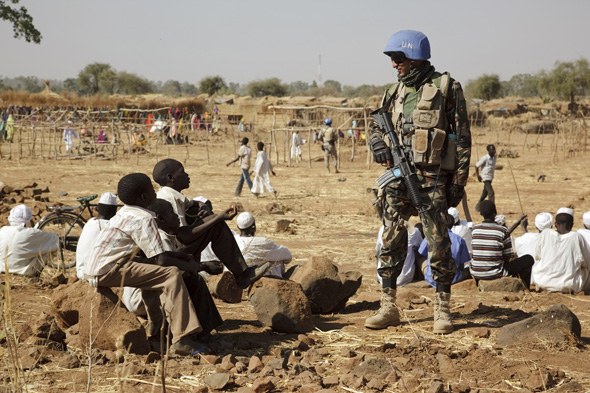
Photo Credit: “UNAMID Peacekeeper Speaks with Sudanese Youth,” courtesy of UN Photo/Albert Gonzalez Farran. -
Managing the Planet: The Road to Rio+20
›“We still see people thinking about the environment as if it is something apart. The idea of a synergy, a balance of development still, I think, eludes us both in theoretical, but especially in practical terms. And that is what Rio+20 is about,” said Ambassador Luiz Alberto Figueiredo Machado, under-secretary for environment, energy, science, and technology at the Brazilian Ministry of Foreign Affairs.
The Rio+20 conference next year, marks the 20th anniversary of the 1992 UN Earth Summit. It will be an opportunity to generate new answers to the question of how to collectively develop in a more sustainable and balanced way, said Figueiredo. Jacob Scherr, director of strategy and advocacy at the Natural Resources Defense Council, Richenda Van Leeuwen, senior director for energy and climate at the UN Foundation, and Thomas Lovejoy, biodiversity chair at the Heinz Center for Science and professor of environmental science and policy at George Mason University, joined the ambassador at the Wilson Center on November 16 for a discussion about preparations for the upcoming conference. The event was part of the Managing the Planet seminar series, coordinated jointly by George Mason University and the Wilson Center.
Sustainable Development Goals
Rio+20 should reaffirm the sustainable development vision of the first Earth Summit, said Scherr, “of our ability to deal with all of these issues at once: to move forward on economics, and dealing with poverty, of being equitable, and protecting and preserving the environment for future generations.”
Figueiredo said he sees the concept of a “green economy” as an “instrument to promote sustainable development and eradicate poverty. And in that sense, it seems clear that we will not find one green economy as such, but probably as many green economies as countries in the world, because each country will find its way of using that kind of tool.”
One proposal for the conference, supported by Brazil, is to devise a set of sustainable development goals, which would “embrace the Millennium Development Goals and instill a certain sustainability viewpoint to all of them,” Ambassador Figueiredo said. Furthermore, they would be global in nature, rather than geared towards developing countries, providing a vision for collective development.
“The Millennium Development Goals were good in some ways [but] they were fairly weak on the environmental side,” said Thomas Lovejoy. “This is a chance to actually improve on that, to really bring these elements together.”
Action and Accountability
Through “sustainable development dialogues,” Brazil is working to provide a new mechanism for civil society input at the conference. According to Figueiredo, Brazil hopes to “create a bridge between those who understand the issues, those who have a deep knowledge of the issues, and those who have the power again to do something about it.”
“We have been talking about these issues for 40 years, what we really need is a meeting that, as the Secretary General recently said, is a conference about implementation…to really start moving us down the path towards a sustainable future,” said Scherr.
“You might argue that everything that happened 20 years ago was an absolute failure, but of course it was not, because an awful lot has happened in the interim, it’s just that it hasn’t happened on a big enough scale or fast enough,” Lovejoy said.
“What gives me a lot of reason for hope going into Rio+20 is there are a lot of very practical, very pragmatic efforts involved,” he said.
Richenda Van Leeuwen pointed to the UN Secretary General’s Sustainable Energy for All initiative as a potential agenda to follow. The initiative has three objectives: ensuring universal access to modern energy services; doubling the rate of improvement in energy efficiency; and doubling the share of renewable energy in the global energy mix.
“We are using Rio, and the seminal opportunity that it represents, as a mechanism to be able to bring these new commitments together…to show that there is an opportunity for concrete actions,” Van Leeuwen said.
A robust accountability framework is vital to that effort, Van Leeuwen said. “It’s easy to make a pledge at a pledging conference, but really what we are looking at is a whole new way of doing business, a whole new action agenda,” she said. “So we are very optimistic and very excited about the opportunity for Rio, but Rio not as an end really, but as a beginning and as an opportunity to be a springboard to get much further global action.”
Photo credit: “Brazil!,” courtesy of Flickr user sparktography.
Event Resources -
Ambassador Melanne Verveer, U.S. Department of State
Ambassador-at-Large for Global Women’s Issues on Durban and the Role of Women in Combating Climate Change
›December 23, 2011 // By Wilson Center StaffThe original version of this article, by Ambassador Melanne Verveer, appeared on the White House Council on Environmental Quality blog.
Last week I traveled to Durban, South Africa to participate in the Conference of the Parties to the United Nations Framework Convention on Climate Change to highlight the critical and largely untapped potential of women to combat climate change. Studies have shown that it is often women who are on the frontlines of, and suffer disproportionately from, the impacts of climate change. This is certainly important. But we must remember that women are also a powerful force for finding solutions to climate change across the board, including in areas such as agriculture, sustainable forest management, and energy access.
Agriculture, which accounts for approximately 14 percent of global greenhouse gas emissions and is a sector that can be particularly sensitive to climate variability and change, is one key area where women can play a major role. A recent FAO report shows that women, in many places, are the main producers of the world’s staple crops, particularly in developing countries and regions likely to be adversely affected by climate change impacts. However, globally, only a small minority of women farmers have access to land tenure. This is a problem for many reasons – including that it limits women’s potential to combat climate change. Studies have shown that women with the right to property are significantly more capable of investing in climate-smart agricultural productivity; we have a lot of work to do to unlock women’s potential in this area.
Women also have untapped potential for increasing energy access, which directly relates to climate change. For example, nearly three billion people globally still rely on traditional cookstoves and open fires to prepare food for their families. In most instances, women are responsible for cooking – not to mention also spending many hours per week collecting fuel, which often puts women at risk of gender based violence. The resulting smoke exposure causes an estimated two million premature deaths annually, with women and young children the most affected. Cookstoves also impact the climate through emissions of greenhouse gases and short-lived particles such as black carbon. Engaging women is critical to tackling this problem. As we work to build a global market for clean cookstoves, integrating women into the cookstoves supply chain will help increase clean cookstove adoption rates while also creating new economic development opportunities. And as Secretary Clinton has noted, women create a multiplier effect in local communities because they disproportionately spend more of their earned income on food, healthcare, home improvement, and schooling.
The United States recognizes the power of women’s potential in these areas and many others, and is investing in major initiatives including Feed the Future and the Global Alliance for Clean Cookstoves, where women’s role in generating transformative change is front and center.
I went to Durban to highlight the critical role of women in combating climate change. While there, I worked with U.S. negotiators on the Durban texts and participated in public engagement events. Our efforts to build on the gender equality and women’s empowerment language in the Cancun agreements are reflected in several crucial institutional developments, including language on gender balance related to the composition of the board of the new Green Climate Fund, the Standing Committee, and the Adaptation Committee. We also worked to reflect gender considerations in the mission of the Climate Technology Center and Network. USAID Assistant Administrator Eric Postel and I solicited input during a meeting with leading non-governmental organizations working on gender and climate issues, and I hosted a high-level side event at the U.S. Center focused on unlocking women’s potential to combat climate change. The level of enthusiasm among my fellow panelists and the audience at the event was inspirational.
We made progress in Durban, but we can’t stop here. To achieve the future we all seek, we must do more. As the late Wangari Maathai, founder of the Green Belt Movement and ground-breaking advocate on women and the environment said, “We must not tire, we must not give up, we must persist.” The future of not only women, but our planet, depends on it.
Ambassador Melanne Verveer is U.S. Ambassador-at-Large for Global Women’s Issues.
Sources: Food and Agriculture Organization, Intergovernmental Panel on Climate Change, The White House.
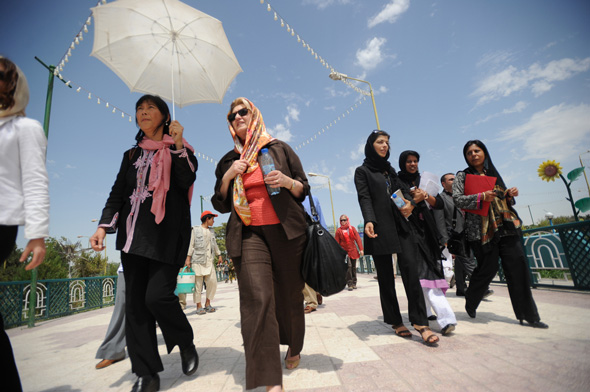
Photo Credit: “Melanne S. Verveer,” courtesy of the U.S. Embassy, Kabul. -
In Somalia, Beyond the Immediate Crises, Demography Reveals a Long-Term Challenge
›December 21, 2011 // By Elizabeth Leahy MadsenIn the nearly 20 years since the infamous intervention that resulted in the deaths of dozens of American and UN peacekeeping soldiers on the streets of Mogadishu, Somalia has become the epitome of a “failed state.” Neighboring countries, global bodies, and aid agencies are rushing to respond to the country’s rapidly evolving political, security and humanitarian crises.
Diplomatic attention has focused on decentralized, weak governance that is divided among the Al Shabab insurgency, clan warlords, and a hamstrung and largely ineffective Transitional Federal Government, whose control does not extend beyond the capital. Foreign militaries have had to devote naval resources to curtailing daring and far-reaching acts of piracy against civilian and military vessels from networks based in Somalia. Aid groups have been stymied in their efforts to stem famine as access to populations in the hardest-hit areas has been cut off by Al Shabab and food aid has been stolen. Most recently, Kenyan and, reportedly, Ethiopian forces have crossed the border, extending the reach of the country’s political crisis. Hundreds of thousands of have fled conditions of hunger, illness, and violence into neighboring countries.
Perhaps the deepest woe of a “failed state” is that its problems are deep-seated and cannot be solved during the brief span of a UN meeting or the news cycle following the latest terrorist attack. Amid the extraordinary efforts to battle the country’s crises, one of the most important underlying structural factors is often overlooked: the country’s unusual demographic picture.
A Demographic Outlier
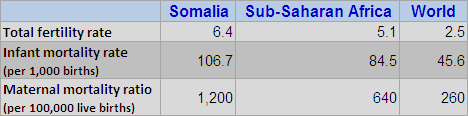
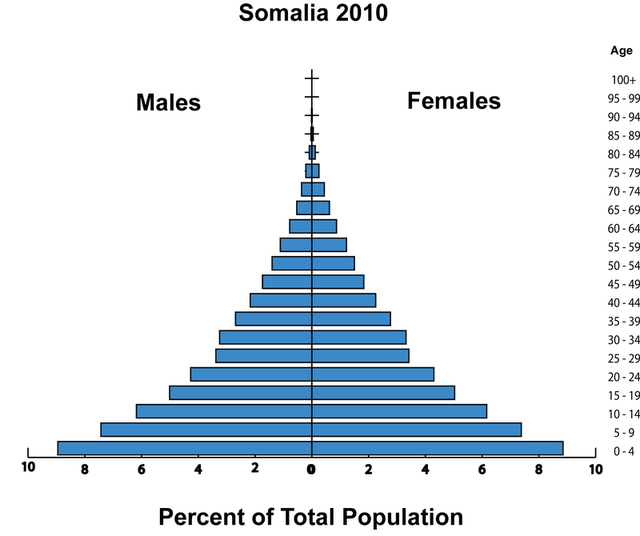
Somalia is a global outlier in demographic terms, with rates of fertility (6.4 children per woman), infant mortality (107 deaths per 1,000 births), and maternal mortality (1,200 deaths per 100,000 live births) all above the already-high averages for sub-Saharan Africa. These demographic indicators are both a reflection of the abysmal state of health care in the country and a warning that its economic and security challenges are unlikely to be easily resolved.Research shows that where at least 60 percent of the population is younger than 30 years old, countries are more prone to outbreaks of civil conflict, and the risk increases as the proportional size of the “youth bulge” grows. In Somalia, 70 percent of the population is younger than 30, a level comparable to Iraq and the Palestinian Territories. With little to no improvements in health care, Somalia’s age structure has remained unchanged over the past 40 years. Unlike dozens of other countries where fertility has declined significantly in recent decades, Somali women have nearly as many children on average today as they did in the 1970s. The current total fertility rate of 6.4 children per woman is only a 12 percent decline from the 1970 rate.
Despite high infant mortality – more than 10 percent of children die before turning one – this sustained high fertility rate has generated rapid population growth, with each successive generation larger than the next. Somalia’s population has almost tripled since 1970, from 3.6 to 9.3 million, although population density remains low (one-third the world average). If the fertility rate remains constant at the current level – not an unreasonable projection considering how stagnant it has been over past decades – Somalia would be home to 33 million people by 2050. Even if the fertility rate drops to near four children per woman, as projected in the UN’s medium variant, the population would still triple to 28 million by mid-century given the demographic momentum of decades of high fertility.The fertility decline built into the UN’s medium variant projection – which would still place Somalia among the highest total fertility rates in the world by 2050 – is unlikely without steady and major improvements in the country’s health system, particularly women’s health. But with decades of conflict, weak governance and little investment, the environment for reproductive health services is dire.
A recent World Health Organization assessment described “unacceptable levels of unmet need, extreme inequities in access…slow progress…[and] underinvestment and poorly coordinated actions.” Pregnancy and childbirth are major risks to women’s well-being. Somali women have a one in 14 chance of dying from maternal causes over their lifetimes, the second-highest risk in the world. Funding to improve reproductive and maternal health care remains too low to meet demand. The United Nations Population Fund reports that donors spent about $6 million on population and reproductive health programs in 2008, about one-third as much as was spent in Benin and Burundi, which have smaller populations.
The Future for Youth
Instability and violence have become entrenched in Somalia; according to the Armed Conflict Dataset, civil conflict occurred in 12 of the past 20 years. The direct causes of the conflict are typically recorded as struggles for power and resources among competing clans. But in considering the underlying causes of conflict, demographic security scholars have suggested that very young age structures such as Somalia’s can create both motive and opportunity for recruitment into a violent uprising. As ever-growing numbers of young people face adulthood with few prospects for employment, hopelessness or desperation can make them vulnerable to the promise of well-being and identity offered by a political faction or rebel group.
There are 1.7 million people between the ages of 15 and 24 in Somalia today, with another 2.5 million following in the next ten-year age cohort. With opportunities for education, jobs, and equitable participation in society, these youth would represent a promising future for their country. Unfortunately, such opportunities are not afforded to most of them. A United Nations survey found that the secondary school enrollment rate is just six percent, with poverty and early marriage keeping many young people out of school. World Bank data from 2002 show that two-thirds of urban working-age adults and 41 percent of those in rural areas were unemployed. Nearly half of the population lives on less than $1 per day.
Youth Education, Economic Opportunities Could Increase Stability
While global attention centers on the government’s commitment to a new roadmap for peace and the efforts of the African Union’s peacekeeping forces to drive Al Shabab out of Mogadishu, development agencies have recognized demographic security as an important component of Somalia’s future.
The United Nations Children’s Fund is supporting schools for displaced children in Mogadishu, saying in a press release that “providing them with learning opportunities in a safe environment is critical for the country’s long-term stability and growth.”
The U.S. Agency for International Development (USAID) has announced plans for a new program called the Somali Youth Leaders Initiative, which aims to improve young people’s access to secondary education and economic opportunities and to increase their civic participation. In designing the program, USAID noted “the recruitment of boys and men by extremist organizations and piracy networks” and “the common perception that an increasing youth population is a potentially destabilizing force.”
As the October 4 bombing at the Education Ministry in Mogadishu showed, young people are often the victims of the country’s instability. Programs such as those of UNICEF and USAID that empower young people to capitalize on their potential should be a greater focus among initiatives to address Somalia’s long-term future as well as its immediate crises.
Elizabeth Leahy Madsen is a consultant on political demography for the Wilson Center’s Environmental Change and Security Program and former senior research associate at Population Action International.
Sources: BBC, Population Action International, The New York Times, UCDP/PRIO, UNICEF, UNESCO, UN Population Division, UN Population Fund, Urdal (2006), USAID, World Bank, World Health Organization.
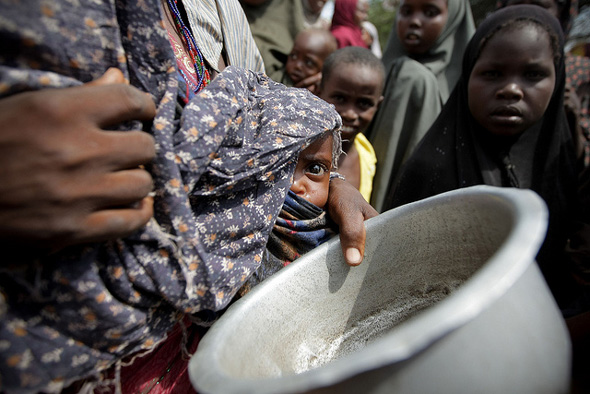
Image Credit: “Somalia Suffers from Worst Drought in Century,” courtesy of flickr user United Nations Photo/Stuart Price; charts arranged by Elizabeth Leahy Madsen, data from the UN Population Division and World Health Organization.
Showing posts from category zz Organizations.