-
Linking the Environment and Women’s Health at the World Conservation Congress
›November 30, 2012 // By Payal Chandiramani
People don’t often think of gender issues when they think of the environment, but in fact sustainable development in many of the world’s most bio-diverse regions has a lot to do with women’s health and well-being.
At this year’s World Conservation Congress, where the theme was improving the inherent resilience of nature, ECSP’s Sandeep Bathala presented alongside Blue Ventures’ Gildas Andriamalala about the connections between women’s health and the environment – specifically on the potential of population, health, and environment (PHE) approaches as an effective sustainable development strategy.
-
Can Family Planning Save Millions From Malnutrition in a Warming World?
›
As the effects of climate change become increasingly apparent, existing poverty and human security challenges are being compounded. Among them, food security is one of the most pressing, especially in the developing world.
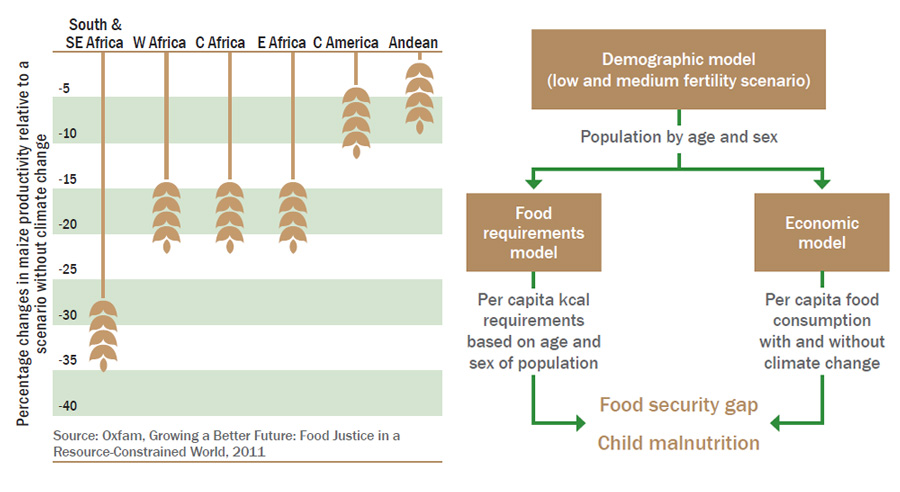
Based on a model developed by researchers at Futures Group, a pilot project in Ethiopia reveals that a lower fertility track for some countries could help compensate for the negative effects of climate change on agricultural yields. The study, conducted by MEASURE Evaluation and funded by USAID and The David and Lucile Packard Foundation, suggests incorporating family planning into existing climate change adaptation strategies.
-
Climate and Conflict in East Africa, and UNEP’s Plan to Avoid Future Famines
›While climate change will undoubtedly have an impact on societies throughout the world, researchers are still debating whether or not it will cause conflict. John O’Loughlin, Frank D.W. Witmer, Andrew M. Linke, Arlene Laing, Andrew Gettelman, and Jimy Dudhia use a quantitative approach to tackle some of “sweeping generalizations” that have come to characterize this debate in a new study, “Climate Variability and Conflict Risk in East Africa, 1990-2009,” published last month in PNAS. They found that while there is “no statistically significant relationship” between precipitation and conflict, increased heat is correlated with more conflict in East Africa. Still, they also found that other factors, like population size and the space-time lag for violence, predict conflict more reliably than either of the climate-related elements. -
Joel Cohen on Why Students Should Consider Demography
›“Why should you consider taking a demography course in college?” That’s the question Joel Cohen, noted demographer and professor at Rockefeller and Columbia University, looks to answer in a 45-minute introduction to demography produced by the Floating University and released for free on YouTube.
-
Green Solutions for Africa’s Urban Food Security
›September 26, 2012 // By Payal ChandiramaniFollowing the steady economic growth that many African countries have experienced in recent years and continued population growth, urbanization has accelerated rapidly on the continent as people turn to cities to take advantage of new economic opportunities. But growing cities have led to another problem. According to a new Food and Agriculture Organization (FAO) report, Growing Greener Cities in Africa, urban populations are exceeding the capacity of African cities to provide food for them, putting nearly 300 million people at risk of hunger and malnutrition, and greener strategies – urban agriculture and better water use – could help considerably.
-
Jill Hagey, Behind the Numbers
Sahel Drought: Putting Malnutrition in the News
›The original version of this article, by Jill Hagey, appeared on the Population Reference Bureau’s Behind the Numbers blog.
Over the past few months, the Sahel drought has sparked attention of news media and concerned citizens around the world. Throughout this media blitz, I have been struck by the sharp contrast between this coverage and how the devastating effects of malnutrition are usually portrayed. Malnutrition is often overlooked in favor of more “newsworthy” diseases, and it takes a crisis to focus our attention on this public health issue. Yet an emergency such as this drought – affecting more than 18 million people, including nearly 2 million children – is difficult to ignore.
-
PRB’s 2012 World Population Data Sheet
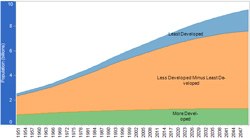
›“The most rapid population growth in many ways [occurs in] the countries that can least afford it,” said Carl Haub in a webinar on July 19 to launch the Population Reference Bureau’s (PRB) 50th annual World Population Data Sheet. This year, the report explores aging populations in more developed countries, rapid population growth in less developed countries, and the increased global prevalence of non-communicable diseases in an interactive map, which concisely illustrates global trends. PRB estimates that the world’s population is 7,057,075,000 as of mid-2012; the global population crossed the seven billion threshold in October 2011.
 “The most rapid population growth in many ways [occurs in] the countries that can least afford it,” said Carl Haub in a webinar on July 19 to launch the Population Reference Bureau’s (PRB) 50th annual World Population Data Sheet. This year, the report explores aging populations in more developed countries, rapid population growth in less developed countries, and the increased global prevalence of non-communicable diseases in an interactive map, which concisely illustrates global trends. PRB estimates that the world’s population is 7,057,075,000 as of mid-2012; the global population crossed the seven billion threshold in October 2011.
Aging Europe and East Asia
Haub explained that population growth in Europe has been declining since the 1970s and is more or less a “pre-programmed destiny” for these countries. People of child-bearing ages make up a smaller percent of the population in many more developed countries, so unless there is an “enormous increase” in total fertility rates, these populations will continue to decline for the foreseeable future.
Haub noted that these aging populations are unprecedented. In Germany and Italy, for example, 21 percent are over the age of 65; many other European countries have similar figures, as do other developed countries like Japan and South Korea. PRB expects these percentages to increase throughout the next century and for European countries to struggle to support greater numbers of retirees.
Many such states have already found it difficult to raise the retirement age, even though medical advances allow people to work until later ages. PRB projects that in Japan, 42 percent of their population will be over the age of 60 in 2050; if such a large percentage of the population is no longer in the labor force, it will be difficult for to find the resources to support them.
The report shows that the United States, on the other hand, is still experiencing modest population growth. The higher birthrate is in part due to immigration, as recent immigrants to the United States tend to have more children. Haub noted that European states have been reluctant to accept greater numbers of migrants to try to reverse their declining population.
Youthful Developing Countries
While the demographic destiny of aging countries is somewhat determined, the future for less developed countries is more uncertain. Many countries in sub-Saharan Africa, the Middle East, and South Asia have large and growing youth populations, and how many children these “future parents” will have is uncertain. That uncertainty is underscored by the variety of scenarios for future population growth. The UN has four variants – high, medium, low, and constant fertility – which vary considerably in their projections for future populations, and PRB’s global projections for 2050 are some 600 million people more than the commonly-used medium variant UN projection.
Rapid growth in the least developed countries is hardly a new phenomenon, but PRB breaks down the numbers to an impressive degree. The 2012 Data Sheet provides updated net migration rates, projected population as a multiple of today’s, infant mortality rates, rate of natural increase, and other basic statistics. PRB also provides population pyramids from the wealthiest and poorest quintiles of the population of Malawi, as an example of the utility of desegregating data to better allocate resources to the underserved. They found that while birthrates have begun to decline for the wealthiest one-fifth of Malawians, the poorest citizens still have a total fertility rate of over seven children per woman.
Measuring Health Systems
Devastating infectious diseases – malaria, tuberculosis, and HIV/AIDS – have long been entrenched in some of the least developed and most rapidly growing parts of the world. But this year, PRB began to assess health on a broader level by tracking deaths attributed to non-communicable diseases as well. Diseases like cardiovascular disease, diabetes, respiratory illness, and cancer are leading causes of death in developed countries, but they have also increased in prevalence in developing countries at an alarming rate.
PRB is not the only organization to take note of the change in disease predominance. The World Health Organization has issued guidelines targeting four factors which increase the risk of these illnesses: tobacco use, alcohol abuse, poor diet/obesity, and physical inactivity. The UN also called a special session last September to discuss non-communicable diseases. President of PRB Wendy Baldwin noted that the last such discussion on a health issue was 10 years ago about HIV/AIDS.
Baldwin also pointed out that non-communicable diseases can increase the burden on the health systems of developing countries even more so than in developed states. She reported that in south Asia, for example, people have heart attacks on average six years earlier than people in developed countries, meaning more families lose their primary breadwinners.
The risk factors for these non-communicable diseases are difficult to target, especially with increasing urbanization in developing countries. But in a video accompanying the report, Baldwin mentioned that raising the price of cigarettes is an effective way to reduce tobacco consumption, especially for youth. Some countries have also made progress in increasing physical activity through sports programs and making urban areas safer for pedestrians. “The low and middle income countries have a real opportunity to take really positive steps to confront that rise in non-communicable diseases and to address the risk factors that drive them,” she said.
The Data Sheet Over Time
The World Population Data Sheet has long been a vital resource for those in the population, health, and environment fields and has grown to include far more data than its first iteration in 1962. At first, the sheet had only four indicators: a population estimate for the year, annual rate of increase, crude birth rate, and crude death rate. Over time, PRB began measuring a greater number of key figures like infant mortality and life expectancy at birth. Population projections, a staple of the current version, were not added until 1978, perhaps in response to the inception of the United Nations World Population Projections in 1974.
Over the past five decades, the data sheet has been witness to some major shifts in global population trends. While PRB discourages researchers from comparing past data to current figures because the measures and methods of gathering information have likely changed over time, it is still possible to see the rise of importance in several trends based on the indicators PRB chose to focus on each year. For example, extremely young populations have been found to have profound effects on a country’s stability and prosperity, as have aging populations. The 1966 data sheet was the first to measure the percentage of the population under the age of 15, and it didn’t become a consistent data point until 1977.
The number of people living in cities in the developing world surpassed those in the developed in 1970, according to the UN, and in 1972, PRB began tracking the percentage of populations living in urban areas. HIV/AIDS indicators were added in 2000, as global awareness and a commitment to fighting the disease was rising.
PRB’s demonstrated commitment to continually adding more data and refining existing projections makes the data sheet is a valuable resource to those studying the problems of today and the future. Fifty years on, the amount of information collected is staggering. The data sheet provides a glimpse at not just how many people there are in the world, but also where and how they live.
For more information, take a look at the full data sheet!
Sources: Population Reference Bureau, UN Population Division.
Image Credit: PRB; Video: Noncommunicable Diseases and Youth in Developing Countries. -
Nancy Lindborg, The Huffington Post
For Yemen’s Future, Global Humanitarian Response Is Vital
›June 12, 2012 // By Wilson Center StaffThe original version of this article, by Nancy Lindborg, appeared on The Huffington Post.
This weekend in Sana’a, I had dinner with a group of young men and women activists who are on the forefront of Yemen’s historic struggle for a better future. They turned out for change with great courage last year, and at dinner, with great eloquence they outlined for me the many challenges facing Yemen during this critical transition period: conflict in the north and south, weak government institutions, cultural barriers to greater women’s participation, an upended economy, and one of the world’s highest birthrates. And, as one man noted, it is difficult to engage the 70 percent of Yemeni people who live in rural areas in dialogue about the future when they are struggling just to find the basics of life: food, health, water.
His comment makes plain the rising, complex humanitarian crisis facing Yemen. At a time of historic political transition, nearly half of Yemen’s population is without enough to eat, and nearly one million children under the age of five are malnourished, putting them at greater risk of illness and disease. One in 10 Yemeni children do not live to the age of five. One in 10. This is a staggering and often untold part of the Yemen story: a story of chronic nationwide poverty that has deepened into crisis under the strain of continuing conflict and instability.
Unfortunately, in communities used to living on the edge, serious malnutrition is often not even recognized in children until they are so acutely ill that they need hospitalization.
Continue reading on The Huffington Post.
Nancy Lindborg is the assistant administrator of the Bureau for Democracy, Conflict, and Humanitarian Assistance at the U.S. Agency for International Development.
Sources: U.S. Department of State.
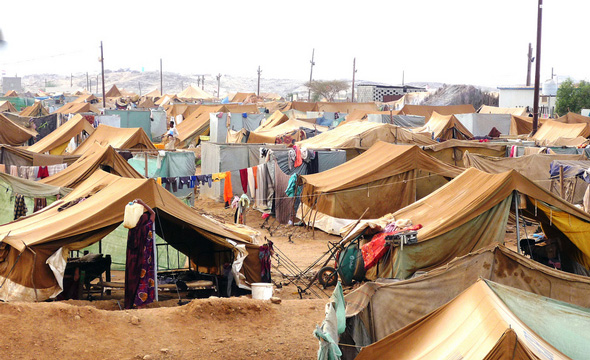
Photo Credit: Informal settlements near the Haddjah governorate, courtesy of E.U. Humanitarian Aid and Civil Protection.
Showing posts from category nutrition.

 “The most rapid population growth in many ways [occurs in] the countries that can least afford it,” said Carl Haub in a webinar on July 19 to launch the Population Reference Bureau’s (PRB) 50th annual