

-
GMOs: Can U.S.-China Cooperation Address Public Distrust and Increase Food Security?
›
Today, China feeds 1.38 billion people—approximately one-fifth of the global population—with about 10 percent of the world’s arable land. Compared to the United States, where each acre of land feeds one citizen on average, China has only 0.2 acres per person. This people-to-land mismatch helps explain why 9.3 percent of China’s population was undernourished in 2015.
-
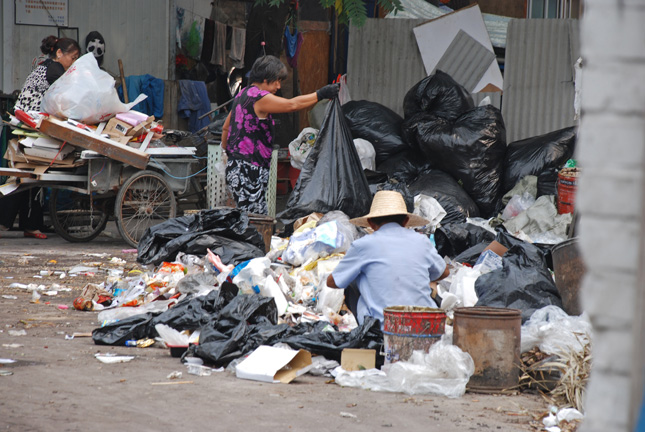
From Trash to Treasure: How Effective Sorting Helps China Utilize Food Waste
›
Launched in Beijing in 2013, the highly successful grassroots “Empty Your Plate” campaign encourages Chinese consumers to eliminate food waste from their meals. Starting with blog posts on Weibo (China’s equivalent of Twitter), this campaign rapidly swept the entire country and attracted support from the central government, which later issued a series of policies urging restaurants to use smaller dishes and remove minimum charges. However, the volume of food waste in China is still astonishing.
-
Feeding the Future? One Year After the Global Food Security Act
›“The United States should maintain a unique leadership role in global food security,” said former Senator Richard Lugar at a recent Center for International & Strategic Studies event, “The U.S. Global Food Security Strategy: Progress, Setbacks, and Forward Momentum,” which marked the one-year anniversary of the passage of the Global Food Security Act. Signed into law on July 20, 2016, the act required the interagency Feed the Future initiative to develop the first-ever U.S. Global Food Security Strategy.
-
Wilson Center’s Lisa Palmer Launches ‘Hot, Hungry Planet’
›A steadily increasing global population, growing food demand, and changing climate necessitate new kinds of thinking in agriculture but also fields like public health and energy, concludes a new book, Hot, Hungry Planet, by former Wilson Center Public Policy Scholar and current Senior Fellow at the National Socio-Environmental Synthesis Center Lisa Palmer.
-
Violence and Water Scarcity Threaten Historic Quadruple Famine
›An international food crisis is currently unfolding on a scale not seen since World War II. More than 20 million people in Somalia, Nigeria, South Sudan, and Yemen are in danger of famine. UN Under-Secretary-General and Emergency Relief Coordinator Stephen O’Brien said in March, “We are facing the largest humanitarian crisis since the creation of the United Nations.”
-
Ocean Fish Stocks on “Verge of Collapse,” Says IRIN Report
›The world’s ocean fish stocks are “on the verge of collapse,” according to a special report from IRIN. Already small fishers in poor countries are reeling, turning to ever-more destructive techniques and suffering from poor health and dwindling livelihoods.
-
Are We Headed Toward “Recurring Storms” of Global Food Insecurity?
›February 27, 2017 // By Erica MartinIt’s often assumed that in the modern era, food security is an achievable goal. But between 2007 and 2008, a confluence of conditions shook the international food system to its core, fueling unrest and riots in more than 40 nations around the world. What’s more, this “perfect storm” may have been only a harbinger of challenges to come, according to a new report by Emmy Simmons of the Center for Strategic and International Studies (CSIS).
-
Richard Choularton on 3 Steps to Avert the Famines We See Coming
›There has been great progress in anticipating famines in recent years, with most predicted six or more months ahead of time, says Richard Choularton, senior associate for food security and climate change at Tetra Tech, in this week’s podcast. But action to address their humanitarian impacts has lagged. Responses need to be more consistent and faster, he says, happening “almost without human intervention.”
Showing posts from category nutrition.
 There has been great progress in anticipating famines in recent years, with most predicted six or more months ahead of time, says Richard Choularton, senior associate for food security and climate change at Tetra Tech, in this week’s podcast. But action to address their humanitarian impacts has lagged. Responses need to be more consistent and faster, he says, happening “almost without human intervention.”

