-
Michael Kugelman, Ahmad Rafay Alam, and Gitanjali Bakshi for Foreign Policy
Why South Asia Needs a Kabul Water Treaty
›December 12, 2011 // By Wilson Center Staff
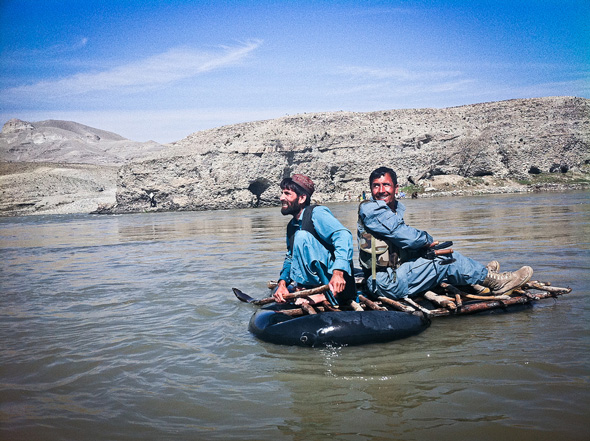
Pakistan is once again accusing India of water hegemony. This time, however, the accusation refers not to Indian damming of the Western Rivers in the disputed regions of Jammu and Kashmir, but to Indian support for Afghan development projects along the Kabul River. This accusation indulges in conspiratorial thinking, and distracts from a factual understanding of the water issues between the two countries.
-
The Legacy of Little America: Aid and Reconstruction in Afghanistan
›In 2007, the United States built a $305 million diesel power plant in Afghanistan – the world’s most expensive power plant of its kind. Yet the facility is rarely used, because the impoverished country cannot afford to operate it.
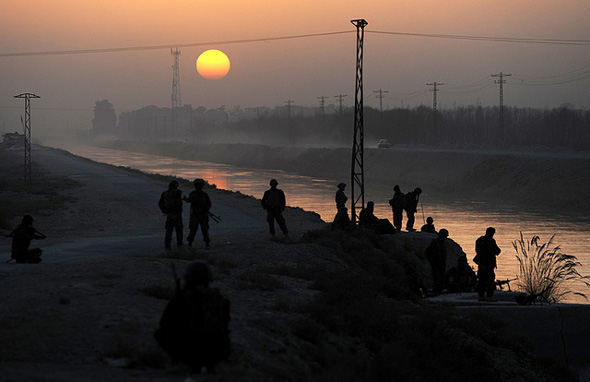
This ill-fated power plant does not represent the only time America has lavished tremendous amounts of money on development projects in Afghanistan that have failed to meet objectives. At a December 7 presentation organized by the Wilson Center’s Asia Program and co-sponsored with the Middle East Program and International Security Studies, Rajiv Chandrasekaran discussed Washington’s expensive attempts to modernize southern Afghanistan’s Helmand River Valley from the 1940s to 1970s – and the troubling implications for U.S. development projects in that country today.
From Morrison Knudsen to USAID
According to Chandrasekaran, a Wilson Center Public Policy Scholar and Washington Post journalist, the story begins after World War II, when Afghanistan’s development-minded king, Zahir Shah, vowed to modernize his country. He hired Morrison Knudsen – an American firm that had built the Hoover Dam and the San Francisco Bay Bridge – to construct irrigation canals and a large dam on the Helmand River. Shah’s view was that by making use of the Hindu Kush’s great waters, prosperity would emerge and turn a dry valley into fertile ground.
Unfortunately, problems arose from the start. The region’s soil was not only shallow, but also situated on a thick layer of subsoil that prevented sufficient drainage. When the soil was irrigated, water pooled at the surface and salt accumulated heavily. Yet despite these challenges, King Shah was determined to continue the massive enterprise. And so, increasingly, was the U.S. government – particularly when Washington began to fear that if it did not support this project, the Soviets would.
In 1949, the United States provided the first installment of what would amount to more than $80 million over a 15-year period. With this aid in hand, Morrison Knudsen not only completed the canals and dam but also constructed a new modern community. Americans called the town Lashkar Gah, but Afghans christened it “Little America.” It boasted a movie theater, a co-ed swimming pool, and a tennis court. Children listened to Elvis Presley records, drank lemonade, and learned English at Afghanistan’s only co-ed school.
However, problems continued to proliferate. Afghans in Lashkar Gah – many of whom had been lured away from their ancestral homelands on the promises of better harvests – did not experience greater farm yields. In the 1960s, the Afghans severed their contract with Morrison Knudsen, and began working directly with U.S. government agencies, including the new U.S. Agency for International Development (USAID). The result was some fairly productive farms, but, due in great part to waterlogging and soil salinity, the objective of transforming the region into Afghanistan’s breadbasket was not attained. U.S. funding slowed in the 1970s, and the grand experiment officially ended in 1978, when all Americans pulled out of Lashkar Gah following a coup staged by Afghanistan’s Communist Party.
“We Need To Find a Middle Ground”
What implications does all this have for U.S. reconstruction efforts in Afghanistan today? Chandrasekaran offered several lessons for American policymakers. One is “beware the suit-wearing modern Afghan” who claims to speak for his less-development-inclined countrymen. Another is to be aware that “there is only so much money that the land can absorb.” Finally, it is unrealistic to expect patterns of behavior to change quickly; he noted how Afghans in Lashkar Gah continued to flood their fields even when advised not to do so.
These lessons are not being heeded today, according to Chandrasekaran. He cited a USAID agricultural project, launched in late 2009, that allocated a whopping $300 million to just two provinces annually, with $30 million spent over only a few months. He said that while this effort may have generated some employment, the immense amounts of money at play fueled tensions among Afghans. Furthermore, contended Chandrasekaran, the program “focused too much on instant gratification and not on building an agricultural economy.”
In conclusion, Chandrasekaran insisted that foreign aid is essential in Afghanistan (and at the recently concluded Bonn Conference, Afghan President Hamid Karzai agreed, calling for financial assistance to continue until 2030). He described past aid efforts as either “starving the patient” or “pumping food into him.” We need to find a middle ground, he argued, and said that working on more modest projects with small Afghan nongovernment organizations is one possibility. The problem, he acknowledged, is that Washington is under pressure to spend ample quantities of money, and therefore depends on large implementing partners – no matter the unsatisfactory results.
Michael Kugelman is program associate with the Asia Program at the Wilson Center. -
Jason Bremner, Behind the Numbers
PHE Champions Bring Their Experiences From the Field to the International Family Planning Conference in Senegal
›December 8, 2011 // By Wilson Center StaffThe original version of this article, by Jason Bremner, appeared on the Population Reference Bureau’s Behind the Numbers blog.
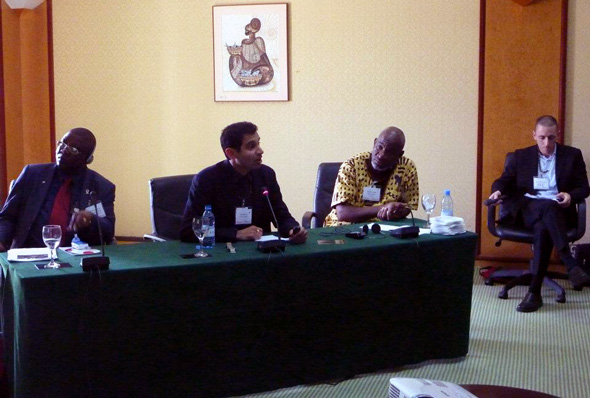
This past week at the 2011 International Conference on Family Planning, four practitioners from the field traveled from remote parts of the Democratic Republic of Congo, Ethiopia, Madagascar, and Tanzania to Dakar, Senegal, to share their successes and challenges in reaching remote communities with an integrated package of health, livelihood, and environment services. Together they made up the panel, “Reaching the Hardly Reached: Delivering Family Planning Through Population, Health, and Environment Integration.”
The panelists came from four environmental organizations whose starting point for working in these remote places was the protection of the biodiversity and natural resources upon which all life depends. Dr. Vik Mohan, physician and medical director for Blue Ventures, talked about how he and his organization transitioned from focusing initially on the conservation of coastal marine reserves and coral reefs to now working to improve health care, including access to family planning.
Blue Ventures, in response to community and women’s needs, opened a family planning clinic, and on the opening day, 20 percent of the women of reproductive age in the community came out to request contraceptives. Today they offer a whole spectrum of short- and long-acting contraceptive methods through partnerships with Marie Stopes International, Population Services International, and various funders. Blue Ventures reported that contraceptive prevalence had risen from 8 percent when they began in 2007 to 35 percent today.
Continue reading on Behind the Numbers.
Photo used with permission courtesy of PRB. Left to right: Didier Mazongo, WWF; Vik Mohan, Blue Ventures; Baraka Kalangahe, Tanzania Coastal Management Partnership; and Jason Bremner, PRB. -
Susanna Murley for The Huffington Post
Compromise Is Hard: The Problems and Promise of REDD+
›December 6, 2011 // By Wilson Center StaffThe original version of this article, by Susanna Murley, appeared on The Huffington Post.
In Durban this week delegates from around the world are examining the options to mitigate carbon emissions. What looks like the best chance for progress? REDD+ (for Reduced Emissions from Deforestation and Degradation, plus co-benefits – like conservation, sustainable management of forests, and enhancement of forest carbon stocks). REDD+ has been seen as a potentially powerful solution to solve both poverty and deforestation – in one fell swoop.
How does it work? Essentially, these programs would be funded by developed nations to help pay for community forestry projects in developing countries, if the communities can demonstrate – with verifiable data – that their efforts are saving forests that would have been destroyed or if they are planting trees that would permanently sequester carbon.
Will this work? Many other systems have tried and failed to reduce deforestation. In Indonesia, where an area of forest about the size of Nevada has been destroyed since 1990, activists have participated in demonstrations, legal actions, blockades and destruction of property to protest timber production. Many international NGOs have joined them in their campaigns against the forestry practices in Indonesia, releasing report after report on the “State of the Forest.” The World Bank and the International Monetary Fund have attempted to regulate forestry as conditions of their loans. None of it worked, and Indonesia continues to see massive amounts of illegal logging and deforestation.
Continue reading on The Huffington Post.
Sources: Center for International Forestry Research, Gellert (2010), MongaBay.com
Photo Credit: “Oil palm plantation,” courtesy of flickr user CIFOR (Ryan Woo). -
Book Preview: In ‘War and Conflict in Africa’, GWU Scholar Skeptical That Natural Resources Play a Leading Role
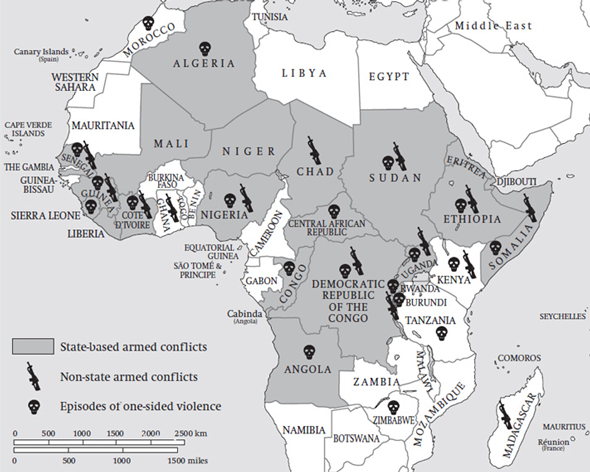
›November 30, 2011 // By Elizabeth Leahy MadsenWhile there is widespread agreement that the incidence of conflict in Africa is high, scholars and development agencies alike debate its driving forces and how to move toward solutions. Paul Williams, associate professor in the Elliott School of International Affairs at George Washington University and collaborator with the Wilson Center’s Africa Program, recently published a book that aims to both quantify African conflicts and devise a framework of their causes. In War and Conflict in Africa, Williams evaluates which factors explain the frequency of conflict in Africa during the post-Cold War era and how the international community has tried to build peace and prevent future conflict.
Although there have been promising trends toward establishing peace and democracy in some African countries, the continent still accounts for about one-third of all armed conflicts annually – more than Europe, the Middle East, and the Americas combined. International responses to these events range from focused humanitarian and conflict resolution efforts, to new regional organizations and global strategic and defense partnerships.
Seven of the 16 current UN peacekeeping missions operate in Africa, more than any other continent. The UK government has elected to spend nearly one-third of its development assistance in conflict-affected areas, and more than half of its “focus” countries are in Africa. In 2008, the Department of Defense created the U.S. Africa Command (AFRICOM), whose commander, General Carter Ham, in a speech to Congress earlier this year, described “an insidious cycle of instability, conflict, environmental degradation, and disease that erodes confidence in national institutions and governing capacity,” as motivation for American military attention. “This in turn often creates the conditions for the emergence of a wide range of transnational security threats,” he said.
Evaluating the Ingredients of Conflict
Williams rejects earlier theses that attribute conflict across the continent to a single factor, such as the boundary legacies of colonialism, greed, or ethnicity. Instead, he characterizes African conflicts as “recipes” composed of case-specific mixes of factors, many of which are underlying and only some of which are sufficient triggers for conflict. “Collier is wrong,” Williams explained in an email interview. “Governance structures are always an important part of the buildup to war.”
Five “ingredients” of conflict are examined in-depth: neo-patrimonial governance structures; natural and human resources; sovereignty and self-determination; ethnicity; and religion. Among these, the book presents a fairly skeptical view of resources, ethnicity, and religion as immediate drivers of conflict. This assessment that environmental and identity issues are not sufficient to generate conflict on their own aligns with the book’s overarching argument: The decisions of political actors can instigate conflict or motivate peace from virtually any context, manipulating factors such as ethnicity and religion for their own advantage.
Effects of Natural Resources Are “Open-Ended”
A widely publicized thread of peace and conflict studies posits that resources, either when scarce or abundant, have an important role in triggering wars. A 2009 UN Environment Programme report found that 40 percent of all internal conflicts since 1950 “have a link to natural resources.” Recent peer-reviewed research has suggested that certain environmental changes increase the likelihood of civil conflicts or are directly responsible for it. Yet the question remains a source of much debate. For his part, Williams asserts that natural resources alone are insufficient to cause conflict.
War and Conflict in Africa presents several reasons that researchers and policymakers should avoid linking resources directly to conflict without considering the influence of intervening factors. Chief among them is that the value of any resource is socially constructed – no stone or river carries worth until humans decide so. Therefore, Williams argues that “it is political systems, not resources per se, that are the crucial factor in elevating the risk of armed conflict.”
The book suggests that two extant theories successfully demonstrate the connection between resources and conflict. The first body of research finds that conflict is more likely in regions that face a combination of resource abundance and a high degree of social deprivation. The second theory suggests that the link between resources and conflict lies in bad governance, whether exploitative or unstable. Both theories have explanatory power for Williams’s central line of thinking: Resources can be either a blessing or a curse, depending on leadership.
“Inserted into a context where corrupt autocrats have the advantage, resources will strengthen their hand and generate grievances,” he writes (p. 93). “Inserted into a stable democratic system, they will enhance the opportunities for leaders to promote national prosperity.”
Population and the Environment
Williams does accede that particular resource factors – land and demography, for example – may play a more significant role than others in conflict, but calls for more research. In a brief discussion of population age structure, the book suggests that there is no single relationship between demography and conflict but multiple ways that the two can relate. Williams mentions the theory that “large pools of disaffected youth” with few opportunities can raise the risk of volatility. However, he then notes other research showing that the most marginalized members of certain African societies are less likely to participate in political protests and more likely to tolerate authoritarian rule than those who are better off.
“The most marginalized from society are the truly destitute without patrons and suffering from severe poverty. They may well be inclined to join an insurgency movement once it begins to snowball but they will not usually play a key role in establishing the rebel group in the first place,” Williams said. However, “any time there are large pools of poor and unemployed youth there is the potential for leaders to manipulate them.”
On environmental resources, the book argues that land should be a central feature of quantitative research on the relationship between resources and conflict. Most African economies continue to rely on agriculture, and Williams observes that land has been “at the heart” of many conflicts in the region through a variety of governance-related mechanisms relating to its management and control. He places less emphasis on water scarcity as a potential factor in conflict, noting that the 145 water-related treaties signed around the world in the past decade auger well for cooperation rather than competition.
Williams is also dubious of emerging arguments that climate change could directly increase the incidence of conflict, either through changing weather patterns or climate-induced migration.
“Because armed conflicts are, by definition, the result of groups choosing to fight one another, any process, including climate change, can never be a sufficient condition for armed conflict to occur,” he argued. “Armed conflicts result from the conscious decisions of actors which might be informed by the weather but are never simply caused by it.”
No Simple Formula
Williams is not the only observer to find the narrative that resource shortage (or abundance) precipitates conflict too simplistic. His message to policymakers is a common refrain from academics and analysts seeking to counteract policymakers’ quest for simple formulas: We need more data.
“When deciding how to spend our money, we need to spend more of it on developing systems which deliver accurate knowledge about what is happening on the ground, often in very localized settings,” Williams said. War and Conflict in Africa contributes to a more complex understanding of the political actors and systems that catalyze or prevent conflict and offers a cautionary tale to those who seek only proven, easy predictions.
Elizabeth Leahy Madsen is a consultant on political demography for the Wilson Center’s Environmental Change and Security Program and senior technical advisor at Futures Group. She was previously a senior research associate at Population Action International. Full disclosure: She was a graduate student of Paul Williams’ in 2007.
Sources: DFID, Englebert and Ron (2004), Ham (2011), Hsiang et al (2011), Kahl (1998), Leysens (2006),Østby et al (2009), Radelet (2010), Themnér and Wallensteen (2011), UNEP (2009), UN Peacekeeping, Williams (2011)
Image Credit: Conflicts in Africa 2000-09, reprinted with permission courtesy of P.D. Williams, War and Conflict in Africa (Williams, 2011), p.3. -
The Yasuní-ITT Initiative Is a Practical Climate Solution That Must Be Embraced at Durban
›As the world turns to Durban, South Africa, for this year’s UN climate summit, new findings are turning up the heat on the urgency to address climate change. The reality though is that we no longer have the luxury of resting our hopes solely on an internationally binding climate agreement; we must begin to look more closely at supporting immediate and tangible solutions. By complementing a global top-down effort of continued international negotiations with bottom-up approaches, we increase our chances at mitigating the most damaging effects of climate change. One of the most innovative models of such a bottom-up approach is the Yasuní-ITT Initiative being undertaken by the Government of Ecuador and supported by the UN Development Programme’s Multi-Partner Trust Fund Office (MPTF Office).
-
Supply and Demand, Land and Power in the Global South
›In “Competition over Resources: Drivers of Insecurity and the Global South,” author Hannah Brock examines how an increased demand for non-renewable resources could lead to insecurity and contribute to local and international discord. The first of four papers examining what the Oxford Research Group has identified as the “most important underlying drivers of insecurity,” the paper focuses on competition over resources – specifically energy, water, and food – and argues that “a new way of approaching security is needed, one that addresses the drivers of conflict: ‘curing the disease’ rather than ‘fighting the symptoms.’” Through numerous examples, Brock illustrates the various strategies that nations are currently undertaking to satisfy demand and cautions that “where northern states and corporations buy access to southern resources, regulatory principles may be required to ensure this competition does not impair the human rights and security of local populations.”A new briefing paper from Oxfam, “Land and Power: The growing scandal surrounding the new wave of investments in land,” heavily criticizes the rising trend of foreign land acquisitions, or “land grabs,” that have occurred since the 2007-08 food prices crisis, calling them an infringement on the rights of more vulnerable populations and decrying their environmental impact. The authors use case studies in Uganda, Indonesia, Guatemala, Honduras, and South Sudan to argue that land grabbing is a type of “development in reverse.” “National governments have a duty to protect the rights and interests of local communities and land rights-holders,” Oxfam writes, “but in the cases presented here, they have failed to do so.” The authors conclude with recommendations to improve transparency and shift power more towards local rights. -
Jill Shankleman for the U.S. Institute of Peace
Lifting the Veil: What Can We Learn From EITI Reports?
›November 22, 2011 // By Wilson Center StaffThe original version of this article, by Jill Shankleman, appeared on the United States Institute of Peace’s International Network for Economics and Conflict blog.
The Extractive Industries Transparency Initiative (EITI), launched in 2002, now has 35 participating countries that have committed to publish annual, independently verified reports on all mining, oil, and gas payments made by companies to governments and all revenues received by governments from these extractive industry companies. The EITI is based on the premise that making public reliable information about extractive industry payments will make corruption and theft of “resource rents” more difficult and will enable informed debate amongst citizens and politicians about how to use resource wealth. While initially some governments could object to joining on the grounds that EITI was “a bad boys’ club,” Norway is now a fully engaged member; the United States has just announced that it will participate; and Australia stated it will pilot-test the system.
The participants in EITI also include Liberia, East Timor, Sierra Leone, and Côte d’Ivoire, which, as post-conflict states, depend more than most on effective management of their resource wealth to establish the foundations for sustained economic growth. Citizens, journalists, and government officials in all the EITI countries now have access to some information on what extractive industry companies are paying to the government and what the government is receiving.
However, examination of country EITI reports reveals several shortcomings in reporting. What do the reports tell us beyond the headline numbers (i.e., total revenues and the size of any discrepancy between what companies report paying and what governments report receiving)? What do they tell us about revenue trends or about the significance of these revenues in total government receipts? How many countries have a pattern similar to Tanzania whereby the largest contribution documented in their first report was through companies collecting payroll taxes on behalf of the government? What is the value of “social investments,” training levies, or research and development contributions made by extractive industry companies? Where, and to what extent, do oil, gas and mining companies make payments to local governments?
Continue reading on the International Network for Economics and Conflict blog.
Jill Shankleman is a senior scholar at the Woodrow Wilson Center and former senior social and environmental specialist at the World Bank.
Video Credit: “Transparency Counts,” courtesy of vimeo user EITI International.
Showing posts from category natural resources.