Showing posts from category natural resources.
-
VIDEO – Juan Dumas on Natural Resources, Conflict, and Peace
›February 24, 2010 // By Michelle NeukirchenMediation and conflict resolution around natural resources require “long-term engagement, timely interventions, and lots of flexibility,” says Juan Dumas, senior advisor for the Fundación Futuro Latinoamericano in Quito, Ecuador. The Woodrow Wilson Center and the Fetzer Institute hosted Dumas for a roundtable event on Pathways to Peace: Stories of Environment, Health, and Conflict. In this interview with ESCP Director Geoff Dabelko, Dumas shares key lessons learned from his experience with his NGO that specializes in prevention and management of socio-economic conflicts around natural resources.
In order to overcome challenges posed by current funding procedures, the foundation has been trying to establish an “early-action fund” that would provide flexible funding to facilitate conflict resolution dialogue. “With the right capacities at the right time… you can make a difference… you can prevent the escalation of conflict into violence… and create a governance path for that conflict to be addressed in a different way,” Dumas says. -
Video—Ken Conca: ‘Green Planet Blues: Four Decades of Global Environmental Politics’
›February 19, 2010 // By Julia Griffin“Much of the conversation about the global environment, frankly, is an elite conversation,” says Ken Conca, professor of government and politics at the University of Maryland. “But at the same time there are community-level voices, there are voices of indigenous people, there are voices of the powerless, as well as the powerful…. I think it’s important to capture them and not just limit [the conversation] to the most easily accessible voices.”
Conca and co-editor Geoff Dabelko include these oft-muted voices in the newly released 4th edition of Green Planet Blues: Four Decades of Global Environmental Politics. “One of the things we were really trying to achieve was to give people a sense of the history,” said Conca. To fully understand the origins of today’s debates, students must go back to the beginning of the last four decades of international environmental politics.
Three key paradigms—sustainability, environmental security, and ecological justice—frame the debates in Green Planet Blues. “Ideas do matter,” says Conca. “They really do change the world, and one of the premises of our work and of the book is to try to understand what sorts of ideas people bring to the table when they think of global environmental problems.” -
Video—Integrating Population, Health, and Environment (PHE) to Conserve Ethiopian Wetlands
›February 1, 2010 // By Julia GriffinIn our latest video interview about PHE programs in Ethiopia, Zuna–a village elder from the Mettu Woreda region of Ethiopia—describes how an integrated intervention by the Ethio-Wetlands and Natural Resources Association (EWNRA) has benefited her community.
EWNRA aims to raise awareness within Ethiopian communities and governmental organizations of the importance of sustainable wetlands management. The organization also imparts local-level training on resource conservation and wise-use labor techniques.
Zuna recounts how EWNRA provided welcome training in sanitation and housekeeping practices that increased both safety and sustainability within her community. The more efficient, cleaner-burning wood stoves introduced in Mettu Woreda, for example, have improved local air quality while decreasing the frequency of skin burns and amount of harvested fuel required for cooking and other activities.
“We are benefiting from all this and I think the benefits from this intervention are good,” she says through an interpreter. “I want them to keep doing this and hopefully we will improve our activities working with them.” -
Collier and Birdsall: Plunder or Peace
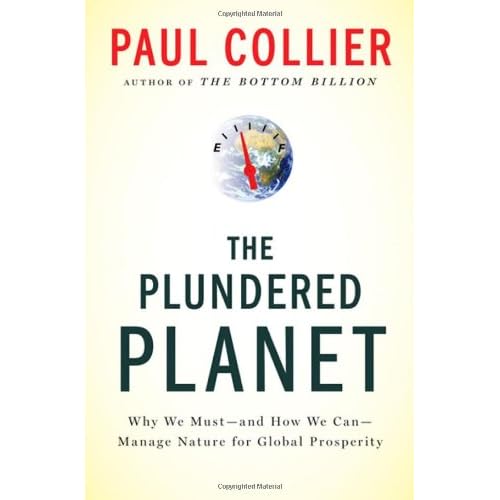
›January 22, 2010 // By Julien Katchinoff In a preview of his new book The Plundered Planet: Why We Must – and How We Can – Manage Nature for Global Prosperity, Paul Collier dispelled the common perception that Africa’s indentified resource reserves are the world’s largest. In actuality, it is estimated that up to four-fifths of the value of subsoil assets in the African continent are yet to be discovered. “That is the big story,” Collier remarked. “Here are assets which could finance transformation….but historically haven’t.” Instead, these resources have been plundered.
In a recent event hosted by the U.S. Institute of Peace, Paul Collier, professor of economics and director of the Center for the Study of African Economies at Oxford University, and Nancy Birdsall, president of the Center for Global Development, discussed how resource-rich environments in developing countries have been traditionally misused. The two also proposed strategies to disrupt these processes and transform resource “curses” into deeply needed support for peace and stable development.
Conflict and instability in countries whose economies are heavily invested in natural resource have often hindered local development and security. Many of these countries—including Cambodia, Angola, Indonesia, and DRC—have suffered from one of two forms of plunder:
Types of Natural Resources Plunder:
1. Where the few steal from the many:
Natural assets are, by definition, without natural owners, and therefore lie as easily taken common goods. “This process of expropriation opens up a whole array of dysfunctional variants, many of which are violent,” Collier noted.
2. Where the present steals from the future:
Intertemporal mismanagement is a possibility, as unlike man-made assets, natural assets belong to all generations.
Operating from a worldview of weak sustainability, where profits from natural assets are reinvested for the benefit of future generations, Collier suggested that natural resource rights are more akin to “rights of stewardship” than traditional property rights. “We may well transform that value into something that is more productive, but if we pull up natural assets from the ground, we should leave to the future something that is equivalently valuable.”
Collier argued that the successful harnessing of natural resources for stable and sustainable development depends on the application of a tenuous decision chain:
Natural Resources Decision Chain:
1. Discovery Process:
Failure in this phase stems from poor property rights, and the time consistency problem—uncertainty that conditions and regulations that make expensive upfront investments profitable today will remain in place in the future.
2. Appropriate Taxation:
Currently, as a result of poor negotiations or limited information regarding the status of resources, governments are unable to craft tax regimes which effectively capture resource rent.
3. Avoiding the Delta:
Sustainable management any discovered subsoil assets must avoid a local “Nigerian Delta” catastrophe. Clearly designating the government as the sole responsible agent for resource rents may limit such failures.
4. Saving the money:
To avoid plunder of the future by the present, Collier suggested that, though politically difficult, a proportion of revenue streams must be delineated from general accounts.
5. Building the capacity to invest in the country:
Collier deemed the inability of resource-rich countries to attract diversified investment as the “killer link.” Governments must use returns from subsoil assets to fund “investment in investment”—directing public capital toward transportation and utility infrastructure, education, health, and other short-term projects. Once in place, such projects encourage future public and private investments, thereby multiplying long-term returns.
As with many complex systems, Collier warned that the chain is only as strong as its weakest link. If one link fails, “the chain won’t pull the country from poverty to prosperity.” On the other hand, if each link holds, the value is tremendous. ”[Y]ou really can pull the country from poverty to prosperity over the course of a generation. There are no fixes in economics that are faster than that.”
Ultimately, Collier and Birdsall emphasized that success depends upon the development of an informed and competent “critical mass” of people. Even the strongest decision chain will fail if it is not underwritten by a majority of the population. Birdsall reiterated the need for public participation in the process, possibly through direct income distribution or responsible interventions by non-vested third parties.
Photo: Courtesy of Oxford University Press. -
UNEP’s David Jensen on Linking Environment, Conflict, and Peace in the United Nations
›November 16, 2009 // By Sajid AnwarAt the United Nations, “we see more and more interest in looking at natural resources: how do they contribute to a conflict, and how can they contribute to peacebuilding,” says David Jensen of the UN Environment Programme’s Post-Conflict and Disaster Management Branch in a video interview with ECSP Director Geoff Dabelko.
For example, UNEP experts travel to the UN Peacebuilding Commission’s target countries to examine how natural resources may have contributed to conflict and what role they could play in restoring peace, explains Jensen: “A new module was approved on environment and natural resources. So it’s now integrated within the overall UN post-conflict assessment framework,” which is used by the UN, World Bank, and the European Commission.
Currently, “there are tremendous opportunities,” Jensen says, for environmental security to become a mainstream issue within the United Nations, as exemplified by the Secretary-General’s report, Climate change and its possible security implications. -
Today: International Day for Preventing the Exploitation of the Environment in War and Armed Conflict
›November 6, 2009 // By Sajid Anwar“There can be no durable peace if the natural resources that sustain livelihoods are damaged or destroyed,” said UN Secretary-General Ban Ki-moon, in his message today, the 9th annual International Day for Preventing the Exploitation of the Environment in War and Armed Conflict. He called for “Member States to clarify and expand international law on environmental protection in times of war.”
Coinciding with this year’s observance, the United Nations Environment Programme, along with the Environmental Law Institute, released “Protecting the Environment During Armed Conflict: An Inventory and Analysis of International Law,” which finds serious gaps and weaknesses in international law and offers 12 recommendations for the UN and policymakers.
“Destroying and damaging the natural assets and ecological infrastructure of a country or community should be an issue of highest humanitarian concern,” said UNEP Executive Director Achim Steiner in a UNEP press release.
Earlier this year, Steiner spoke at the Wilson Center to launch From Conflict to Peacebuilding: The Role of Natural Resources and the Environment. In a recent ECSP video interview, UNEP’s David Jensen spoke about how post-conflict resource management can be a platform for economic recovery and cooperation. -
VIDEO: David Jensen on UNEP and Natural Resource Management After Conflict
›November 5, 2009 // By Sajid Anwar“We don’t do the gloom-and-doom scenarios anymore,” says David Jensen of the UN Environment Programme’s Post-Conflict and Disaster Management Branch, in a video interview with ECSP Director Geoff Dabelko. “We focus on the opportunities provided by resource management. We focus much more on how they can support economic recovery, how they support livelihoods, how environment can be a platform for cooperation.”
When conducting its post-conflict environmental assessments, UNEP looks for “entry points using specific hotspots or specific sites that people can really understand and see the linkage between environment and conflict, or between their livelihoods and natural resources,” says Jensen. “We always try to be in the field and demonstrate the value of better resource management” for post-conflict recovery. -
Climate Change Is Linked to Security, But Don’t Overplay It
›August 31, 2009 // By Wilson Center StaffAs the impacts of climate change on national security are beginning to receive attention at the highest levels of government, climate-security experts must avoid oversimplifying these complex connections, said Geoff Dabelko, director of the Environmental Change and Security Program at the Woodrow Wilson Center.
“Today, with climate change high on the political agenda, powerful actors in the security community are assessing its potentially dangerous effects on conflict and military readiness,” Dabelko said. In “Planning for Climate Change: The Security Community’s Precautionary Principle” in the journal Climatic Change, Dabelko views the defense community’s interest in climate change as an understandable development. “Climate change poses threats and opportunities that any risk analysis calculation should take seriously—including the military’s planning efforts, such as the Quadrennial Defense Review,” he says.
“However, it is important to remember that in the mid-1990s, advocates oversold our understanding of environmental links to security, creating a backlash that ultimately undermined policymakers’ support for meeting the very real connections between environment and conflict head-on. Today, ‘climate security’ is in danger of becoming merely a political argument that understates the complexity of climate’s security challenges.”
In a new op-ed in the Bulletin of the Atomic Scientists, Dabelko offers some advice to scientists, politicians, and the media:- Don’t oversimplify the links between climate change and violent conflict or terrorism.
- Don’t neglect ongoing natural resource and conflict problems.
- Don’t assume we know the precise scale and location of climate-induced migration.
- Don’t forget that climate mitigation efforts can introduce social conflict and needs to be factored into both mitigation and adaptation efforts.