

Showing posts from category natural resources.
-
Nigeria’s Future Clouded by Oil, Climate Change, and Scarcity [Part Two, The Sahel]
›November 19, 2010 // By Schuyler NullIf southern Nigeria’s demographic and environmental problems have helped fuel today’s conflicts, it’s the north’s issues that may feed the conflicts of tomorrow.
Nigeria’s lack of development and poor governance is not exclusive to the delta region, only more well-known because its oil reserves. The north of the country, which is predominately Muslim and accounts for more than half of Nigeria’s population, faces many of the same problems of environmental degradation, lack of jobs, and inadequate infrastructure. Northern Nigeria is also growing much faster than the south, with a total fertility rate of 6.6 children per woman, compared to 4.6 in the southern states. The median age of first-time mothers in northern Nigeria is only 18 years old.Nigeria holds nearly a fifth of the entire population of sub-Saharan Africa. By 2050, it’s expected to pass Indonesia, Brazil, and Bangladesh and take its place among the top five most populous countries in the world, according to UN estimates. But a litany of outstanding and new development, security, and environmental issues – both in the long-troubled Niger delta in the south and the newly inflamed north – present a real threat to one West Africa’s most critical countries.
If southern Nigeria’s demographic and environmental problems have helped fuel today’s conflicts, it’s the north’s issues that may feed the conflicts of tomorrow.
Nigeria’s lack of development and poor governance is not exclusive to the delta region, only more well-known because its oil reserves. The north of the country, which is predominately Muslim and accounts for more than half of Nigeria’s population, faces many of the same problems of environmental degradation, lack of jobs, and inadequate infrastructure. Northern Nigeria is also growing much faster than the south, with a total fertility rate of 6.6 children per woman, compared to 4.6 in the southern states. The median age of first-time mothers in northern Nigeria is only 18 years old.
Climate, Culture, and Discontent in the North
Last summer, in an offensive that stretched across four northern states, a hardline Islamist group called Boko Haram emerged suddenly to challenge the government, attacking police stations, barracks, and churches in escalating violence that claimed more than 700 lives, according to The Guardian. The government responded with a brutal crackdown, but recent targeted killings and a prison break seem to indicate the group is back.
Perhaps most distressingly, Boko Haram appears to have won some local support. Said one local cloth trader to The New York Times in an interview this October, “It’s the government’s fault. Our representatives and our government, they are not sincere. What one person acquires is enough to care for a massive amount of people.”
As in the south, mismanagement of natural resources has also played a role in creating a dangerous atmosphere of distrust in the government. After gold was discovered this spring in northwestern Nigeria, many under- and unemployed flocked to the region to try their luck, but they also unwittingly contaminated local water with high levels of lead. Although the state health officials say they have now identified more than 180 villages thought to be affected, the epidemic was only discovered after a French NGO stumbled upon it while testing for meningitis in June. More than 400 infant deaths have been connected to the mining, according to Reuters.
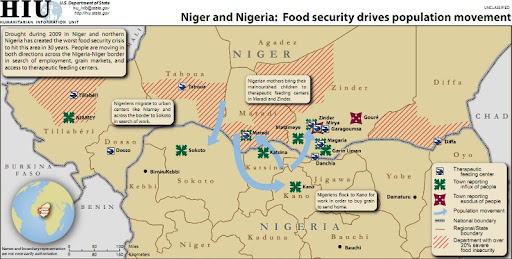
Contributing to natural resource-related misery in the north are climatic changes. Declining rainfall in the West African Sahel over the last century has pushed rain belts successively south, driving pastoralists into areas often already occupied. According to Anthony Nyong’s work, presented in ECSP Report 12, these changes have elevated competition over natural resources to the single most common cause of conflict in northern Nigeria in recent years. In addition to the long-term trend of declining rainfall, an acute drought in 2009 and another this year in neighboring Niger and Chad have created the worst food security crisis in 30 years. The droughts have also driven a great deal of cross-border migration into Nigeria, which itself saw lower than usual rainfall in the north, especially the northeast, around the ever-disappearing Lake Chad (see map above for resulting migration patterns).
What rain did fall in the border areas fell suddenly and torrentially, causing rampant flooding that affected two million people. The floods not only caused physical damage but also came just before harvest season, destroying many crops and further reducing food security. Made more vulnerable by the number of displaced people and flooding, the area was then hit with its worst cholera outbreak in years, which has killed 1,500 people so far and spread south.
Cholera is not the only preventable disease to flourish in northern Nigeria in recent years. In 2003, cleric-driven fear of a U.S. plot to reduce fertility in Muslim women caused the widespread boycott of a UN-led polio vaccination drive. The fast-spreading disease then emerged in six of Nigeria’s neighbors where the disease had previously been eradicated. The northern states today remain the only consistently polio-endemic area in Africa, according to the Global Polio Eradication Initiative.
“A Stable Nigeria Is a Stable Africa”
Nigeria’s size and its wealth of natural resources make it a strategically important country for the future of the region. “A stable Nigeria is a stable Africa,” said Wilson Center scholar and former NEITI officer Uche Igwe in an interview. “Nigeria is 150 million people and the minute Nigeria becomes unstable, the West Africa sub-region will be engulfed.”
While there have been some strides in recent years in reducing corruption and addressing infrastructure needs (for example, NEITI’s work to promote revenue transparency), the development, health, environmental security, and human security situations remain dire in many parts of the country. With one of the fastest growing populations in the world and severe environmental problems in both the north and the south, scarcity will almost certainly be a challenge that Nigeria will have to face in the coming years. How the government responds to these challenges moving forward is therefore critical.
In 2008, in response to high oil prices, British Prime Minister Gordon Brown announced his intentions to send military aid to help combat Niger Delta militants. The statement was met with dismay from humanitarian organizations and caused the collapse of a ceasefire (which was then resumed for a time and now seems to be falling apart again). Brown was forced to backtrack into simply offering training support to Nigerian security forces.
In terms of U.S. assistance, USAID requested $560 million for Nigeria in FY 2010 – 75 percent of which is allocated towards HIV/AIDS – and the U.S. military has engaged in joint exercises with Nigerian forces. But so far, little has been done to integrate U.S. aid in a cohesive manner. Given the breadth of these issues, such integration is crucial.
“We need partners, like the United States and Europe, who have a stake in stability – in Nigeria, the Niger Delta, the Gulf of Guinea, and the world,” Igwe said. It remains to be seen what the Nigerian reaction would be to an offer of aid from the West that addresses not only the country’s security issues but also its myriad other problems, in a substantial and integrated fashion.
Part one on Nigeria’s future – The Delta – addresses oil, insurgency, and the environment in the south.
Sources: AFP, AFRICOM, AP, BBC, Global Polio Eradication Initiative, The Guardian, Independent, The New York Times, ReliefWeb, Reuters, SaharaReporters, USAID.
Photo Credit: “The Ranch,” courtesy of flickr user Gareth-Davies, and “Niger and Nigeria: Food security drives population movement,” courtesy of the U.S. State Department. -
Nigeria’s Future Clouded by Oil, Climate Change, and Scarcity [Part One, The Delta]
›November 18, 2010 // By Schuyler NullNigeria holds nearly a fifth of the entire population of sub-Saharan Africa. By 2050, it’s expected to pass Indonesia, Brazil, and Bangladesh and take its place among the top five most populous countries in the world, according to UN estimates. But a litany of outstanding and new development, security, and environmental issues – both in the long-troubled Niger Delta in the south and the newly inflamed north – present a real threat to one of West Africa’s most critical countries.
A 400-Year CurseNigeria collected $46 billion in oil revenue during FY 2009, trailing only Saudi Arabia, Iran, and the United Arab Emirates. Despite their country’s mineral wealth, however, roughly 70 percent of Nigerians live below the poverty line, with the oil-producing south facing particularly abject deficiencies.
“I have never worked in an area as bereft as the Niger Delta – it is shockingly undeveloped,” said former Wilson Center fellow Deirdre Lapin, in a phone interview with ECSP (listen to the audio embedded above for the full interview). Lapin worked in community development for Shell in Nigeria from 1997-2003 and also spent time at USAID and UNICEF. “Compared to everywhere else I have been, it is without question the most neglected and the least advanced in terms of general development and welfare for the ordinary person,” she said.
According to the UN, the Niger Delta accounts for upwards of 80 percent of Nigeria’s foreign exchange earnings and about 70 percent of total government revenues. Instead of benefiting from its mineral wealth, the delta has suffered tremendous environmental damage that has spurred a grassroots anti-oil (and later anti-government) insurgency. During the oil companies’ drilling drive in the 1970s, it was not uncommon to see large amounts of tar collected on the roots of mangroves and the sides of creeks, and oil slicks were frequent, Lapin said.
The environmental situation in the delta improved as production plateaued, but due to oil theft, poor maintenance, and derelict equipment and pipelines scattered across the delta, spills continue. According to The New York Times, by some estimates, the delta has endured the equivalent of an Exxon Valdez spill every year, for the last 50 years. But there has never been an impartial, empirically based environmental study of the impact of the oil and gas industry on the delta, Lapin said, which would be an important step forward. (A UNEP study is currently underway but has already been criticized for alleged inaccuracy.)
Southern Nigeria’s infamous duality – miserable lack of infrastructure, services, and security in the midst of abundant natural resources – helped give rise to the term “resource curse” among development specialists, a term which has since been applied to similar situations in the Democratic Republic of Congo, Sierra Leone, and even Afghanistan. Lapin pointed out that in the eastern part of the delta, the resource curse actually goes back 400 years, to the slave trade and palm oil.
“Blood Oil” and Scarcity in the Delta
The sophisticated insurgency in the delta began as a response to the oil and gas industry, but has in many ways become dependent on it. Groups of armed “boys” – some of whom are remnants of political-intimidation efforts during the 2003 elections – have become notorious in the delta and abroad, often putting on shows for the media. Some of these groups are loosely organized under the moniker MEND (Movement for the Emancipation of the Niger Delta), with the stated intent of driving the oil companies out of the delta in response to environmental destruction and lack of revenue sharing, but others simply profit through extortion, racketeering, and oil theft (also known as “bunkering”). At the peak of their activities, insurgent activity has cut oil production between 25 and 35 percent, Lapin said, prompting oil companies to move further and further off-shore in recent years.With unemployment in the delta at 90 percent by some estimates, militancy has become a viable way of life for many. Bunkering can net up to $60 million a day, according to a BBC report. The practice, which former president Umaru Yar’Adua called Nigeria’s “blood oil,” costs the government up to $5 billion annually, and many gangs are rumored to have political connections that protect them in exchange for their services.
Contributing to the delta’s propensity for conflict is the region’s demography.
“There are probably 120 mutually unintelligible languages and dialects that are spoken [in the Niger Delta] and 40 major identifiable ethnic groups,” Lapin said. Because of the number of creeks and lack of infrastructure, the region’s 20 million inhabitants are fractured into many small communities – roughly 80 percent are under 1,500 people, according to Lapin. In addition to its splintered social structure, population growth and years of conflict have left a mass of unemployed delta residents who have adopted a “siege mentality,” as a UN report puts it (a feeling especially prevalent among the young). With three percent population growth and local fish and agriculture sectors on the decline, it is likely the Niger Delta will face increased scarcity in the coming years, further fueling discontent.
“What is truly needed in order to put Nigeria on a solid footing for the future is a government with very clear objectives for the economic and social development of the country, putting those forward as the priorities, changing the style in which governance is taking place today,” Lapin said. “And that will require something of a revolution, a major sea-change.”
Part two on Nigeria’s future – The Sahel – addresses conflict, scarcity, and demographics in the northern part of the country and concludes with recommendations for the future.
Sources: BBC, CIA, Energy Information Agency, The Guardian, The New York Times, Population Reference Bureau, Reuters, UN.
Photo Credit: “Niger Delta oil disaster,” courtesy of flickr user Sosialistisk Ungdom – SU, and a NASA Space Shuttle Overflight photo of the Niger Delta, courtesy of NASA. -
Colin Kahl on Demography, Scarcity, and the “Intervening Variables” of Conflict
›“One of the major lessons of 9/11 is that even superpowers can be vulnerable to the grievances emanating from failed and failing states,” said Colin Kahl, now deputy assistant secretary of defense for the Middle East, at an ECSP event at the Wilson Center in October 2007. However, “if poverty and inequality were enough to lead to widespread civil strife, the entire world would be on fire.”
“I think any in-depth examination of particular cases shows that there’s a complex interaction between demographic pressures, environmental degradation and scarcity, and structural and economic scarcities – that they tend to interact and reinforce one another in a kind of vicious circle,” Kahl said.
“It’s really important to keep in mind that any attempt to address…environmental and demographic factors should focus not just on preventing environmental degradation, or slowing population growth, or increasing public health. They must also focus on those intervening variables in the middle that make certain societies and countries more resilient in the face of crisis.”
The “Pop Audio” series is also available as podcasts on iTunes. -
Governing the Far North: Assessing Cooperation Between Arctic and Non-Arctic Nations
›November 12, 2010 // By Ken CristDespite fears of an unregulated race for Arctic territory and resources, there is currently considerable international cooperation occurring to address key issues in the Far North, said Betsy Baker of the Vermont Law School at an event hosted by the Canada Institute in collaboration with the Friedrich Ebert Foundation, the Kennan Institute, and the Environmental Change and Security Program. The program provided a timely forum to discuss efforts by Arctic and non-Arctic nations to cooperate on key environmental, security, and economic issues, and foster discussion on pressing Arctic governance questions. The event’s first panel was moderated by Don Newman, former senior parliamentary editor, CBC News.
Assessing Cooperation Among Arctic Nations
The United States, said Baker, is currently engaged in international cooperation in a number of areas including, shipping, emergency response and rescue, science, seabed mapping, and joint military exercises. The majority of U.S. Arctic initiatives are conducted via the Arctic Council, an institution that Secretary of State Hillary Clinton favors strengthening. Baker maintained that the most effective form of Arctic governance would be a “bottom up” approach. Governing structures closest to the end users, she explained, are the most effective means of ensuring economic development and environmental security.
Baker noted that the lack of infrastructure and search and rescue capabilities represent the most pressing security concerns in the Arctic. Until this occurs, the international community will not be able to adequately respond to a potential oil spill or grounded vessel in the region. While some analysts have expressed concern over the militarization of the Arctic, Baker and other panelists downplayed the possibility of military conflict in the Far North as a significant concern. She suggested that science-based diplomacy would be the best means to peacefully resolve disputes in the region.
Danila Bochkarev of the EastWest Institute in Brussels said that the development of sea routes (particularly the Northern Sea Route), border protection, and infrastructure development are among Russia’s top Arctic priorities. Bochkarev noted that the Arctic region has increased in economic importance to Russia and currently represents 11 percent of its GDP and 80 percent of the country’s discovered industrial gas. Aside from economic opportunities, melting Arctic ice has also allowed increased access to Russian territory, which is also viewed as a security concern by Russian officials. Other looming Russian concerns, noted Bochkarev, include the increasing internationalization of Arctic governance, competing claims for the Arctic continental shelf, and challenges to Russia’s sovereignty claim over the Northern Sea Route. He maintained that Russia has committed to following the principles of the UN Convention on the Law of the Sea to peacefully resolve any territorial disputes.
Joël Plouffe of the Université du Québec à Montreal noted that Canada’s recently published “Statement on Canada’s Arctic Foreign Policy” highlights the Harper government’s desire to bolster economic development, protect the environment, strengthen its sovereignty claim, and improve governance in the Far North. Plouffe said that the Arctic policy document also shows Canada’s commitment to foster bilateral relationships among Arctic nations, particularly the United States. He noted that Canada has always promoted international cooperation in the Arctic and was one of the founding members of the Arctic Council. Canada’s Arctic policy, said Plouffe, also serves to fill a security gap in the Far North, an area of particular concern to the United States.
While Canada has demonstrated a willingness to engage coastal Arctic states on key environmental, security, and economic issues in the Far North, the Canadian government’s willingness to work with non-Arctic states is less clear, said Plouffe. Canada, he remarked, has yet to decide whether it would like to create an exclusive neighborhood of Arctic states to resolve governance issues, or if it is willing to include non-Arctic nations in international meetings and Arctic forums.
The Perspective of Non-Arctic Nations
“[W]e cannot be indifferent to a region whose melting ice sheet, volumes of water, and temperatures have a direct impact on Germany and Europe,” said Franz Thönnes, SPD Member of the German Bundestag. He explained that Germany and the European Union’s interest in the Arctic stem in part from the importance the EU places on the principles of stability and sustainability. EU interests in the Arctic also extend to the economic realm. Of particular interest, said Thönnes, are untapped Arctic oil and gas reserves and potential new shipping routes. He noted that the shipping route from Hamburg to Shanghai would be cut from 25,200 km to 17,000 km should the Northwest Passage become accessible. Given that Germany operates the world’s largest container fleet, access to such routes would be of major importance to Germany and other European maritime countries.
Ted McDorman of the University of Victoria stated that from an international law perspective, the Arctic Ocean is legally no different than any other ocean. Like other oceans, noted McDorman, there are significant gaps in governance that will require international cooperation to address. These include setting standards for shipping vessels passing through Arctic water and waterways, collaboration on marine science, and how to manage the Arctic marine ecosystem sustainably. According to McDorman, while some aspects of Arctic oil and gas development, such as drilling, will fall under domestic jurisdictions, international standards will still need to be negotiated to address potential oil spills or other environmental repercussions that may affect other countries. McDorman questioned whether an international treaty modeled after the Antarctic treaty would make sense for the Arctic region and he echoed comments by others that the idea is not supported by key Arctic players and is unlikely to move forward.
The Scandanavian countries vary in their level of Arctic engagement, said Timo Koivurova of Finland’s University of Lapland. Finland is currently developing a new Arctic strategy, and Iceland remains adamantly opposed to an exclusive Arctic Five governance structure while supporting active EU involvement in Arctic affairs. On the other hand, Sweden remains relatively inactive on the Arctic policy front. Koivurova noted that there are a growing number of non-Arctic nations – including China, South Korea, and Japan – that are seeking to become a part of the Arctic Council.
Koivurova closed by asking whether the Arctic Council could be reformed in a manner that allowed Arctic nations to retain their status while allowing greater representation for non-Arctic nations. Such reform, said Koivurova, may be necessary given the increasing desire and number of countries vying for a voice on Arctic governance.
Ken Crist is program associate with the Canada Institute at the Woodrow Wilson Center.
Photo Credit: “Arctic Sunrise,” courtesy of flickr user drurydrama (Len Radin). -
Yale Environment 360: ‘When The Water Ends: Africa’s Climate Conflicts’
›November 10, 2010 // By Wilson Center StaffOriginally posted on Yale Environment 360:
For thousands of years, nomadic herdsmen have roamed the harsh, semi-arid lowlands that stretch across 80 percent of Kenya and 60 percent of Ethiopia. Descendants of the oldest tribal societies in the world, they survive thanks to the animals they raise and the crops they grow, their travels determined by the search for water and grazing lands.These herdsmen have long been accustomed to adapting to a changing environment. But in recent years, they have faced challenges unlike any in living memory: As temperatures in the region have risen and water supplies have dwindled, the pastoralists have had to range more widely in search of suitable water and land. That search has brought tribal groups in Ethiopia and Kenya in increasing conflict, as pastoral communities kill each other over water and grass.
When the Water Ends, a 16-minute video produced by Yale Environment 360 in collaboration with MediaStorm, tells the story of this conflict and of the increasingly dire drought conditions facing parts of East Africa. To report this video, Evan Abramson, a 32-year-old photographer and videographer, spent two months in the region early this year, living among the herding communities. He returned with a tale that many climate scientists say will be increasingly common in the 21st century and beyond — how worsening drought in parts of Africa, the Middle East, and elsewhere will pit group against group, nation against nation. As one UN official told Abramson, the clashes between Kenyan and Ethiopian pastoralists represent “some of the world’s first climate-change conflicts.”
But the story recounted in When the Water Ends is not only about climate change. It’s also about how deforestation and land degradation — due in large part to population pressures — are exacting a toll on impoverished farmers and nomads as the earth grows ever more barren.
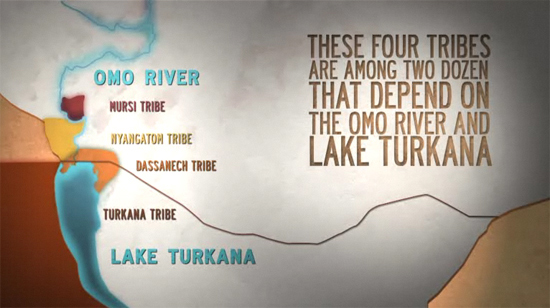
The video focuses on four groups of pastoralists — the Turkana of Kenya and the Dassanech, Nyangatom, and Mursi of Ethiopia — who are among the more than two dozen tribes whose lives and culture depend on the waters of the Omo River and the body of water into which it flows, Lake Turkana. For the past 40 years at least, Lake Turkana has steadily shrunk because of increased evaporation from higher temperatures and a steady reduction in the flow of the Omo due to less rainfall, increased diversion of water for irrigation, and upstream dam projects. As the lake has diminished, it has disappeared altogether from Ethiopian territory and retreated south into Kenya. The Dassanech people have followed the water, and in doing so have come into direct conflict with the Turkana of Kenya.
The result has been cross-border raids in which members of both groups kill each other, raid livestock, and torch huts. Many people in both tribes have been left without their traditional livelihoods and survive thanks to food aid from nonprofit organizations and the UN.
The future for the tribes of the Omo-Turkana basin looks bleak. Temperatures in the region have risen by about 2 degrees F since 1960. Droughts are occurring with a frequency and intensity not seen in recent memory. Areas once prone to drought every ten or eleven years are now experiencing a drought every two or three. Scientists say temperatures could well rise an additional 2 to 5 degrees F by 2060, which will almost certainly lead to even drier conditions in large parts of East Africa.
In addition, the Ethiopian government is building a dam on the upper Omo River — the largest hydropower project in sub-Saharan Africa — that will hold back water and prevent the river’s annual flood cycles, upon which more than 500,000 tribesmen in Ethiopia and 300,000 in Kenya depend for cultivation, grazing, and fishing.
The herdsmen who speak in this video are caught up in forces over which they have no real control. Although they have done almost nothing to generate the greenhouse gas emissions that cause global warming, they may already be among its first casualties. “I am really beaten by hunger,” says one elderly, rail-thin Nyangatom tribesman. “There is famine — people are dying here. This happened since the Turkana and the Kenyans started fighting with us. We fight over grazing lands. There is no peace at all.”
Watch When the Water Ends: Africa’s Climate Conflicts on Yale Environment 360.
For more on integrated PHE development and the Horn of Africa, see “The Beat on the Ground: Video: Population, Health, and Environment in Ethiopia” and “As Somalia Sinks, Neighbors Face a Fight to Stay Afloat,” on The New Security Beat. -
Fixing the Sky: The Checkered History of Weather and Climate Control
›As geoengineering becomes a more politically and technologically appealing approach to addressing climate change, it is critical to heed the lessons of history and understand the limits of our control over nature, said James Fleming of Colby College. Speaking at the launch of his new book, Fixing the Sky: The Checkered History of Weather and Climate Control, at the Wilson Center on October 6, Fleming brought what he called a “historically informed view of the humanities” to a growing policy discussion: the possibility of using geoengineering as a “quick fix” for the problem of climate change.
Not So Ancient History
“When facing unprecedented challenges, it’s good to take a look at the precedents,” said Fleming. He pointed to recent weather management projects conducted in China, U.S. experiments in the 1940s, and older historical discussions about geoengineering as evidence of humanity’s long fascination with “fixing of the sky.”In 2008, “they had 30,000 Chinese artillerists shooting chemicals at the clouds to keep either the venues clear or get the rain down on the weekend before the Olympics started,” Fleming said. “And they’re still doing this kind of stuff. So now there’s inter-regional tensions in China, because imagine rains comes across the country, some places get hit some places get missed, there’s intermittent showers, but now every intermittent shower is seen as a managed event where ‘you took my rain away from my farmland.’ So as soon as you start managing the sky, you start fighting about it.”
In 1839, the United States’ first meteorologist, James Espy, proposed lighting regular fires along the Appalachians to induce rainfall on the eastern seaboard. “What if Espy’s idea actually worked?” asked Fleming. “It’d very much like that Chinese story today, where there’s internecine struggles between keeping and taking the rain away from others,” he said.
The Threat of Militarization
Fleming highlighted a number of fundamental ethical concerns raised by atmospheric scientist Alan Robock:
In 1947 Nobel Laureate Irving Langmuir, in conjunction with GE and the U.S. military, experimented with controlling Hurricane King by seeding it with dry ice. They expected the storm to continue its course off the coast of Florida into the Atlantic, but instead it veered west and hit Savannah, Georgia, causing considerable damage. The lesson, said Fleming, is that “you can intervene in a cloud, but you can’t point it downwind – you can’t tell it what to do.”- Who has the moral right to change the climate?
- Where would be the “global thermostat” be?
- Will it reduce incentives for mitigation?
- Could it be commercialized and/or militarized?
Other U.S. military research into geoengineering included researching the possibility of inducing west-to-east moving rain storms in Europe to help neutralize a Soviet invasion and using the magnetosphere to create selective blackouts over Moscow.
“Shall we fix the sky – is it broken?” asked Fleming. “And if it is broken should we have people with military hardware shooting at it?”
One possible institutional counter could be strengthening the UN Environmental Modification Convention (ENMOD), which Fleming said “has been revisited again twice, and could be revisited again if large-scale environmental modification were to get more serious – if there’s deployment of geoengineering techniques.” The treaty prohibits environmental modification “through the deliberate manipulation of natural processes – the dynamics, composition or structure of the Earth, including its biota, lithosphere, hydrosphere and atmosphere, or of outer space.”
The Once and Future Earth
The Greek myth of Phaeton illustrates how old, but also flawed, the human desire to control climate really is, said Fleming. In the myth, Phaeton convinces his father, Helios, to let him drive the sun’s chariot for a day. However, Phaeton falters, lacking the strength and experience to control the reins, and Zeus intervenes to save the world from immolation. “Take up Phaeton’s reins,” said Fleming, should be interpreted as “control your carbon emissions,” rather than trying to control the sky.
We should consider geoengineering to be only an “interesting hypothetical exercise,” said Fleming, until the consequences and results of such colossal tinkering can be better assessed. “Even perfect climate prediction would lead to climate chaos, because the country that could do that could trump its competitors” in various markets, he said. However, such predictions might never be possible, considering the difficulty in modeling cultural and ethical norms, as well as the geostrategic implications – in short, the human element.
Fleming cautioned against the fundamental belief that you can accurately model the impact of geoengineering projects, reminding would-be geoengineers that “you can only have one Earth to experiment on, you don’t have a lot drosophila Earths or laboratory rat-Earths – you only have one.”
Event Resources
Sources: NASA, Toronto Star, U.S. State Department.
Image Credit: Adapted from original by Craig Phillips for The Wilson Quarterly, reproduced with permission. -
Rare Earths Intrigue: In Response to Chinese Ban, Japan and Vietnam Make a Deal
›November 2, 2010 // By Schuyler NullThe BBC is reporting that Japan has reached an agreement with Vietnam that will help provide a secure supply of rare earth minerals, after China reportedly stopped exports to Japan during an ongoing territorial dispute last month.
China produces nearly all (97 percent, according to the GAO) of the rare earth minerals used around the world, minerals that are used in many advanced electronics including mobile phones, missiles, and key components of cleaner energy tech. Japanese companies are expected to gain exclusive exploration and mining rights in northwest Vietnam in exchange for technical assistance on nuclear reactors.
China’s reported export freeze on rare earths raised warning flags in the region as well as in Washington, where fears over exclusive supply of the crucial minerals have been growing for some time – particularly in the defense community. (Although Bloomberg reports a new Pentagon study says it’s not such a big deal after all.) Control over and access to resources has become an important concern in East Asian diplomacy, as population and consumption in the region rises. For more, check out The New Security Beat’s coverage of the many diplomatic fault lines at play between the lower Mekong countries, China, and the United States, rare earth minerals and green energy, and the conflict potential of future resource scarcity.
Sources: BBC, Bloomberg, Government Accountability Office, The New York Times, TechNewsDaily.
Image Credit: Adapted from “The Huc Bridge, Hanoi,” courtesy of flickr user -aw-. -
PATH Foundation’s ‘Population, Health, and Environment Leadership as a Way of Life’
›PATH Foundation Philippines, Inc. (PFPI) just released a short documentary, Population-Health-Environment (PHE) Leadership as a Way of Life in All Walks of Life. The video features interviews with peer educators and local government officials who have partnered with PFPI on integrated coastal resource management in the Philippines that combines family planning and reproductive health services with environmental services.
According to those interviewed, an integrated approach is the best way to alleviate food insecurity in the area. “We cannot separate population, health, and environment, they should be implemented hand in hand,” said Marlyn Alcanises, a Fisheries and Coastal Resource Management program officer. “Even if we manage our coastal resources well, if there are many children due to high fertility and population growth, many people are hungry.”
The comprehensive program has been successful in addressing the social and environmental problems in the Verde Island Passage of the Philippines, one of Asia’s most densely populated regions, as well as a marine biodiversity hotspot and sea lane for many commercial ships.
The program uses community-based distribution of contraceptives to increase access to family planning, micro-credit schemes to finance sustainable livelihoods and alleviate poverty, and advocacy campaigns to increase government support for integrated health and environment programs.
Municipal Planning and Development Coordinator Cecilia Zulueta praised the integrated approach, saying “it can slow down population growth, decrease the number of malnutrition cases, lessen the number of out-of-school youth, and it can also decrease the crime rate, because if one does not have a stable source of income it may force him to engage in illegal activities.”
In ECSP’s FOCUS Issue 15, “Fishing for Families: Reproductive Health and Integrated Coastal Management in the Philippines,” Joan Castro and Leona D’Agnes demonstrated that PFPI’s Integrated Population and Coastal Resource Management project (IPOPCORM) was more cost-effective and had a greater impact on the wellbeing of both human reproductive health and coastal resources than non-integrated programs. In a study measuring the impacts of integrated versus single-sector reproductive health (RH) or coastal resource management (CRM) programs, they found the integrated approach met or exceeded single-sector outcomes for 26 out of 27 indicators.
Reducing high fertility rates reduces pressure on natural resources, decreases high rates of malnutrition, crime and HIV/AIDS, and preserves local fisheries, “making life sustainable for both humans and nature,” as PFPI puts it in the documentary. The hope is that the community leaders featured in the documentary will inspire others in similar situations to take the lead on integrated issues in their communities.
“Even if we are doing environmental conservation through population management in our province but the others are not, it will still create conflict somehow,” said Alcanises. “I believe that whatever program is being done in one province should also be done in other provinces, in order to avoid conflict and promote balance in program implementation.”
Julio Lopez, president of the Galera Association of Managers and Entertainers said, “this land is ours, and we are responsible in taking care of it.”
PFPI, along with the University of Rhode Island’s Coastal Resource Center and Conservation International, is part of the BALANCED project, which last year launched the PHE Toolkit as a resource for PHE professionals. For more on PFPI’s IPOPCORM program, see ECSP’s interviews with Joan Casto and Leona D’Agnes on our YouTube channel: “Joan Castro – Integrated Population and Coastal Resource Management (IPOPCORM)” and “Leona D’Agnes on Population, Health, and Environment.”
Video Credit: “Population-Health-Environment (PHE) A Video Documentary,” courtesy of YouTube user PATHFoundationPhils.
Sources: Population Reference Bureau.










.jpg)