Showing posts from category natural resources.
-
A Crucial Connection: India’s Natural Security
›January 5, 2011 // By Michael KugelmanExcerpted from the original op-ed, “A Crucial Connection,” by Michael Kugelman in The Times of India:
With India’s soaring growth and rising global clout hogging media headlines, it is easy to forget the nation is beset by security challenges. Naxalite insurgency rages across more than two-thirds of India’s states, while long-simmering tensions in Jammu and Kashmir exploded once again this summer. Meanwhile, two years post-Mumbai, Pakistan remains unwilling or unable to dismantle the anti-India militant groups on its soil. Finally, China’s military rise continues unabated. As Beijing increases its activities across the Himalayan and Indian Ocean regions, fears about Chinese encirclement are rife.
It is even easier to forget that these challenges are intertwined with natural resource issues. Policy makers in New Delhi often fail to make this connection, at their own peril. Twenty-five per cent of Indians lack access to clean drinking water; about 40 per cent have no electricity. These constraints intensify security problems.
India’s immense energy needs – household and commercial – have deepened its dependence on coal, its most heavily consumed energy source. But India’s main coal reserves are located in Naxalite bastions. With energy security at stake, New Delhi has a powerful incentive to flush out insurgents. It has done so with heavy-handed shows of force that often trigger civilian casualties. Additionally, intensive coal mining has displaced locals and created toxic living conditions for those who remain. All these outcomes boost support for the insurgency.
Meanwhile, the fruits of this heavy resource extraction elude local communities, fuelling grievances that Naxalites exploit. A similar dynamic plays out in Jammu and Kashmir, where electricity-deficient residents decry the paltry proportion of power they receive from central government-owned hydroelectric companies. In both cases, resource inequities are a spark for violent anti-government fervor.
Continue reading on The Times of India.
For more on India’s Naxalite rebellion and its natural resource drivers, see The New Security Beat’s “India’s Maoists: South Asia’s ‘Other’ Insurgency.”
Michael Kugelman is program associate with the Asia Program at the Woodrow Wilson International Center for Scholars.
Photo Credit: “Mysore Coal Man,” courtesy of flickr user AdamCohn. -
Minister Izabella Teixeira at the Wilson Center
A Review of Brazil’s Environmental Policies and Challenges Ahead
›Stressing the need for concrete, tangible institutional policies, Izabella Teixeira, Brazil’s Minister of the Environment, discussed the challenges and goals of her ministry at the Wilson Center on October 20. Sustainable development, not just conservation, must be the focus, and that requires bringing lots of different players to the table, taking into account not only environmental but also social and economic agendas. To do this, she argued, one must take the rather ephemeral and hypothetical notions of environmental stewardship and put them into the realm of a practicable, institutionalized framework, built on a social pact that engages all sectors of society. The foundation of sustainable development and environmental policy must be biodiversity, according to Teixeira. Central concerns, such as food and energy security and combating climate change, all rely on a diverse array of natural resources. These need to be conserved, but they must also be developed in a responsible, sustainable way. A legal international framework toward this end, covering access to biodiversity and genetic resources, has yet to be implemented. Developing and developed countries need to find a middle ground on allocating the benefits that accrue from the use of genetic resources found in areas such as the Amazon, and this agreement must then be linked into existing political institutions.
Teixeira noted the strides Brazil has made toward protecting its environment – including having set aside the equivalent of 70 percent of all protected areas in the world in 2009 and the establishment of the Amazon Fund. Nevertheless, Brazil must continue to protect and maintain these nature preserves, not just establish them. Creating a program that pragmatically implements international goals in a national context is an ongoing process, and countries like Brazil now need to focus on the “how” of implementing these goals, rather than just the “what.”
Teixeira also highlighted the complexity of formulating environmental policy that integrates all the various points of view that must be taken into consideration. At recent meetings to discuss transitioning to a low-carbon economy, 17 different cabinet ministers had to be present to coordinate government positions and policies. The complexity is due in part to the need to create alternatives, not just to prevent certain activities. For example, one must not only use legal enforcement to stop illicit deforestation, but also create paths to legal, sustainable logging. Once again, attempting to balance environmental, social, and economic concerns is difficult, to say the least, but crucial for long-term effectiveness.
Also a unique challenge for Brazil is the natural diversity that exists within such a large country. While much of the attention paid to the environment goes (rightly so) to the Amazon, there are many other biomes and local environments that must be taken into consideration, Teixeira observed.
The cerrado, Brazil’s enormous savanna, requires a different strategy than the Amazon, which is different than the coastal Atlantic forest. Furthermore, urban areas need their own environmental policies that can take into account issues of human development and population density.
To illustrate the need for an inclusive, well-thought-out policy, Teixeira discussed–rather frankly–the controversy surrounding the recent proposed amendments to the Forest Code. She argued that the proposal makes blanket changes that do not take into consideration differences in biomes, differences between large agribusinesses and family farms, and between historic, settled communities and recent developments. The implications of this proposal, according to the minister, could have enormous social costs. Teixeira said she believes that it would be virtually impossible to enforce the amended Forest Code if it was approved by Congress. She used this example to underscore her role in offering legislative alternatives that seek to provide a more nuanced, and ultimately more effective, institutional framework that can use Brazil’s many natural resources to help its population to the greatest extent possible.
J.C. Hodges is an intern with the Brazil Institute at the Wilson Center; Paulo Sotero is the director of the Brazil Institute.
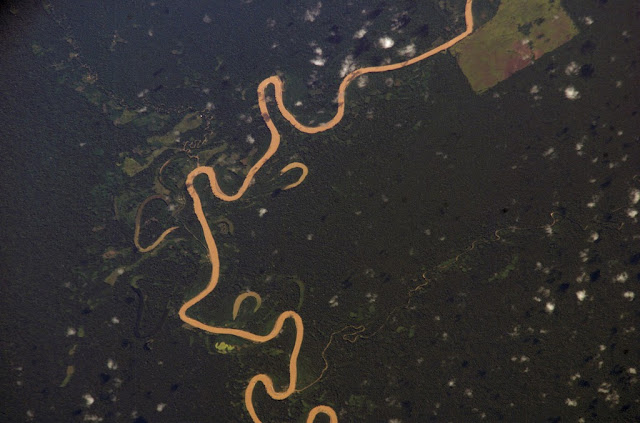
Photo Credit: “Rio Jurua, Brazil (NASA, International Space Station Science, 05/29/07),” courtesy of flickr user NASA’s Marshall Space Flight Center, and David Hawxhurst/Wilson Center. -
Those Who Would Carry the Water
›December 24, 2010 // By Mark NepoThis article will appear as the introduction in the forthcoming Fetzer Institute and Wilson Center publication, Our Shared Future: Environmental Pathways to Peace, based on an event cosponsored at the Wilson Center in January 2009.
It is fitting to say “welcome,” since this timeless greeting originally meant “come to the well.” Let me try to describe the well we are coming to. We are at once trying to gather the best experience and thinking of current environmental practice, to help advance the issue of water as a resource, and to use environmental work around water as a case study for the lessons and challenges of global community engagement. In convening leading practitioners and thinkers in the field of environmental peace-building and focusing on the ever-present issue of water, we hope to surface the strengths of human resources and how they impact the emerging global community.
In truth, the issues that bring us here have been present in the human condition forever. They are spoken to in every tradition. A few stories will help create a context for our time together.
If we turn to the Hindu tradition, we learn that Saraswati is the goddess of knowledge, music, and the arts. Her name means “the one who flows” and legend has it that she was born of the Saraswati River, which is an invisible river that carries the waters that sustain all life. From the earliest times, in many traditions, the waters that sustain all life refer to both natural resources and human and spiritual resources; actual water and the water we have come to know since the beginning of time as wisdom and love.
In Hindu lore, Saraswati’s ageless counterpart on earth is the serpent-demon, Vritrassura, who is driven to hoard all the Earth’s water. And so the endless struggle begins; at least this is one tradition’s beginning. Thankfully, in the Rig-Veda, the sacred collection of Sanskrit hymns, we are given hope as Saraswati – with help from her brother Ganesh, the provider and remover of obstacles, and Indra, the god who connects all things – kills the demon who would hoard the Earth’s water.
But clearly, throughout the ages, those who would carry the water and those who would hoard the water have appeared again and again and again. This is why we are here. Unspoken or not, unaware or not, we are by care and kinship of the lineage that would carry the water.
If we turn to the Haitian tradition, we find a very telling teaching story called The Chief of the Well. This story speaks of a time of drought when the streams are dry and the wells are parched. There is no place to get water. The animals meet to discuss the situation and decide to ask God for help. God creates a well that will have endless water as long as one of the animals serves as caretaker and welcomes all who would come in need. The lizard Mabouya volunteers. But intoxicated with his newfound power, Mabouya becomes a gatekeeper, not a caretaker, and sends everyone in need away. Eventually, God replaces the lizard with the frog who croaks to all, “Come! This is God’s well! The hole in the ground is yours, but the water belongs to God.” And we are left, in each generation, to discover what is ours and what is God’s, and to understand what turns the caretaker in us to the gatekeeper?
If we can accept our role as caretakers of resources that outlive us, then the history of the acequia might be relevant. An acequia (a-sā’kē-e) is a community-operated waterway used for irrigation. It is the name for a sluiceway or gravity chute that flows down a mountainside, providing water for a village. The Spanish word acequia, which means “ditch or canal,” comes from the Arabic al saqiya, which means “water conduit.” The Islamic occupation of Spain, beginning late in the eighth century, brought this technique of irrigation to Spain.
Acequias were then brought to the Americas by the Spanish, only to find their indigenous counterparts already in use. Particularly in the Andes, northern Mexico, and the modern-day American Southwest, acequias exist as the outgrowth of ancient systems created to carry snow runoff or river water to villages and distant fields. Many South American villages have settled around the mouth of an acequia that begins high and out of sight in the crags of a mountain. There, the source-water collects all winter near the top and, in spring, with the thaw, it streams into the village.
In many of these South American villages, as in Peru for example, there is an annual ritual in which an entire village climbs the acequia in early spring to clear the rocks and tree limbs and snake nests that during the winter have blocked the path of water that the village depends on. This ancient pragmatic ritual of clearing the acequia provides a powerful model for how community can care for its natural resources together.
In fact, keeping the acequia clear and flowing is a useful metaphor for interdependence and cooperation. The life of the acequia and our responsibility to keep its path of flow clear represents a cycle of natural and human erosion and cleansing that is intrinsic to life on earth. Therefore, keeping the acequia clear – both the actual acequia and the acequia of humanity – bears learning how to do well.
With all this in mind, I am drawn to lift up one more story. It comes from Éliane Ubalijoro, a professor at McGill University in Montreal, who as a Rwandan is working with the generation there orphaned by the genocide. After the mass killings, those surviving were confined to refugee camps. In this particular settlement, women had to cross a dark field outside of the camp and risk being raped to get water for their children, which they did repeatedly. This difficult situation points to the complex levels of the issues before us; all of which demand our attention.
First, we might consider access to the water itself. With regard to the conservation and preservation of natural resources, we are asked to solve the perennial question: How do you bring the water to those who need it? At this level, a direct solution might be to move the water supply inside the refugee camp.
Under this, however, we might consider access to the human resources. What is blocking the human acequia? With regard to conflict transformation and peace-building, we are compelled to ask: What are the values implicit in this situation by which the refugee camp guards put the water outside of the camp in the first place in order to create the opportunity to rape the women?
This leads to the work of education, the work of clearing the human acequia. So with regard to the development of social equity, we are now compelled to ask: What are the assumptions and traditions in this community that enable them to believe that exploiting women is not only permissible but entitled? How do we clear the human acequia so that wisdom and compassion can flow?
Finally, we might consider the conservation and preservation of human resources. For at the heart of this insidious atrocity is the resilience and courage and love of these women who went into the dark to get water for their children knowing the violation that awaited them. What kind of deep water is this and how can we insure access to this resource?
This story from Rwanda is one more example that shows how natural resources and human resources are inextricably linked. One central question before us is: How do we tend all levels at once? How do we develop multiple strategies? How do we convene and surface the wisdom of all frames?
Part of our inquiry here is to take our turn in trying to understand how natural resources and human resources are so linked. What blocks their access? What lets them flow together and sustain life? How do we understand the water of humanity and the water of the earth and how both kinds of water are shared or not in the world today?
We could say that knowledge flows like water between countries and communities. If this is so, then each of you is such water. We are here to drink from you and people like you, and to understand the currents that run between us and beneath us; to insure the clear flow of natural and human resources into the world; and to keep the global acequia clear; to embody and to further the art and science of carrying the water in all its forms to those who need it.
Mark Nepo is the author of The Book of Awakening as well as the forthcoming As Far As the Heart Can See.
Photo Credit: Adapted from “The Water Carrier,” courtesy of flickr user Portrait Artist – Enzie Shahmiri. -
Watch: Joel E. Cohen on Solving the Resource-Population Equation in the Developing World
›December 14, 2010 // By Wilson Center Staff“It’s very hard to put a number on a quantity that depends on future events, processes we don’t understand, and values that may change over time,” said Joel E. Cohenof the Rockefeller University in this interview with ECSP. “That doesn’t mean we have no problems and it doesn’t mean there’s nothing we can do.”
There are three schools of thought or proposed “panaceas,” when it comes to balancing natural resources and population, said Cohen: a bigger pie (new technology to increase productivity), fewer forks (reduced consumption), and better manners (reduced irrational market inequities and better governance).
In the 15 years since his book How Many People Can the Earth Support? was published, Cohen’s approach has changed. While the 1996 book lacked a definitive policy recommendation, he is now analyzing options. “The evolution of my thought has moved from ‘how many people can the Earth support?’ to ‘what do we need to solve problems?’” he said.
You need adequate child and maternal nutrition to produce potential problem solvers and you need education to give them the tools to do it with, said Cohen, who studied the impact of universal primary and secondary education with colleagues at the American Academy of Arts and Sciences.
“If you look at a map of stunting in the world, there are parts of South Asia and sub-Saharan Africa where more than half the children are stunted – that means two standard deviations [of] height below normal for their age,” said Cohen. “Those populations are handicapped at the starting gate because they don’t have the problem solvers.” -
International Responses to Pakistan’s Water Crisis
›December 6, 2010 // By Michael KugelmanExcerpt from the executive summary of the NOREF Policy Brief, via the Norwegian Peacebuilding Centre:
Pakistan faces a multidimensional water crisis that claims hundreds of thousands of lives every year. The root causes of the crisis are twofold:- Circumstantial, which are linked to poor water-resource management policies (including water-wasting flood irrigation);
- Structural, tied to factors deeply ingrained in politics and society such as the obsession with India, inequitable rural land-ownership and endemic water misgovernance (for example, exploitation of the rotational irrigation system to the detriment of the poor).
However, international responses must be measured. They should actively target the circumstantial causes but, at the same time, recognize that their ability to take on the structural ones is limited. While the international community can help mitigate the effects of the underlying structural drivers, Pakistan itself must take the ultimate steps to eliminate them.
Circumstantial causes can be addressed through international aid provision and international exchanges. Aid provision must be generous enough to meet Pakistan’s prodigious needs but modest enough to respect the country’s limited absorptive capacities. It should emphasize the restoration of infrastructure and distribution systems, be more responsive to the needs of Sindh and Baluchistan provinces, and be channeled through both government agencies and civil society.
Despite the challenges the international community faces in addressing the structural causes, opportunities do abound. These include embarking on back-channel diplomacy to bring Pakistan and India closer together and cooperative projects with Pakistanis to make water distribution more equitable. To be effective, international responses must target all affected parties and be sensitive to ground realities. They should also be mindful of indigenous success stories and the factors that bring about that success.
The full report, “International Responses to Pakistan’s Water Crisis: Opportunities and Challenges,” is available through the Norwegian Peacebuilding Centre.
Michael Kugelman is program associate with the Asia Program at the Woodrow Wilson International Center for Scholars.
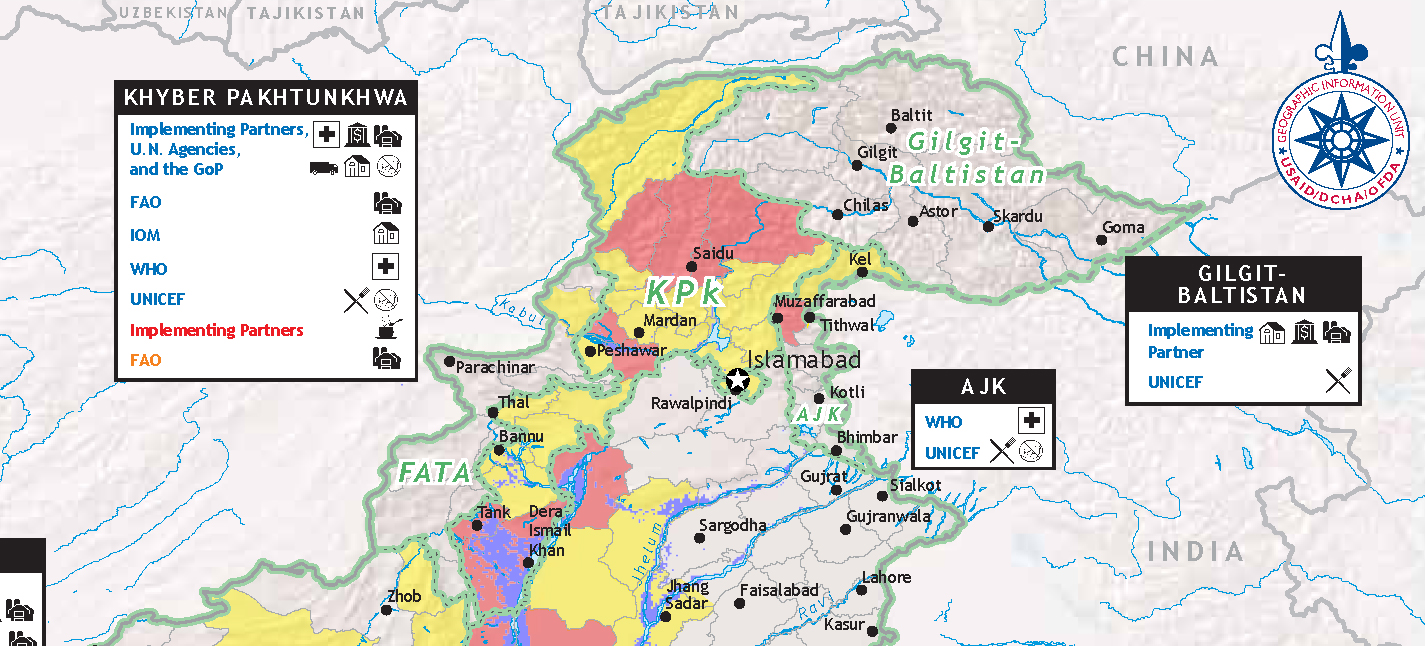
Image Credit: Adapted from “USG Humanitarian Assistance to Pakistan for Floods in FY 2010 and FY 2011 (as of 30 Nov 2010),” courtesy of USAID and ReliefWeb. -
Joydeep Gupta, ChinaDialogue
Nervous Neighbors: China-India Water Relations
›December 3, 2010 // By Wilson Center StaffExcerpted from the original article, “Nervous Neighbors,” on ChinaDialogue.net:
Only five rivers in the world carry more water than the Yarlung Zangbo, or Brahmaputra, as it is known when it reaches India. Only one carries more silt. Rising at a height of 5,300 meters in the Kailash range of the Middle Himalayas – an area holy to both Hindus and Buddhists – the river flows east through Tibet for 1,625 kilometers before taking a horseshoe bend, changing its name and flowing as the Brahmaputra into north-eastern India.
There, for 918 kilometers, it is both a lifeline, due to the water it carries, and a scourge, because of the floods it causes almost every year. It then takes a southward turn and flows into Bangladesh for 363 kilometers before it merges with the Ganges, together forming South Asia’s largest river, the Meghna, and flowing into the Bay of Bengal. This huge river, with its 25 large tributaries in Tibet and 105 in India, drains much of the eastern Himalayas.
As the world’s youngest mountain range, the Himalayas are particularly unstable – and so is the river. It has changed its course significantly at least once in the last 200 years, following a major earthquake. Smaller changes in course are common, wiping out farms and homes on one bank while depositing fertile silt on the other. Now humans are changing the course of this river: Chinese engineers have started to build the Zangmu hydroelectric power station in Lhoka prefecture, 325 kilometers from Lhasa, Tibet’s capital. The development has led to serious expressions of concern, particularly in India but also in China.
Continue reading on ChinaDialogue.net.
Joydeep Gupta is the project director (South Asia) of ChinaDialogue’s Third Pole Project.
Map Credit: Google Maps. -
Climate-Proofing Development: An Interview With Karen Hardee
›November 29, 2010 // By Hannah MarquseeWhile expectations are deflated for broad international consensus at the UN Climate Change Convention in Cancun, the need to “climate-proof” development efforts has been gaining ground in recent years as a necessary preventative measure to help developing countries adapt to the adverse effects of climate change.
-
Watch: Blue Ventures PHE Program in Madagascar
›“All conservation efforts will be in vain if family planning issues aren’t addressed,” says Rebecca Hill, project manager for the Sexual and Reproductive Health Programme at Blue Ventures in a video highlighting their population, health, and environment (PHE) programming in Madagascar.
While primarily a marine conservation group, Blue Ventures also recognizes the need for integrating population into their efforts. They began a family planning program in southwestern Madagascar in 2008 as part of a “holistic approach to conservation.” The project aims to address the high unmet need for family planning, high fertility and maternal and infant mortality, and conserve the coastal environment. “We are directly saving lives,” Hill says.
Rapid population growth is creating an unsustainable strain on natural resources, as Matthew Erdman of Blue Ventures wrote in a previous post on The New Security Beat:The average total fertility rate in Velondriake is 6.7 children per woman, according to our data. On average women are only 15 years old when they first conceive. To compound this problem, a majority of the population is under the age of 15 – at or approaching reproductive age. At the current growth rate, the local population will double in only 10 to 15 years. The local food sources, already heavily depleted, barely feed the current population, let alone twice that amount. Without enabling these coastal communities to stabilize their population growth, efforts to improve the state of marine resources and the community’s food security are considerably hindered.
Hill describes the situation in the village when she joined the Blue Ventures in 2008 as “alarming,” with women “having up to 17 children despite not wanting children.” Many people in the town had never heard of condoms and had no idea how to use them, she said, and “they are desperate to have access to contraception.”
Today, the initial family planning program has been scaled up to the surrounding region and generated significant community involvement by peer educators teaching community members about sexual and reproductive health. It’s also become the first PHE project to receive support from the UNFPA within Madagascar.
There are currently 18 community-based distributors who give out two types of contraception in their villages. The fact that the community has so fully embraced the project shows that it can be replicated elsewhere, says Hill in the video. “Communities themselves have harnessed the ideas and consider that what we’re doing is vitally important.”
“Addressing family planning needs and issues is inextricably linked with conservation issues,” says Hill. “All conservation efforts will be in vain, if family planning issues are not addressed.”
Video Credit: Blue Ventures Family Planning Project from Alexander Goodman on Vimeo.