Showing posts from category natural resources.
-
Keith Schneider, Circle of Blue
Double Choke Point: Demand for Energy Tests Water Supply and Economic Stability in China and the U.S.
›The original version of this article, by Keith Schneider, appeared on Circle of Blue.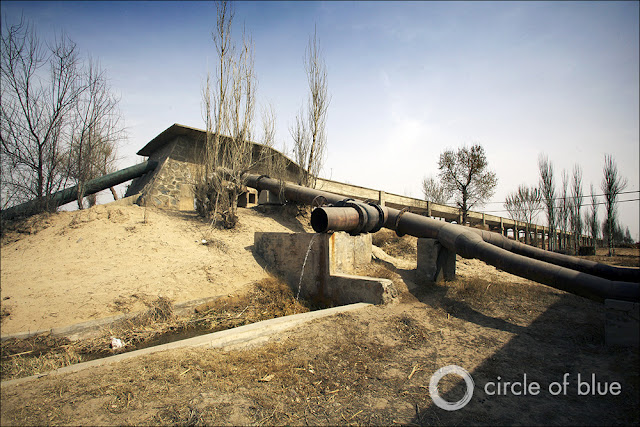
The coal mines of Inner Mongolia, China, and the oil and gas fields of the northern Great Plains in the United States are separated by 11,200 kilometers (7,000 miles) of ocean and 5,600 kilometers (3,500 miles) of land.
But, in form and function, the two fossil fuel development zones – the newest and largest in both nations – are illustrations of the escalating clash between energy demand and freshwater supplies that confront the stability of the world’s two biggest economies. How each nation responds will profoundly influence energy prices, food production, and economic security not only in their domestic markets, but also across the globe.
Both energy zones require enormous quantities of water – to mine, process, and use coal; to drill, fracture, and release oil and natural gas from deep layers of shale. Both zones also occur in some of the driest regions in China and the United States. And both zones reflect national priorities on fossil fuel production that are causing prodigious damage to the environment and putting enormous upward pressure on energy prices and inflation in China and the United States, say economists and scholars.
“To what degree is China taking into account the rising cost of energy as a factor in rising overall prices in their economy?” David Fridley said in an interview with Circle of Blue. Fridley is a staff scientist in the China Energy Group at Lawrence Berkeley National Laboratory in California. “What level of aggregate energy cost increases can China sustain before they tip over?”
“That’s where China’s next decade is heading – accommodating rising energy costs,” he added. “We’re already there in the United States. In 13 months, we’ll be fully in recession in this country; 9 percent of our GDP is energy costs. That’s higher than it’s been. When energy costs reach eight to nine percent of GDP, as they have in 2011, the economy is pushed into recession within a year.”
Continue reading on Circle of Blue.
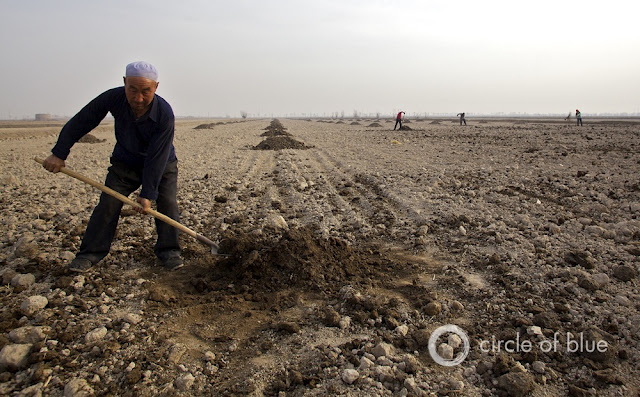
Photo Credit: Used with permission, courtesy of J. Carl Ganter/Circle of Blue. In Ningxia Province, one of China’s largest coal producers, supplies of water to farmers have been cut 30 percent since 2008. -
Nepal to East Africa: Population, Health, and Environment Programs Compared
›“Practice, Harvest and Exchange: Exploring and Mapping the Global, Health, Environment (PHE) Network of Practice,” by the University of Rhode Island’s Coastal Resources Institute and the USAID-supported BALANCED Project, explores the successes and challenges of their global population, health, and environment (PHE) network (with a heavy presence in East Africa). In order to increase support of the nascent PHE approach, the network seeks to shorten the “collaborative distance” between “PHE champions,” so they can develop a stronger body of evidence for the links between population, health, and the environment. In their analysis, the authors write that the network has facilitated the development of independent, information-sharing relationships between “champions.” However, they also observed shortfalls in the network, such as its limited reach into less technologically advanced yet more biodiverse regions, its bias toward BALANCED meet-up event participants, and its exclusion of those experts unlikely to be included in published works. In “Linking Population, Health, and the Environment: An Overview of Integrated Programs and a Case Study in Nepal” from the Mount Sinai Journal of Medicine, Sigrid Hahn, Natasha Anandaraja, and Leona D’Agnes provide both a broad survey of the structure and content of programs using the PHE method and an in-depth case study of a successful initiative in Nepal. Hahn et al. praise the Nepalese program for simultaneously addressing deforestation from fuel-wood harvesting, indoor air pollution from wood fires, acute respiratory infections related to smoke inhalation, as well as family planning in Nepal’s densely populated forest corridors. “The population, health, and environment approach can be an effective method for achieving sustainable development and meeting both conservation and health objectives,” the authors conclude. In particular, one benefit of cross-sectoral natural resource and development programs is the inclusion of men and adolescent boys typically overlooked by strictly family planning programs.
 -
Ecological Tourism and Development in Chi Phat, Cambodia
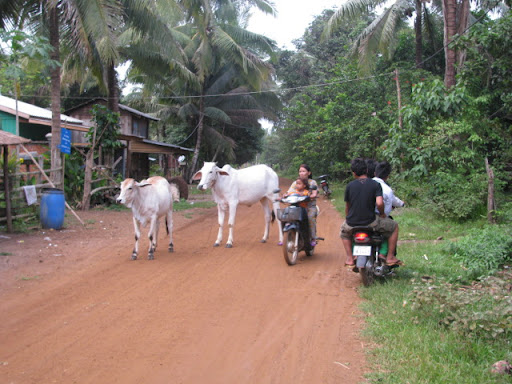
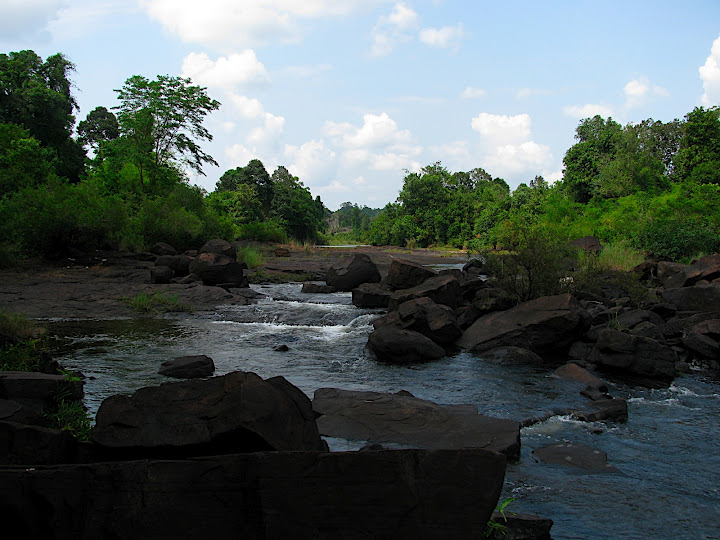
›Chi Phat is a single-dirt-road town nestled in the Cardamom Mountains of Southwestern Cambodia, one of the largest intact forests in Southeast Asia. The town is only accessible by two routes: a three-hour river boat trip up the Phipot River or, if the road isn’t flooded by the rainy season, an exhilarating 30-minute motorbike ride from Andoung Tuek, a blip on the one paved road that runs along Cambodia’s southwestern border. Since 2007, Wildlife Alliance has been running an ecotourism project in Chi Phat (full disclosure: I used to work for Wildlife Alliance in Washington, DC).
The project has been featured in The New York Times and since its inclusion in the Lonely Planet travel guide, has become a destination for backpackers looking to leave the beaten path. I recently visited the project after spending time in neighboring Vietnam and was struck by the contrast between the densely populated and urbanized Mekong Delta and the visibility of rural poverty in Cambodia.
“Cambodia’s contemporary poverty is largely a legacy of over twenty years of political conflict,” reads a 2006 World Bank Poverty Assessment. The Pol Pot regime’s agrarian collectivization forced millions into the countryside and as a result, even in today’s predominantly-urban world, Cambodia remains 78 percent rural. Today 93 percent of Cambodia’s poor live in rural areas, two thirds of rural people face food shortages, and maternal and reproductive health outcomes in the country lag far behind those in the cities. Chi Phat and the sparsely populated northeast have over ten or twenty times the rate of maternal deaths of Phnom Penh.
A Town Transformed
Before Wildlife Alliance began the Community-Based Ecotourism (CBET) project in Chi Phat, most villagers made a living by slash-and-burn farming, illegal logging, and poaching endangered wildlife. Wildlife Alliance Founder and CEO Suwanna Gauntlett described the ecological zone around the town as “a circle of death,” in an audio interview with New Security Beat last year.Now, Chi Phat is a rapidly growing tourism destination offering treks and bike tours. In 2010 they brought in 1,228 tourists – not huge by any means, but over twice the number from 2009. The town now boasts a micro-credit association, a school, and a health clinic that offers maternal and reproductive health services. The village is also visited by the Kouprey Express, an environmental education-mobile that provides children and teachers with lessons, trainings, and materials on habitat and wildlife protection, pollution prevention, sustainable livelihoods, water quality, waste and sanitation, energy use, climate change, and adaptation.
One villager, Moa Sarun, described to me how he went from poacher and slash-and-burn farmer, to tour guide, and finally, chief accountant:Since I have started working with CBET, I realize that the wildlife and forest can attract a lot of tourists and bring a lot of income to villagers in Chi Phat commune. I feel very regretful for what I have done in the past as the poacher…I know clearly the aim of CBET is to alleviate the poverty of local people in Chi Phat, so I am very happy to see people in Chi Phat have jobs and better livelihoods since the project has established.
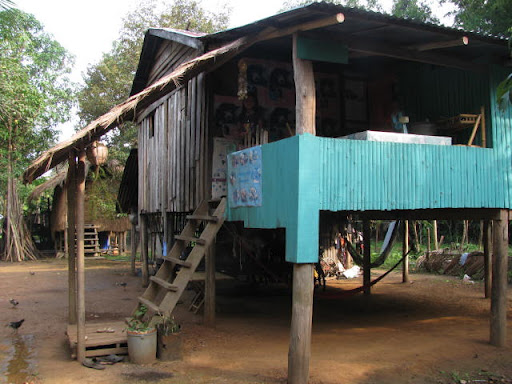
It’s hard to imagine what the town would have looked like before Wildlife Alliance arrived. The visitor center, restaurant, and “pub” (really, a concrete patio with plastic chairs and a cooler filled with beer), together make up nearly half of the town’s establishments. For two dollars a night, I stayed in a homestay and lived as the locals do on a thin mattress under mosquito netting, with a bucket of cold water by the outhouse for a shower, and a car battery if I wanted to use the fan or light (but not both). These amenities place Chi Phat above average for rural Cambodia. According to 2008 World Bank data, only 18 percent of rural areas had access to improved sanitation and only 56 percent had access to an improved water source.
Poaching Persists
Real change has certainly hit Chi Phat, but illegal activities persist, as a Wall Street Journal review of the project noted. In one Wildlife Alliance survey, 95 percent of members participating in the project made less than 80 percent of their previous income and 12 percent of people made less than 50 percent. “That, to me, is a red flag,” Director of U.S. Operations Michael Zwirn acknowledged to me. Nevertheless, he said “it is well documented that it’s the most lucrative community-based ecotourism project in Cambodia. That doesn’t mean that everyone is making money, or that they’re making enough money, but the community is clearly benefiting.”
Harold de Martimprey, Wildlife Alliance’s community-based ecotourism project manager, told me in an email interview:We monitor closely the impact of the CBET project on the diminution of poaching and deforestation. We estimate that since the beginning of the project, the illegal activities have decreased by almost 70 percent.
As Chi Phat ecotourism continues to scale up, de Martimprey expressed hope that more and more villagers would participate in the project and stop destructive livelihoods.
After four years, Chi Phat has already developed enough to operate financially on its own. Wildlife Alliance will stop funding the project later this year and transition it towards total self-sustainability. The plan is to then ramp up efforts at a neighboring project in Trapeang Ruong, due to open to the public next month.
A Land of Opportunity
So far Chi Phat lacks much of what do-gooder tourists are hoping to find when they come in search of ecotourism. There is little to no information about the work of Wildlife Alliance and how ecotourism benefits the town, or the health, education, and economic benefits the villagers have received. A little more obvious justification for ecotourism’s inflated prices might appease the average backpacker used to exploitatively lower prices elsewhere in the country. The guides, staff, and host families for the most part speak little English, which does not bode well for its tourism potential. “This is a work in progress,” said de Martimprey.
Most of my time in Chi Phat, I felt like the only foreigner to ever set foot in the town – refreshing after witnessing much of the rest of Southeast Asia’s crowded backpacker scene. As Chi Phat continues to grow, hopefully it will “bring in enough people to support the community without the adverse effects of tourism,” said Zwirn. “They don’t want it to turn into the Galapagos.” Thankfully, de Martimprey told me, “Chi Phat is far from reaching this limit and can be scaled up to much bigger operation,” without negatively impacting the environment.
Luckily, plans to build a highly destructive titanium mine near the town were recently nixed by Prime Minister Hun Sen in what was an unexpected victory over industrial interests. However, soon after, the town was again under threat – this time by a proposed banana plantation nearby.
“The Cardamom Mountains are still seen as a land of opportunity for economic land concessions for some not-so-green investors looking at buying land for different purposes, and often disregarding the interest of the local people,” said de Martimprey.
Eventually Zwirn hopes that as more tourists come to the Cardamoms, they will become “a constituency for conservation,” he said. “We need to build a worldwide awareness of the Cardamoms as a destination, and as a place worth saving.”
Sources: BBC, IFAD, Phnom Penh Post, New York Times, United Nations, Wall Street Journal, Wildlife Alliance, World Bank, World Wildlife Fund.
Photo Credit: Hannah Marqusee. -
Scott Wallace, National Geographic
A Death Foretold
›June 23, 2011 // By Wilson Center StaffThe original version of this article, by Scott Wallace, appeared on National Geographic News Watch.
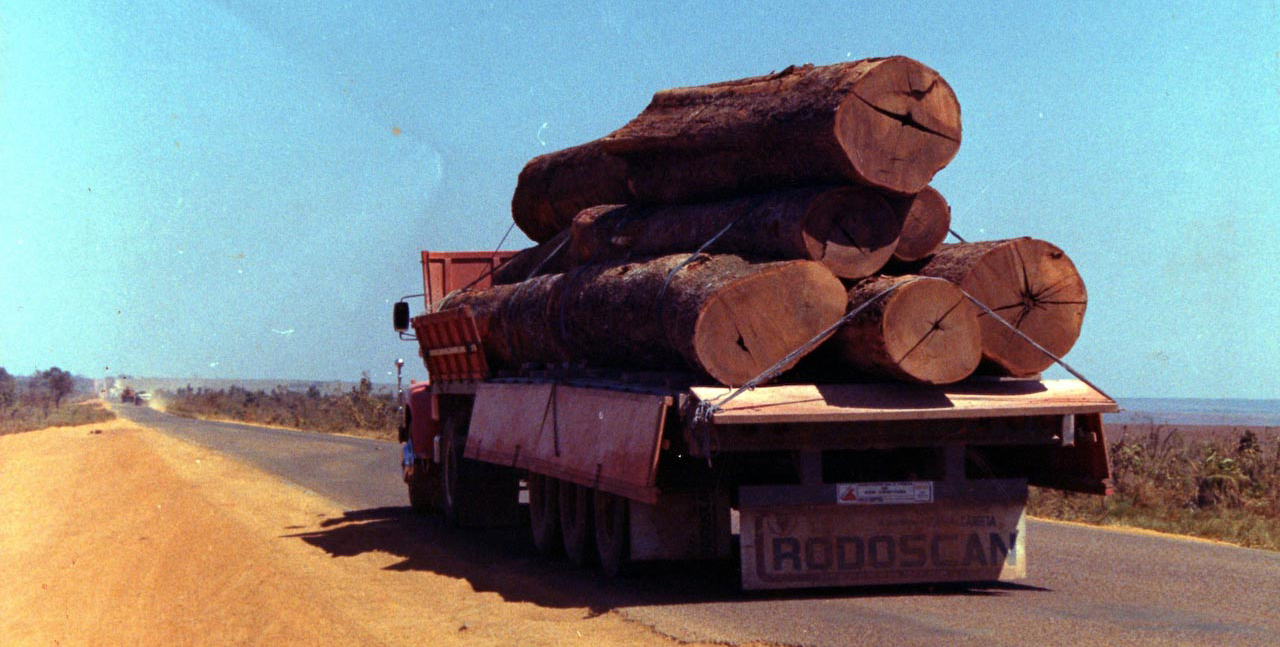
Late last month the Brazilian Congress passed a bill that if it becomes law would ease restrictions on rain-forest clearing and make it easier than ever to mow down the Amazon. That same day, 800 miles north of the parliamentary chamber in Brasilia, assailants ambushed and killed a married couple whose opposition to environmental crimes had placed them in the crosshairs of those who most stand to gain from the new legislation.
It’s a nauseatingly familiar story. Over the past 20 years, there have been more than 1,200 murders related to land conflict in Brazil’s Amazon region. Most of the victims, like the married activists Zé Claudio Ribeiro and Maria do Espírito Santo, were defenders of the rain forest – people seeking sustainable alternatives to the plunder-for-profit schemes that characterize much of what passes for “development” in the Amazon.
The state of Pará – where Zé Claudio and Maria were ambushed on their motorbike as they crossed a rickety bridge – holds an especially notorious reputation for environmental destruction and organized violence. Pará is the bloodiest state in Brazil, accounting for nearly half of all land-related deaths in recent decades. It sprawls across an area larger than the states of Texas, Oklahoma, and New Mexico combined. Picture a tropical version of the Wild West, stripped of the romance, where loggers and ranchers muscle their way onto public land as though they own the place and impose a law of the jungle with their hired thugs. Those who have the nerve to protest soon find themselves the targets of escalating threats. If they persist, they find themselves staring down the gun barrels of those come to make good on the threats.
Continue reading on National Geographic.
Photo Credit: “Toras,” courtesy of flickr user c.alberto. -
Watch: Richard Matthew at TEDxChange on Natural Resources, Conflict, and Environmental Peacemaking
›“It’s not surprising that about half the time, efforts to try to stabilize countries as they come out of war fail,” said Richard Matthew, associate professor at the University of California at Irvine and founding director of the Center for Unconventional Security Affairs, at a recent TEDxChange event. “Wars today are very destructive. They may not be as big as the wars of the last century, but they do a lot of damage.”
Matthew’s work focuses on the environmental dimensions of conflict and peacebuilding. Conflict can be spurred by competition over natural resources but it also contributes to further scarcity in many cases, creating a feedback loop. The natural resource aspect of conflict is particularly important in areas where livelihoods depend directly on access to land, water, and forests, he said.
In addition to discussing the benefits of including the environment in peacemaking efforts, Matthew also touched on the need for an increased proportion of national security spending to be spent on peace and development rather than defense. “It is in our interest to grow people out of the conditions that foster terrorism and extremism and infectious disease and crisis,” he said.
In particular, Matthew remains confident that an emerging group of leaders will find new and creative ways to support peacebuilding, natural resource management, and adaptation activities in the future: “Social entrepreneurs – people willing to combine their passion to make a better world with sound business tools – are developing truly innovative ways of taking daunting social problems and making them manageable.” -
New Oxfam Report Tackles Broken Food System
›June 17, 2011 // By Ramona Godbole“The global food system is broken,” reads a new report from Oxfam International. While much of Growing a Better Future: Food Justice in a Resource-Constrained World essentially reviews the major factors that contribute to food insecurity, Oxfam’s call to transform the food system is certainly timely, given this year’s high food prices (blamed in part for inflaming popular revolts in the Middle East) and fears of another global food crisis.
Despite producing enough food for everyone, one in seven people globally face chronic under-nutrition and almost one billion people are food insecure. Hunger is concentrated within rural areas in developing countries, and within families, women are often disproportionally affected, having serious implications for maternal and child health.
“We face three interlinked challenges in an age of growing crisis: feeding nine billion without wrecking the planet; finding equitable solutions to end disempowerment and injustice; and increasing our collective resilience to shocks and volatility,” write the authors of the report.
A “Perfect Storm” for Hunger
If current trends continue, population growth, natural resource scarcity, and climate change will put increasing stress on the food system in the future and create a “perfect storm” for more hunger, says Oxfam.
In the short term, oil price hikes, extreme weather, and speculative trading in markets have caused food prices to rise. With global population slated to grow to 9.1 billion and the global economy projected to be three times as big, demand for food may increase by as much as 70 percent by 2050. Food scarcity will also be deeply affected by the depletion of other natural resources including water, oil, and land.
According to the report’s predictions, child malnutrition levels in sub-Saharan Africa are expected to grow by 8 million by 2030. This estimate is before taking into account the effects of climate change, which could reduce agricultural yields by 20 to 30 percent in sub-Saharan Africa by 2080. The latest UN Population Division projections over that same time period predict an additional two billion people will be living in the region.
The Broken Food System
Up until now, many governments in developed countries have either ignored rising food prices or made it worse by imposing trade restrictions or encouraging the production of biofuels, says Oxfam. Thirty to fifty percent of all food grown is wasted, at least in part, as the result of poor consumer and business practices in rich countries, write the authors, and national governments are not doing enough to address climate change and manage scarce resources, especially water.
Another major challenge that contributes to global hunger is equitable access to land, technology, and markets, says Oxfam. In Guatemala, for example, less than eight percent of agricultural producers hold almost 80 percent of the land, and in developing countries, despite sharing an equal or larger burden of the work, women account for only 10 to 20 percent of landowners. Large companies, rather than local farmers, make the majority of decisions regarding key resources such as land, water, seeds, and infrastructure, while ignoring the technological needs of small-scale farmers.
“Growing a Better Future”
The report concludes that “from the failing food system to wider social and ecological challenges, the dominant model of development is hitting its limits.” The authors recommend three ways to effectively reduce hunger and fix the broken food system:1) Make food security a top priority for national and international governing bodies;
To make this a reality, write the authors, governments must invest in climate adaptation, disaster risk reduction, and social protection, while international governance of trade, food aid, financial markets, and climate change must work to reduce risks of future shocks and respond quickly and effectively when shocks do occur. The policies and practices of both governments and businesses should support the needs and interests of small-scale farmers, ensuring access to natural resources, technology, and markets.
2) Support small-scale food producers in developing countries; and
3) Set clear global targets for the equitable distribution of scarce resources.
While not exactly novel or ground-breaking ideas, these reforms certainly are lofty and the report avoids sugarcoating issues of food security, directly calling out governments and the private sector for their role in supporting food injustice. But, some argue that simpler solutions, like promoting fertilizers and new technologies among poor farmers, might be more effective at fighting malnutrition. Others question the validity of the reports assertion that the average food prices will more than double in the next 20 years.
Despite criticisms, this report and the corresponding GROW campaign will hopefully help further highlight the importance of food security and the need to move towards a more sustainable future.
Image Credit: “Thriving in Africa,” courtesy of flickr user Gates Foundation. -
Keith Schneider, Circle of Blue
China’s Other Looming Choke Point: Food Production
›The original version of this article, by Keith Schneider, appeared on Circle of Blue.
Even along the middle reaches of the Yellow River, which irrigates 402,000 hectares (993,000 acres) of farmland north of the Ningxia Hui Autonomous Region’s provincial capital, there is still no mistaking the smell of dry earth and diesel fuel, the abiding scents of a desert province that is also among China’s most efficient grain producers.
Ningxia farmers have relied on the Yellow River since 221 BCE, when Qin Dynasty engineers clawed narrow trenches from the sand, introducing some of the first instances of irrigated agriculture on earth. Despite persistent droughts, in each of the last five years irrigation has made it possible for annual harvests to increase by an average of 100,000 metric tons.
The 2010 harvest of 3.5 million metric tons was nearly double what it was in 1990. The 3.9 million people who live and work on Ningxia’s 1.2 million farms, most no larger than three-quarters of a hectare (1.6 acres), produce the highest yields of rice and corn in the nine-province Yellow River Basin, according to central government crop statistics.
In sum, the farm productivity of this small northern China region – about the same size as West Virginia and located 1,200 kilometers (745 miles) to the west of the Bohai Sea – reflects the major shifts in geography and cultivation practices over the last generation that have made China both self-sufficient in food production and the largest grain grower in the world.
Yet Chinese farm officials here and academic authorities in Beijing are becoming increasingly concerned that China does not have enough water, good land, and energy to sustain its agricultural prowess. As Circle of Blue and the Woodrow Wilson Center’s China Environment Forum have reported in the Choke Point: China series, momentous competing trends – rising energy demand, accelerating modernization, and diminishing freshwater resources – are putting the country’s energy production and security at risk.
The very same trends also threaten China’s farm productivity. Last year, the national farm sector and the coal sector combined used 85 percent of the 599 billion cubic meters (158 trillion gallons) of water used in China.
Continue reading on Circle of Blue.
Keith Schneider is the senior editor of Circle of Blue and was a New York Times national correspondent for over a decade, where he continues to report as a special writer on energy, real estate, business, and technology.
Photo Credit: Used with permission, courtesy of J. Carl Ganter/Circle of Blue. -
Michael Kugelman, Dawn
Aquaculture’s Promise for Food-Insecure Pakistan
›June 7, 2011 // By Wilson Center StaffThe original version of this article, by Michael Kugelman, appeared on Dawn.
“Give a man a fish and you feed him for a day,” the ancient Chinese philosopher Lao Tzu famously said. “Teach a man to fish and you feed him for a lifetime.”
For years, this adage has helped frame debates across a variety of disciplines. However, while globally influential, it is by no means universally applicable – as the sad realities of Sindh make painfully clear. In this parched, food-insecure region flush with fishermen and farmers, people have long known how to fish. The problem is that with water bodies shriveling up, there are increasingly fewer fish to catch. Many impoverished residents would be grateful for a single fish, given their struggles to secure a day’s worth of food.
Pakistan’s natural resource constraints know no provincial borders, yet they are notably severe in Sindh. Water tables are plummeting, with great volumes of Indus River flows diverted upstream to satiate agricultural and urban demand in Punjab.
Sindh’s water security is further threatened by population growth and global warming, and by the water-intensive, large-scale farming envisioned by foreign investors jockeying for agricultural land.
With surface water supplies threatened, users are increasingly tapping groundwater resources – yet according to the Pakistan Council of Research in Water Resources, a staggering 95 percent of the province’s shallow groundwater supplies are bacteriologically contaminated. This is unsurprising, given the technical deficiencies and inefficiency that characterize Sindh’s water treatment facilities.
In a province where so many livelihoods are tied to water availability and food production, water stress aggravates food insecurity and threatens economic well-being. A recent World Bank report concludes that Pakistan’s poorest spend at least 70 percent of their meager incomes on food – and undoubtedly many of them hail from Sindh. According to data from the Pakistan Agricultural Research Council, some of the province’s small farmers spend a whopping 87 percent of their incomes on food.
Continue reading on Dawn.
Michael Kugelman is a program associate for the Asia Program at the Woodrow Wilson Center.
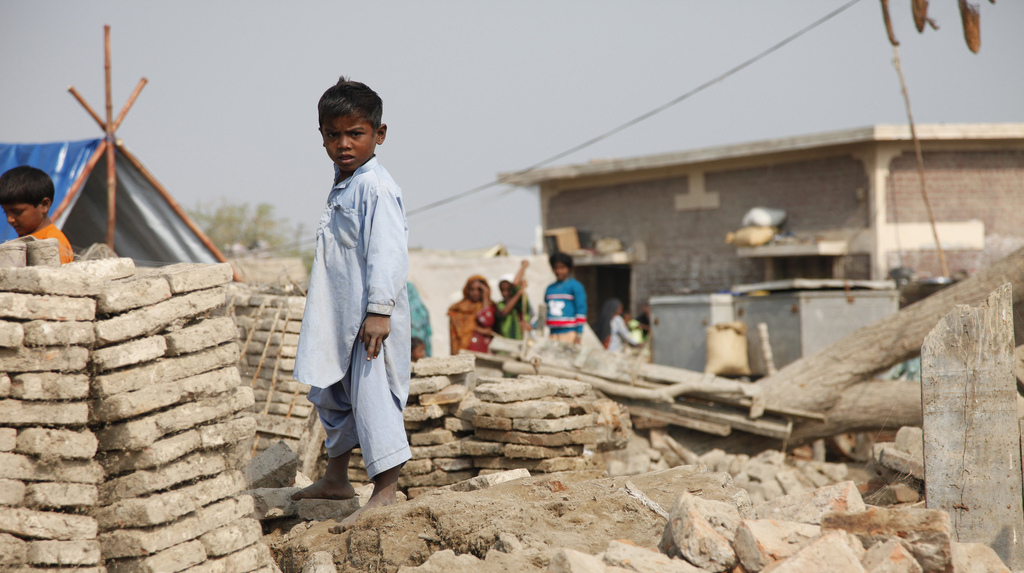
Photo Credit: A child stands amongst buildings destroyed by the floods in Sindh province, courtesy of flickr user DFID – UK Department for International Development.