-
Michael Klare on the Race for What’s Left
›Around the world, as the most easily accessible natural resources are depleted, states are beginning to turn to more remote reserves to meet their needs and the shift may spark international tensions or even conflict, said Hampshire College professor Michael Klare in a recent interview with ECSP. “I worry very much about this growing global competition for the remaining resources in those parts of the world,” he said.
-
Artisanal Gold Mining Threatens Riverine Communities in Guyana
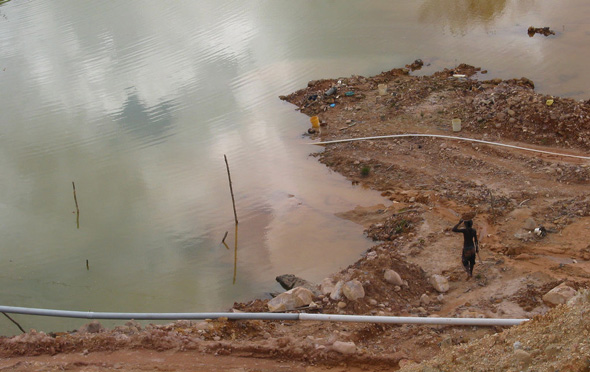
›August 14, 2012 // By Keenan Dillard“Sometimes we make sure that we catch enough rainwater to use or we would have to search out the creeks to for water clean enough to drink,” said Guyanese villager Fabian George in a June interview with the United Nations University. The negative effects of a mining boom fueled by surging gold prices have become so widespread in the small South American country, which is about the size of Idaho, that the government has temporarily stopped issuing new gold and diamond mining permits.
The ban, which was announced on July 6 and is still in effect, will last until officials are able to complete a review “of the current management/oversight arrangement of river and tributary mining.” A statement released by the Guyanese Ministry of Natural Resources and Environment explained that “damage caused by increasingly irresponsible mining in Guyana’s rivers and tributaries,” has been a cause of major concern for citizens who depend on them to survive.
Guyana, a former colony of both the Netherlands and the United Kingdom, has a population that is predominantly split between people of African and East Indian descent who were recruited as indentured servants for the tea industry during the 19th century. Amerindians – indigenous Guyanese people – made up just nine percent of the population, as of the most recent census in 2002. A vast majority of Guyanese (71.5 percent) live in rural villages, most of which are located near the coastline. The remaining population resides in the capital, Georgetown, or one of four other urban centers.
While mining is responsible for just nine percent of the country’s GDP, it accounts for almost 60 percent of exports. Gold, bauxite (the precursor to aluminum), and diamonds are extracted and exported to countries including the United States, Canada, and the United Kingdom. In 2011 Guyana produced 363,000 ounces of gold, which represents a 23 percent increase since 2009 and can be attributed “to consistently active mining by small- and medium-scale miners that benefited from the continued increase in gold prices on the international market,” according to the U.S. Geological Survey. The Communities and Small Mining Initiative reports that more than 15 percent of Guyanese citizens economically depend on small-scale mining to support themselves.
Dredging the Jungle
These small-scale operations, also known as artisanal mines, generally employ rudimentary methods to extract and process minerals, as opposed to large scale industrial operations. As of 2011 there were less than 10 industrial-scale companies with any sort of presence in Guyana, while the number of licensed artisanal miners is more than 14,000, according to the government. Although the latter usually consists of just a few workers, they are also incredibly environmentally destructive.
The methods used most by artisanal miners in Guyana begin in one of two ways, according to the Blacksmith Institute: either large water hoses are used to quickly erode a plot of land or barges are used to dredge up sediment from the bottom of a river. Then, they “combine mercury with gold-laden silt to form a hardened amalgam that has picked up most of the gold metal from the silt. The amalgam is later heated with blow torches or over an open flame to evaporate the mercury, leaving small gold pieces.”
The environmental impacts of artisanal mining in Guyana are well-documented and include “drastic increases in the sediment content of river water, increased levels of mercury in river water, creation of artificial sandbars in rivers, deforestation and degradation of land fertility, and mosquito infestation and malaria,” according to a Harvard Human Rights Program study.
A report issued by the Guyanese Ministry of Natural Resources and the Environment last month noted that current environmental problems associated with mining operations include, “widening of the river channel[s] and weakening of soil at river banks resulting in toppling of trees into the river course, blockages and changes to the main river channels resulting in un-navigable channels in the dry seasons.” High levels of turbidity, which is a measure of water clarity, have resulted in the deaths of some fish species that serve as a primary food source for riverine Guyanese communities.
The health of Guyanese rivers and streams is of particular concern to the Amerindians who make up the majority of the population in Guyana’s hinterlands where most artisanal mining occurs. The Harvard Human Rights Program report points out that indigenous people, most of whom survive on subsistence agriculture, are disproportionately affected due to their dependence on waterways for food, transportation, communication, and sanitation.
Adapting to a “Changing World”
Over the past few months the environmental, social, and health effects caused by gold mining in Guyana has become serious enough to warrant a temporary governmental halt to the issuance of any new licenses. In the meantime, scientists employed by the Guyana Geology and Mines Commission are attempting to find a viable alternative to using mercury – the most damaging practice of artisanal miners – amid increasing pressure from the international community. In addition to polluting waterways and contaminating fish, mercury releases highly toxic vapors when it is burned away from gold, which can damage both internal organs and unborn children.
Damages from the run-away mining sector aren’t limited to the environment. The Amerindian Peoples’ Association in Guyana blames increases in prostitution, drug trafficking, and human trafficking on the country’s gold rush. According to the UN, “interior police investigated nearly 50 bush murders last year, about 40 more than normal, many from fights over gold and women or from drunken rum sprees by miners on time off.” Unlicensed mines and illegal aliens who cross the border from Brazil, compounded with a large smuggling operation that bypasses Guyanese gold taxes via Suriname, have left the government struggling to “enforce regulations, hire enough trained jungle mines inspectors, qualified geologists and other personnel to keep pace, and generally maintain order,” according to the UN.
On July 28, the Guyana Geology and Mines Commission issued a statement regarding the future of mining, and stressed the need to create a “holistic plan to have the industry adapt to a changing world.” For now it seems that complaints from Amerindian groups and other Guyanese citizens are the driving force in affecting change within the country, but opposition from interest groups such as the Guyana Gold and Diamond Miners Association is intense. The government has acknowledged international pressure too as a factor in its decision to suspend new permits and recently began a partnership with the United Nations Development Programme to develop a natural resource management plan. It remains to be seen exactly what measures will be taken to address the serious problems facing the Guyanese people as a result of gold mining, but given the strong economic imperative for artisanal miners and the severity of environmental and human health effects, action must be taken soon.
Keenan Dillard is a cadet at the United States Military Academy at West Point and an intern with the Woodrow Wilson Center’s Environmental Change and Security Program.
Sources: Amerindian Peoples Association, Blacksmith Institute, Bureau of Statistics (Guyana), Center for International Forestry Research, Central Intelligence Agency, Communities and Small-Scale Mining, The Daily Herald, Demerara Waves, Environmental Protection Agency, Guyana News and Information, Harvard Law School, Inter Press Service, Ministry of Natural Resources and the Environment (Guyana), National Communications Network (Guyana), Stabroek News, United Nations, U.S. Geological Survey, USAID.
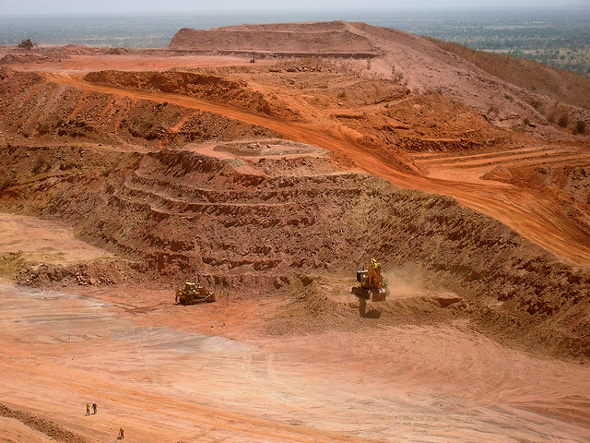
Photo Credit: “Gold Mine (Mahdia, Guyana),” courtesy of flickr user caribbeanfreephoto (Georgia Popplewell). -
New USGS Report and Maps Highlight Afghanistan’s Mineral Potential, But Obstacles Remain
›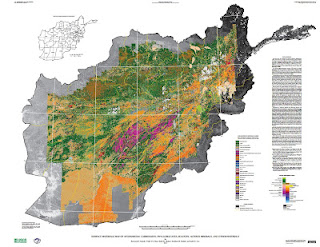
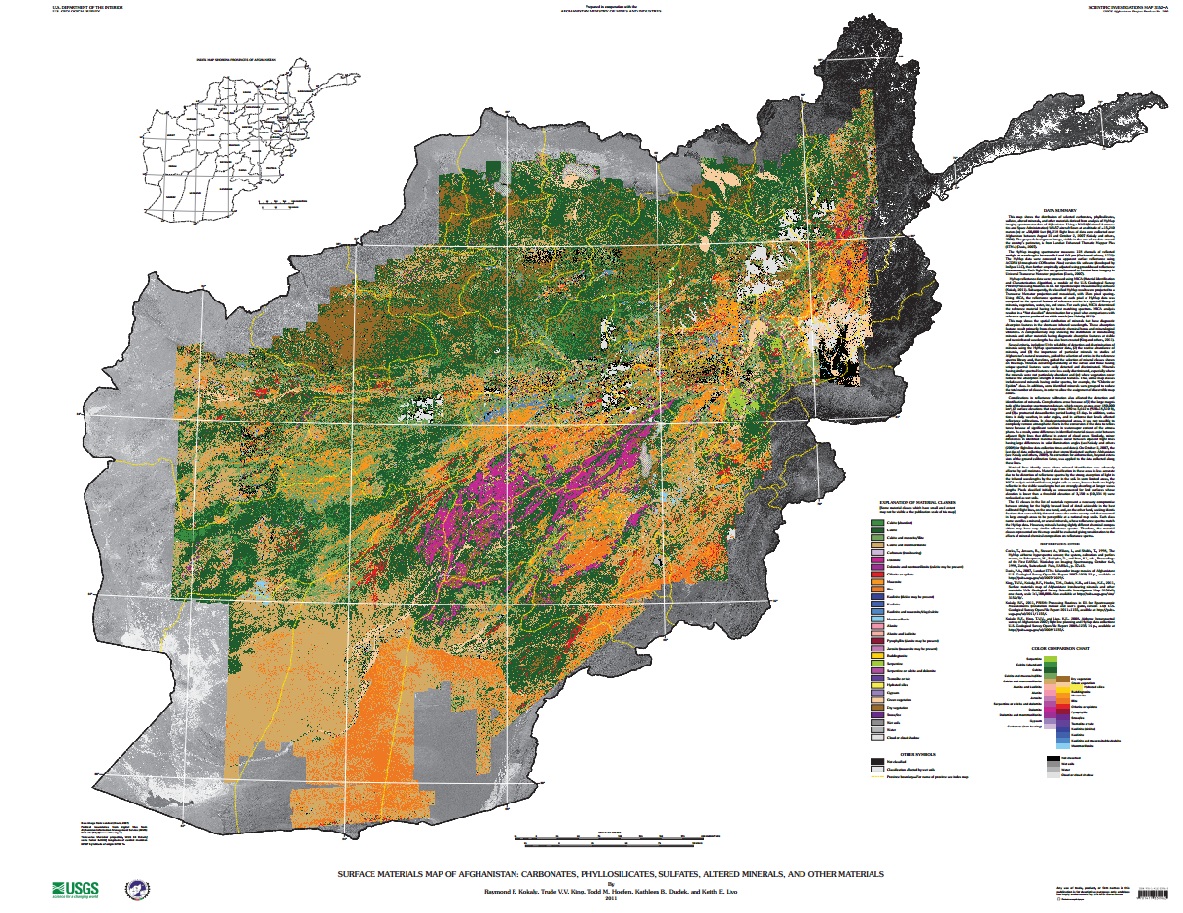
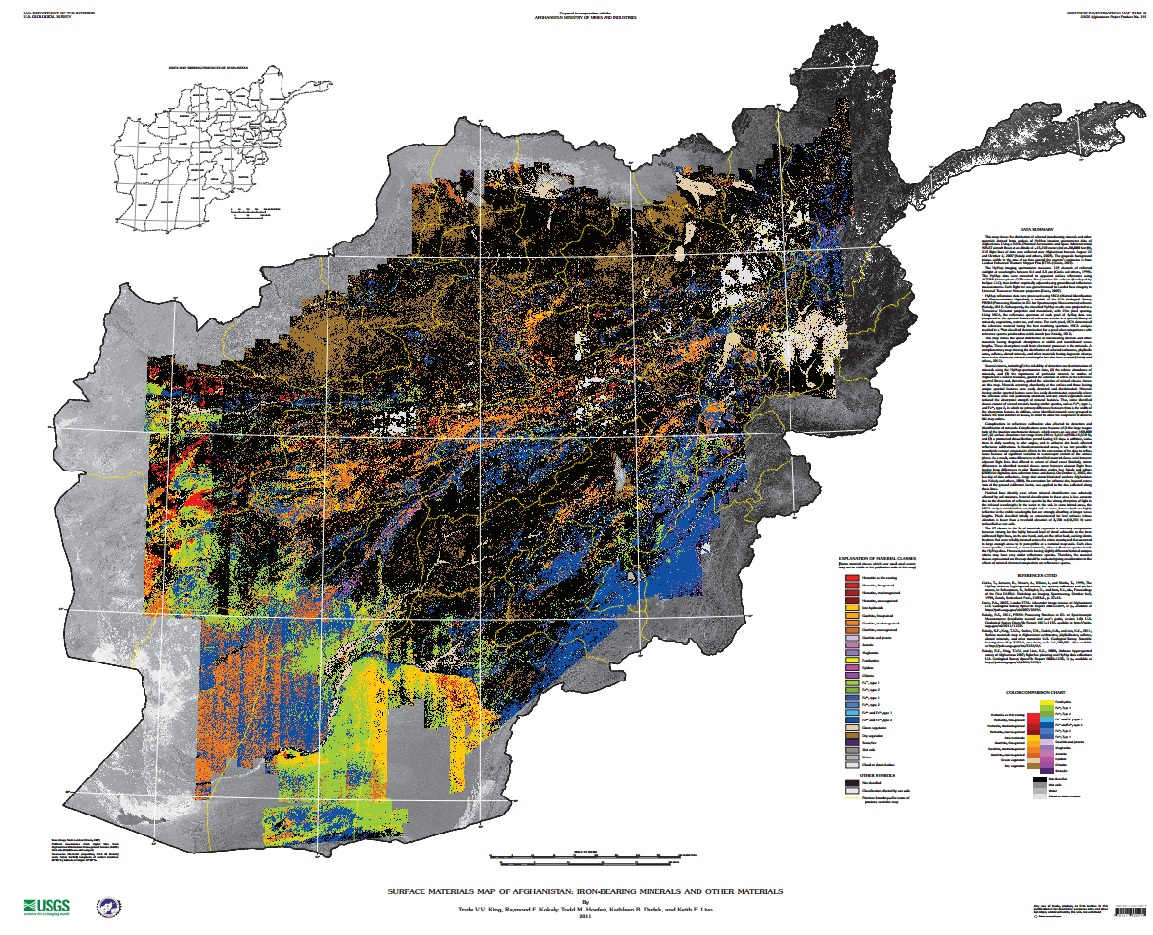
Two maps released to the public for the first time this month illustrate the vast wealth of mineral deposits in the war-torn nation of Afghanistan. The maps, created through a joint effort from the U.S. Geological Survey and Department of Defense Task Force for Business and Stability Operations, are the first of their kind to provide large-scale coverage of a country using a technology called hyperspectral imaging, which measures the reflectance of material on the Earth’s surface simultaneously across a continuous band of wavelengths broken up into 10 to 20 nanometer intervals. More than 800 million individual pixels of data were collected during a period of 43 days in 2007 by a NASA aircraft. Each data point was then “compared to reference spectrum entries in a spectral library of minerals, vegetation, water, ice, and snow in order to characterize surface materials across the Afghan landscape.”
Two maps released to the public for the first time this month illustrate the vast wealth of mineral deposits in the war-torn nation of Afghanistan. The maps, created through a joint effort from the U.S. Geological Survey and Department of Defense Task Force for Business and Stability Operations, are the first of their kind to provide large-scale coverage of a country using a technology called hyperspectral imaging, which measures the reflectance of material on the Earth’s surface simultaneously across a continuous band of wavelengths broken up into 10 to 20 nanometer intervals. More than 800 million individual pixels of data were collected during a period of 43 days in 2007 by a NASA aircraft. Each data point was then “compared to reference spectrum entries in a spectral library of minerals, vegetation, water, ice, and snow in order to characterize surface materials across the Afghan landscape.”
Accompanying the release of the maps is a USGS study, completed in September of 2011, that largely confirms earlier reports from the DOD and USGS on the size of Afghanistan’s untapped mineral resources. The first reports received widespread media coverage last year, and updated estimates indicate that upwards of $900 billion worth of mineral reserves are present in a number of different forms including copper, iron, gold, and, most notably, more than one million metric tons of rare earth elements.
Scientists involved with the project believe that there may be even more reserves awaiting discovery. “I fully expect that our estimates are conservative,” said Robert Tucker from the USGS in an interview with Scientific American. “With more time, and with more people doing proper exploration, it could become a major, major discovery.”
Over the course of the study, scientists from the USGS and Afghan Geological Survey combined the newly-created spectral data with existing maps to identify 24 areas of interest (AOIs) that warranted hands-on investigation.
The two hyperspectral maps illustrate different parts of the electromagnetic spectrum. Shortwave infrared wavelengths reveal carbonates, phyllosilicates, and sulfates, while visible and near-infrared wavelengths show iron-bearing minerals, which yield products ranging from copper to rare earth elements and uranium. Each map classifies 31 different types of materials by color.
Although the hyperspectral maps only show mineral deposits on the surface, geologists were able to estimate what lies beneath by combining new data with samples previously taken from trenches, drill holes, or underground workings at the AOIs by Soviet and Afghan scientists. According to the USGS, “A number of the AOIs were field checked by USGS and DOD geologists between 2009 and 2011, and the previous geologic interpretations and concepts were confirmed.”
Actual Extraction: Not Easy
Afghanistan has been “scouring the globe for investors to develop its mines in an attempt to lift one of the world’s poorest nations out of misery through investment,” according to The Wall Street Journal. Contracts have already been awarded to China and India to develop copper and iron mines, respectively, and another round of bidding is currently in progress for four unexploited sites that are being closely eyed by countries such as the United States, Australia, and Turkey.
But significant hurdles remain in the quest to turn Afghanistan’s buried minerals into a steady source of income for the government and the Afghan people. Security is still a major concern and United States will pull out a vast majority of its combat troops by 2014. The government has established a Mines Protection Unit to guard sites where ground has already been broken, and plans to increase the size of the unit as necessary to provide security for all mining projects nationwide. For now the Afghan Ministry of Mines is only taking bids for projects in the more secure northern part of the country, where deposits of copper and gold are located. As the nation develops and stabilizes, massive resources of rare earth elements located in the notoriously volatile Helmand Province will open for bids.
Security isn’t the only factor affecting the country’s mining prospects. “If you want to do mineral resource development, there are two things you need to pay attention to: water and energy resources. Where is the power going to come from? You can’t develop these large mineral deposits without energy,” said director of the USGS program in Afghanistan, Jack Medlin, in an interview with EARTH magazine.
There are also the traditional pitfalls of developing extractive industries, especially in poor and conflict-prone countries, including corruption, inequity, land disputes, and environmental degradation. And the fact that Afghanistan is landlocked, making supply lines in an out of the country difficult (as the United States has discovered).
Despite the many hurdles, there is plenty of optimism for an Afghan future brightened by mineral wealth. The new data shows that previous reports of substantial resources were not far off, and the Afghan economy, which for years has relied on opium as its biggest export, could certainly use the help. “The prognosis is extremely encouraging and could play a significant role in recovery from decades of war,” USAID advisor Wayne Pennington told EARTH.
For the full resolution versions of the hyperspectral imaging maps (~90MB each) see here and here.
Keenan Dillard is a cadet at the United States Military Academy at West Point and an intern with the Woodrow Wilson Center’s Environmental Change and Security Program.
Sources: Afghan Geological Survey, Afghan Ministry of Mines, Christian Science Monitor, U.S. Department of Defense, EARTH, The New York Times, Scientific American, U.S. Geological Survey, The Wall Street Journal, World Bank.
Image Credit: USGS.
-
In Mongolia, Climate Change and Mining Boom Threaten National Identity
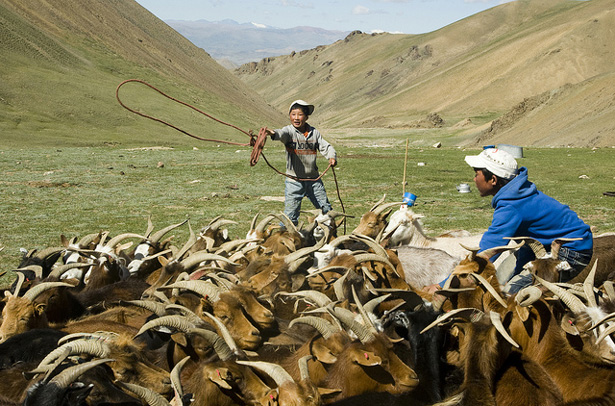
›July 23, 2012 // By Kate DiamondMongolia, a vast, sparsely populated country almost as large as Western Europe, is at once strikingly poor and strikingly rich. Its GDP per capita falls just below that of war-torn Iraq, and Ulan Bator has some of the worst air pollution ever recorded in a capital city. At the same time, Mongolia sits atop some of the world’s largest mineral reserves, worth trillions of dollars, and its economy, already one of the world’s fastest growing, could expand by a factor of six by the end of the decade as those reserves are developed.
-
Fiona Harvey, The Guardian
Re|Source 2012 Conference: Global Fight for Natural Resources “Has Only Just Begun”
›July 18, 2012 // By Wilson Center StaffThe original version of this article, by Fiona Harvey, appeared in The Guardian.
The global battle for natural resources – from food and water to energy and precious metals – is only beginning, and will intensify to proportions that could mean enormous upheavals for every country, leading academics and business figures told a conference in Oxford on Thursday.
Sir David King, former chief scientific adviser to the UK government, who convened the two-day Re|Source 2012 conference, told The Guardian: “We are nowhere near realizing the full impact of this yet. We have seen the first indications – rising food prices, pressure on water supplies, a land grab by some countries for mining rights and fertile agricultural land, and rising prices for energy and for key resources [such as] metals. But we need to do far more to deal with these problems before they become even more acute, and we are not doing enough yet.”
Countries that are not prepared for this rapid change will soon – perhaps irrevocably – lose out, with serious damage to their economies and way of life, the conference was told.
Amartya Sen, a Nobel prize-winning economist, said that the free market would not necessarily provide the best solution to sharing out the world’s resources. Governments would need to step in, he said, to ensure that people had access to the basics of life, and that the interests of businesses and the financial markets did not win out over more fundamental human needs.
Continue reading on The Guardian.
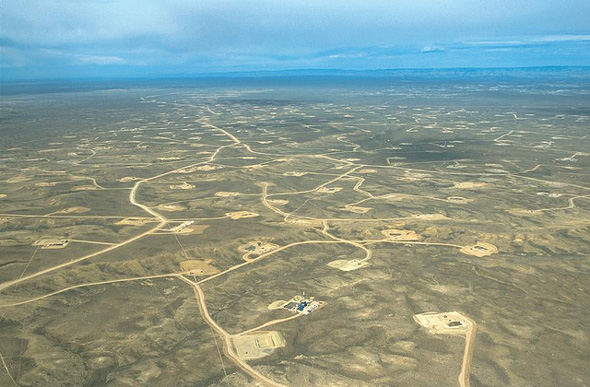
Photo Credit: “Aerial view of the Jonah natural gas field, upper Green River valley, Wyoming, 2001,” courtesy of flickr user SkyTruth and Peter Aengst/The Wilderness Society. -
African Nations Pioneer Natural Resource Accounting With ‘Gaborone Declaration’
›June 20, 2012 // By Graham NorwoodIn a move with potentially substantial ramifications for future sustainable development, 10 African nations have agreed to begin assigning monetary value to the benefits provided by non-commodity natural resources, including ecosystems such as forests, grasslands, and coral reefs.
Botswana, Gabon, Ghana, Kenya, Liberia, Mozambique, Namibia, Rwanda, South Africa, and Tanzania each affirmed their support for the “Gaborone Declaration” during last month’s Summit for Sustainability in Africa, co-hosted by Conservation International and the government of Botswana. The goal, according to Botswanan President Ian Khama, is to include these new valuations in national accounting, providing policymakers a clear perspective on the costs and benefits associated with the development or conservation of their natural resources for the first time.
Coming just prior to the Rio+20 conference, the signatories said they hoped assigning calculable costs to resource usage would encourage more sustainable development by bringing hitherto “invisible” costs and externalities into the open and onto the balance sheet.
Though the challenges of properly assessing the values of various ecosystem services are understandably many, the potential benefits of natural capital accounting are substantial.
According to SciDev.Net, the World Bank’s Vice President for Sustainable Development Rachel Kyte spoke in support of the declaration at the summit. She pointed out, for example, the advantage of knowing that a hectare of mangrove trees in a certain region of Thailand has been calculated to provide approximately $16,000 of flood protection when considering whether to clear-cut and sell the raw wood (worth about $850), convert the region into a shrimp farm ($9,000), or preserve it.
Such accounting may be particularly beneficial to the Gaborone signatories and other African nations, given growing concern among experts about foreign investment in land, natural resources, and even water on the continent.
But the declaration – and the very idea of natural capital accounting – is not without controversy.
Some argue that commodifying such resources will actually encourage their destruction rather than protect them by ascribing monetary values to previously free and shared resources, thus advantaging richer stakeholders and nations at the expense of poorer ones. As Hannah Griffiths of the UK-based World Development Movement recently wrote in The Guardian, “the result [of natural resource accounting] would be the further privatisation of essential elements of our planet to which we all share rights and have responsibilities.”
Along these lines, Nigerian environmental activist and chair of Friends of the Earth International, Nnimmo Bassey, has voiced his strenuous opposition to the plan made at the summit. “This declaration is blind to the fact that the bait of revenue from natural capital is simply a cover for continued rape of African natural resources,” he said in SciDev.
However, the signatories of the Gaborone Declaration dismissed these concerns and pointed to the value of natural resource accounting for sustainable development.
“Africa is where sustained and sustainable economic growth and stewardship of natural wealth become one and the same thing,” said Kyte at the summit. “By endorsing natural capital accounting as a tool for delivering on more inclusive green growth, Africa is showing the way for the rest of the world.”
Conservation International CEO and Chairman Peter Seligmann agreed, calling the declaration “a very big deal, a very big moment, and a big step forward.” He connected it to the imminent Rio+20 conference as well, saying the pledge is “truly a beacon on the hill for the rest of societies” and that “it will be held up on top of that hill in Rio de Janeiro.”
Indeed, the World Bank has listed natural capital accounting as one of six key issues for Rio+20, and in a report last month titled Inclusive Green Growth: The Pathway to Sustainable Development, noted that “it is vital that economic values for environmental assets be comparable to other economic values.”
The World Bank has already made significant progress in promoting the practice through its Wealth Accounting and the Valuation of Ecosystem Services (WAVES) global partnership, encouraging at least 24 countries to use some form of natural resource accounting to date. WAVES aims to sign up 50 more nations and 50 private corporations beginning at Rio+20, as a part of its “50:50 Campaign.”
WAVES and the Gaborone Declaration show that natural capital accounting is gaining momentum as a means to incentivize more sustainable development. The international news media is beginning to take notice as well. The results of the Rio+20 conference will be a good opportunity to gauge just how far the idea has come and what the extent of its future application might be.
Sources: Conservation International, The Guardian, SciDev.Net, World Bank.
Photo Credit: “Saving the Sacred Rock,” courtesy of flickr user isurusen (Isuru Senevi); video: The World Bank. -
Re-Thinking Price Shocks and Conflict?
›“Conflict, Food Price Shocks, and Food Insecurity: The Experience of Afghan Households,” a paper prepared for presentation at the Agricultural and Applied Economics Association’s annual meeting, examines the relationship between conflict and food prices, using Afghanistan during the 2008 global food crisis as a case study. By examining per capita food intake, numbers of fatalities and injuries, and the number of violent incidents in a given area, authors Anna D’Souza and Dean Jolliffe, of the U.S. Department of Agriculture and World Bank, respectively, determine that “at least in the case of Afghanistan, conflict does not seem to be the predominant driver of food insecurity.” Instead, inhabitants of conflict-prone regions, namely southern Afghanistan, consume more food, on the whole, than their northern compatriots. Residents of conflict areas do seem to be more affected by major food price increases, however these are fairly uncommon. D’Souza and Jolliffe speculate that this may be due to “interruptions in market access, inability to trade and barter, and worse food production and distribution systems.” These findings may be somewhat counterintuitive, but are an important resource for those seeking to reduce food insecurity in both conflict-prone and peaceful regions.In a working paper for the Center of Global Development, Samuel Bazzi and Christopher Blattman upend much of the established thinking on the relationship between commodity prices and conflict onset. Past researchers have found that lower prices of agricultural commodities lead to conflict as civilians have less to lose by rebelling against the government, and higher prices of resources like oil and minerals can lead to conflict as rebel groups have greater incentive to seize control. Contrary to these explanations, however, Bazzi and Blattman find “no evidence of a consistent, robust relationship between commodity price shocks and political instability.” Even when examining states with higher risks of conflict, like those which are particularly fragile, ethnically polarized, economically unequal, especially poor, and/or located in sub-Saharan Africa, they find no correlation between price shocks and conflict. The only evidence of a relationship they find is that rising prices lead to rising incomes, which can hasten the end of a conflict, but even this correlation is weak and varies from state to state. Though currently only a working paper, Bazzi and Blattman’s research provides an intriguing counter-narrative: “We argue that errors and publication bias have likely distorted the theoretical and empirical literature on political instability,” they write. -
Environment, Natural Resource Guidelines for Peacekeepers Moves UN Closer to ‘Greening the Blue Helmets’
›May 30, 2012 // By Stuart KentUN peacekeepers not only operate in conflicts where land and natural resources are a component of the fighting but their own bases and operations can also impact the local environment. As well as documenting practical steps to minimize the footprint of field missions, a new report from the United Nations Environment Program (UNEP) reviews the relationship between natural resources and conflict and what it means for peacekeeping.
While there’s been talk about “greening” UN peacekeeping for years, the details about the economic, environmental, and mission benefits contained in Greening the Blue Helmets: Environment, Natural Resources and UN Peacekeeping Operations suggest that this talk is getting closer to reality.
As of December 2011, the UN’s Department of Peacekeeping Operations was responsible for 121,591 personnel, 17,000 vehicles, and 257 aircraft across 16 different operations worldwide. These forces account for more than half of the entire UN system’s carbon emissions and can significantly strain the resources of fragile host communities, according to the report.
Building on the 2009 Environmental Policy for UN Field Missions, the UNEP report provides a dozen best practice examples from ongoing missions.
Field cases serve as evidence of how increasing water and energy efficiency, safely discarding solid and hazardous wastes, protecting cultural and historical sites, and ensuring a limited footprint after the closing down of camps, can save environmental and financial resources. These measures, the report claims, also reduce the risk of tension with host communities, such as occurred in Haiti when an outbreak of Cholera was traced to unsanitary water management practices at a UN camp.
Technologies recommended include better waste management systems, improved water systems, energy efficient buildings, and green energy capacities. However, some improvements can be made by simply encouraging behavioral changes; the UN mission in Timor-Leste reduced energy consumption by 15 percent over 12 months using a “CarLog” system to encourage fuel efficiency. With a 2009 global fuel bill of $638 million, even a 15 percent margin relates to a significant figure (much like the logic behind similar efficiency efforts within the U.S. military).
However, uncertain mission lengths are a major barrier to the adoption of more efficient technologies. Despite UN operations lasting an average of seven years and evidence indicating that capital investments could be recovered within one to five years in some cases, year-to-year mandates complicate long-term planning.
Natural Resource Nexus
Conceptually, the nexus of natural resources, conflict, and peacebuilding must be a central concern of peacekeeping operations, asserts the report.
In Africa alone, 13 operations have been conducted in response to conflicts associated with natural resources, at a cost of around $32 billion. Exploitation of natural resources such as diamonds, timber, and oil has financed and fueled conflicts in Sierra Leone, the Democratic Republic of the Congo, and Liberia. Communal tensions over access to scarce land and water resources are also considered an exacerbating influence on conflict dynamics in much of Sudan and now South Sudan, according to the report.
Addressing this nexus can also provide opportunities to reduce and redress conflict. In Darfur, firewood collection is a dangerous task for women and girls. By making “firewood patrols” a regular feature of the UN forces’ protection, the prevalence of sexual violence has been limited.
The UN Assistance Mission in Afghanistan is cited in the report for its efforts to hire ex-combatant and vulnerable populations to aid in the reforestation of extensively degraded pistachio woodlands from 2003 to 2009.
“Natural resources can provide opportunities for emergency employment and…sustainable livelihoods for former combatants,” write the authors.
Countries recovering from episodes of violence tend to have a low capacity to effectively and equitably manage a natural resource base that itself may have been degraded by conflict. Recent attention, however, is being paid to the peacebuilding potential of managing shared resources.
According to the report, “while only 54 percent of peace agreements reached between 1989 and 2004 contained provisions on natural resources, all of the major agreements concluded between 2005 and 2010 included such provisions.” This includes the renovation of land tenure systems, management of valuable extractive industries, and reallocation of resource rents.
Preventing Predatory Extraction
As peace begins to take hold, “access to land may be a key determining factor affecting the successful reintegration of a former combatant into a community.”
According to interview data from Northern Uganda, 93 percent of male LRA ex-combatants were unable to access land after demobilization. Often due to the death of an elder relative, sale of land by a family member, or land grabs by other members of the community.
While shared resources can build trust between communities, spoiler groups that use aggressive means to secure resource rents in the aftermath of conflict can endanger a fragile peace. The report identifies a role here for peacekeeping forces – and in particular for their civilian contingent – to identify these potential risks and opportunities for action.
In particular, the report recommends a higher level of clarity about the relationship between peacekeeping forces and so called “expert panels” – groups of civilian specialists called upon by the Security Council to provide advice on an official basis about natural resources in the aftermath of conflict.
The UN mission in the Democratic Republic of Congo, for instance, was given a direct mandate in 2008 to work with the DRC expert panel and to “use its monitoring and inspection capacities to curtail the provision of support to illegal armed groups derived from illicit trade in natural resources.”
UNEP Program Officer Matti Lehtonen, in an email interview, called the panels a “tremendous asset that is not yet used up to its full potential.” However, he noted, “expert panels and peacekeeping missions are different tools with different objectives so there is also a need to maintain a degree of independence.”
The report identifies a set of key recommendations for the UN moving forward:- Ensure that pre-deployment and in-mission training includes instruction on environment and natural resource management
- Aid and encourage disarmament, demobilization, and reintegration programs to look closely at emergency employment and sustainable livelihoods related to natural resources and the environment
- Support and encourage civil affairs personnel to seek ways to capitalize on peacebuilding opportunities around natural resources and the environment
- Systematically inform the Security Council of linkages between natural resources and conflict in states where the Council may be considering action
- Where natural resources have fueled or financed conflict, provide peacekeepers with a more systemic mandate to act on these issues
- Effectively implement best practices identified in the 2009 environmental policy
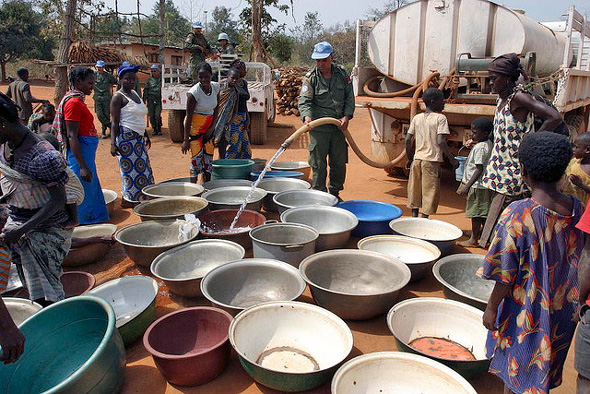
Photo Credit: UN peacekeepers in Côte d’Ivoire distribute water during a 2007 mission, courtesy of United Nations Photo.
Showing posts from category minerals.