

-
“Adapt we must”: Joshua Busby on the Climate-Security Connection
›August 29, 2008 // By Sonia Schmanski In “The Climate Security Connection: What it Means for the Poor,” Joshua Busby (listen to ECSP podcast with Busby) discusses the security implications of climate change for the developing world. In this paper, written for “Development in the Balance: How Will the World’s Poor Cope With Climate Change?,” the fifth annual Brookings Blum Round Table, held earlier this month, Busby explains that “[d]eveloping countries are most vulnerable, partly as an accident of geography, but also because vulnerability is made worse by poverty, bad governance, and past conflict.”
Busby compares the aftermath of Cyclone Nargis, which pounded Burma in May 2008, to that of an armed attack, describing both as causing “widespread suffering, destruction of infrastructure, mobilization of the military, and the movement of refugees.” In fact, between 1991 and 2005, natural disasters led to as many deaths as armed conflict, as Busby notes. The subsequent political battles around outside efforts to deliver aid “gave people around the world a visual image of the potential future,” says Busby, and offered a glimpse of “the security risks when affected countries lack the capacity or will to respond.”
The economic consequences of natural disasters can also be crippling. In absolute terms, the developed world suffers larger financial losses, but as a share of GDP, the damage to developing countries is far greater. Additionally, though the death toll of natural disasters continues to fall, the total number of affected people is on the rise, which means that many more people are relying on government services to regain their footing in the wake of natural disasters.
These consequences have long-term security implications for a world in which natural disasters are becoming more frequent and severe. “Post-disaster environments are going to be dangerous moments,” Busby predicts, “when mishandled or inadequate disaster response can give way to the kinds of lingering grievances that can motivate people to take up arms.” To prevent this, he advocates an international focus on adaptation and risk-reduction strategies, and cautions against narrowly focusing on the causal relationship linking climate change to violent conflict. By doing so, policymakers and practitioners overlook what Busby says is the more likely outcome, in which large-scale disasters sap government resources by creating humanitarian emergencies that require military mobilization in response. In “Gathering Storm – the humanitarian impact of climate change,” the UN’s Integrated Regional News Networks (IRIN) explores how climate change has altered the face of global humanitarian crises.
Offering a sharp critique of the reactive strategy of many governments, Busby suggests that a modest investment in prevention would be more efficient and more effective. A joint assessment by the World Bank and the U.S. Geological Survey, for example, found that a $40 billion investment in natural-disaster prevention could have prevented $280 billion in damages worldwide during the 1990s. The reactive approach also threatens to politicize the carefully guarded neutrality of aid workers and organizations; engender international friction where inadequate government response leads to international intervention; and sap government resources through costly responses to humanitarian crises.
Busby envisions a system where “the poor bear less of the brunt of half-hearted and partial reactive measures” in response to climate change. Noting Paul Collier’s finding in The Bottom Billion that past conflict is an accurate predictor of future poverty, Busby argues that reducing the potential for violence in post-disaster situations will improve development prospects for countries worldwide. An enlightened approach, emphasizing prevention over reaction, will not only insulate vulnerable regions from the immediate dangers of natural disasters, but will also protect them from more indirect, long-term threats to their prosperity and security.
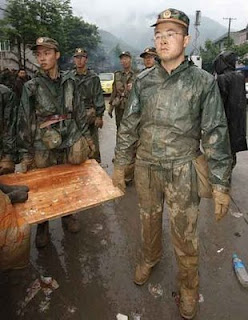
Photo: Tens of thousands of Chinese soldiers were mobilized in response to the May 12th earthquake. As climate change makes natural disasters more frequent and more severe, this will likely become an increasingly common sight. Photo courtesy of Flickr user Alex and Jerry.
-
Weekly Reading
›“Over the next twenty years physical pressures – population, resource, energy, climatic, and environmental – could combine with rapid social, cultural, technological, and geopolitical change to create greater uncertainty,” warns the newly released 2008 National Defense Strategy. Demographic trends, resource scarcity, and environmental change all inform the updated strategy, which encourages international cooperation to address these impending challenges.
The “Population Forum” in the September issue of WorldWatch Magazine “reveals that empowering women to make their own family size choices…is the best strategy to tackle population growth” and the environmental and security problems linked to it. A short history of population trends is available online; the website offers free previews of Lori Hunter’s article on PHE and gender, as well as “Population and Security” by Elizabeth Leahy and ECSP’s own Sean Peoples. Bernard Orimbo links population growth and environmental degradation in his native Kenya, and PAI staff discuss urbanization.
Climate change threatens to exaggerate the challenges faced by the billions of people worldwide who depend upon natural resources for their survival. But the competition and, at times, violent conflict that results from increased resource scarcity is not a given; the recently released World Resources Report 2008 finds that “well-designed, community-based enterprises” can ease the environmental burden on natural resources and pave the way for sustainable dependence on the land.
At the 2008 World Expo’s “Water and Conflict Resolution” week, municipal representatives working with Friends of the Earth Middle East (FoEME) presented case studies from its “Good Water Neighbors” programs: cross-border solutions for the Lower Jordan River; the Jordan River Peace Park project; and the town of Auja in the Jordan River Valley. Speaking about these programs the Wilson Center, FOEME’s Gidon Bromberg said that “by working together, not only do we advance the environmental issues…we also advance peace between our peoples.” -
Defense, Development, Diplomacy Experts Debate DoD’s Role in Development
›July 18, 2008 // By Rachel Weisshaar“The U.S. military recognizes that the use of conventional military force is of limited use” in advancing U.S. national security, said Reuben Brigety II, director of the Sustainable Security Program at the Center for American Progress (CAP), at a July 18 launch of his report Humanity as a Weapon of War: Sustainable Security and the Role of the U.S. Military. The tragedy of 9/11, as well as the setbacks experienced in the wars in Afghanistan and Iraq, emphasized to the U.S. defense community that although combat operations remain critical to its mission, the military must also strive to “prevent conflict from emerging in the first place” through activities that stabilize societies, economies, and governments.
Brigety cited efforts by the Combined Joint Task Force for the Horn of Africa (CJTF-HOA), the nascent U.S. Africa Command (AFRICOM), and the U.S. Southern Command (SOUTHCOM) as examples of the U.S. military’s growing appreciation of how development assistance can help stabilize countries, build goodwill toward the United States, and increase U.S. understanding of local socio-political and economic conditions. In recent years, CJTF-HOA has dug wells, vaccinated livestock, and provided health services, while SOUTHCOM has a long track record of providing humanitarian assistance in Central and South America, particularly in the wake of natural disasters.
Although Brigety asserted that it is nothing “new for the military to be involved in addressing basic human needs,” he and his fellow presenters—Elisabeth Kvitashvili of the U.S. Agency for International Development (USAID), James Schear of the Institute for National Security Studies, and Stewart Patrick of the Council on Foreign Relations—agreed that the Department of Defense (DoD) has been undertaking an increasing share of the U.S. government’s development activities in recent years. As Brigety’s report notes, the “share of the U.S. government’s official development assistance, or ODA, spent by the Defense Department increased to 22 percent in 2005, the last year for which complete data is available, from 3.5 percent in 1998. Over the same time period, USAID’s share of ODA fell to less than 40 percent from 65 percent.”
Earlier this week, Secretary of Defense Robert Gates made waves when he said that “the United States military has become more involved in a range of activities that in the past were perceived to be the exclusive province of civilian agencies and organizations. This has led to concern among many organizations…about what’s seen as a creeping ‘militarization’ of some aspects of America’s foreign policy. This is not an entirely unreasonable sentiment.”
At the CAP launch, Patrick asserted that one reason why the DoD has become increasingly involved in development activities—in peaceful regions as well as violent ones—is the “massive budgetary asymmetry” between the DoD and the State Department and USAID. Gates made a similar point: “America’s civilian institutions of diplomacy and development have been chronically undermanned and underfunded for far too long—relative to what we spend on the military, and more important, relative to the responsibilities and challenges our nation has around the world.”
Kvitashvili agreed that USAID is underfunded and understaffed, but said the solution was not having the military take the lead in development activities. She argued that the military—which, unlike USAID, is not staffed by development professionals—tends to engage in “feel-good, short-term, one-off” projects that do not lead to sustainable gains for local populations. Instead, she welcomed a stepped-up supporting role for the military in development activities. -
Weekly Reading
›In a foreign policy speech on Tuesday attended by several of the New Security Beat’s authors, Senator Barack Obama said the danger posed by the price of oil “is eclipsed only by the long-term threat from climate change, which will lead to devastating weather patterns, terrible storms, drought, and famine. That means people competing for food and water in the next 50 years in the very places that have known horrific violence in the last fifty: Africa, the Middle East, and South Asia. Most disastrously, that could mean destructive storms on our shores, and the disappearance of our coastline. This is not just an economic issue or an environmental concern—this is a national security crisis.”
“The US security community has been looking at environment and security links for much longer than the current attention around climate/security linkages would suggest,” ECSP Director Geoff Dabelko told the Yale Forum on Climate Change & the Media, which published a piece examining climate change and national security earlier this week.
“The next president must strengthen civilian professional capacity to carry out diplomatic and development operations. More funding is needed to address the current 17 to 1 spending imbalance in staffing and resources between defense and diplomatic/development operations, and to reduce the use of contractors in foreign assistance programs,” argues a report from Refugees International, U.S. Civil-Military Imbalance for Global Engagement: Lessons From the Operational Level in Africa.
An opinion piece by Laurie Mazur and Priscilla Huang argues against blaming immigrants for environmental degradation. “Environmental impact is determined not just by our numbers, but by how we use resources—our systems of production and consumption and the policies that shape them,” they write. “It’s laughable to blame immigrants and population growth for traffic, as the [anti-immigrant] ads do, without mentioning, say, our chronic neglect of public transportation.” -
The Changing Countenance of American Security
›July 10, 2008 // By Daniel Gleick“Among the major challenges that the United States will face over the coming decades are climate change, water scarcity, food insecurity, and environmental degradation. These are challenges that will threaten the economic well-being and security of all countries on earth, and by dint of their global nature, their effects cannot be overcome unless we adopt a global perspective and strategy,” writes Gayle Smith of the Center for American Progress in In Search of Sustainable Security, where she argues that the United States must improve its security by coordinating and modernizing its global development programs and re-engaging in international institutions.
The sustainable security Smith proposes combines three elements:- National security, “the safety of the United States”;
- Human security, “the well-being and safety of people”; and
- Collective security, “the shared interests of the entire world.”
According to Smith, U.S. security policy is currently focused almost exclusively on direct, traditional threats—nations, terrorist cells, and rebel groups—and it goes about combating those threats unilaterally. As a result, the United States has withdrawn from the global community. Yet in efforts such as the war in Iraq, we have seen that security is unattainable without strong states and strong societies in which people feel they have economic and social opportunities. Even enormous military commitment cannot guarantee security in the absence of these conditions.
Over the course of the past several years, the Department of Defense (DoD), including Secretary of Defense Robert Gates, has increasingly recognized the role development plays in security. “The Pentagon’s development budget has soared from 5.6 percent of the executive branch total in 2002 to 21.7 percent, or $5.5 billion, in 2005, and is slated to increase further. New authorities have been secured, new programs have been initiated, and with DoD Directive 3000.05, the U.S. military is now mandated to treat stability operations as a core mission on par with combat operations,” writes Smith. A 2007 working paper by the Center for Global Development also addressed the DoD’s expanding role—and interest—in international development.
“America used to be the champion for all of us, and now it is the champion only for itself,” the report quotes a young attorney in East Africa as saying. By re-energizing our commitment to global development and multilateral engagement, we can once again become the world’s champion—and strengthen our own security at the same time. -
House Energy Subcommittee Debates Economic, Human, Security Costs of Climate Change
›June 30, 2008 // By Rachel WeisshaarThe cost of taking no action to reduce greenhouse gas emissions would be “equivalent to a 3.6% loss of the U.S. GDP in 2100,” said Sir Nicholas Stern in his written testimony to the Energy and Commerce Subcommittee on Energy and Air Quality last week (archived webcast). “We should emphasize, however, that there are many likely, larger, and deeply damaging, effects which will occur after 2100 and these calculations take no account of the effects on the USA of the damages and devastation which occur outside the USA.”
Stern, who authored the 2006 Stern Review on the Economics of Climate Change, discussed the non-economic costs of climate change, as well. Extreme climate change scenarios “involve movements of population, and we know that movement of population means not only the hardship around the movements themselves, but also conflict,” he said at the hearing.
Sherri Goodman, general counsel of the Center for Naval Analysis (CNA) Corporation, asserted the interdependence of climate change, national security, and energy dependence. “Numerous DoD studies have concluded that high fuel demand by combat forces detracts from combat capability, makes our forces more vulnerable, diverts combat assets from offense to supply line protection, and increases operating costs,” said Goodman’s testimony.
Energy is also a security issue at home. “The Defense Department is almost completely dependent on electricity from the national grid to power critical missions at fixed installations,” explained Goodman. “The national electric grid is fragile and can be easily disrupted, as happened in the Northeast Blackout of 2003, caused by trees falling onto power lines in Ohio. It affected 50 million people in eight states and Canada, took days to restore and caused a financial loss in the U.S. estimated to be between $4 billion and $10 billion. As extreme weather events become more common [due to climate change], so do the threats to our national electricity supply.”
A day earlier, two other House committees discussed the newly completed—and still classified—National Intelligence Assessment on the U.S. national security implications of climate change. -
U.S. Army War College Report Says We Ignore Climate Change Security Risks “At Our Peril”
›May 20, 2008 // By Sonia SchmanskiThe narrow window of opportunity to address climate change makes it imperative that we “remove our heads from the proverbial sand,” writes editor Carolyn Pumphrey in “Global Climate Change: National Security Implications,” released by the U.S. Army War College earlier this month. The report aggregates the presentations given at a 2007 colloquium by the same name in Chapel Hill, North Carolina, and features contributions from several authors who have worked recently with ECSP, including Kent Hughes Butts, Joshua Busby, and John T. Ackerman (who has also been a guest contributor to the New Security Beat).
The risks associated with climate change include the spread of disease, severe drought, and coastal flooding, which could lead to decreased agricultural output, mass migration, and other challenges. Pumphrey writes that while social scientists are not in full agreement that violence will result from these developments, conference participants agreed that climate change presents a serious threat, “compounded by a context of rapid population growth, increasing economic appetite, pockets of extreme violence, and global interdependence.” By inflaming latent tensions, climate change will “complicate American foreign policy in a wide variety of ways,” says Pumphrey.
Since the Senate Armed Services Committee called environmental destruction a “growing national security threat” in the late 1990s, some effort has been devoted to crafting a U.S. response, but politicians have hesitated to act on uncertain scientific data, says Pumphrey, arguing additionally that the creeping dangers associated with climate change have only recently begun to captivate the public imagination, and that attempts to spice them up can lead to inaccurate exaggeration. Finally, Pumphrey says, pervasive overconfidence in the ability of “American ingenuity” to outpace emerging dangers has hindered decisive action.
Pumphrey calls for a three-pronged strategy that includes “better intelligence, better science, and better understanding of the relationships between such things as violence, society, and climate change.” She maintains that we must slow the rate of climate change and prepare for unavoidable changes, take action to alleviate international social distress, and prepare to address potential conflicts. And, she notes, this is “a job for everyone,” not just the military.
-
Will Burmese Junta’s Response to Cyclone Nargis Provoke Protests?
›May 9, 2008 // By Rachel WeisshaarBurma’s ruling military junta is prohibiting almost all foreign aid workers from entering the country, despite the massive devastation wreaked by Cyclone Nargis last week. The military has also impounded an aid shipment from the UN World Food Program (WFP) and has refused aid from the United States, among other countries. “We are very concerned that this food is not reaching—on day six after a cyclone—the very victims of that cyclone,” said WFP spokesman Paul Risley. The United Nations has suspended aid to Burma pending resolution of the situation.
In a statement released earlier this week, the junta said it would be willing to accept foreign aid, as long as it could distribute the shipments itself. But so far, the statement has not matched up with reality.
The official death toll from the cyclone is approximately 23,000, but experts say this figure could rise significantly, as approximately 40,000 people remain missing. Hundreds of thousands are currently without shelter, food, safe water, or medical care, and international experts agree that the Burmese military does not have the capacity to meet the need. Further compounding the problem, Burma’s military rulers have pressed on with plans to conduct a national constitutional referendum in the less-affected areas tomorrow. Soldiers who could be delivering much-needed aid to survivors have instead been assigned to guard and run polling places. The ruling generals claim that approval of the referendum will set Burma on a gradual path to democracy; nearly all other observers say the vote is a sham. “If you believe in gnomes, trolls and elves, you can believe in this democratic process in Myanmar,” said chief UN human rights investigator Paulo Sergio Pinheiro last year.
Many of Burma’s citizens are probably too preoccupied with immediate survival right now to be thinking about protesting the junta’s delay of humanitarian relief. But in a few weeks or months, when the situation has (hopefully) stabilized somewhat and word has spread of the holdup of humanitarian aid, one wonders whether the junta will find itself the target of popular outrage. By dragging their feet on international humanitarian relief, Burma’s military rulers seem to be begging for an uprising.
Showing posts from category military.
 In “
In “

