-
New UNEP Report Explores Environment’s Links to Conflict, Peacebuilding
›March 10, 2009 // By Will Rogers “Integrating environment and natural resources into peacebuilding is no longer an option—it is a security imperative,” says a new report from the UN Environment Programme (UNEP), From Conflict to Peacebuilding: The Role of Natural Resources and the Environment (to be launched by Achim Steiner, executive director of UNEP, at a March 24, 2009, event at the Wilson Center). A joint product of UNEP and UNEP’s Expert Advisory Group on Environment, Conflict and Peacebuilding, the report was co-authored by Richard Matthew of the University of California, Irvine, Oli Brown of the International Institute for Sustainable Development, and David Jensen of UNEP’s Post-Conflict and Disaster Management Branch. Though environmental conditions are rarely – if ever – the sole precipitator of violent conflict and war, they do play an important role as a “threat multiplier which exacerbates existing trends, tensions and instability” that can ultimately lead to conflict.
Environmental factors can play a pivotal role along all points of the conflict continuum—from the outbreak of conflict, to the perpetuation of conflict, to the collapse of peace and return to violence. “Attempts to control natural resources or grievances caused by inequitable wealth sharing or environmental degradation can contribute to the outbreak of conflict,” the report says. In Darfur, for example, “water scarcity and the steady loss of fertile land are important underlying factors” that have combined with ethnic rivalry, human and livestock population growth, and weak governance to contribute to conflict.
Exploitation of natural resources also played a substantial role in financing and sustaining conflicts in Sierra Leone, Liberia, Angola, and Cambodia, “transforming war and insurgency into an economic rather than purely political activity.” Economic incentives to control valuable natural resources can reinforce political fragmentation, derail a peace process, and even “undermine genuine political reintegration and reconciliation” after peace has been forged.
Not only can natural resources help precipitate violence, conflict can also affect natural resources, destroying people’s livelihoods and perpetuating the conflict cycle. During conflict, the environment can be transformed into a weapon of war that can endanger human health and disrupt and destroy livelihoods—as when wells are poisoned or crops are burned, for example. Environmental destruction disrupts “normal socio-economic patterns,” forces “populations to adopt coping strategies, and often leads to internal displacement or migration to neighboring countries.” And conflict can erode or destroy state institutions and civil society, exacerbating grievances (or creating new ones) and furthering the resource exploitation that fuels the conflict.
Successful peacebuilding therefore requires that “environmental drivers are managed, that tensions are defused, and that natural assets are used sustainably to support stability and development in the long term.” According to the report, successfully integrating natural resource and environmental issues into conflict prevention and peacebuilding strategies requires the United Nations and international community to:- Improve the capacity for early warning and action “in countries that are vulnerable to conflict over natural resources;”
- Implement economic sanctions and develop new legal strategies to improve “oversight and protection of natural resources during conflicts” to minimize their use in financing and sustaining conflict;
- Address natural resource and environmental issues in the initial peacemaking and peacekeeping processes;
- Incorporate natural-resource and environmental issues into integrated peacebuilding strategies in order to avoid a relapse into conflict;
- Help countries use their natural resources to promote economic growth, while practicing good governance and environmental sustainability; and
- Promote confidence building and cooperation between conflicting groups that have shared interests over natural resources and the environment.
-
Weekly Reading
›“A New Military Mission: Clean Energy,” part of the Center for American Progress’ “It’s Easy Being Green” series, highlights the military’s attempts to become more energy-efficient. Read more about the U.S. military’s environmental initiatives.
Simon Dalby, a professor at Carleton College, discusses the evolution of environmental security with John Tessitore, executive editor of the Carnegie Council, in a video interview (transcript available).
Climate Change, Food Security, and the Right to Adequate Food examines climate change’s expected impact on food production, with a special focus on Africa and Asia.
The BDA Foundation, a Canadian charity, and PharmAfrica, a pharmaceutical company, are working to create a medicinal plants industry that will lift local people out of poverty in the Democratic Republic of the Congo. -
Mind the Gap: Forging a Consensus on Security and Climate Change in EU and US Foreign Policy
›March 5, 2009 // By Will Rogers“There are political and economic vulnerabilities that are in fact more important—or seem more important—to the participants of conflict than the physical vulnerability to climate change,” said Clionadh Raleigh at the February 19, 2009, event, “Climate Security Roundtable: U.S. and EU Research and Policy.” Raleigh, a lecturer at Trinity College Dublin, was joined by Nick Mabey, founding director and chief executive of E3G, and Sharon Burke, a senior fellow at the Center for a New American Security, to discuss climate change’s impact on conflict and how the United States and European Union (EU) have begun to adapt their foreign and security policies to the threat of climate change.
Ecological Change, Migration, and Conflict: A Complex Story
“The lack of access to power for certain communities, certain ethnic groups in sub-Saharan Africa, and basic access to resources among the most vulnerable populations has led to people misinterpreting the relationship that ecological change plays in their decision to either participate in conflict or to migrate,” Raleigh said. Although Raleigh’s research, which examined civil conflicts from 1990 to 2004, found that population density and growth were related to higher risks of conflict, “environmental pressures were not more likely to cause conflict in poor states—and not more likely during periods of instability,” she concluded. “Social, political, and economic factors are the most important determinants of civil war within developing countries,” she emphasized. “Poverty and unequal development come up time and time again.”
According to Raleigh, fears of mass international migration in response to climate change are overplayed. “Individuals and communities have quite a lot of coping mechanisms to deal with ecological difficulty,” including migration from rural to urban areas in the same country, she explained. Most migration, including labor and distress migration, “is temporary, internal, and circular,” she emphasized. “There is very little to no evidence that there will be an increase in international migration” in response to ecological change, although “there is evidence that there will be an increase in internal migration.”
Climate Change and Security: Perspectives from the EU“Climate change is serious,” emphasized Mabey. “It’s a threat multiplier, it will make unstable places less stable—it’s going to change strategic interests, alliances, borders, threats, economic relationships, comparative advantages, the nature of international relations, and the legitimacy of the UN.” In the future, “security policy will need to get more preventive and risk-based because climate change just injects a huge bolt of uncertainty into the future,” said Mabey. He urged the expansion of forward-looking information systems that provide policymakers with the data they need to make decisions at the geopolitical, strategic, and operations levels. He also said security experts should strive to communicate the potential consequences of climate change to decisionmakers.
The EU has taken steps to integrate climate change into its security strategy; Great Britain, Germany, and Denmark have taken the lead. The Arctic has been a particular focus, with security experts examining trade routes, maritime zones, and new access to resources. Climate change “is not all about instability” in fragile, impoverished states, Mabey explained. “The Arctic is by far the most important climate security issue in the minds of traditional foreign-policy types in Europe.”
Environmental Security Gets a New Tool: The Climate War GameLast year, Burke helped conduct a climate change war game based on a scenario of extreme weather events like droughts, wildfires, and cyclones. “Every country sort of hewed to what you would expect,” said Burke of the high-profile participants from China, India, Europe, and the United States. “The EU team spent the first two hours debating whether they could really be a country; the Indian team instantly came up with a negotiating strategy that sounded cooperative and brilliant but was completely impossible to execute; the Chinese team was, ‘No, we’re not going to do anything unless you pay us’; and the American team was keen to lead, only nobody was following.” One of the key lessons from the game, Burke explained, was that “everything comes down to what China is prepared to do.”
In developing the game, Burke and her colleagues discovered “that there’s a vast poverty of the kinds of information that you need to make decisions.” As Burke explained, policymakers need specific data “to obligate large amounts of money and personnel,” and the game revealed that “policymakers don’t have the information they need to make decisions.”
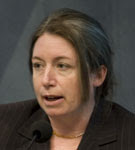
Photos: From top to bottom, Clionadh Raleigh, Nick Mabey, and Sharon Burke. Courtesy of Dave Hawxhurst and the Woodrow Wilson Center. -
From Report 13: Watch Jennifer Dabbs Sciubba on Population in Defense Policy Planning
›February 25, 2009 // By Wilson Center Staff“Demography will have a greater role in defense planning in the future,” says Jennifer Dabbs Sciubba in this short video preview of her article, “Population in Defense Policy Planning,” now appearing in the 13th issue of Environmental Change and Security Program Report. “Robert Gates has put a lot of emphasis on development as a key to peace, and Africa Command may be the area that brings together issues of demography, the environment, and development, and sends those observations back up the higher levels at DOD,” she observes. Sciubba, Mellon Environmental Fellow in the Department of International Studies at Rhodes College, and six other demographic experts analyze the links connecting population and environmental dynamics to conflict in a set of commentaries on “New Directions in Demographic Security.” -
PODCAST – A Discussion on Climate Change and Security: Arctic Links and U.S. Intelligence Community Responses
›February 24, 2009 // By Wilson Center Staff“The climate issue also very clearly illustrates the whole complexity of the security issue,” says Henrik Selin. “Arctic melting is a national security issue in the traditional national security kind of way.” In this podcast from the Environmental Change and Security Program, Selin, assistant professor of international relations at Boston University, and Stacy VanDeveer, associate professor of political science at the University of New Hampshire, sat down with ECSP Director Geoff Dabelko to discuss the resonance of climate change in the U.S. security community.
VanDeveer and Selin were in Washington to speak at a January 12 event, “Governing the Climate: Lessons From the National Conference on Climate Governance.” VanDeveer has frequently coauthored articles with Dabelko, including “It’s Capacity, Stupid: International Assistance and National Implementation” in Global Governance, “European Insecurities: Can’t Live With ’Em, Can’t Shoot ‘Em” in Security Dialogue, and “Environmental Cooperation and Regional Peace: Baltic Politics, Programs, and Prospects” in Environmental Peacemaking. -
Weekly Reading
›Conflicts among pastoralists over water and land have increased in drought-stricken northeastern Kenya, reports IRIN News.
Country for Sale, a report by Global Witness, alleges that Cambodia’s oil, gas, and mineral industries are highly corrupt.
Foreign Policy features an interview with General William “Kip” Ward, the commander of the new U.S. Africa Command. The New Security Beat covered General Ward’s recent comments on civilian-military cooperation.
Healthy Familes, Healthy Forests: Improving Human Health and Biodiversity Conservation details Conservation International’s integrated population-health-environment projects in Cambodia, Madagascar, and the Philippines.
Double Jeopardy: What the Climate Crisis Means for the Poor, a new report on climate change and poverty alleviation, synthesizes insights from an August 2008 roundtable convened by Richard C. Blum and the Brookings Institution’s Global Economy and Development Program at the Aspen Institute.
“Although the long-term implications of climate change and the retreating ice cap in the Arctic are still unclear, what is very clear is that the High North is going to require even more of the Alliance’s attention in the coming years,” said NATO Secretary General Jaap de Hoop Scheffer at a seminar on security prospects in the High North hosted by the Icelandic government in Reykjavik.
“I think we will work our way towards a position that says that having more than two children is irresponsible. It is the ghost at the table. We have all these big issues that everybody is looking at and then you don’t really hear anyone say the “p” word,” says UK Sustainable Development Commission Chair Jonathon Porrit, speaking about population’s impact on the environment. Porrit has drawn criticism for his remarks.
A local priest has warned that a Norwegian company’s proposed nickel mines will threaten food security on the Philippine island of Mindoro. -
VIDEO: Kent Butts on Climate Change, Security, and the U.S. Military
›February 5, 2009 // By Wilson Center Staff“Climate change is an important issue that can be addressed by all three elements of the national security equation: defense, diplomacy, and development,” says Kent Butts, in this short expert analysis from the Environmental Change and Security Program. Kent Butts, professor of political-military strategy at the Center for Strategic Leadership, U.S. Army War College, makes the case for considering global climate change a nontraditional threat to security and discusses how the U.S. military is reacting to a changing climate.
-
In the Wake of Conflict, Gaza Faces Severe Public Health Challenges
›February 4, 2009 // By Lauren Herzer RisiAn 18-month blockade, three weeks of intense bombardment, and continuing sporadic violence are setting up the Gaza Strip for a “devastating humanitarian crisis,” according to the UN Office for the Coordination of Humanitarian Affairs. As of January 31, 1,380 Palestinians had been killed and 5,380 had been injured in the conflict, including many civilians. Additionally, the World Health Organization recently warned that…
Enduring [health] risks include complications and excess mortality in patients with chronic diseases as a result of the suspension of treatment and delayed access to health care during the conflict; diarrhea outbreaks from water-borne and food-borne diseases as a result of the lack of access to clean water and sanitation and the weak public health surveillance system; as well as long-term mental health problems as a result of the conflict.
Slightly more than twice the size of Washington, D.C., with a population of 1.5 million people, the Gaza Strip is among the most densely populated regions in the world. Gaza’s high population density has likely compounded residents’ vulnerability to white phosphorus, a highly flammable chemical that provides smoke screens for troop movements. The outrage provoked by its use by the Israeli Defense Forces (IDF) stems from the intense, uncontrollable fires it causes. The IDF has admitted to using white phosphorus in Gaza against Hamas and is investigating whether it also used it against residents, which is prohibited by the 1980 Convention on Conventional Military Weapons.
In 2008, prior to the war, the UN Relief and Works Agency reported that despite the humanitarian assistance flowing to Gaza, 51.8 percent of households were below the poverty line, and unemployment was at an unprecedented high of 45.3 percent. Prior to the recent conflict, 80 percent of the population was dependent on aid from the United Nations.
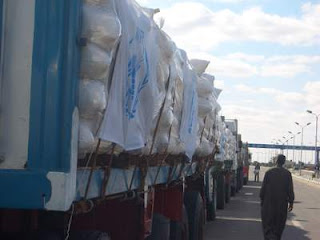
Although the current ceasefire has allowed for a slight increase in access to Gaza, humanitarian agencies and aid workers still struggle to get supplies into the territory. Day after day, truckloads of supplies—everything from food, clothing, and baby formula to blankets, plastic tarps, and technical equipment to draw water from the ground—sit at border crossings in Egypt, waiting for permission to enter Gaza. While Egyptians blame the Israelis for limiting access, Israeli officials claim that the Egyptians have not done enough to coordinate the flood of aid. Regardless of who is to blame, it is clear that limiting the access of humanitarian workers and supplies is having dire consequences for the residents of Gaza.
Photo: Humanitarian cargo waits at the Rafah border crossing on the Gaza-Egyptian border on January 9, 2009. Photo courtesy of Ekram Elhuni (World Food Programme) and Flickr user Peter Casier.
Showing posts from category military.
 “Integrating environment and natural resources into peacebuilding is no longer an option—it is a security imperative,” says a new report from the UN Environment Programme (UNEP),
  “There are political and economic vulnerabilities that are in fact more important—or seem more important—to the participants of conflict than the physical vulnerability to climate change,” said Clionadh Raleigh at the February 19, 2009, event, “
 “Climate change is serious,” emphasized Mabey. “It’s a threat multiplier, it will make unstable places less stable—it’s going to change strategic interests, alliances, borders, threats, economic relationships, comparative advantages, the nature of international relations, and the legitimacy of the UN.” In the future, “security policy will need to get more preventive and risk-based because climate change just injects a huge bolt of uncertainty into the future,” said Mabey. He urged the expansion of forward-looking information systems that provide policymakers with the data they need to make decisions at the geopolitical, strategic, and operations levels. He also said security experts should strive to communicate the potential consequences of climate change to decisionmakers.
 Last year, Burke helped conduct a