

Showing posts from category migration.
-
Strategic Thinking on Climate, Conflict, and Adaptation
›June 24, 2009 // By Rachel Weisshaar “I don’t know of an armed conflict that has got a single cause,” said International Alert Secretary General Dan Smith at an event sponsored by the Wilson Center’s Environmental Change and Security Program on June 10, 2009. “Our argument is simply that climate change adds another major variable into that mix.” Smith was joined by Shruti Mehrotra, a senior consultant to International Alert on climate change, for a nuanced discussion of climate change’s potential impacts on global stability.
The Netherlands and Bangladesh: Capacity Matters
Both the Netherlands and Bangladesh are low-lying coastal countries vulnerable to sea-level rise and extreme weather events. Yet the Netherlands is “a wealthy country with stable government that’s transparent and accountable to the people,” said Smith. “A country like Bangladesh which is poor, which has got democracy but it’s a very iffy democracy—it’s really still in a state of transition—and which does not itself have the resources to handle those problems” could experience “great social pressure as a consequence of climate change,” he said.
Cascading Impacts: Water, Food, Livelihoods
Four hundred million people depend on the glacier-fed Ganges-Brahmaputra river system for water, food, and industry, said Smith. “A very large number of people’s livelihoods are going to be affected if water management in the Ganges-Brahmaputra area is not adequate to the task” of adapting to changing precipitation patterns and melting glaciers.
Seventy percent of Peruvians depend on glacial runoff for their water needs, according to Smith. But the Andean glaciers will essentially melt and disappear by 2015, meaning that an initial excess of water will be followed by a terrible deficit, said Smith. The impacts on Peruvian society will largely depend on how well the government, the private sector, and civil society mobilize to manage their water supply.
Scarce Resources: Migration and Conflict
Scarcer resources may lead to mass migration and conflict, said Smith, but he urged the audience to be wary of the “factoids and guesstimates being thrown around about how many people will migrate under the pressure of climate change.”
People sometimes move to avoid conflict, but “very often, unwittingly, they become the vector of conflict themselves,” said Smith. Most climate-induced migration is likely to be within a country or within a region, so “a lot of that migration is going to be people moving from areas which are no longer viable to areas which are barely viable—indeed, where their arrival threatens the viability of the area into which they’re moving,” he said.
According to International Alert’s report A climate of conflict: The links between climate change, peace and war, there are 46 countries that will be at high risk of violent conflict due to the intersecting impacts of climate change and economic, political, and social problems.
Envisioning Adaptation
No matter what happens at the December 2009 Copenhagen climate conference, people will need to adapt to the changes already underway in the climate system. But if adaptation is seen as a purely technical process, it will fail, said Smith. It is a cultural process that will only work if people have the chance to express their opinions and misgivings—and then buy into it.“Most of development discourse is not being taken into account in these environmental negotiations,” said Mehrotra. Most climate negotiators are climate scientists or diplomats, not development practitioners. But in low-income countries, climate change will primarily be a development issue. “There is a potential that huge amounts of money will be put into this [adaptation], using a way of thinking about development from the 1970s,” warned Mehrotra.
Photos: Dan Smith and Shruti Mehrotra. Courtesy of David Hawxhurst and the Wilson Center. -
VIDEO: Geoff Dabelko on the Global Environmental Change and Human Security Conference
›June 23, 2009 // By Wilson Center StaffMore than 150 experts from around the world are assembled this week in Oslo, Norway, for the capstone conference of the Global Environmental Change and Human Security (GECHS) Project. The conference features a mix of researchers and policymakers, who are debating the practical impacts of bringing a focus on people more firmly into discussions of global environmental change.
The Wilson Center’s Geoff Dabelko, director of the Environmental Change and Security Program, is attending the conference, and in this video, he comments on three themes prominently discussed in the opening day of the conference: human security versus national security; climate change and migration; and practical avenues for incorporating human security research into the fifth assessment of the Intergovernmental Panel on Climate Change. -
VIDEO: Jon Barnett on Climate Change, Small Island States, and Migration
›June 23, 2009 // By Wilson Center StaffNo one is currently emigrating from Pacific small island states principally due to climate change, according to Australian geographer Jon Barnett of the University of Melbourne. In this short interview conducted at the Woodrow Wilson Center, Barnett situates climate change’s potential future impacts within the broader social, political, and economic challenges for residents of small island states, reminding us that there is great physical and political diversity among these islands.
Stressing the mix of pushes and pulls that motivate people to move, Barnett suggests we examine existing patterns of migration to better understand how they will develop in the future. He emphasizes that climate change is most likely to push islanders to move due to declining food production and drinking water availability, rather than sea-level rise—despite the iconic image of lapping waves submerging low-lying countries. These sober reminders on the complexity of climate-migration links are worth keeping in mind when evaluating the plethora of new reports on the topic. -
Weekly Reading
›In Search of Shelter: Mapping the Effects of Climate Change on Human Migration and Displacement, launched at the climate negotiations this week in Bonn, represents a major step forward in the effort to determine how environmental shocks and stresses precipitated by climate change will compel populations to migrate.
According to Family Planning and Economic Well-Being: New Evidence From Bangladesh, a report from the Population Reference Bureau, “long-term investment in an integrated family planning and maternal and child health (FPMCH) program contributes to improved economic security for families, households, and communities through larger incomes, greater accumulation of wealth, and higher levels of education.”
A YouTube video from the UN Office of the High Commissioner for Refugees (UNHCR) shows how Darfuri refugees are struggling to manage scarce natural resources in refugee camps in Chad.
Facing Global Environmental Change: Environmental, Human, Energy, Food, Health, and Water Security Concepts, the fourth volume of the Hexagon Series on Human and Environmental Security and Peace, was launched at a side event to the 17th Session of the Commission on Sustainable Development.
The Obama Plan for Energy and Climate Security: Conference Proceedings and Final Recommendations lays out the Center for a New American Security’s recommendations to President Obama for achieving his climate and energy goals. -
Weekly Reading
›The International Institute for Sustainable Development has released two reports on climate change and security: Rising Temperatures, Rising Tensions: Climate change and the risk of violent conflict in the Middle East and Climate Change and Security in Africa.
In “The Changing Face of Israel,” a Foreign Policy web exclusive, Richard Cincotta and Eric Kaufmann explain how Israel’s demographics are influencing the country’s politics.
CNN’s Inside Africa reports on a bill in the U.S. Congress that seeks to quell the violence in the Democratic Republic of the Congo by forcing American companies to disclose the sources of their minerals.
Population Action International’s Kathleen Mogelgaard reports from international climate change negotiations in Bonn, Germany, on how climate change disproportionately affects women and the poor.
A Christian Science Monitor op-ed on global demographic trends cites Wilson Center Senior Scholar Martin Walker.
On Grist, Earth Policy Institute Founder Lester Brown explores the massive migration that would be precipitated by even partial melting of the Antarctic and Greenland ice sheets. -
Mind the Gap: Forging a Consensus on Security and Climate Change in EU and US Foreign Policy
›March 5, 2009 // By Will Rogers“There are political and economic vulnerabilities that are in fact more important—or seem more important—to the participants of conflict than the physical vulnerability to climate change,” said Clionadh Raleigh at the February 19, 2009, event, “Climate Security Roundtable: U.S. and EU Research and Policy.” Raleigh, a lecturer at Trinity College Dublin, was joined by Nick Mabey, founding director and chief executive of E3G, and Sharon Burke, a senior fellow at the Center for a New American Security, to discuss climate change’s impact on conflict and how the United States and European Union (EU) have begun to adapt their foreign and security policies to the threat of climate change.
Ecological Change, Migration, and Conflict: A Complex Story
“The lack of access to power for certain communities, certain ethnic groups in sub-Saharan Africa, and basic access to resources among the most vulnerable populations has led to people misinterpreting the relationship that ecological change plays in their decision to either participate in conflict or to migrate,” Raleigh said. Although Raleigh’s research, which examined civil conflicts from 1990 to 2004, found that population density and growth were related to higher risks of conflict, “environmental pressures were not more likely to cause conflict in poor states—and not more likely during periods of instability,” she concluded. “Social, political, and economic factors are the most important determinants of civil war within developing countries,” she emphasized. “Poverty and unequal development come up time and time again.”
According to Raleigh, fears of mass international migration in response to climate change are overplayed. “Individuals and communities have quite a lot of coping mechanisms to deal with ecological difficulty,” including migration from rural to urban areas in the same country, she explained. Most migration, including labor and distress migration, “is temporary, internal, and circular,” she emphasized. “There is very little to no evidence that there will be an increase in international migration” in response to ecological change, although “there is evidence that there will be an increase in internal migration.”
Climate Change and Security: Perspectives from the EU“Climate change is serious,” emphasized Mabey. “It’s a threat multiplier, it will make unstable places less stable—it’s going to change strategic interests, alliances, borders, threats, economic relationships, comparative advantages, the nature of international relations, and the legitimacy of the UN.” In the future, “security policy will need to get more preventive and risk-based because climate change just injects a huge bolt of uncertainty into the future,” said Mabey. He urged the expansion of forward-looking information systems that provide policymakers with the data they need to make decisions at the geopolitical, strategic, and operations levels. He also said security experts should strive to communicate the potential consequences of climate change to decisionmakers.
The EU has taken steps to integrate climate change into its security strategy; Great Britain, Germany, and Denmark have taken the lead. The Arctic has been a particular focus, with security experts examining trade routes, maritime zones, and new access to resources. Climate change “is not all about instability” in fragile, impoverished states, Mabey explained. “The Arctic is by far the most important climate security issue in the minds of traditional foreign-policy types in Europe.”
Environmental Security Gets a New Tool: The Climate War GameLast year, Burke helped conduct a climate change war game based on a scenario of extreme weather events like droughts, wildfires, and cyclones. “Every country sort of hewed to what you would expect,” said Burke of the high-profile participants from China, India, Europe, and the United States. “The EU team spent the first two hours debating whether they could really be a country; the Indian team instantly came up with a negotiating strategy that sounded cooperative and brilliant but was completely impossible to execute; the Chinese team was, ‘No, we’re not going to do anything unless you pay us’; and the American team was keen to lead, only nobody was following.” One of the key lessons from the game, Burke explained, was that “everything comes down to what China is prepared to do.”
In developing the game, Burke and her colleagues discovered “that there’s a vast poverty of the kinds of information that you need to make decisions.” As Burke explained, policymakers need specific data “to obligate large amounts of money and personnel,” and the game revealed that “policymakers don’t have the information they need to make decisions.”
Photos: From top to bottom, Clionadh Raleigh, Nick Mabey, and Sharon Burke. Courtesy of Dave Hawxhurst and the Woodrow Wilson Center. -
VIDEO: From Report 13 – Christian Leuprecht on Migration as the Demographic Wild Card in Civil Conflict
›March 3, 2009 // By Wilson Center StaffContrary to what many people might think, most migration is within the developing world—“among countries that already face enormous challenges in terms of provisions for their populations, but also ethnic conflict,” says Christian Leuprecht in this short video preview of his article, “Migration as the Demographic Wild Card in Civil Conflict: Mauritius and Fiji,” now appearing in the 13th issue of Environmental Change and Security Program Report.
“So if you have particular ethnic groups, religious groups, or linguistic groups then spilling over borders, there’s a good chance they might destabilize the neighboring country; not just because of carrying capacity and provision of services within that country, but also because it changes the population dynamics and group dynamics within that particular country,” says Leuprecht.
Leuprecht, an assistant professor at the Royal Military College of Canada, and six other demographic experts analyze the links connecting population and environmental dynamics to conflict in a set of commentaries on “New Directions in Demographic Security.” -
From Report 13: Watch Jennifer Dabbs Sciubba on Population in Defense Policy Planning
›February 25, 2009 // By Wilson Center Staff“Demography will have a greater role in defense planning in the future,” says Jennifer Dabbs Sciubba in this short video preview of her article, “Population in Defense Policy Planning,” now appearing in the 13th issue of Environmental Change and Security Program Report. “Robert Gates has put a lot of emphasis on development as a key to peace, and Africa Command may be the area that brings together issues of demography, the environment, and development, and sends those observations back up the higher levels at DOD,” she observes. Sciubba, Mellon Environmental Fellow in the Department of International Studies at Rhodes College, and six other demographic experts analyze the links connecting population and environmental dynamics to conflict in a set of commentaries on “New Directions in Demographic Security.”
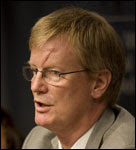 “I don’t know of an armed conflict that has got a single cause,” said International Alert Secretary General Dan Smith at an
  “Most of development discourse is not being taken into account in these environmental negotiations,” said Mehrotra. Most climate negotiators are climate scientists or diplomats, not development practitioners. But in low-income countries, climate change will primarily be a development issue. “There is a potential that huge amounts of money will be put into this [adaptation], using a way of thinking about development from the 1970s,” warned Mehrotra.
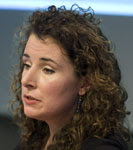 “There are political and economic vulnerabilities that are in fact more important—or seem more important—to the participants of conflict than the physical vulnerability to climate change,” said Clionadh Raleigh at the February 19, 2009, event, “
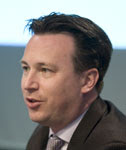 “Climate change is serious,” emphasized Mabey. “It’s a threat multiplier, it will make unstable places less stable—it’s going to change strategic interests, alliances, borders, threats, economic relationships, comparative advantages, the nature of international relations, and the legitimacy of the UN.” In the future, “security policy will need to get more preventive and risk-based because climate change just injects a huge bolt of uncertainty into the future,” said Mabey. He urged the expansion of forward-looking information systems that provide policymakers with the data they need to make decisions at the geopolitical, strategic, and operations levels. He also said security experts should strive to communicate the potential consequences of climate change to decisionmakers.
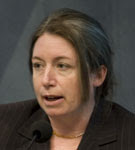 Last year, Burke helped conduct a

