-
Managing the Planet: The World at Seven Billion
›
Population growth “is highly concentrated in what are today the poorest and least well-governed areas of the world,” said George Mason University professor Jack Goldstone at the Wilson Center on December 5.
Goldstone was joined by Suzanne Ehlers, president and CEO of Population Action International (PAI), and Matthew Erdman, population-health-environment technical advisor at USAID, to discuss the implications of seven billion people and counting for the environment as part of the joint Wilson Center-George Mason University Managing the Planet series. [Video Below]
-
‘The New York Times’ Highlights Converging Development Trends in Brazil’s Amazon
›
The Amazon is home to some of the world’s most expansive rainforest – and, increasingly, some of Brazil’s fastest growing cities. Urbanization and deforestation are upending the traditional image of the Amazon, turning one of the world’s most biodiverse regions into an economic and demographic explosion, according to an in-depth article by Simon Romero in The New York Times.
-
Joel Cohen on Why Students Should Consider Demography
›“Why should you consider taking a demography course in college?” That’s the question Joel Cohen, noted demographer and professor at Rockefeller and Columbia University, looks to answer in a 45-minute introduction to demography produced by the Floating University and released for free on YouTube.
-
António Guterres, The New York Times
Why Mali Matters
›September 11, 2012 // By Wilson Center StaffThe original version of this op-ed, by António Guterres, appeared in The New York Times.
For many people, Timbuktu has long represented the essence of remoteness: a mythical, faraway place located on the boundaries of our collective consciousness. But like many of the myths associated with colonialism, the reality is very different.
-
As Urbanization Accelerates, Policymakers Face Integration Hurdles
›August 31, 2012 // By Blair A. RubleThe challenges for cities in the coming century will be many, but accounting for swelling numbers of new residents – due to more open avenues of communication and flows of goods, economic opportunity, population growth, and potential climate change-induced displacement – is perhaps the biggest.
-
In Mongolia, Climate Change and Mining Boom Threaten National Identity
›July 23, 2012 // By Kate DiamondMongolia, a vast, sparsely populated country almost as large as Western Europe, is at once strikingly poor and strikingly rich. Its GDP per capita falls just below that of war-torn Iraq, and Ulan Bator has some of the worst air pollution ever recorded in a capital city. At the same time, Mongolia sits atop some of the world’s largest mineral reserves, worth trillions of dollars, and its economy, already one of the world’s fastest growing, could expand by a factor of six by the end of the decade as those reserves are developed.
-
Center for American Progress Takes on Climate Change, Migration, and Why They Matter to U.S. National Security
›July 19, 2012 // By Kayly OberIn early 2012, the Center for American Progress (CAP) released Climate Change, Migration, and Conflict: Addressing Complex Crisis Scenarios in the 21st Century. Although generally in line with climate-migration pieces before it (“It is difficult to fully understand the detailed causes of migration and economic and political instability, but the growing evidence of links between climate change, migration, and conflict raise plenty of reasons for concern”), the report strays from the usual by focusing on U.S. national security interests and four particular sub-regions of concern.
Northwest Africa
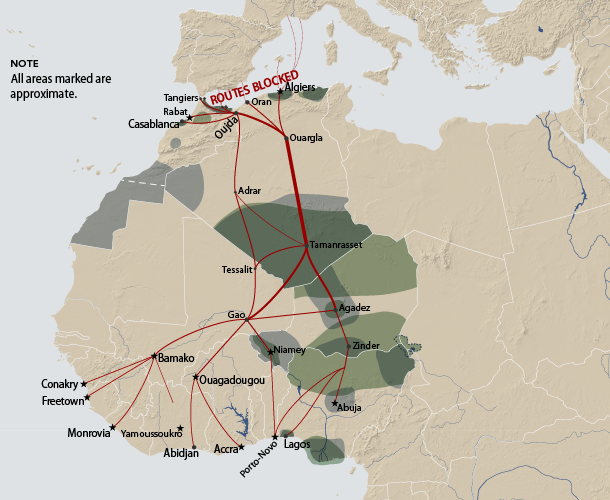
The first region examined – and the one perhaps most on the radar of security analysts at the moment – is Northwest Africa. Here the already-tenuous political stability left in the wake of the Arab Spring will most certainly be exacerbated by climate change, authors Michael Werz and Laura Conley write. “Northwest Africa is crisscrossed with climate, migration, and security challenges…rising coastal sea level, desertification, drought, and the numerous other potential effects of climate change have the potential to increase the numbers of migrants.” All of these factors combine to create what Werz and Conley define as an “arc of tension,” that will strengthen organizations that thrive on chaos, like Al Qaeda in the Islamic Maghreb, which has already taken advantage of the regional power vacuum left by Muammar Gaddafi’s ouster.
CAP investigates this arc of tension more fully in a more focused, separate brief on Northwest Africa, drilling down on Nigeria, Niger, Algeria, and Morocco. They find that these countries already grapple with a complex set of issues, including population pressures, drought, land degradation, large-scale migration, and natural resource conflicts. Climate change exacerbates all of these. Particularly worrying is the threat it poses to traditional pastoral and agricultural livelihoods, which could translate into “increasing numbers of disenfranchised youth, who security experts believe are more easily recruited to assist [terrorist groups] in return for money and food.”But environmental pressures and related conflict are not new in these areas, so how do we parse out the slow-onset climate change factors from the usual variety? That question is left unanswered and remains an open – and hotly debated – problem for researchers. The multi-faceted nature of migration, in particular, makes it hard to define the exact causes of movement.
On a larger scale, flagging the environment as the principal reason for migration has its problems, especially under the umbrella of “refugee” status. According to respected migration experts, using the term “refugee” in the case of environmental or climate scenarios is incorrect, since the environment is often simply one “push” factor, while economic opportunities make for a heavier “pull.” Furthermore, applying the term refugee in this case, they say, is misleading and undermines true political refugees.
CAP uses the less polarizing term “climate migrants” in their paper, saying “no universally accepted concepts, much less legal categories, exist to describe or define climate migrants. There is agreement, however, that factors such as drought, flooding, severe weather, and environmental degradation can cause human mobility in large numbers that are certain to increase in the near future.”
South Asia
In a case like Bangladesh and India, the second sub-region to be examined, the international community is preoccupied with rising sea levels, which is considered a more concrete example of climate change affecting migration. Ultimately, as CAP notes, it’s also a security issue:In December 2008 the National Defense University in Washington, D.C., ran an exercise that explored the impact of a flood that sent hundreds of thousands of refugees into neighboring India. The result: the exercise predicted a new wave of migration would touch off religious conflicts, encourage the spread of contagious diseases, and cause vast damage to infrastructure.
While true that India is “not in a position to absorb climate-induced pressures,” as Werz and Conley write, it’s not quite true that “foreign climate migrants” would be necessarily be an immediate problem, as they suggest.
India has a history of taking in Bangladeshi migration, with an estimated 10 to 20 million illegal Bangladeshis currently living in India, according to the Institute for Defence Studies and Analyses, an Indian think tank. Traditionally, Bangladeshis have migrated for a myriad of socioeconomic reasons, but most alluring are land availability and a stronger Indian economy. In any case, Bangladesh-India migration would not be new phenomenon.
The environment has also been a part of the equation, but in the case of large-scale sea level rise, its effect on migration can be a bit more nuanced. As the International Food Policy Research Institute noted in its study “Environmental Migrants: A Myth?,” Bangladeshis often have “risk-sharing and informal lending arrangements” to deal with idiosyncratic shocks, which include flooding. Instead, crop failure actually has the strongest effect on mobility. This suggests that it’s not just sea level rise that observers worried about environmentally-driven migration need to track in Bangladesh, but also drought and rain-induced flooding.
The Andes
The third region, the Andes of South America, also suffers from a slightly myopic security lens. Here, it’s all about melting glaciers and snowcaps. Retreating glaciers would spell disaster for countries which rely heavily on seasonal melt for agriculture and hydroelectric power. Most vulnerable are those with weak governance systems and infrastructure like Peru, Bolivia, Ecuador, and Colombia. For reference, hydropower supplies a whopping 80 percent of Peru’s electricity. However, there are more subtle impacts that could portend bigger trouble for the region.
Regional security experts concede that higher temperatures are already affecting crop production in rural Colombia, harming the ability to consolidate the security gains made by Plan Colombia over the last decade, for example. And a recent report from EUROCLIMA, the European Union’s program on climate change in Latin America, paints an even bleaker picture for agricultural production in the face of desertification and drought:Natural ecosystems, agriculture, water resources, and human health in Latin America have been impacted by unusual extreme weather events reported in the past years. For example, droughts related to El Niño impacts on the flows of the Colombia Andean region basins (particularly in the Cauca river basin), are causing a 30 percent reduction in the mean flow, with a maximum of 80 percent loss in some tributaries. Consequently, soil moisture, and vegetation activity are strongly reduced.
Perhaps more worrying is the impact on the biodiversity in the region. Considering that Latin America represents 16 percent of the world’s surface but 40 percent of its biodiversity this could have serious implications for the biomedical field and others. In a recent Nature study, scientists discovered that in situations where glacial coverage is reduced to the point where it only covers 30 to 50 percent of the drainage basin, several species begin to disappear. They calculated that the entire melting of the glaciers in these areas would result in a huge loss of biodiversity, where between 11 and 38 percent of animal and plant species could go extinct, including many of endemic species that can be found only in these areas.
China and the Third Pole
Finally, China is now in its fourth decade of ever-growing internal migration, some of it driven in recent years by environmental change. Today, across its vast territory, China continues to experience the full spectrum of climate change-related consequences that have the potential to drive migration. CAP finds that the consequences of climate change and continued internal migration in China include “water stress; increased droughts, flooding, or other severe events; increased coastal erosion and saltwater inundation; glacial melt in the Himalayas that could affect hundreds of millions; and shifting agricultural zones” – all of which will affect food supplies and the country’s seemingly relentless pace of development. Still, the most unique factor of migration in China is the power of the central government to be the main “push factor,” as in the case of the Three Gorges Dam.
Agreeing to Agree
Though they might sacrifice some nuance in the regional breakdowns, the core of CAP’s argument for why climate migration matters to U.S. national security is solid. The United States has a “vested interest in helping ensure that areas with weak or absent governance structures – where poverty, environmental degradation, and grievances over central governments and energy production coincide – do not become future recruiting grounds for extremists,” write Werz and Conley. “The possible impacts of climate-related migration in such fragile situations could be destabilizing.” Invest in people rather than just military might; invest in poverty reduction, economic development, and alternative livelihoods.Jon Barnett on migration as adaptation
In the context of climate change, this means accepting that migration is a form of adaptation. As Jon Barnett notes in an interview with ECSP:In some circumstances it might be appropriate to [invest in traditional adaptation projects like] infrastructure and hard options where we’re very certain about the nature of the risk…but in other cases, expanding the range of choices and freedoms and opportunities that people have to deal with climate change in the future is perhaps the better strategy.
This requires higher-level thinking by states to concede that migration will happen and it isn’t necessarily a bad thing. Migration bolsters origin communities through remittances and education and technology sharing. But this thinking has yet to permeate policymaking, with obvious political reasons. Until then, states that are committed to preventing migration are actually cutting off important community responses.
Ultimately, what we consider adaptation and development needs to evolve. By investing in an integrated, multi-sector development approach, we can prevent violent responses to migration at the source rather than relying on reactionary and military solutions. Or, as CAP’s Michael Werz and Laura Conley put it more boldly, “our security can no longer be guaranteed by military strength or economic clout alone, but only by our ability to compel collective action.”
Photo credit: “Villagers going to the local market in Bogoro walk past a Bangladeshi patrol unit of the United Nations Mission in the Democratic Republic of the Congo (MONUC) as the country prepares for the second round of elections. 12/Oct/2006. UN Photo/Martine Perret,” courtesy of United Nations Photo Flickr.
Sources: Center for American Progress, Institute for Defence Studies and Analyses, Inter-American Development Bank, International Food Policy Research Institute, Nature, The World Bank.
Video Credit: “The Nexus of Climate Change, Migration and Security,” courtesy of the Center for American Progress. Image: “The Arc of Tension,” courtesy of the Center for American Progress. -
UNHCR Report on East African Environmental Migrants: Long on Anecdotes, Short on Data
›July 6, 2012 // By Graham NorwoodAs part of the recently-concluded Rio+20 Conference on Sustainable Development, the UN High Commissioner for Refugees (UNHCR) presented a new report last week, titled Climate Change, Vulnerability, and Human Mobility: Perspectives of Refugees From the East and Horn of Africa. The report was created in order to “understand the extent to which refugees and IDPs (internally displaced persons) in the East and Horn of Africa have perceived, experienced, and responded to climatic events and trends in recent years.”
In order to achieve this goal, UNHCR and its collaborators (including the United Nations University Institute for Environment and Human Security, the London School of Economics, and the University of Bonn) interviewed approximately 150 refugees and IDPs in parts of Ethiopia and Uganda.
While the narrative is more anecdotal than data-driven, it nevertheless identifies several apparent trends in climate-related migration:Overwhelmingly, stories of mobility associated with moving away from worsening impacts associated with climate variability followed a specific pattern. That is, where movement related to climatic stressors did occur, such movement was taken as a last resort (only after all efforts to remain and adopt other methods of adaptation had been exhausted), particularly where the land being left was self-owned and only after all efforts to remain and try a number of alternative forms of adaptation had failed. Where movement occurred, in most cases it was likely to be internal, circular, and temporary rather than cross-border and permanent.
Stories of international migration were rare, and generally occurred either because migrants already lived near a border and were familiar with the area, or because they had encountered violent conflict (often of a political nature) during an earlier intra-state relocation.
The report also mentions that a majority of those interviewed claimed to have noticed significant changes in weather patterns over a 10- to 15-year period. In fact, many interviewees frequently claimed to be able to distinguish “normal” climate variability from more “permanent” changes.
Significantly, Climate Change, Vulnerability, and Human Mobility highlights several ongoing sources of debate and controversy regarding the issue of climate-induced migration as well.
The links between climate change, migration, and violent conflict are not well understood. And the question of whether climate change precipitates conflict or merely exacerbates it is still unresolved, though research on the subject is ongoing.
The terminology used to describe climate migrants remains a hotly-contested issue as well. While terms like “environmental refugee” and the especially popular “climate refugee” can make for good headlines, the UNHCR report strongly disapproves of such terms, given that the word “refugee” has a very specific legal definition.
Indeed, there is still much debate over how to classify climate migrants. It has been pointed out, for instance, that it is virtually impossible to separate out the various factors that induce migration, and questions as to whether migration is forced or voluntary also persist. For the most part, the UNHCR report shies away from such contentious questions, aiming instead to present a general and “human” narrative designed to call attention to the plight of climate migrants.
Definitional debates aside, the issue of climate-induced migration has been in headlines recently. The Asian Development Bank reported in March that 42 million people were displaced in the region during the last two years due to storms, floods, and other extreme weather events. And Israel signaled a tougher stance on immigration by deporting South Sudanese refugees in the wake of a major Israeli Ministry of Environmental Protection report warning of future climate-induced migration.
The particular vulnerability of women too is drawing increased interest. An article in Environmental Research Letters points out that “women tend to be poorer, less educated, have a lower health status, and have limited direct access to or ownership of natural resources,” and will therefore be disproportionately affected by climate change. Gender disparities must be accounted for in policymaking then, to ensure that future climate migration policies are equitable and inclusive, the author, Namrata Chindarkar, argues.
The challenges of defining and measuring the phenomenon remain – the UN Environment Program’s 2006 prediction of 50 million climate migrants by 2010 has not come true, and has even been a source of some embarrassment for the organization – but the recent UNHCR report is a timely reminder that climate-induced migration remains a major issue with tremendous long-term implications.
Sources: Asian Development Bank, Environmental Research Letters, Human Rights Education Association (HREA), The Jerusalem Post, The New Republic, National Geographic, OECD, Scientific American, Der Spiegel, UNHCR, The Washington Post.
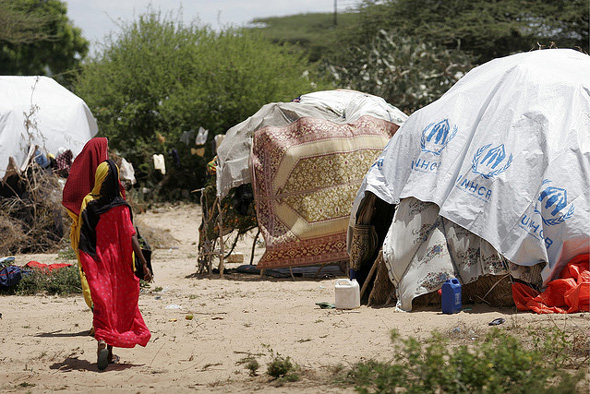
Photo Credit: Displaced Somalis, courtesy of UNHCR.
Showing posts from category migration.