Showing posts from category security.
-
Gwen Hopkins, Aspen Institute Global Health and Development
Aspen Ideas Festival Takes on “The Population Challenge”
›The original version of this article, by Gwen Hopkins, appeared on the Aspen Ideas Festival blog.
The pictures flash quickly: lush sea vegetation replaced by empty grey-blue seabed as carbon bubbles out of undersea vents. Reservoirs depleted too quickly, never to refill. Forests and mountains leveled for coal, deep sea oil rigs ablaze, the arctic ice cap visibly retreating. Dennis Dimick is answering the question posed to him with a litany of evidence collected by National Geographic: Does population matter?
Yes, he says – a lot.
Kicking off the Our Planet: The World at Seven Billion track, on a panel called “The Population Challenge,” Washington Post staff writer Joel Achenbach moderated a conversation between Dimick and Helene Gayle, president and CEO of CARE USA, following Dimick’s presentation about how the earth’s human population has made its presence known.
Dimick explains that this new geologic era has been dubbed Anthropocene, the age of man, as we “transform the planet to perpetuate our lifestyle.” That’s a lifestyle powered first and foremost by what he calls “the new sun” – coal, oil, and gas, or in Dimick’s words, “ancient plant goo.” These transformations are deep and widespread – and according to Dimick, growing worrisome in their magnitude. While there is searing inequity – “few have a lot, and a lot have few” – those that lead the consumption have, for example, caught 90 percent of the big fish in the sea already, and burn in one year a quantity of fuel that took a million years to coalesce underground. “If everyone in the world lived like Americans do, we’d need four planets.”
Continue reading on the Aspen Ideas Festival blog.
Photo Credit: Aspen Institute. -
What Are the Most Important Factors in the Failed States Index?
›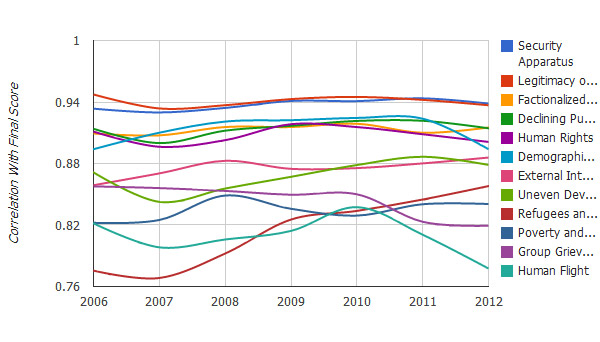
Last week, the Fund for Peace issued its eighth annual Failed States Index (FSI). The index gives 177 countries a score between 1.0 and 10.0 for 12 indicators, ranging from the legitimacy of the state and the security apparatus to demographic pressure and uneven development (high being bad, low being good – see full descriptions of the indicators here). But which of these indicators has the biggest impact? We did a quick analysis of the Failed States Indexes published from 2006 to 2012 to show which of the indicators correlate most with a high score. (We skipped 2005 since the roster of analyzed countries was significantly smaller.)
-
IFPRI Launches First ‘Global Food Policy Report’
›June 27, 2012 // By Carolyn Lamere“The Global Food Policy Report is the first publication that represents the major, major food policy developments in the past year and the outlook for 2012,” said Director of the International Food Policy Research Institute (IFPRI) Shenggen Fan in a video to promote the launch of the institute’s most comprehensive policy publication yet. The report is focused on regional developments, new research, debates, and legislation regarding food security both within individual states and at the international level.
A Guidebook for Policy
The 2008 global food crisis launched food security back onto the global agenda. A rapid rise in food prices contributed to instability around the world, and policymakers began to realize that access to food is an important security issue (high food prices have been linked to riots, for example).
“For 2012, food prices will remain very high and volatile, and some of the long-term trends like climate change, population growth, and demographic shifts towards more urbanized and higher income [populations] will continue to put pressure on global food security,” predicted Fan.
But the report notes that much of the fluctuation in global food prices is due to a lack of knowledge, not necessarily scarcity. The authors point to issues of preparedness and regulation as exacerbating factors and suggest that more detailed information, like that provided in the report, can help provide better solutions to policymakers.
Fan said that, by design, the report is “nontechnical, so the nontechnical person such as politicians, policymakers, practitioners, or anybody else who is interested in food security can use it as a comprehensive handbook.”
Making Connections Between Disciplines
The report draws on the expertise of dozens of authors who discuss topics ranging from biofuels to climate change. Rajul Pandya-Lorch, head of IFPRI’s 2020 Vision Initiative, spoke about the utility of collaboration among different disciplines in an interview with IFPRI: “I think for me 2011 was the time when we began to realize that we cannot think of agriculture simply for agriculture; we need to think of agriculture as a way in which we can impact on other development outcomes, especially nutrition and health,” she said.
Kathy Spahn, president and CEO of Helen Keller International, a speaker at the launch event, agreed. “The development community is beginning to realize that achieving food security is about more than just growing more food. It is also about growing more nutritious foods and making sure these foods are available and accessible to the families in need,” she wrote for Helen Keller International.
Fan emphasized that although agriculture has become more prominently featured in discussions of development, it is important to continue to link it to other outcomes. “We must find new ways to exploit the links between agriculture and other sectors, including health, nutrition, water, and energy,” he wrote in the overview of the report.
Past Developments and Future Outlook
Several key developments are highlighted that shaped food security in 2011. Food prices were particularly volatile – rising for the first half of the year then dropping – which caused a renewed global emphasis on food from policymakers.
New players ranging from emerging economies to the private sector “are increasingly reshaping the structure and nature of the global food landscape,” write the authors. The G-20 is “claiming a growing role” to help manage economic issues, and states like China, Brazil, and India are becoming more vocal regarding global food policy. Partnerships between governments and private companies have also become more common.
These and other developments described in the report will have an impact into 2012 and beyond. The report points out that “food emergencies” caused by natural disasters like the 2011 drought in the Horn of Africa will likely occur in 2012 as well, but also emphasizes that these cannot overshadow more long-term drivers of food insecurity, like land degradation.
The report describes four “high-priority areas of action” for this year. First, the G-20 should try to reduce price volatility (although some have argued volatility is less a problem than consistently high prices). Second, policymakers should work to improve agricultural production specifically through strategies like soil nutrient management which provide high yields but are more sustainable than high use of fertilizers. States should also ensure that the infrastructure necessary to make these strategies successful is in place. The next target is based on the Rio+20 conference, namely that participants should “integrate economic, social, and environmental sustainability efforts” to improve outcomes like nutrition and health. There were in fact several seminars on cross-discipline partnerships at the conference, and the importance of integration was mentioned in the outcome text that emerged.
Finally, the report calls for further collaboration across disciplines, in emulation of the internal IFPRI effort for the report which included a wide variety of expertise. The authors emphasized that though progress has been made, the challenge of achieving global food security will remain a concern for the near future, and cooperation across communities will be critical.
“The idea and the impact of the report is to make people aware of the problems that we are facing and the concerns…clearly the problem is not resolved and it’s something that we need to take very seriously,” said contributor Maximo Torero in an interview with IFPRI. “There’s a lot of work to be done to try to do this.”
Sources: Bill & Melinda Gates Foundation, CNN, Hellen Keller International, International Food Policy Research Institute, UN Conference on Sustainable Development.
Video Credit: IFPRI. -
Climate-Conflict Thresholds and Water as a Casualty of Conflict
›While numerous studies have examined the perils faced by businesses operating in conflict-affected or high-risk locations, Water as a Casualty of Conflict: Threats to Business and Society in High-Risk Areas, written by Kristina Donnelly, Mai-Lan Ha, Heather Cooley, and Jason Morrison, is the first such report to focus specifically on water. The report – a collaborative effort between the UN Global Compact and the Pacific Institute – aims to provide a framework for understanding the conflict-water-business nexus by first tracing the ways in which conflict and high-risk areas can adversely impact local and regional water systems and then illustrating the challenges such impacts can pose to businesses in conflict-affected or high-risk areas. Water as a Casualty of Conflict was published online this week and was introduced at a Rio+20 Corporate Sustainability Forum panel session.In an article titled “Climate Change and Violent Conflict,” appearing in the May 18th edition of Science, authors Jürgen Scheffran, Michael Brzoska, Jasmin Kominek, Michael Link, and Janpeter Schilling attempt to sort out some of the controversy surrounding the intersection of climate change and violent conflict. They urge greater interdisciplinary research to identify and provide solutions for possible “tipping points” where the impacts of climate change may prove too great for human adaptive capacity. Such research has been scarce due to difficulties in collecting sufficient data. Moreover, the authors note that many of the extant studies on climate change and conflict are flawed because of how they define violent conflict. The commonly-used Uppsala Conflict Data Program and Peace Research Institute Oslo (UCDP-PRIO) Armed Conflict dataset, for instance, excludes by definition many riots, protests, incidences of livestock theft, and other violent or potentially violent behaviors. This is problematic because, as the authors point out, “in recent decades, climate variability may have been more associated with low-level violence and internal civil war – which fall below the UCDP-PRIO definition cutoff – than with armed conflict or war between countries.” -
Kirk Talbott, State of the Planet
Burma at a Crossroads for Peacebuilding and Natural Resource Governance
›June 18, 2012 // By Wilson Center StaffThe original version of this article, by Kirk Talbott, appeared on the Columbia University Earth Institute’s State of the Planet blog.
After a half-century of authoritarian rule, armed conflict against millions of ethnic minorities, and natural resource plunder, Burma, also known as Myanmar, now stands at a crossroads. As conditions for peace coalesce and civil society begins to blossom, there is hope once more for Burma’s people.
Burma’s quasi-civilian government, led by reformist Thein Sein, has initiated a series of surprising political openings and continues to engage actively with Nobel laureate Aung San Suu Kyi, now a member of parliament. Civil society and international relations are flourishing in contrast to conditions just one year ago. In May, the United States suspended economic sanctions and President Obama appointed a U.S. Ambassador for the first time in decades.
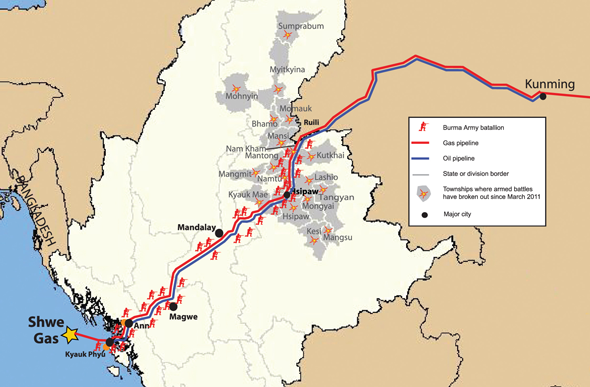
A new set of challenges emerge, however, around sharing the benefits and responsibilities of governing the country’s diverse wealth of natural resources. Nestled strategically between China and India, Burma has been isolated from the world’s attention since a coup in 1962. Its military government has consolidated a brutal grip on power through the sale of its rich timber, mineral, natural gas, and other resources, primarily to China and Thailand. This practice expanded after 1995, when the regime brokered a series of cease fire agreements with several ethnic armies along mountainous border areas. (For the first time in 60 years the Karen National Union joined almost all other major ethnic armies in agreeing to a cease fire, with the notable exception of the Kachin Independence Army.)
Oil and gas revenues fund the Tatmadaw, Burma’s half-million-strong army, one of Asia’s largest. Currently the huge offshore Shwe and Yadana natural gas reserves provide more than 90 percent of the nation’s foreign exchange. Chinese and Thai companies fund extensive pipeline, hydro-power, and transport networks as Burma becomes a potential regional economic corridor and natural resources production hub. China looms large in the geo-political equation investing over $12 billion in Burma in 2011.
Continue reading on State of the Planet.
Image Credit: Shwe gas line map, courtesy of Shwe Gas Movement. -
Gidon Bromberg at TEDx on Peacebuilding Through Water in the Middle East
›“Cooperation over water is not a privilege, it’s a necessity,” said Gidon Bromberg, co-director of Friends of the Earth Middle East, in a TEDx talk at Yale. He sees the shortage of water in Jordan, Israel, and Palestine as an opportunity to bring these contentious communities together – even more so during this period of upheaval in the region.
Water woes have long contributed to regional tensions, said Bromberg. Water rights between Israel and Palestine were supposed to be settled during the Oslo accords in 1993, but negotiations were unsuccessful and water discussions were consequently left unfinished. The lack of formal negotiations caused each side to seize whatever resources they could Although Jordan was not part of the negotiations, it does share water resources with Israel and the West Bank and thus has been impacted by the lack of formal allocation processes. Both Jordan and Israel have diverted flow of the Jordan River into dams and irrigation projects. As a result, the Jordan River has lost 98 percent of its historic flow and the Dead Sea has lost one-third of its surface area.
Today, Israel has restricted Palestinian water use such that Palestinians have access to water only once a week in winter and once every three weeks in the summer, leading them to store water in containers on their roofs, Bromberg said. Though mismanagement is as much to blame as conflict, he notes, Palestinians chafe under the limitations.
Yet Friends of the Earth Middle East has used this difficult situation to educate the public, propose reforms, and build trust between Palestinian, Jordanian, and Israeli communities. Bromberg highlighted “fear of a small but vocal minority on both sides” as a key factor in preventing dialogue between the communities, but insists that water can bring people together. Neighboring communities have to work together, he said, “not because they’re best friends,” but to improve their own water situations.
Friends of the Earth provides that opportunity with their Good Water Neighbors project and hopes the trust built between communities extends beyond water issues as well. Since communities have strong motives to solve these problems, they work together more effectively than high-level politicians who may not be as apt to collaborate.
A positive update on the state of the Jordan River given in an interview with ECSP in October suggests that Bromberg may be on to something.
Sources: Amnesty International, Friends of the Earth.
Video Credit: TEDx. -
Nancy Lindborg, The Huffington Post
For Yemen’s Future, Global Humanitarian Response Is Vital
›June 12, 2012 // By Wilson Center StaffThe original version of this article, by Nancy Lindborg, appeared on The Huffington Post.
This weekend in Sana’a, I had dinner with a group of young men and women activists who are on the forefront of Yemen’s historic struggle for a better future. They turned out for change with great courage last year, and at dinner, with great eloquence they outlined for me the many challenges facing Yemen during this critical transition period: conflict in the north and south, weak government institutions, cultural barriers to greater women’s participation, an upended economy, and one of the world’s highest birthrates. And, as one man noted, it is difficult to engage the 70 percent of Yemeni people who live in rural areas in dialogue about the future when they are struggling just to find the basics of life: food, health, water.
His comment makes plain the rising, complex humanitarian crisis facing Yemen. At a time of historic political transition, nearly half of Yemen’s population is without enough to eat, and nearly one million children under the age of five are malnourished, putting them at greater risk of illness and disease. One in 10 Yemeni children do not live to the age of five. One in 10. This is a staggering and often untold part of the Yemen story: a story of chronic nationwide poverty that has deepened into crisis under the strain of continuing conflict and instability.
Unfortunately, in communities used to living on the edge, serious malnutrition is often not even recognized in children until they are so acutely ill that they need hospitalization.
Continue reading on The Huffington Post.
Nancy Lindborg is the assistant administrator of the Bureau for Democracy, Conflict, and Humanitarian Assistance at the U.S. Agency for International Development.
Sources: U.S. Department of State.
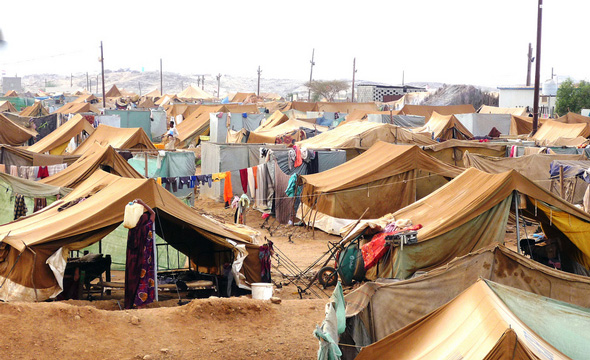
Photo Credit: Informal settlements near the Haddjah governorate, courtesy of E.U. Humanitarian Aid and Civil Protection. -
Re-Thinking Price Shocks and Conflict?
›“Conflict, Food Price Shocks, and Food Insecurity: The Experience of Afghan Households,” a paper prepared for presentation at the Agricultural and Applied Economics Association’s annual meeting, examines the relationship between conflict and food prices, using Afghanistan during the 2008 global food crisis as a case study. By examining per capita food intake, numbers of fatalities and injuries, and the number of violent incidents in a given area, authors Anna D’Souza and Dean Jolliffe, of the U.S. Department of Agriculture and World Bank, respectively, determine that “at least in the case of Afghanistan, conflict does not seem to be the predominant driver of food insecurity.” Instead, inhabitants of conflict-prone regions, namely southern Afghanistan, consume more food, on the whole, than their northern compatriots. Residents of conflict areas do seem to be more affected by major food price increases, however these are fairly uncommon. D’Souza and Jolliffe speculate that this may be due to “interruptions in market access, inability to trade and barter, and worse food production and distribution systems.” These findings may be somewhat counterintuitive, but are an important resource for those seeking to reduce food insecurity in both conflict-prone and peaceful regions.In a working paper for the Center of Global Development, Samuel Bazzi and Christopher Blattman upend much of the established thinking on the relationship between commodity prices and conflict onset. Past researchers have found that lower prices of agricultural commodities lead to conflict as civilians have less to lose by rebelling against the government, and higher prices of resources like oil and minerals can lead to conflict as rebel groups have greater incentive to seize control. Contrary to these explanations, however, Bazzi and Blattman find “no evidence of a consistent, robust relationship between commodity price shocks and political instability.” Even when examining states with higher risks of conflict, like those which are particularly fragile, ethnically polarized, economically unequal, especially poor, and/or located in sub-Saharan Africa, they find no correlation between price shocks and conflict. The only evidence of a relationship they find is that rising prices lead to rising incomes, which can hasten the end of a conflict, but even this correlation is weak and varies from state to state. Though currently only a working paper, Bazzi and Blattman’s research provides an intriguing counter-narrative: “We argue that errors and publication bias have likely distorted the theoretical and empirical literature on political instability,” they write.