-
Demographic Trends
›Worldfocus recently featured two pieces on the Arab world’s burgeoning population. “Demographics of the Arab World,” a radio broadcast, brings together Magda Abu-Fadil of the American University in Beirut and Bernard Haykel of Princeton University for a look at the region’s demographic trends. Despite possessing different political systems and being at different levels of economic development, demographic challenges of youth bulges, emigration, and gender gaps are common to countries across the Arab world. “Arab World Experiences Rapid Population Explosion,” a written interview with demographer Patrick Gerland of the United Nations Population Division, tackles similar issues. Topics of discussion include demographic variations between Middle Eastern nations, fertility rates, the consequences of the region’s youth bulge, and best- and worst-case scenarios for the Arab world’s future.
State of the World’s Cities 2010/2011: Bridging the Urban Divide is the most recent edition of UN-HABITAT’s biennial outlook into global population centers. Analyzing the “the complex social, political, economic, and cultural dynamics of urban environments,” the report explores the “ways in which many urban dwellers are excluded from the advantages of city life.” UN Secretary General Ban Ki-Moon draws a connection between cities and climate change in the report’s preface, writing, “With over half the world’s population now living in cities, and cities making a disproportionate contribution to climate change, urbanization is one of the ‘crucial agendas’ of our time.” -
The Feed for Fresh News on Population
›March 25, 2010 // By Wilson Center StaffUSAID’s Gloria Steele offers written testimony on the FY2011 Global Health and Child Survival (GH CS) budget request before the House Appropriations Subcommittee on State, Foreign Operations
Andrew Revkin gives a shout-out to family planning and notes the lack of population discussion at Copenhagen in his blog post, “From Wishful Thinking to Real-World Action on Climate“
Video of Secretary of State Hilary Clinton addressing the Commission on the Status of Women in which she discusses the Global Health Initiative, maternal mortality, family planning, and “gendercide“
Family planning-environmental connections headline PATH‘s March edition of Outlook
Youth bulges and social conflict are noted in Nicholas Kristoff’s recent article on child marriages in Yemen
Follow Geoff Dabelko on Twitter for more population, health, environment, and security updates -
A Forecast of Push and Pull: Climate Change and Global Migration
›March 10, 2010 // By Julien Katchinoff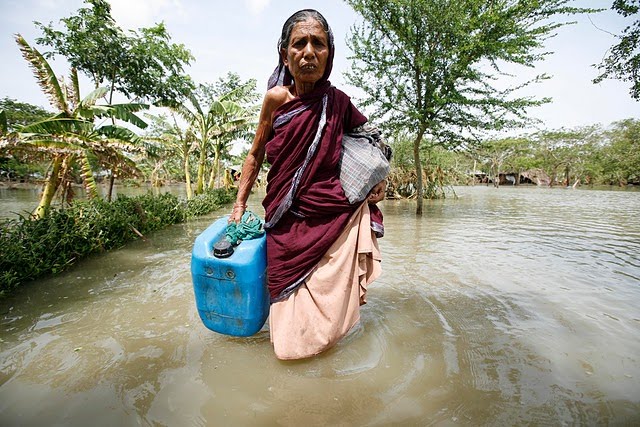
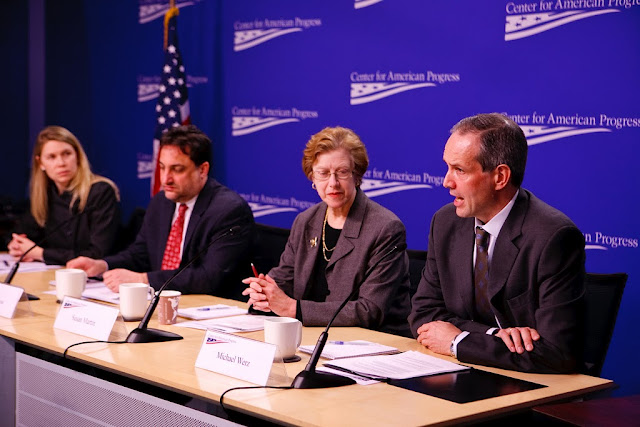
“As we …talk about the interconnections between climate change and migration we need to look at the interconnections in a way that understands what’s positive about the processes of migration and what’s problematic,” said Susan Martin, Herzberg Professor of International Migration at Georgetown University, during a recent event on climate and migration at the Center for American Progress.
Susan Martin joined Cynthia Brady, senior conflict advisor for the Office of Conflict Management and Mitigation at USAID and David Waskow, director of the Climate Change Program at Oxfam America, to identify the catalysts for future population flows, offer pragmatic policy solutions, and discuss work to be done on the ground.
While reminding the audience that climate-induced migration will tend to follow already existing patterns, Susan Martin broadly outlined four major intersections between migration and climate change impacts:
“Slow” Migration Pressures:- Drought or desertification resulting in a loss or depreciation of livelihoods.
Result: Push working family members to migrate to domestic or international urban centers. - Rising sea levels damaging fishing and agriculture opportunities.
Result: Migration to inland regions to reduce future risk.
“Rapid” Migration Pressures:- Intensification of natural disasters and damage to infrastructure.
Result: The coping costs increase to the point where they push large numbers of people to leave their homes. Most individuals migrate internally. Of the four intersections, this is currently the most common. - Threats to the availability of food, water, and other natural resources.
Result: Low or high intensity conflict, leading to migrations. The short timeframes and potentially large numbers of migrants involved make this driver the most problematic. Differing degrees of internal political stability are factors that can interfere for better or worse.
Yet these relationships are not without controversy. “Environmentalists have tended to see the issue of migration as a way of getting attention to mitigation and have often talked about migration in very alarmist terms,” Martin said. “Migration experts, on the other hand, have been very skeptical about the interconnection.” Instead, they have argued that other push and pull factors outside of climate are much more significant to the migration calculation.
Operating from the perspective that migration itself is an adaptation failure, David Waskow outlined several strategies that Oxfam deploys to help communities copewith uncertain futures:
- Building climate resilience and developing adaptation strategies: Proactive approaches are essential, as agencies and communities can address future threats with disaster planning and creating early-warning systems.
- Managing risk: The establishment of micro-insurance projects can cushion vulnerable populations against unexpected economic shocks.
- Resettling communities: The movement of rural populations to urban areas could result in tensions over land use and strains on urban governance and carrying capacities. As a result, this approach is left as a last recourse.
Brady, though in agreement with Waskow concerning climate change’s threat to livelihoods and its role as a catalyst for conflict, suggested that there may be positive opportunities for managing climate risks. “The environment can and does provide an essential and effective platform for dialogue, communication, and confidence-building around shared interests,” Brady said. “It may be that certain conflicts actually lend themselves to the use of climate-related collaboration as a mechanism to resolve conflict or reduce tension between parties,” she said.
Climate-related projects at the community-level, from adaptive early-warning systems to mitigating carbon storage schemes, hold the possibility to bring groups together in cooperative projects, build confidence, and defuse existing tensions. Transparent and participatory management of new investments may also increase trust in local and national governments with whom trust was previously lacking. While forestalling crises in the future, adaptation projects also hold the potential to unlock opportunities for peacebuilding and conflict resolution today.
Photo Credits: Photo 1 courtesy Oxfam America. Photo 2 courtesy Center for American Progress. - Drought or desertification resulting in a loss or depreciation of livelihoods.
-
World Bank Data Visualization
›Yesterday Google and the World Bank expanded their data-sharing partnership, first initiated last fall, to include a subset of 54 World Development Indicators and enhanced visualization tools. Users can now interact with data—spanning a range of both environmental and population statistics, from forest coverage area to contraceptive prevalence—using line graphs, bar graphs, maps, and xy-plots. Each option also offers users the ability to follow the data changes over time.
An alternative to Google’s Public Data Explorer is the World Bank’s Data Visualizer. Although limiting data output to an xy-plot, the customization options go beyond those offered by the Public Data Explorer and achieve a good balance between flexibility and ease of use. Table colors and groupings are fully customizable, scales are adjustable, and the chart can be quickly printed or exported as a jpeg. -
Urbanization and Deforestation
›The journal Nature Geoscience recently published a study comparing the impacts of rural and urban population growth on deforestation. “Deforestation Driven by Urban Population Growth and Agricultural Trade in the Twenty-First Century” finds deforestation is positively correlated with urban population growth and agricultural exports to international markets. In rural areas, however, the link between deforestation and population growth was absent, indicating that urbanization and agricultural export-oriented economies were the primary drivers for forest loss. The study concludes that, rather than focusing on the activities of rural populations, deforestation reduction efforts should target “industrial-scale, export-oriented agricultural production, concomitant with efforts to increase yields in non-forested lands.” (SUBSCRIPTION ONLY)
“The Population, Agriculture, and Environment Nexus in Latin America: Country-Level Evidence from the Latter Half of the Twentieth Century,” a study published in the journal Population & Environment, examines the relationship between land use and population shifts in Latin America between 1961 and 2001. The paper focuses on deforestation, which was found to be spurred by both Malthusian and Boserupian demographic drivers. It concludes that population growth, urban consumption patterns, and land-use constraints will continue to pose challenges for Latin American policymakers trying to achieve a sustainable equilibrium. (SUBSCRIPTION ONLY) -
Visualizing Natural Resources, Population, and Conflict
›Environmental problems that amplify regional security issues are often multifaceted, especially across national boundaries. Obtaining a comprehensive understanding of the natural resource, energy, and security issues facing a region is not fast or easy.
Fortunately, the Environment and Security Initiative (ENVSEC) has created highly informative, easy-to-understand maps depicting environmental, health, population, and security issues in critical regions.
Published with assistance from the United Nations GRID-Arendal, these maps offer policymakers and the public a snapshot of the complex topography of environmental security hotspots in Central Asia, Eastern Europe, Southeastern Europe, and the Southern Caucasus.
Some that caught our eye:• Environmental Issues in the Northern Caspian Sea: Overlaying environmental areas and energy production zones, this map finds hydrocarbon pollution in sturgeon spawning grounds, seal habitats in oil and gas fields, and energy production centers and waste disposal sites in flood zones.• Water Withdrawal and Availability in the Aral Sea Basin: Simple and direct, this combination map and graph contrasts water usage with availability in Turkmenistan, Uzbekistan, and Kazakhstan—which stand in stark comparison to the excess water resources of Tajikistan and Kyrgyzstan.• Environment and Security Issues in Belarus: In addition to noting the parts of the country with poor water quality and potassium mining, the map also delineates wildfires that occurred in areas contaminated by the Chernobyl explosion, thus threatening downwind populations.
Maps: Illustrations courtesy of the Environment & Security Initiative. -
Video—Ken Conca: ‘Green Planet Blues: Four Decades of Global Environmental Politics’
›February 19, 2010 // By Julia Griffin“Much of the conversation about the global environment, frankly, is an elite conversation,” says Ken Conca, professor of government and politics at the University of Maryland. “But at the same time there are community-level voices, there are voices of indigenous people, there are voices of the powerless, as well as the powerful…. I think it’s important to capture them and not just limit [the conversation] to the most easily accessible voices.”
Conca and co-editor Geoff Dabelko include these oft-muted voices in the newly released 4th edition of Green Planet Blues: Four Decades of Global Environmental Politics. “One of the things we were really trying to achieve was to give people a sense of the history,” said Conca. To fully understand the origins of today’s debates, students must go back to the beginning of the last four decades of international environmental politics.
Three key paradigms—sustainability, environmental security, and ecological justice—frame the debates in Green Planet Blues. “Ideas do matter,” says Conca. “They really do change the world, and one of the premises of our work and of the book is to try to understand what sorts of ideas people bring to the table when they think of global environmental problems.” -
Video—Integrating Population, Health, and Environment (PHE) to Conserve Ethiopian Wetlands
›February 1, 2010 // By Julia GriffinIn our latest video interview about PHE programs in Ethiopia, Zuna–a village elder from the Mettu Woreda region of Ethiopia—describes how an integrated intervention by the Ethio-Wetlands and Natural Resources Association (EWNRA) has benefited her community.
EWNRA aims to raise awareness within Ethiopian communities and governmental organizations of the importance of sustainable wetlands management. The organization also imparts local-level training on resource conservation and wise-use labor techniques.
Zuna recounts how EWNRA provided welcome training in sanitation and housekeeping practices that increased both safety and sustainability within her community. The more efficient, cleaner-burning wood stoves introduced in Mettu Woreda, for example, have improved local air quality while decreasing the frequency of skin burns and amount of harvested fuel required for cooking and other activities.
“We are benefiting from all this and I think the benefits from this intervention are good,” she says through an interpreter. “I want them to keep doing this and hopefully we will improve our activities working with them.”
Showing posts from category population.