-
Minority Youth Bulges and the Future of Intrastate Conflict
›October 13, 2011 // By Richard Cincotta
From a demographic perspective, the global distribution of intrastate conflicts is not what it used to be. During the latter half of the 20th century, the states with the most youthful populations (median age of 25.0 years or less) were consistently the most at risk of being engaged in civil or ethnoreligious conflict (circumstances where either ethnic or religious factors, or both, come into play). However, this tight relationship has loosened over the past decade, with the propensity of conflict rising significantly for countries with intermediate age structures (median age 25.1 to 35.0 years) and actually dipping for those with youthful age structures (see Figure 1 below).
-
Jon Foley: How to Feed Nine Billion and Keep the Planet Too
›October 12, 2011 // By Geoffrey D. DabelkoJon Foley of the University of Minnesota’s Institute on the Environment is a food security rock star, plain and simple. And he deserves that lofty status in part because he explains our complex 21st century agriculture challenges in such a clear and accessible fashion. See him present (like in the TEDx video above), and you are left wishing all scientists would drop in on the “how to make your work understandable” class that Foley must have aced.
Foley brought that clarity of presentation, mixed with self-deprecating humor, to this past week’s inaugural South by Southwest (SXSW) Eco conference in Austin, Texas. Foley said we must meet three big challenges in the realm of agriculture:- Feeding the population today: One in seven of the world’s seven billion people do not know where their next meal is coming from.
- Feeding the future population: The planet is expected to reach more than nine billion people in just 39 years (and may still continue to grow beyond nine billion, rather than leveling off as expected until recently).
- Farming the planet sustainably: We are a long way from achieving sustainable agriculture, given overuse of fertilizers, soil erosion and degradation, deforestation (leading to loss of biodiversity), and energy-intensive practices (producing excessive carbon emissions).
But Foley and his colleagues retain their scientific union cards while suggesting specific ways the world might meet the three food security goals listed above. In what must be considered the academic equivalent of a walk-off grand slam, they will be featured as next week’s cover story in Nature and a more accessible derivative in the November issue of Scientific American.
“Today, humans are farming more of the planet than ever, with higher resource intensity and staggering environmental impacts, while diverting an increasing fraction of crops to animals, biofuels and other nonfood uses,” Foley et al. write in Nature. “Meanwhile, almost a billion people are chronically hungry. This must not continue: the requirements of current and future generations demand that we transform agriculture to meet the twin challenges of food security and environmental sustainability.”
Their four-step plan in brief:- Slow agricultural expansion to stop deforestation and the huge ecological cost that stems from expanding into new lands, often to grow animal feed rather than food for direct human consumption.
- Grow more food on the acres currently under cultivation. The attention, resources, and innovation applied to the best-producing farms need to also be turned on the least productive farms, where rates as low as 20 percent of potential yields are the norm.
- Improve the resource efficiency of agriculture, through better water use, for example. Places like India, where the energy to pump groundwater is effectively free, are very inefficient in the use of water per calorie grown.
- Close “diet gaps,” where only 60 percent of what is grown is actually for human consumption (the rest for animals and fuel), and reduce food waste, whether it is spoilage on the way to market or the excesses of a food industry that leaves so much uneaten.
Sources: Nature.
Video Credit: “TEDxTC – Jonathan Foley – The Other Inconvenient Truth,” courtesy of Youtube user TEDxTalks. -
Lisa Hymas on Envisioning a Different Future With Family Planning in Ethiopia
›ECSP caught up with Lisa Hymas, senior editor at Grist, last week during the first South by Southwest (SXSW) Eco conference and she spoke about her recent visit to Ethiopia to see the country’s community health extension program in action. “Ethiopia has a big challenge around population,” Hymas said, “but the government is committed to bringing that down.”
The government extension program places health-workers – young women, for the most part, who have received basic training – directly into each community, where they are able to give out immunizations, provide advice on nutrition, teach families how to properly hang bed nets to prevent mosquito-borne illnesses, and provide family planning services and advice.
Thanks to the program, these health workers and those in the communities they service can “envision very different lives for themselves than their mothers had,” Hymas explained. For instance, one woman recounted that her mother gave birth to 10 children, “and almost died giving birth to the last one, because there was no access to birth control, and there was no good access to health care.” In contrast, she is now able to have a career and to use family planning to delay and space her own childbearing.
For more on Ethiopia’s health extension program, see Schuyler Null’s report on visiting a village health clinic near the town of Fiche last spring. -
Strengthening the Voices of Women Champions for Family Planning and Reproductive Health
›“The health, security, and well-being of families depend importantly on the health of women,” said Carol Peasley, president and CEO of the Centre for Development and Population Activities (CEDPA). “When women have the ability to voluntarily space and limit the number of children they have, maternal and newborn child deaths decrease, as do abortions and abortion-related injuries,” she continued.
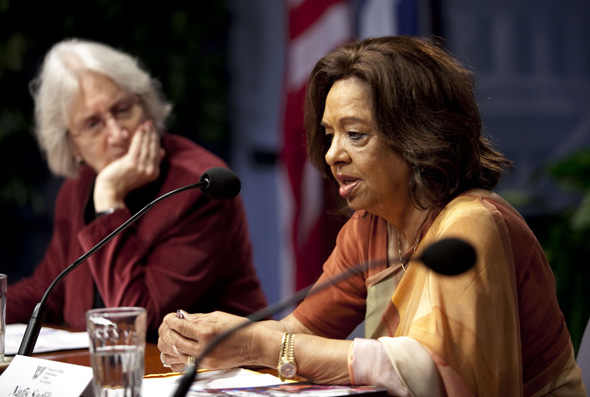
Peasley was joined by three panelists on September 28 at the Wilson Center: Dr. Nafis Sadik, special advisor to the UN Secretary General; Tigist Kassa Milko, health communications program coordinator for Panos Ethiopia; and Rosemary Ardayfio, a reporter for the Ghanaian paper, The Daily Graphic.
Ardayfio and Milko both recently participated in a CEDPA-led workshop, which is designed to create effective women champions for family planning and reproductive health.
“The voices of women champions may in fact be the best way to influence policymakers and just average citizens around the world,” said Peasley.
Women’s Rights Essential for Development of All
According to Sadik, women have gained some autonomy over their reproductive health:- Maternal mortality around the world is down by 40 percent compared to 1990 levels;
- Family planning reaches over 65 percent of women who need and want it;
- Many developing countries will achieve parity in girls’ and boys’ education by 2015; and
- Women are increasingly prominent in national and international leadership.
- Women’s literacy rates are still much lower than men’s;
- Pregnancy and childbirth still pose major health risks for women;
- Maternal mortality is the single biggest differential between developed and developing countries;
- We are far from reaching the Millennium Development Goal of reducing maternal mortality by 75 percent; and
- The current unmet demand for family planning (215 million women) is projected to rise by 40 percent by 2050 as the reproductive age population grows.
Local Champions for Local Needs
Although Tigist Kassa Milko and Rosemary Ardayfio come from two African countries hundreds of miles apart, their struggles are eerily similar.
In Ethiopia, the more than 1.5 million women who live in pastoral or nomadic areas shoulder many responsibilities, including walking long distances to fetch food and water for their families. The well-being of these women and their families is further strained by the challenges of climate change and limited health service provision.
To help overcome these obstacles, a number of micro-credit associations now offer female pastoralists alternative livelihood options. Panos Ethiopia also provides “reproductive health, family planning, gender-based violence forums” and “trainings on life skills and saving” to those who come for loans, said Milko.
But “when it’s a choice between walking to get water and walking to get contraceptives, water will win,” said Milko, so it is essential to focus on integrating ways to improve livelihoods, health, and ecosystems – also known as population, health, and environment (PHE) programs.
In Ghana, women also grapple with competing issues of development, poverty, healthcare, and cultural barriers. According to Ardayfio, 35 out of every 100 Ghanaian women want to space or limit births but are not using modern family planning methods. As a journalist, she acknowledged that there are many myths about reproductive health that need to be dispelled. The newspaper she writes for, The Daily Graphic, publishes three articles on women’s health each week.
“The stories of women dying from pregnancy-related causes should continue to be told in a compelling manner until our government makes good on the many international commitments it has signed to,” said Ardayfio. “Our decision-makers should be told again and again that it’s time to scale up family planning.”
Event Resources:
Sources: CEDPA, Guttmacher Institute, Population Reference Bureau, UNESCO, UNICEF, USAID.
Photo Credit: Dave Hawxhurst/Wilson Center. -
Watch: First Impressions From the Inaugural SXSW Eco Conference
›October 6, 2011 // By Schuyler NullOur director, Geoff Dabelko, provides a brief update from South by Southwest’s (SXSW) first Eco conference, being held in Austin, Texas this week:
Bill Ritter, former governor of Colorado, was impressive in an interview with Bryan Walsh of Time magazine, seamlessly alternating between technical and policy questions about energy security.
Ned Breslin, CEO of Water for People, provided some real talk, challenging the notion that it’s “easy” to provide needy populations with freshwater. It’s not as simple as “$25 saves a life,” he said. Providing long-term, sustainable water and sanitation solutions to people around the world requires a great deal of hard work, particularly on financing and ownership questions.
Finally, Jon Foley of the University of Minnesota’s Institute on the Environment presented a five-step response to what he called today’s three main food challenges: providing enough to feed today’s population, tomorrow’s (an estimated nine billion people by 2050), and doing it all in a sustainable fashion. The Institute on the Environment publishes an almost-quarterly magazine, Momentum, whose work we’ve featured before on New Security Beat (here, here, and here), and, incredibly, is available, delivered to your house, for FREE. Highly recommended.
Stay tuned for more updates from SXSW, including the ECSP-supported panel, “Three Great Ideas That Won’t Be On the Rio+20 Agenda.” -
Weathering Change: New Film Links Climate Adaptation and Family Planning
›“Our planet is changing. Our population is growing. Each one of us is impacting the environment…but not equally. Each one of us will be affected…but not equally,” asserts the new documentary, Weathering Change, launched at the Wilson Center on September 22. The film, produced by Population Action International (PAI), explores the devastating impacts of climate change on the lives of women in developing countries through personal stories from Ethiopia, Nepal, and Peru. Family planning, argue the filmmakers, is part of the solution.
-
SXSW Eco Panel: Three Great Ideas That Won’t Be On the Rio+20 Agenda
›September 30, 2011 // By Schuyler NullSouth by Southwest (SXSW) – the popular music, film, and alternative showcase – is moving into the green space with its first ever “eco” conference, kicking off next week, October 4, with more than 50 panels on “solutions for a sustainable world.” There’s one in particular though you should tune into: “Three Great Ideas that Won’t Be On the Rio Agenda,” featuring Geoff Dabelko, director of the Wilson Center’s Environmental Change and Security Program; Roger-Mark De Souza, vice president of research and director of the climate program at Population Action International; and Aimee Christensen, CEO of Christensen Global Strategies.
The panel will feature discussion on three issues that will likely not be on the table at the Rio+20 UN Conference on Sustainable Development next year: integrated population, health, and environment development programs, climate adaptation as a path to peacebuilding, and how to get the private sector better involved in helping cope with climate change.
If you’re traveling down to Austin, “Three Great Ideas” is scheduled for Thursday, October 6 at 10am CST; if not, stay tuned for webcast information! -
Aaron Wolf on Water Management, Agriculture, and Population Growth in the Middle East
›In terms of groundwater depletion, “Yemen and Gaza are probably the two places worst off in the Middle East,” Aaron Wolf told ECSP in a recent interview. Wolf, a water expert and geography professor at Oregon State University, said population growth across the broader Middle East region has led to intensified groundwater pumping in recent years. This trend has raised the prospects for water-related conflict down the road, as countries drain their groundwater stocks faster than the aquifers can recharge. Potentially complicating matters further, said Wolf, is that most aquifers in the Middle East cross international boundaries.
Despite the region’s history of water tensions, Wolf said the unprecedented level of demographic change currently being experienced across the Middle East is not necessarily a recipe for future confrontations over the resource, in part thanks to the existence of water-sharing agreements in the area. Nevertheless, mounting demand will likely force water-users across the region – especially within the agriculture sector – to change the ways they utilize the resource.
Accounting for 80 to 90 percent of total water usage in some Middle Eastern countries, agricultural operations have already been forced to adjust to the evolving water-access situation. While moving from flood irrigation to drip irrigation represents one policy option if sufficient funds are available, Wolf said doing away with local food production “is a path that a lot of countries are going to have to take” to ensure a relatively stable water supply for their populations’ drinking, cooking, and cleaning needs.
Wolf added that one frequently discussed but not entirely realistic option for addressing the region’s water-supply concerns involves desalination. To date, widespread deployment of the technology has been hampered by high costs and substantial energy requirements, although that hasn’t stopped a few countries in the region – among them the United Arab Emirates, Saudi Arabia, and Israel – from becoming partially reliant on converted fresh water.
Wolf maintained that desalination’s hefty price tag means the technology is useful only for urban population centers near the coast. Moving converted sea water further inland remains a non-starter, he said, because transporting it requires an enormous amount of energy (a cubic meter of water weighs a metric ton).
For the same reasons, Wolf asserted, using desalinated water for agriculture doesn’t seem to be in the cards any time soon. “Right now a cubic meter of desalinated water costs about 40 cents, and you can’t use that for agriculture unless it drops down to about 8 cents a cubic meter,” Wolf said. “So until you can irrigate with desalinated water, it really doesn’t go a long way towards mitigating the larger water crisis.”
The “Pop Audio” series is also available as podcasts on iTunes.
Sources: American University, International Food Policy Research Institute, World Bank.
Showing posts from category population.