-
Those Who Would Carry the Water
›December 24, 2010 // By Mark NepoThis article will appear as the introduction in the forthcoming Fetzer Institute and Wilson Center publication, Our Shared Future: Environmental Pathways to Peace, based on an event cosponsored at the Wilson Center in January 2009.
It is fitting to say “welcome,” since this timeless greeting originally meant “come to the well.” Let me try to describe the well we are coming to. We are at once trying to gather the best experience and thinking of current environmental practice, to help advance the issue of water as a resource, and to use environmental work around water as a case study for the lessons and challenges of global community engagement. In convening leading practitioners and thinkers in the field of environmental peace-building and focusing on the ever-present issue of water, we hope to surface the strengths of human resources and how they impact the emerging global community.
In truth, the issues that bring us here have been present in the human condition forever. They are spoken to in every tradition. A few stories will help create a context for our time together.
If we turn to the Hindu tradition, we learn that Saraswati is the goddess of knowledge, music, and the arts. Her name means “the one who flows” and legend has it that she was born of the Saraswati River, which is an invisible river that carries the waters that sustain all life. From the earliest times, in many traditions, the waters that sustain all life refer to both natural resources and human and spiritual resources; actual water and the water we have come to know since the beginning of time as wisdom and love.
In Hindu lore, Saraswati’s ageless counterpart on earth is the serpent-demon, Vritrassura, who is driven to hoard all the Earth’s water. And so the endless struggle begins; at least this is one tradition’s beginning. Thankfully, in the Rig-Veda, the sacred collection of Sanskrit hymns, we are given hope as Saraswati – with help from her brother Ganesh, the provider and remover of obstacles, and Indra, the god who connects all things – kills the demon who would hoard the Earth’s water.
But clearly, throughout the ages, those who would carry the water and those who would hoard the water have appeared again and again and again. This is why we are here. Unspoken or not, unaware or not, we are by care and kinship of the lineage that would carry the water.
If we turn to the Haitian tradition, we find a very telling teaching story called The Chief of the Well. This story speaks of a time of drought when the streams are dry and the wells are parched. There is no place to get water. The animals meet to discuss the situation and decide to ask God for help. God creates a well that will have endless water as long as one of the animals serves as caretaker and welcomes all who would come in need. The lizard Mabouya volunteers. But intoxicated with his newfound power, Mabouya becomes a gatekeeper, not a caretaker, and sends everyone in need away. Eventually, God replaces the lizard with the frog who croaks to all, “Come! This is God’s well! The hole in the ground is yours, but the water belongs to God.” And we are left, in each generation, to discover what is ours and what is God’s, and to understand what turns the caretaker in us to the gatekeeper?
If we can accept our role as caretakers of resources that outlive us, then the history of the acequia might be relevant. An acequia (a-sā’kē-e) is a community-operated waterway used for irrigation. It is the name for a sluiceway or gravity chute that flows down a mountainside, providing water for a village. The Spanish word acequia, which means “ditch or canal,” comes from the Arabic al saqiya, which means “water conduit.” The Islamic occupation of Spain, beginning late in the eighth century, brought this technique of irrigation to Spain.
Acequias were then brought to the Americas by the Spanish, only to find their indigenous counterparts already in use. Particularly in the Andes, northern Mexico, and the modern-day American Southwest, acequias exist as the outgrowth of ancient systems created to carry snow runoff or river water to villages and distant fields. Many South American villages have settled around the mouth of an acequia that begins high and out of sight in the crags of a mountain. There, the source-water collects all winter near the top and, in spring, with the thaw, it streams into the village.
In many of these South American villages, as in Peru for example, there is an annual ritual in which an entire village climbs the acequia in early spring to clear the rocks and tree limbs and snake nests that during the winter have blocked the path of water that the village depends on. This ancient pragmatic ritual of clearing the acequia provides a powerful model for how community can care for its natural resources together.
In fact, keeping the acequia clear and flowing is a useful metaphor for interdependence and cooperation. The life of the acequia and our responsibility to keep its path of flow clear represents a cycle of natural and human erosion and cleansing that is intrinsic to life on earth. Therefore, keeping the acequia clear – both the actual acequia and the acequia of humanity – bears learning how to do well.
With all this in mind, I am drawn to lift up one more story. It comes from Éliane Ubalijoro, a professor at McGill University in Montreal, who as a Rwandan is working with the generation there orphaned by the genocide. After the mass killings, those surviving were confined to refugee camps. In this particular settlement, women had to cross a dark field outside of the camp and risk being raped to get water for their children, which they did repeatedly. This difficult situation points to the complex levels of the issues before us; all of which demand our attention.
First, we might consider access to the water itself. With regard to the conservation and preservation of natural resources, we are asked to solve the perennial question: How do you bring the water to those who need it? At this level, a direct solution might be to move the water supply inside the refugee camp.
Under this, however, we might consider access to the human resources. What is blocking the human acequia? With regard to conflict transformation and peace-building, we are compelled to ask: What are the values implicit in this situation by which the refugee camp guards put the water outside of the camp in the first place in order to create the opportunity to rape the women?
This leads to the work of education, the work of clearing the human acequia. So with regard to the development of social equity, we are now compelled to ask: What are the assumptions and traditions in this community that enable them to believe that exploiting women is not only permissible but entitled? How do we clear the human acequia so that wisdom and compassion can flow?
Finally, we might consider the conservation and preservation of human resources. For at the heart of this insidious atrocity is the resilience and courage and love of these women who went into the dark to get water for their children knowing the violation that awaited them. What kind of deep water is this and how can we insure access to this resource?
This story from Rwanda is one more example that shows how natural resources and human resources are inextricably linked. One central question before us is: How do we tend all levels at once? How do we develop multiple strategies? How do we convene and surface the wisdom of all frames?
Part of our inquiry here is to take our turn in trying to understand how natural resources and human resources are so linked. What blocks their access? What lets them flow together and sustain life? How do we understand the water of humanity and the water of the earth and how both kinds of water are shared or not in the world today?
We could say that knowledge flows like water between countries and communities. If this is so, then each of you is such water. We are here to drink from you and people like you, and to understand the currents that run between us and beneath us; to insure the clear flow of natural and human resources into the world; and to keep the global acequia clear; to embody and to further the art and science of carrying the water in all its forms to those who need it.
Mark Nepo is the author of The Book of Awakening as well as the forthcoming As Far As the Heart Can See.
Photo Credit: Adapted from “The Water Carrier,” courtesy of flickr user Portrait Artist – Enzie Shahmiri. -
‘New Security Beat’ Goes Mobile and a Guide to ECSP Media Sources
›December 22, 2010 // By Schuyler NullThanks to a handy tool from Blogger, The New Security Beat now has a more mobile-optimized version that will load automatically if you visit the site from your phone. The formatting is lighter to ease your strained, possibly cubicle-choked 3G connections, and it is easier to navigate using touch. Alternatively (or just because it’s so cool) you can scan the QR code to the right to load it right up on your Android or iOS-powered device (no guarantees with Blackberry).
The Environmental Change and Security Program has a wealth of media resources available online which we try to make as accessible as possible straight from the blog, but just in case you’ve forgotten, here’s a comprehensive listing:Be sure to also follow ECSP on Facebook and Twitter to see and comment on posts as they roll out on The New Security Beat and keep abreast of the latest population, environment, and security-related news.
-
Rebuilding Stronger, Safer, Environmentally Sustainable Communities After Disasters
The GRRT Toolkit for Humanitarian Aid
›Natural disasters present an immediate humanitarian crisis but are also an opportunity to rebuild societies to be more resilient and environmentally sustainable than they were before. The “Green Recovery and Reconstruction Training Toolkit” (GRRT), created by World Wildlife Fund (WWF) and the American Red Cross and launched at the Wilson Center on November 19, will help future humanitarian efforts integrate principles of environmental conservation into their disaster recovery strategies. This strategic partnership has been “an incredible effort and marriage between organizations that have different operating styles, different approaches to situations,” said WWF Chief Operating Officer Marcia Marsh. While implementing the GRRT may not be easy, “we need integrated solutions for integrated problems,” said Erika Clesceri, bureau environmental officer at USAID.
A Critical Partnership
In the midst of a crisis, humanitarian workers on the ground often do not have the time, skills, or funding to incorporate environmental concerns into relief efforts, said Robert Laprade, senior director for emergencies and humanitarian assistance at CARE. Humanitarian workers are “going a hundred miles an hour, they’re going on adrenaline and they’re there to save people’s lives – and the environment is just of secondary importance,” he said.
But “environmental sustainability is critical to the achievement of long-lasting recovery results,” said Roger Lowe, senior vice president of communications at American Red Cross. The Red Cross Principles of Conduct state that “relief aid must strive to reduce future vulnerabilities to disaster as well as meeting basic needs” and “avoid long-term beneficiary dependence upon external aid,” he said.
From Damnation, Purgatory, and Armageddon to Redemption
For many crisis-stricken regions, lack of an emphasis on environmental sustainability during disaster recovery efforts can mean “damnation in the present, purgatory in the near future, and Armageddon in the long term,” said Peter Walker, director of the Feinstein International Center at Tufts University. Stress on the environment caused by climate change or unsustainable resource consumption can often contribute to conflict, he explained.
In Darfur, “the environmental change was part and parcel of what led to that conflict,” Walker said. At one time an “environmental Eden” of diverse ecological zones, Darfur gradually became an environment that could not support a society of livestock herding. As the environment changed, some former herders became salaried, armed gunmen, known as the Janjaweed who felt they faced “a choice of no choice,” Walker said, to either “die as pastoralists or become pariahs as mercenaries.”
The challenge for humanitarian aid organizations is to not only help communities recover from disasters, but help them adapt to future environmental stress caused by globalization, climate change, or other factors. “If you cannot adapt,” Walker said, “that’s going to lead to violence.” To avoid aid dependency or resurgence in conflict it is critical to integrate environmental sustainability into disaster relief efforts from the beginning, he said:We used to believe that our world in the aid business was divided between relief on the left and long-term development on the right, and one would gradually go into the other in this relief-development continuum. But the reality is that you have a significant population – a population of millions of people – who are effectively trapped in a form of aid purgatory. They’re basically on a drip feed. Humanitarian assistance does not get you forward, it keeps you alive.
The GRRT offers organizations guidelines for implementing integrated disaster relief to provide a sustainable solution. While every crisis is different, the GRRT’s guidelines should be as applicable to “flooding in Boston as they are to flooding in Aceh,” said Walker.
Implementing Integrated Solutions
Securing funding for this integrated approach will be a challenge, as a significant portion will go towards staffing and training people on the ground, said Clesceri. A stand-alone, dedicated budget for environmental issues within humanitarian assistance programs must “be fought and re-fought for on a continual basis,” she said.
Local partnerships are essential. “Replicate” should be “stricken from the lexicon,” said Marsh. “You can’t replicate, and this toolkit isn’t meant to be a one-size-fits-all.” Instead, she said, the goal of the GRRT is to “create very practical approaches with communities.”
The key to helping communities recover from disasters is to form the kinds of strategic partnerships demonstrated by WWF and the American Red Cross in the creation of the GRRT. “Interdisciplinary groups are always, in my mind, going to get you a better solution in the end, but the risk is that they take more time…but it’s absolutely worth it,” she said.
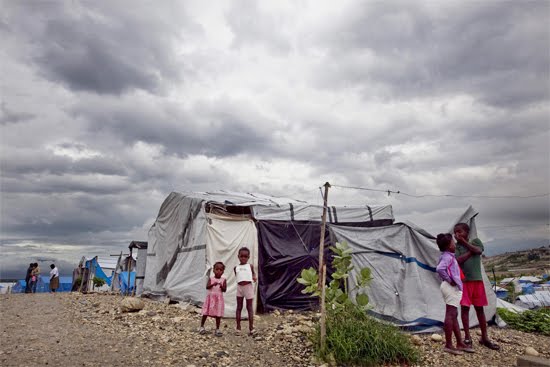
Photo Credit: “Dark Clouds from Haiti’s Hurricane Tomas Loom over Camps,” courtesy of flickr user United Nations Photo. -
An Integrated Climate Dialogue
COP-16 Cancun Coverage Wrap-up
›December 13, 2010 // By Schuyler NullAfter focused last-minute negotiations, the UNFCCC COP-16 parties meeting in Mexico finally reached an agreement on a package being called “The Cancun Agreements” on Saturday. One of the most important impacts of the agreement (also referred to as the “balanced package”) is the establishment of a green climate fund which will help developing countries adapt to and mitigate the effects of climate change.
For more on the green fund as well as the integration of gender, population, development, and even a little bit of security in the broader climate dialogue, see The New Security Beat’s coverage of Cancun below.- Interview with Karen Hardee: Climate-Proofing Development
- Pop Audio: From Cancun: Roger-Mark De Souza on Women and Integrated Climate Adaptation Strategies
- Guest Contributor Alex Stark: From Cancun: Getting a Climate Green Fund
- The Number Left Out: Bringing Population Into the Climate Conversation
Kicking off our coverage was an email interview with Karen Hardee, visiting fellow with the Population Reference Bureau, on “climate-proofing” development. Hardee gives a brief overview of the UN National Adaptation Programmes of Action system and the current state climate adaptation integration in international development. She points out that one of the enduring positives from COP-15 was a renewed focus on financing tools that has permeated to the top levels of the UN.
Hardee also touched on the nascent but largely unfulfilled connection between population growth and resilience, noting that “of the first 41 programs submitted to the UNFCCC…37 noted that population growth exacerbated the effects of climate change, but only six explicitly stated that meeting an unmet demand for RH/FP should be a key priority for their adaptation strategy and only two proposed projects that included RH/FP.”
Next, Population Action International’s Roger-Mark De Souza was kind of enough to speak with us briefly over the phone from the conference itself, providing a run-down on a PAI-sponsored side event focusing on empowering women in climate debates.
“When you look at the negative impacts of climate change, the impacts on the poor and the vulnerable – particularly women – increase, so investing in programs that put women at the center is critical,” De Souza said.
Leaving gender issues, like child and maternal health and education, out of deliberations like those COP-16 are missed opportunities to get more “power for your peso,” he said.
Alex Stark, formerly of CNAS and now with the Adopt a Negotiator program in Cancun, provided an update and a strong argument for one of the most critical elements of the “balanced package” that many are hoping will come out of Cancun – the establishment of an international fund to help pay for adaptation and mitigation programs in developing countries.
Stark provides an insight into some of the chatter on the floor at COP-16 and also outlines the moral, development, and security advantages to supporting a green fund, pointing out that “by managing displacement, migration, and violent conflict driven by the effects of climate change, such as water scarcity, climate change adaptation can help bolster international security and stability.”
“Within the UN process itself,” she writes, “a robust, well-run, equitable green fund would help rebuild the trust lost between developed and developing countries at Copenhagen last year.”
Lastly, Bob Engelman, of the Worldwatch Institute, provides a broad argument for more inclusion of a key variable in climate debates – population (and not in the Ted Turner mold). He enumerates the common pitfalls of population debates, from sensitivities about personal choices to squeamishness about sexuality and reproductive health, and just plain gender bias.
But despite these barriers, says Engelman, population – and not just growth but demographics too – matters in the climate debate and therefore needs to be part of the conversation (an argument he makes more comprehensively in a new report, Population, Climate Change, and Women’s Lives). Echoing De Souza, he concludes by pointing out that although the discussion may be difficult, the solution is relatively simple: “On population, the most effective way to slow growth is to support women’s aspirations.”
“As societies, we have the ability to end the ongoing growth of human numbers – soon, and based on human rights and women’s intentions,” Engelman said. “This makes it easy to speak of women, population, and climate change in a single breath.”
Sources: Population Action International, Slate, UN Framework Convention on Climate Change, The Washington Post, Worldwatch Institute.
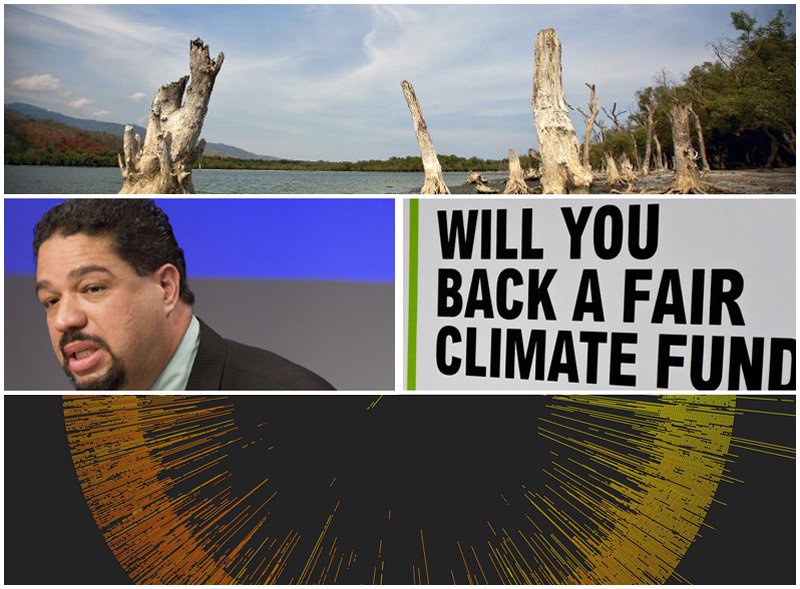
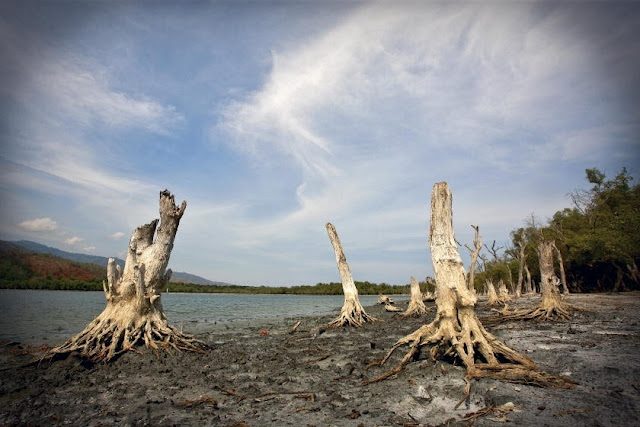
Photo Credit: Adapted from “Trees Dead on Shore of Timor-Leste Lake,” courtesy of flickr user United Nations Photo; Roger-Mark De Souza, courtesy of David Hawxhurst/Wilson Center; “Will you back a climate fund?,” courtesy of flickr user Oxfam International; and “Met Office Climate Data – Month by Month (September),” courtesy of flickr user blprnt_van. -
From Cancun: Getting a Climate Green Fund
›Over 9,000 negotiators from 184 countries have gathered for the 16th Conference of the Parties of the UN Framework Convention on Climate Change (UNFCCC), known as COP-16, in Cancun, Mexico. No one expects a binding emissions reduction agreement, but a successful outcome on a set of decisions here – the so-called “balanced package” – will help build trust among countries and make progress towards a final emissions agreement next year.
One of the most important parts of the package is agreement on the creation of a green climate fund – an international fund designed to help developing countries adapt to and mitigate the effects of climate change.
If the negotiations are as successful, as expected, the fund will be part of a package that also includes the architecture for an adaptation body, technology transfer, REDD-plus, and progress towards a binding international mitigation agreement that negotiators hope to conclude at COP-17 in Durban, South Africa.
An event Monday morning co-hosted by Oxfam and the Global Campaign for Climate Action, featured a variety of developed and developing country perspectives about what a new fund for mitigation and adaptation programs should look like.
The event was galvanized by a letter, currently being circulated here at the talks, signed by 215 civil society organizations and calling for “the establishment of a fair global climate fund at COP-16 that will meet the needs and interests and protect the rights of the most vulnerable communities and people around the world.” In opening comments and a question-and-answer session, panelists articulated some of the most contentious points that negotiators are currently discussing, some of the reasons why a green fund is so important, and the implications for global equity, sustainable development, and international security.
A main point under discussion right now is how the fund will be governed. The United States and other developed countries argue that the fund should work under the supervision of the UNFCCC but international financial institutions, like the World Bank, should also assist in creating the fund.
Judith McGregor, the UK ambassador to Mexico, argued in her opening statement that for the United Kingdom, “climate finance… is a clear, clear priority” at the COP, but that the World Bank would lend the fund legitimacy and make donors more confident in the fund’s ability to deliver. Tim Gore from Oxfam expressed the opinion held by many civil society organizations and delegates from developing countries, that the fund must “act under the authority of the UNFCCC… independent from institutions such as the World Bank,” because a new climate fund should have an equitable governance structure that includes the voices of developing countries, civil society members, indigenous peoples, women, and other stakeholders – not a majority share by the developed countries like at the World Bank.
Another stumbling block is how climate finance will be divided between adaptation and mitigation programs. Gore argued that adaptation and mitigation finance must be balanced 50-50, whereas currently “there is a huge adaptation gap… less than 10 percent of current climate finance is going to adaptation.” Evans Njewa, the lead finance negotiator representing the group of Least Developed Countries (LDCs), noted in his statement that “adaptation is the priority for the LDCs [in Cancun].”
The source of these funds is also a contentious issue that divides developed and developing countries. Under the Copenhagen Accord, most of the COP country parties agreed that developed countries would mobilize $30 billion in fast start finance by 2012 and $100 billion per year by 2020 in climate finance from public, private, and other “innovative sources,” such as a carbon tax or cap-and-trade systems. Developed countries like the United States are mobilizing public funds for climate finance but argue that the majority of the $100 billion figure should be provided by private investments and that loans provided by development institutions as well as grants should also count.
Climate finance for adaptation will help make poor, rural communities in particular more resilient to the effects of climate change, including drought, floods and tropical storms, and therefore help the international community to achieve several related development milestones such as the Millennium Development Goals, according to Alzinda Abrea, finance minister of Mozambique.
Cate Owen of the Women’s Environment and Development Organization (WEDO) explained that investing in climate adaptation now “makes good sense” because “investing now in responding to climate change will lessen the long-term costs” to developed country donors.
The message that climate adaptation measures are becoming essential to sustainable development was perhaps delivered most forcefully by Florina Lopez, an indigenous person from Panama, who described the impacts that her people are already suffering as a result of climate change. Since her community survives by fishing, hunting and growing crops, severe flooding is disrupting indigenous ways of life and floods bring assaults on community health, like diarrhea, skin disease, and malnutrition. Community activities that contribute to development such as education and healthcare are also paralyzed by these impacts. Adaptation funding will be essential for her community to survive and to avoid disruptive displacement.
Still, perhaps the most compelling political reason for American taxpayers to invest in climate change adaptation in the developing world is the national security implications of the effects of climate change. A report issued this week by the Center for American Progress and the Alliance for Climate Protection explains why the United States must have a global climate investment strategy, despite adverse economic and political conditions domestically. Adaptation funding will “reduce risks of climate-related national security threats, including from severe floods or droughts in Pakistan and the Middle East” and strengthen our relationships with developing country recipients, including strategically important partners like India, Indonesia, and Brazil, write the authors. Finally, by managing displacement, migration, and violent conflict driven by the effects of climate change, such as water scarcity, climate change adaptation can help bolster international security and stability.
The establishment of a climate green fund here in Cancun is essential for an equitable and balanced international climate deal. A fund is first and foremost the moral imperative of developed countries, known as the Annex-I parties under the UNFCCC, who are historically responsible for greenhouse gas emissions. However, developed countries need not rely on the moral argument to convince policymakers and taxpayers that climate adaptation for the poorest and most vulnerable countries and people is a good investment.
Within the UN process itself, a robust, well-run, equitable green fund would help rebuild the trust lost between developed and developing countries at Copenhagen last year. In Gore’s words, Oxfam is “cautiously optimistic that we can get an agreement here in Cancun that rebuilds trust between rich and poor countries.”
Alex Stark is a program assistant at the Friends Committee on National Legislation, working on the Peaceful Prevention of Deadly Conflict Program. She is attending the Cancun negotiations as part of the Adopt a Negotiator team.
Sources: Alliance for Climate Protection, British Foreign and Commonwealth Office, Center for American Progress, Global Campaign for Climate, Mozambique Ministry of Planning and Finance, Oxfam, UN Framework Convention on Climate Change, Women’s Environment and Development Organization.
Photo Credit: “Will you back a climate fund?,” courtesy of flickr user Oxfam International. -
David Lawson, Wildlife Conservation Society
Afghanistan’s Non-Confrontational Conservation
›December 7, 2010 // By Wilson Center Staff
Excerpt from the Center for a Better Life:
Afghanistan is more than war and turmoil; it has a long and colorful history, strong cultures and a stunning landscape. It has enormous biodiversity, as it sits at the crossroads of what biologists call “biological realms.” The country, therefore, has plants and animals that also occur in Europe, northern Asia, India, south Asia and Africa. It has nine species of wild cats, which is the same as the whole of sub-Saharan Africa, as well as an estimated 800 plant species that occur nowhere else in the world. In other words, Afghanistan is worth attention in terms of its biodiversity alone.These natural resources are also critically important from the people’s perspective. After 30 years of conflict, more than 80 percent of Afghanistan’s population relies directly on natural resources for their livelihood. Most of the inhabitants are rural and desperately poor by world standards. Child mortality is the highest in the world, and their infrastructure is mostly broken down and inoperable. The economy is donor-dependent, and the Afghan government is still in its infancy. Outside the capital of Kabul, governance sometimes seems non-existent. As a result, movement away from the major population centers can be very risky due to the presence of various insurgent groups.
And yet, what is seldom mentioned in newscasts and media is that the Afghans are proud and resilient. They want what everyone else wants: education for their children, healthcare for the young and elderly, and reliable livelihoods to support their families. Then they want to get on with their lives in their own unique, culturally diverse way, free of violence and conflict.
Understanding Cultures
Understanding these things is one reason why the Wildlife Conservation Society (WCS) has been successful in Afghanistan. When hearing of the Society’s field work in this war-torn country, most people are surprised. They wonder how, with its pressing problems, Afghanistan can afford the time, let alone the resources, to conserve its remaining wildlife and wild places. But this is one of the core strengths of WCS – to offer assistance in conserving natural resources at a practical level within a country in need, like Afghanistan. As one of the oldest conservation organizations in the world, with more than 100 years of field conservation experience, the Society has extensive seasoning under extreme circumstances. Currently, WCS has more than 600 projects in place with 3,000 staff; and, many of these projects are in the most remote areas of the world.
Since 2006, USAID has supported WCS’s work in Afghanistan within three geographical areas – the northeast in Badakhshan Province’s Wakhan District, Bamiyan’s central province and the eastern, forested Nuristan province. Experts chose these areas because they believed they held the largest numbers of untouched remaining wildlife; this presumption generally proved correct. Through the years, WCS has created trust by having conservation teams on the ground and working year-round with local communities. Similar trust has been established with the relevant ministries by WCS’ central office, located in Kabul, through continuous presence and assistance.
Results are impressive. More than seven pieces of environmental legislation were enacted; 10,000 Afghans received conservation training; the first biological surveys in 30 years were completed (which doubled as crucial skills development exercises for Afghan scientists); the first wildlife/domestic stock disease assessments were accomplished, with corresponding human health effects, plus many more exemplary achievements. One of the more intriguing results was WCS’ ability to build local governance in the most remote communities, thus connecting communities that had seen no real government representatives for years. This link extended to district authorities then to provincial authorities, and finally to the Kabul central government. This extension of Afghanistan’s rule-of-law is paramount because it improves governance, which is one of the more crucial strategic needs in the country today.
How was a non-governmental conservation organization able to contribute to governance and rule-of-law? It is simple. Wildlife conservation is usually a non-confrontational issue, and most people, when exposed to the process, take an active interest and express opinions. Rural people have grown up with and are surrounded by wildlife everyday; they have local knowledge and feel comfortable discussing how things have changed. They want to be empowered to make natural resource decisions in the areas in which they live. WCS staff encourages local people to discuss species protection with their local and provincial governments. In some instances, WCS workers have taken government officers into communities that cannot recall ever seeing a government official. These processes and contacts evolve and can be used as basis for non-conservation related discussion. These processes and relationships become the building blocks for extending governance and empowering local communities. And, the process works.
Continue reading on the Center for a Better Life.
David Lawson is the Wildlife Conservation Society Afghanistan country director.
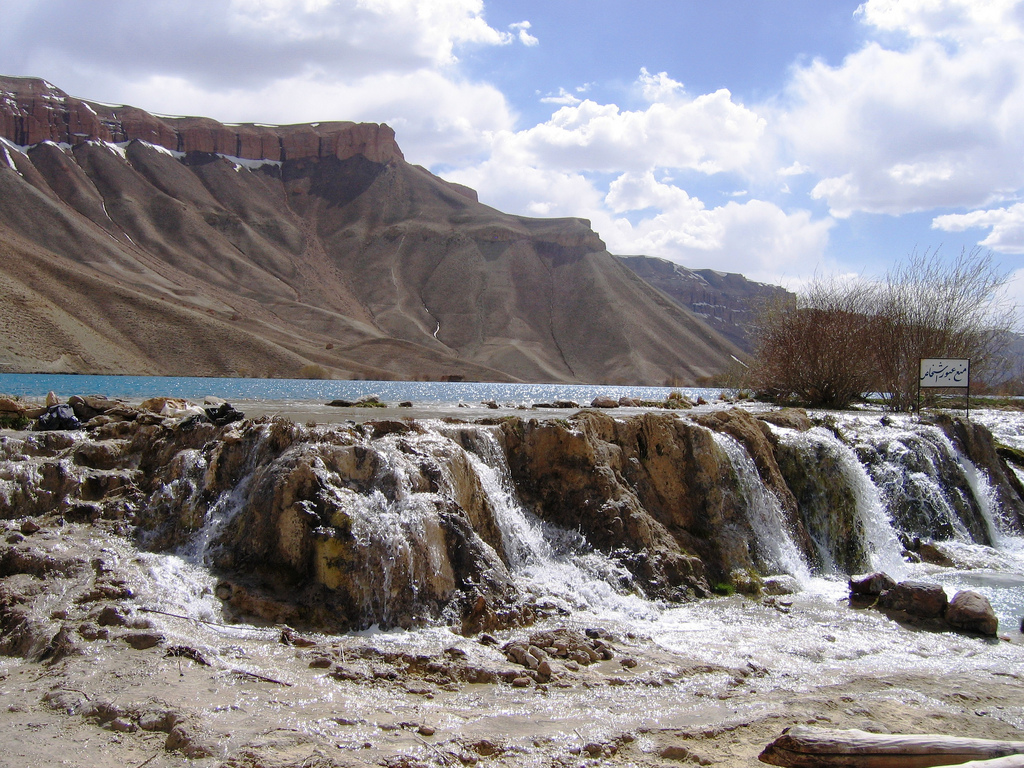
Photo Credit: “Bamiyan Band-e-Emir,” courtesy of flickr user USAID Afghanistan. USAID and WCS have been working in the Band-e-Amir lakes region since 2006 to create a national park. -
From Cancun: Roger-Mark De Souza on Women and Integrated Climate Adaptation Strategies
›“When you look at the negative impacts of climate change, the impacts on the poor and the vulnerable – particularly women – increase, so investing in programs that put women at the center is critical,” said Roger-Mark De Souza, vice president of research and director of the climate program at Population Action International (PAI), speaking to ECSP from the UN Climate Change Conference in Cancun, Mexico. “There are a number of missed opportunities here in Cancun and in climate change deliberations overall that are not including women and are missing an opportunity to have a bigger bang for the buck, or power for the peso, as we say in Mexico.”
PAI hosted a side session with five panelists from Denmark, Ethiopia, Kenya, Suriname, and Uganda on “Healthy Women, Healthy Planet: Women’s Empowerment, Family Planning, and Resilience.” The session attracted more than 100 attendees and prompted incisive, informative questions, said De Souza.
“There was a call for additional research that is policy relevant that identifies some of the key entry points and added benefits at a country level,” said De Souza. “And there is a very strong call for youth partnerships from a number of youth advocates who are looking at medical and public health interventions and are desirous of including reproductive health programming as part of that.”
“One concrete next step for Cancun is to work with other civil society partners who are here who are tracking how gender is being integrated into the negotiating language, particularly with regard to financing mechanisms,” De Souza said.
Besides financing and the need for more research, De Souza said the key issues that emerged from the panel were: the importance of linking programs of different scales; ensuring women’s empowerment and ownership; and recognizing and replicating effective partnerships.
For more from Roger-Mark De Souza, see ECSP Focus Issue 19, “The Integration Imperative: How to Improve Development Programs by Linking Population, Health, and Environment.”
The “Pop Audio” series is also available as podcasts on iTunes. -
Climate-Proofing Development: An Interview With Karen Hardee
›November 29, 2010 // By Hannah MarquseeWhile expectations are deflated for broad international consensus at the UN Climate Change Convention in Cancun, the need to “climate-proof” development efforts has been gaining ground in recent years as a necessary preventative measure to help developing countries adapt to the adverse effects of climate change.
Showing posts from category environment.