• woodrow wilson center
  • ecsp

New Security Beat

Subscribe:
  • rss
  • mail-to
  • Who We Are
  • Topics
    • Population
    • Environment
    • Security
    • Health
    • Development
  • Columns
    • China Environment Forum
    • Choke Point
    • Dot-Mom
    • Friday Podcasts
    • Navigating the Poles
    • Reading Radar
  • Multimedia
    • Water Stories (Podcast Series)
    • Backdraft (Podcast Series)
    • Tracking the Energy Titans (Interactive)
  • Films
    • Water, Conflict, and Peacebuilding (Animated Short)
    • Paving the Way (Ethiopia)
    • Broken Landscape (India)
    • Scaling the Mountain (Nepal)
    • Healthy People, Healthy Environment (Tanzania)
  • Publications
  • Events
  • Contact Us

NewSecurityBeat

The blog of the Wilson Center's Environmental Change and Security Program
Showing posts from category global health.
  • Nabeela Ali on How PAIMAN Is Improving Maternal Health in Pakistan

    ›
    Dot-Mom  //  May 1, 2012  //  By Wilson Center Staff
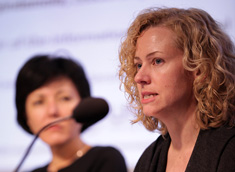
    “Maternal mortality is a very complex thing – it’s not just patient-doctor relationships, it has so much to do with behaviors, with communities, with the household, with family members,” said Nabeela Ali, chief of party for the Pakistan Initiative for Mothers and Newborns (PAIMAN), which received USAID maternal and child health funding from 2004 to 2010.

    Pakistan is the world’s sixth most populous country, yet has long held one of the world’s highest maternal mortality rates. Ali spoke at the Wilson Center last fall about strategies to better engage faith-based organizations on maternal and child health issues. In this interview with ECSP, she stressed that despite Pakistan’s very religious society, these interventions are possible with the right messaging.

    PAIMAN aims to reach vulnerable and isolated groups, including poor, rural, or conservative women. “The areas where no one can reach [are] where we targeted,” Ali said.

    In these areas, ulama – influential religious leaders and scholars – are highly trusted. “It was not a one-size-fits-all strategy,” Ali emphasized. “Religious leaders are not technical people, but they are experts in their own field. You have to approach them with trust and respect.”

    “The first step is establishing rapport with them; then they listen to you,” said Ali. This is best done through another alim, not a technical person. Those ulama that were approachable proved to be valuable allies in the promotion of maternal health. PAIMAN has reached over 35 million people in Pakistan over its now eight-year run.

    Projects like PAIMAN are necessary in areas of the world where religious leaders are the most respected community authorities. In Pakistan, Ali believes that now that this strategy has been demonstrated to be viable, the government should help bring it to scale. An NGO-funded project ends, but a government-funded program has much more continuity, which in turn helps build trust with local leaders, she said.

    Sources: UN Population Division.
    MORE
  • Women’s Rights and Voices Belong at Rio+20

    ›
    Guest Contributor  //  April 27, 2012  //  By Musimbi Kanyoro
    This summer, world leaders will gather in Rio de Janeiro for the 20th anniversary of the first UN Earth Summit to hammer out a new set of agreements on what sustainable development means and, more importantly, how both rich and developing nations can get there before it’s too late. However, for the scores of women who will be attending (and just importantly for those who aren’t), there are glaring omissions: reproductive health, gender equality, and girls education are nowhere to be found on the Rio+20 agenda.

    Women offer many of the most promising levers for the transformation to sustainable development. My experience with the Global Fund for Women tells me that women are full of creative and strategic solutions to the problems facing their communities around the world. Their voices must be included in critical decisions affecting our world. And the fact is, sustainable development isn’t sustainable if it doesn’t include empowering women to plan their families, educate themselves, and their children, and have a voice in government at all levels. Rio+20 must have human rights – and women’s rights – at its core. Earth summit planners haven’t yet done that, but women can make it happen.

    Women are 51 percent of the world’s population, yet own only one percent of its assets, are two-thirds of the world’s workers but earn a mere 10 percent of wages. Rio+20 must not become another forum in which women’s issues are not heard. Instead, the summit must demonstrate that women’s voices are integral to all development. Environmental sustainability simply can’t happen without women’s inclusion.

    For example, in West Africa, women make up 70 percent of workers in agriculture. In Burkina Faso, deforestation, water scarcity, and soil erosion show us that climate change is already impacting women farmers. Women tend to “sacrifice themselves” in order to care for their families – feeding themselves last. And women are most likely to suffer and die in environmental disasters – particularly in the Asian countries most at risk from climate change.

    So how do we support women while supporting the environment that sustains us all?

    Simply meeting women’s needs for family planning is one inexpensive and powerful development strategy with a host of environmental benefits. Over 200 million women around the world want the ability to choose the spacing and number of children but don’t have access to, or accurate information about, basic contraceptives like condoms, pills, and IUDs. One-hundred and seventy-nine nations already agree that meeting this need is a top priority, and the Millennium Development Goals (MDGs) reflect a goal of universal access to family planning as well.

    Satisfying this demand would dramatically reduce maternal and child mortality and enhance human rights. What’s more, two recent studies show that a reduction of 8 to 15 percent of essential carbon emissions can be obtained by meeting women’s needs for family planning. This reduction would be equivalent to stopping all deforestation or increasing the world’s use of wind power fortyfold.

    The Earth Summit presents a major opportunity to ensure that women’s needs and rights are given top priority in plans for sustainable development. In a time of multiple, interlinked human and environmental crises and a very tight funding environment, investing in women is a clear winner.

    A greater understanding of the impact of environmental degradation, pollution, and climate change on women, coupled with solid public policy that respects and protects women’s reproductive rights, is essential to the “Sustainable Development Goals” that many believe will emerge from Rio+20 to replace the MDGs, which expire in 2015.

    As the summit approaches, it’s time to reflect on why women’s full participation and inclusion is so important and call for world leaders to harness the power of women as we launch the era of sustainable development.

    Musimbi Kanyoro is president and CEO of the Global Fund for Women, which advances women’s human rights by investing in women-led organizations worldwide.

    Sources: Food and Agriculture Organization, Guttmacher Institute, Moreland et al. (2010), O’Neill et al. (2010), Princeton Environmental Institute, UN, UNEP, World Bank, World Health Organization.

    Photo Credit: “Reokadia Nakaweesa Nalongo,” courtesy of Jason Taylor/Friends of Earth International.
    MORE
  • Uganda’s Demographic and Health Challenges Put Into Perspective With Newfound Oil Discoveries [Part One]

    ›
    April 26, 2012  //  By Kate Diamond

    Uganda’s population is the second youngest in the world, with half of the country younger than 15.7 years old (just older than Niger’s median age of 15.5 years). In the past 10 years, the country – about half the size of France in land area – has added 10 million people, growing from 24 to 34 million. That growth, paired with other factors like poor governance and long-standing insecurity, has made providing basic services a difficult task for a government that is one of Africa’s most aid-dependent.

    MORE
  • John Donnelly, Global Post

    Aspen Institute on Women, Population, and Access to Safe Water

    ›
    April 24, 2012  //  By Wilson Center Staff
    Loading the player…The original version of this article, by John Donnelly, appeared on the Global Post.

    The U.S. Census Bureau’s World Clock says that the population of the world today is estimated at 7.008 billion people, while projections show that the world could reach the 9 billion marker by 2050.

    In the last of its series called “7 Billion: Conversations That Matter,” Aspen Institute’s Global Health and Development hosted a panel of experts based in Africa and the United States on the interconnectedness of gender issues, family planning, population, and access to safe water.

    The point of the series was to ask questions about why it mattered that the world was passing the seven billion mark, and the questions today in Washington were appropriately big: Will water wars replace oil wars? What are the solutions to expand water and sanitation to the 2.5 billion people who don’t have it? And just how many people can the world support in an equitable fashion?

    An answer to the last question: You need a bigger pie, better manners, and fewer forks.

    Borrowing from a book by Joel Cohen called How Many People can the Earth Support? (written in 1996 when the world supported a 5.7 billion population), Laurie Mazur, director of the Population Justice Project, said that the answer was “it depends on how we use resources.”

    Continue reading on the Global Post.

    Sources: U.S. Census Bureau.
    MORE
  • Loaded Dice and Human Health: Measuring the Impacts of Climate Change

    ›
    Reading Radar  //  April 24, 2012  //  By Stuart Kent
    In a new article in the Proceedings of the National Academy of Sciences (PNAS), “Insights From Past Millennia Into Climatic Impacts on Human Health and Survival,” Anthony McMichael compares scientific literature that reconstructs past climates with epidemiological research and comes away with more than a dozen examples of the influence of climate on human health and survival. “Risks to health [as a result of climatic change] are neither widely nor fully recognized,” McMichael writes, but “weather extremes and climatic impacts on food yields, fresh water, infectious diseases, conflict, and displacement” have led to human suffering across the centuries. Some of the literature reviewed, for instance, links the Younger Dryas (a several centuries long period of cooling) to hunger in the Nile Valley between 11,000 and 12,000 years ago, climatic shifts that expanded the range of disease carrying rats and fleas to the “Black Death” during the mid-1400s, and unusually strong El Niño events to a series of late Victorian-era droughts during the late-1800s.

    “Climate Variability and Climate Change: The New Climate Dice,” a working paper from James Hansen, Makiko Sato, and Reto Ruedy recently submitted to PNAS, uses surface air temperature analysis from the Goddard Institute for Space Studies to examine the impact of global warming on the frequency of extreme weather events. Using measurements from 1951 to 1980 as a baseline, the study finds, first, that the planet has warmed by around half of a degree Celsius since the reference period, and second, that the global area affected by “extreme anomalies” (exceeding three standard deviations from the mean climate) has increased by a factor greater than 10. Affecting approximately 10 percent of global land surface in the last several years, these anomalies, such as the droughts and heat waves observed in Texas in 2011, Moscow in 2010, and France in 2003, “almost certainly would not have occurred in the absence of the global warming,” according to the authors.

    The study uses this new evidence about the impact of climate change to update the concept of climate change as a “loading of the climate dice.” Where, the “climate of 1951-1980 [is represented] by colored dice with two sides red for ‘hot,’ two side blue for ‘cold,’ and two sides white for near average temperature,” and the dice themselves represent the chance of observing variations on mean temperature. Under this metaphor, today’s climate is best approximated by a dice with four sides red, one blue, and one white, according to the study.

    As for the future, the data suggest that with just one full degree of warming, anomalies three deviations beyond the mean will be the norm, and five deviations beyond the mean will become more likely (the latest IPCC projections suggest between 1.8 and 4.0 degrees Celsius are likely). In essence, the red side of the die are not only multiplying, but becoming much more extreme. To put this into scale, the Moscow 2010 heat wave, an event that exceeded the three deviations mark, coincided with a doubling of the death rate in the Russian capital.
    MORE
  • In Building Resilience for a Changing World, Reproductive Health Is Key

    ›
    April 20, 2012  //  By Laurie Mazur

    Change is a constant in human (and natural) history. But today, we have entered an era in which the pace, scale, and impact of change may surpass anything our species has previously confronted.

    MORE
  • ‘Earth Focus’ Talks to PAI About Bringing Out Women’s Voices on Climate Change

    ›
    On the Beat  //  April 19, 2012  //  By Stuart Kent
    “We have got to build an increased desire for [and] interest in what happens outside of the United States,” said Suzanne Ehlers, CEO of Population Action International (PAI). She was joined by Vice President of Research, Roger-Mark De Souza, in an episode of Link TV’s Earth Focus, “Women and the Changing Environment,” to discuss the interconnections between women’s reproductive health and climate change.

    The episode, built around PAI’s Weathering Change documentary, draws together footage from Ethiopia, Peru, and Nepal to construct messages about the role that reproductive health services can play in responding to the burden that climate change places upon women in the developing world.

    “Women are at the forefront of climate change impacts [and] they are disproportionately affected by the negative impacts,” said De Souza. Empowering women by increasing access to voluntary family planning services that allow them to make choices about the timing and the spacing of their births is a way to help ensure that women have the resilience required to react to climate impacts, he continued.

    “I want the American people to get out of their borders more often,” said Ehlers. “The U.S. is an unbelievable global leader on reproductive health,” but fluctuations in funding due to domestic politics have sometimes “forced closures of clinics throughout the world.” By listening to those voices that are too often marginalized in international decision making, especially women, we can build a desire for international engagement, she suggests.

    “It’s got to be something that the American people see as development…how it links to diplomacy and it absolutely supports defense – that those three D’s are interchangeable,” she said.
    MORE
  • Megacities, Global Security, and the Map of the Future

    ›
    From the Wilson Center  //  April 19, 2012  //  By Stuart Kent
    “We’re in an urban century, there is no doubt,” said Peter H. Liotta, visiting scholar at the U.S. Military Academy West Point and co-author of The Real Population Bomb: Megacities, Global Security, and the Map of the Future, during a March 20 event at the Wilson Center. Liotta’s book focuses on the geopolitical impacts of poorly managed urbanization on the most vulnerable as well as the security issues such urbanization might create. He was joined by Jaana Remes of the McKinsey Global Institute, who painted a more promising picture of a globally rising, economically prosperous urban middle class, and Stimson Center visiting fellow Peter Engelke, who grappled with the contradictions between these alternative urban realities. [Video Below]

    “Urbanization is key to economic development, but it has been, is now, and will continue to be into the future beset by a very large shadow side, wherein the marginalized face grinding poverty, squalor, and despair,” explained Engelke.


    Although Liotta and Remes laid out very different “maps of the future,” Engelke suggested three commonalities. First, they both highlight the “unprecedented scale and speed of global change.” Second, they acknowledge that “a global demographic shift is well underway, and has been for some time.” And third, they accept that we have yet to fully integrate cities into the physical and mental maps by which we navigate the world, he said. Despite the economic dynamism of cities, “we live in a world that, I submit, has not yet grasped this reality even in conceptual terms, much less political and policy ones.”

    The City as a Source of Vulnerability

    People come to megacities “because there’s a chance,” said Liotta. “It looks like a nightmare to us, but people come because they’re waiting for a future.” This chance, however, is often slim, according to Liotta.

    The sheer scale of modern urbanization (approximately 200,000 people move every day from rural to urban areas) produces myriad sources of vulnerability for the poorest and most marginalized, said Liotta. “World population growth will occur in the poorest, youngest, and often heavily Muslim states, which lack education, capital, and employment. And for the first time in history the world will be primarily urbanized, with most megacities in the poor states where you don’t have policing, sanitation, and health care.”

    Catherine Kyobutungi on monitoring the health needs of urban slums
    This urban shift concentrates young populations presumed to be unstable, exacerbates the risk of disease and climate change, and increases the threat of declining resource availability and food production, Liotta said. In states where “the lights are out” – that is, where urbanization is not met with sufficient economic development – our new urban century may feature significant security challenges, he argued. “Every single security problem we have today, and in the future – whether it’s human security, environmental security, or national security – is [in] the places where the lights are out.”

    In The Real Population Bomb, Liotta links these sorts of security issues to what he terms “entangled vulnerability scenarios,” such as scarcity of water for drinking and irrigation, outbreak and rapid spread of disease, or lack of sufficient warning systems for natural disasters or environmental impacts. These scenarios, he argues, deserve a greater showing next to the traditional focus on hard security “threats.”

    Fertility rates are generally declining, which will eventually dissipate the youth bulges being experienced by many countries, but the challenge is how to “manage that glide path,” said Liotta. It is about “doing it well collectively, because we are not thinking collectively well about how to do this and places in the world are in serious trouble.”

    The City as a Center of Growth

    Jaana Remes presented both a broader scale of analysis and a more positive outlook. Urbanization is “the most powerful positive economic force in today’s environment,” she asserted, drawing on the McKinsey Global Institute report, Urban World: Mapping the Economic Power of Cities.

    Compared to the historical experiences of the Western world, change in the most rapidly urbanizing of today’s developing states is occurring at “100 times the scale, in one tenth of the time,” said Remes. This change is fundamentally shifting the economic profiles of states such as India and China, which are projected to account for approximately one third of global GDP by 2050.

    This growth in economic prominence can be accounted for by the rise of urban populations of middle class consumers not just in megacities, but also in the rapidly growing “middleweight” cities (from 200,000 to 10 million people) explained Remes. The path that these cities take will be “very significant for…how our world is going to look like in the next few decades,” she said. They are where “the lion’s share of global investment is going to be made.”

    Engaging Global Urbanization

    “That we are seeing cities rise in their profile is nothing new in history,” said Remes, “in fact you can argue that cities are actually some of the longest-lasting assets in the world.” Today, 600 urban centers generate more than 60 percent of global GDP; 400 of these are in emerging markets. So, “even though the scale of the change we expect to see is very dramatic, from the cities perspective, it is probably going to be more evolution than revolution.”

    Taking advantage of this growth will require some significant global re-posturing. In terms of commercial diplomacy for instance, most nations continue to distribute their people more according to the “geopolitical power of the 20th century than the economic opportunity of the 21st,” said Remes. She points out, for example, that the city of Wuhan in China is expected to generate 10 times the GDP growth of Auckland, New Zealand, yet the number of foreign service officials stationed in each city is in the opposite proportion.

    Policymakers looking to adapt should also look more closely at opportunities to re-develop existing, or “brownfield,” infrastructure. The challenge of accommodating the tremendous pace of urbanization may be great, she said, but “we have not yet seen one piece of infrastructure where you can’t make substantial improvements.”

    Summing up the need to work on what he argued has been a shortfall in policy engagement, Engelke concluded that, “we are indeed quite a ways from acknowledging the enormous challenges, but also the opportunities, that global urbanization presents to us.”

    Event Resources
    • Book preview
    • Photo gallery
    • Video
    Sources: UN Population Division.

    Photo Credit: David Hawxhurst/Wilson Center.
    MORE
Newer Posts   Older Posts
View full site

Join the Conversation

  • RSS
  • subscribe
  • facebook
  • G+
  • twitter
  • iTunes
  • podomatic
  • youtube
Tweets by NewSecurityBeat

Trending Stories

  • unfccclogo1
  • Pop at COP: Population and Family Planning at the UN Climate Negotiations

Featured Media

Backdraft Podcast

play Backdraft
Podcasts

More »

What You're Saying

  • Volunteers,At,The,Lagos,Food,Bank,Initiative,Outreach,To,Ikotun, Pan-African Response to COVID-19: New Forms of Environmental Peacebuilding Emerge
    Rashida Salifu: Great piece 👍🏾 Africa as a continent has suffered this unfortunate pandemic.But it has also...
  • A desert road near Kuqa An Unholy Trinity: Xinjiang’s Unhealthy Relationship With Coal, Water, and the Quest for Development
    Ismail: It is more historically accurate to refer to Xinjiang as East Turkistan.
  • shutterstock_1779654803 Leverage COVID-19 Data Collection Networks for Environmental Peacebuilding
    Carsten Pran: Thanks for reading! It will be interesting to see how society adapts to droves of new information in...

What We’re Reading

  • Rising rates of food instability in Latin America threaten women and Venezuelan migrants
  • Treetop sensors help Indonesia eavesdrop on forests to cut logging
  • 'Seat at the table': Women's land rights seen as key to climate fight
  • A Surprise in Africa: Air Pollution Falls as Economies Rise
  • Himalayan glacier disaster highlights climate change risks
More »
  • woodrow
  • ecsp
  • RSS Feed
  • YouTube
  • Twitter
  • Facebook
  • Home
  • Who We Are
  • Publications
  • Events
  • Wilson Center
  • Contact Us
  • Print Friendly Page

© Copyright 2007-2021. Environmental Change and Security Program.

Woodrow Wilson International Center for Scholars. All rights reserved.

Developed by Vico Rock Media

Environmental Change and Security Program

Woodrow Wilson International Center for Scholars

Ronald Reagan Building and International Trade Center

  • One Woodrow Wilson Plaza
  • 1300 Pennsylvania Ave., NW
  • Washington, DC 20004-3027

T 202-691-4000