-
Edward Carr, Open the Echo Chamber
Drought Does Not Equal Famine
›July 27, 2011 // By Wilson Center StaffThe original version of this article, by Edward Carr, appeared on Open the Echo Chamber.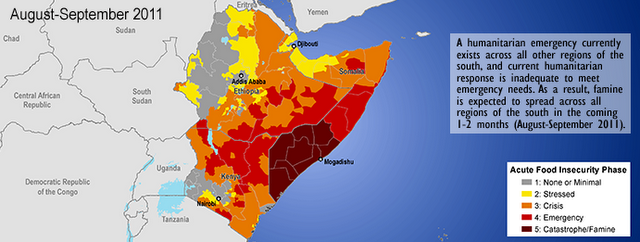
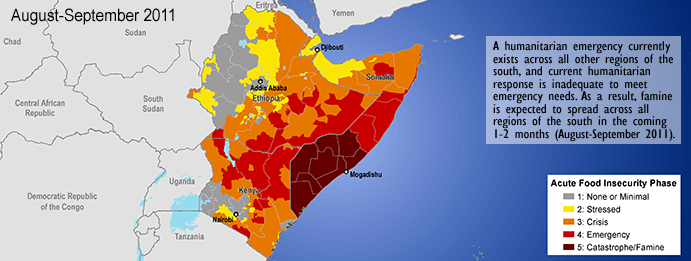
After reading a lot of news and blog posts on the situation in the Horn of Africa, I feel the need to make something clear: The drought in the Horn of Africa is not the cause of the famine we are seeing take shape in southern Somalia. We are being pounded by a narrative of this famine that more or less points to the failure of seasonal rains as its cause…which I see as a horrible abdication of responsibility for the human causes of this tragedy.
First, I recommend that anyone interested in this situation – or indeed in food security and famine more generally, to read Mike Davis’ book Late Victorian Holocausts. It is a very readable account of massive famines in the Victorian era that lays out the necessary intersection of weather, markets, and politics to create tragedy – and also makes clear the point that rainfall alone is poorly correlated to famine. For those who want a deeper dive, have a look at the lit review (pages 15-18) of my article “Postmodern Conceptualizations, Modernist Applications: Rethinking the Role of Society in Food Security” to get a sense of where we are in contemporary thinking on food security. The long and short of it is that food insecurity is rarely about absolute supplies of food – mostly it is about access and entitlements to existing food supplies. The Horn of Africa situation does actually invoke outright scarcity, but that scarcity can be traced not just to weather – it is also about access to local and regional markets (weak at best) and politics/the state (Somalia lacks a sovereign state, and the patchy, ad hoc governance provided by Al Shabaab does little to ensure either access or entitlement to food and livelihoods for the population).
For those who doubt this, look at the Famine Early Warning System Network (FEWS NET) maps I put in previous posts here and here (Editor: also above). Famine stops at the Somali border. I assure you this is not a political manipulation of the data – it is the data we have. Basically, the people without a functional state and collapsing markets are being hit much harder than their counterparts in Ethiopia and Kenya, even though everyone is affected by the same bad rains, and the livelihoods of those in Somalia are not all that different than those across the borders in Ethiopia and Kenya. Rainfall is not the controlling variable for this differential outcome, because rainfall is not really variable across these borders where Ethiopia, Kenya, and Somalia meet.
Continue reading on Open the Echo Chamber.
Image Credit: FEWS NET and Edward Carr. -
Farahnaz Zahidi Moazzam on the Population Reference Bureau’s “Women’s Edition” Trip to Ethiopia
›The original version of this article, by Farahnaz Zahidi Moazzam, appeared on the Population Reference Bureau’s Behind the Numbers blog.My name is Farahnaz Zahidi Moazzam, and I’m a freelance journalist, writer, and editor from Pakistan. My passion is writing about human rights with a special focus on gender issues and reproductive health. Blogging is a personal joy to me, as I put my heart into my writing and blogging allows for a more personalized style. Digital journalism is a sign of evolution – one I happily accept. My pet peeve is marginalization on any grounds. I am a mother of a teenage daughter and live in Karachi.
As part of the Population Reference Bureau’s (PRB) group of journalists in Women’s Edition 2010-2012, I recently had the chance to travel to Ethiopia on a visit that was unforgettable. The visit inspired a series of seven brief travel-blogs, based on my seven days there. Women’s Edition is a wonderful opportunity to connect with other like-minded female journalists from developing countries around the world, and learn solutions to the problems from this interaction. The program has reaffirmed my belief that our commonalities are more than the differences.
Read Farahnaz Zahidi Moazzam’s posts from her trip to Ethiopia on her blog, Impassioned Ramblings, and view photos from the trip on PRB’s Facebook page.
Photo Credit: PRB. -
Connections Between Climate and Stability: Lessons From Asia and Africa
›“We, alongside this growing consensus of research institutes, analysts, and security agencies on both sides of the Atlantic, think of climate change as a risk multiplier; as something that will amplify existing social, political, and resource stressors,” said Janani Vivekananda of International Alert, speaking at the Wilson Center on May 10. [Video Below]
Vivekananda, a senior climate policy officer with International Alert’s Peacebuilding Program, was joined by co-presenter Jeffrey Stark, the director of research and studies at the Foundation for Environmental Security and Sustainability (FESS), and discussant Cynthia Brady, senior conflict advisor with USAID’s Office of Conflict Management and Mitigation, to discuss the complex connections between climate change, conflict, stability, and governance.
A Multi-Layered Problem
Climate change and stability represent a “double-headed problem,” said Vivekananda. Climate change, while never the only cause of conflict, can increase its risk in certain contexts. At the same time, “states which are affected by conflict will already have weakened social, economic, and political resilience, which will mean that these states and their governments will find it difficult to address the impacts of climate change on the lives of these communities,” she said.
“In fragile states, the particular challenge is adapting the way we respond to climate change, bearing in mind the specific challenges of operating in a fragile context,” said Vivekananda. Ill-informed intervention programs run the risk of doing more harm than good, she said.
For example, Vivekananda said an agrarian village she visited in Nepal was suffering from an acute water shortage and tried adapting by switching from rice to corn, which is a less water-intensive crop. However, this initiative failed because the villagers lacked the necessary technical knowledge and coordination to make their efforts successful in the long term, and in the short term this effort actually further reduced water supplies and exacerbated deforestation.
“Local responses will only be able to go so far without national-level coordination,” Vivekananda said. What is needed is a “harmony” between so-called “top-down” and “bottom-up” initiatives. “Adapting to these challenges means adapting development assistance,” she said.
“What we’re finding is that the qualities that help a community, or a society, or in fact a government be resilient to climate change are in fact very similar qualities to that which makes a community able to deal with conflict issues without resorting to violence,” said Vivekananda.
No Simple, Surgical Solutions
“The impacts of environmental change and management of natural resources are always embedded in a powerful web of social, economic, political, cultural, and historical factors,” said Stark. “We shouldn’t expect simple, surgical solutions to climate change challenges,” he said.
Uganda and Ethiopia, for example, both have rich pastoralist traditions that are threatened by climate change. Increasing temperatures, drought, infrequent but intense rains, hail, and changes in seasonal patterns are threatening pasture lands and livelihoods.
At the same time, pastoralists are confronting the effects of a rapidly growing population, expanding cultivation, forced migration, shrinking traditional grazing lands, anti-pastoralist attitudes, and ethnic tensions. As a result, “any intervention in relation to climate adaptation – whether for water, or food, or alternative livelihoods – has to be fully understood and explicitly acknowledged as mutually beneficial by all sides,” Stark said. “If it is seen in any way to be favoring one group or another it will just cause conflict, so it is a very difficult and delicate situation.”
Yet, the challenges of climate change, said Stark, can be used “as a way to involve people who feel marginalized, empower their participation…and at the same time address some of the drivers of conflict that exist in the country.”
Case Studies: Addressing the “Missing Middle”
When doing climate change work in fragile states, “you have to think about your do-no-harm parameters,” said Brady. “Where are the opportunities to get additional sustainable development benefit and additional stabilization benefit out of reducing climate change vulnerability?”
More in-depth case studies, such as the work funded by USAID and conducted by FESS in Uganda and Ethiopia, are needed to help fill the “missing middle” between broad, international climate change efforts – like those at the United Nations – and the community level, Brady said.
The information generated from these case studies is being eagerly awaited by USAID’s partners in the Departments of State, Defense, and Treasury, said Brady. “We are all hopeful that there will be some really significant common lessons learned, and that at a minimum, we may draw some common understanding about what climate-sensitive parameters in fragile states might mean.”
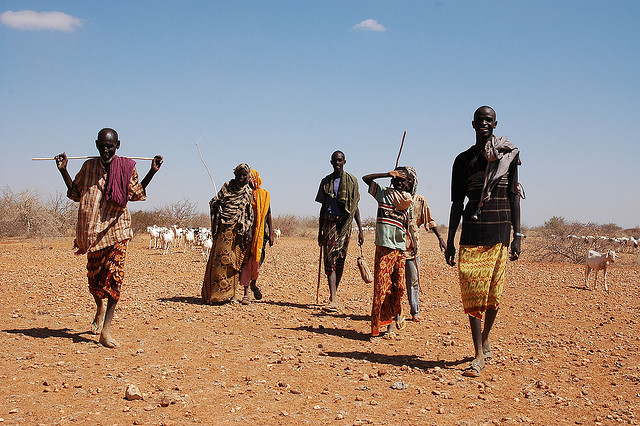
Image Credit: “Ethio Somali 1,” courtesy of flickr user aheavens. -
Integrated Approach Helps “Model Farmers” Increase Productivity in Ethiopia
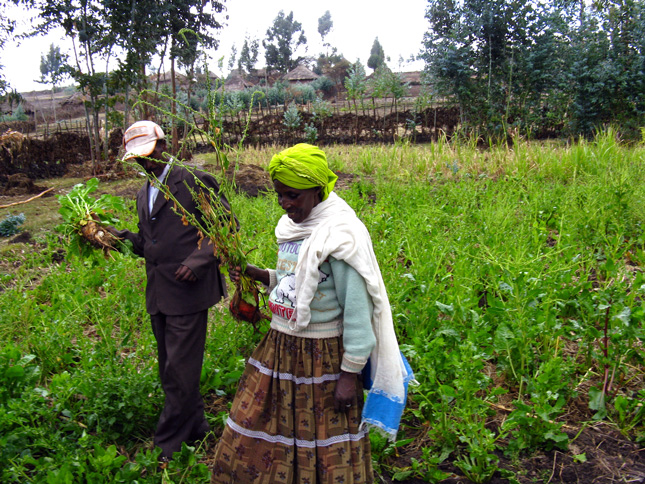
›March 24, 2011 // By Schuyler NullTo reach the village of Grar Gaber from Addis Ababa, you drive up over the Entoto Mountains overlooking the capital then motor down two hours of new Japanese-built highway to the town of Fiche. From there it’s 20 minutes on a broken dirt road across rocky hills. I was joined there by about 20 others from the PHE Ethiopia Consortium’s general assembly (see day one and day two coverage here) and Population Action International, to visit an integrated population, health, and environment (PHE) development program run by LEM Ethiopia.
-
The Continuing Challenges of Integrated Development
›March 20, 2011 // By Schuyler Null“How are we going to feed all these mouths?” asked Bekele Hambissa, director of the Environmental Protection and Development Organization in Addis, on day two of the PHE Ethiopia Consortium general assembly (read about day one here). Environmental resources are directly tied to Ethiopia’s population growth, said Hambissa, during a discussion of balancing efforts to address population growth, environment, and livelihoods. While poverty alleviation is an important goal of population, health, and environment integration (PHE), it must be environmentally sustainable, he said.
-
“Better Bang for the Buck”: Blogging From Ethiopia’s Population, Health, and Environment General Assembly
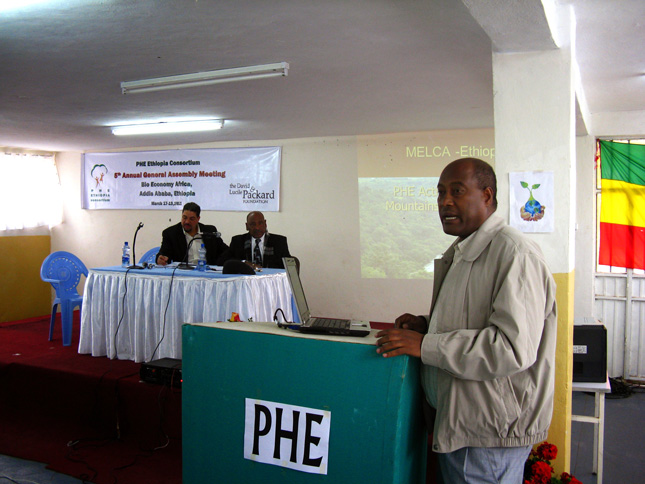
›March 18, 2011 // By Schuyler NullHello from Addis Ababa, where I am blogging from the 5th annual general assembly of the Population, Health, and Environment (PHE) Consortium of Ethiopia (see further coverage here). Along with the Philippines, Ethiopia is the largest PHE programmer in the world, both in terms of number of programs and people affected, and for good reason: The country combines dire need, willing donors, and a great deal of local capacity and will.
-
Watch: Richard Cincotta on Political Demography and Unrest in the Middle East
›March 9, 2011 // By Schuyler Null“Countries that have a high proportion of young people are typically more prone to political violence,” said demographer-in-residence at the Stimson Center, Richard Cincotta, in this interview with ECSP. “That is, not necessarily international war [but] internal conflict, which may take different forms,” including civil and ethnic strife, domestic terrorism, and violent political demonstrations.
The role of unemployed and angry youths in the recent unrest that has swept the Middle East has received a great deal of coverage, but though the region in general is very young, some countries are more so than others.
Tunisia (median age of 29) is actually well into its demographic transition, where fertility declines towards replacement level. “Fertility – the number of children women have in their lifetime – is now lower than it is in the United States,” said Cincotta. As a result, Tunisia’s prospects for achieving a stable, liberal democracy – based on the historical relationship between age structure and political freedoms (see Cincotta’s full post on Tunisia and the two follow-ups for a more complete treatment of that relationship) – are about even.
In contrast, Egypt’s age structure remains young (median age of 24) and Yemen’s (median age of 17) is extremely young. “Those difference are very stark,” said Cincotta, and they play out in the risk of political violence: Tunisia is less likely to experience continuing political violence; Egypt, more so; and Yemen, even more likely.
The relationships between age structure and political violence and the emergence of democratic institutions can be useful in other conflict-prone regions as well. “Afghanistan, Pakistan, Iraq, the Palestinian Authority, most of the central band of sub-Saharan Africa – from Nigeria to the Congo, to Kenya and Ethiopia – we know that these countries are volatile, we’re not always sure why,” said Cincotta. But “age structure gives you a clue, because it tells you something about a lot of barriers that are important to development.”
Sources: UN Population Division. -
Integrated Development in PHE: Updates From Ethiopia and the Philippines
›“All protected areas in Ethiopia are being threatened by population pressure,” said Negash Teklu, executive director of PHE Ethiopia at an event at the Wilson Center co-sponsored by ECSP and the Africa Program. The best way to address this pressure is by implementing integrated population, health, and environment (PHE) programs that combine natural resource management with family planning services, said Teklu. “Without the family planning component, they cannot solve the protected area problems,” he said.
Teklu was joined by Joan Regina Castro, executive vice president at PATH Foundation Philippines, Inc., and Annie Wallace, PHE technical advisor with the USAID Global Health Fellows Program, to compare PHE projects in Ethiopia and the Philippines and identify best practices. [Video Below]
The Population-Climate Connection
To address population growth in areas of high biodiversity, Teklu created PHE Ethiopia, a consortium to coordinate PHE projects in the country and increase awareness of the value added by integrating them.
“The population-climate connection is easily seen in Ethiopia,” said Teklu. The country’s deforestation, loss of biodiversity, poverty, high maternal and child mortality, and vulnerability to climate change are linked to the rapid growth of its population, which is currently 85 million. Building community resilience in this kind of environment is “critical,” he said.
Bridging Gaps: Gender, Youth, and Religion
Wallace, in her assessment of the Packard Foundations’ PHE projects in Ethiopia, found the projects bridged gender gaps. By integrating health and environmental education in PHE youth groups and in outreach by extension workers, the projects increased male involvement in health and family planning (a traditionally female activity) and increased women’s involvement in agriculture and environmental activities (traditionally male). This cross-gender success increased the total number of family planning users, said Wallace.
But for any of this work to succeed, “community ownership and participation are very critical and essential,” said Teklu. Both youth and religious leaders were primary stakeholders in this process. “Youth are the next leaders. By targeting youth you can get them to think about livelihoods and make these connections,” said Wallace.
PHE has proven to “transcend religion,” said Castro. Despite traditional opposition to abortion and family planning, support from Christian and Islamic leaders in Ethiopia and the Philippines was critical in determining a project’s success. “When religious leader buy-in comes in, the community really responds to that,” said Wallace.
In addition, religious leaders understand the population-environment connection. “Our livelihoods are affected when we have too many mouths to feed…family planning and reproductive health makes sense,” an Ethiopian religious leader told Wallace.
Securing Sustainable Support for Scaling Up
IPOPCORM, the PHE initiative in the Philippines, is now “the biggest [PHE] project, modesty aside, in the world,” said Castro, because it has succeeded in working at all levels of government. To scale up its work in the “priority areas” of high biodiversity and rapid population growth, where the “poorest of the poor” live, IPOPCORM first scaled up its advocacy work. To be sustainable, “you have to have a lot of PHE leaders and champions” at all levels, from village to national government, she said.
Ethiopia faces a significant challenge in securing sustainable support and funding from the national government and other sources. “While there is buy-in for the local approach, there isn’t funding,” Wallace said. “A lot of work is donor-driven, whether we like it or not,” she added. “There needs to be a more sustainable strategy” to ensure the survival of these projects, she said, which means garnering national and international support.
But it also means conducting research to provide empirical evidence of PHE’s added value, the speakers agreed. A new paper in the journal Environmental Conservation, coauthored by Castro, uses evidence from IPOPCORM’s projects to conclude that integrating family planning and coastal resource management offers benefits over single-sector approaches. But elsewhere, there is a “big need for monitoring and evaluation” to “strongly gather data to show our success on the ground,” said Teklu.
However, communities on the ground “don’t need the empirical evidence,” said Castro. “The community and the people say their lives are linked and so the solutions should be linked,” she said. “The life that they live speaks of integration.”
Photo Credit: “Safia Fungie Hasenna – Climate witness from Ethiopia” by Zeresenay Berhane Mehar courtesy of flickr user Oxfam International
Showing posts from category Ethiopia.