

Showing posts from category environmental security.
-
VIDEO: Nick Mabey on Climate Change and Security on the Road to Copenhagen
›March 9, 2009 // By Wilson Center StaffThe security community needs to “tell leaders that they won’t be able to guarantee security in a world where we don’t control climate change,” says Nick Mabey in this video from the Environmental Change and Security Program. “Because unless we have the authority of the security establishment and the foreign policy establishment at the table,” he says, “there’s no chance of both delivering the trillions of dollars needed to create a new clean energy economy, but also mak[ing] those tough choices.”
In this short expert analysis, Nick Mabey, founding director and chief executive of E3G, discusses why security must be at the heart of the upcoming Copenhagen Agreement on Climate Change. -
Weekly Reading
›“A New Military Mission: Clean Energy,” part of the Center for American Progress’ “It’s Easy Being Green” series, highlights the military’s attempts to become more energy-efficient. Read more about the U.S. military’s environmental initiatives.
Simon Dalby, a professor at Carleton College, discusses the evolution of environmental security with John Tessitore, executive editor of the Carnegie Council, in a video interview (transcript available).
Climate Change, Food Security, and the Right to Adequate Food examines climate change’s expected impact on food production, with a special focus on Africa and Asia.
The BDA Foundation, a Canadian charity, and PharmAfrica, a pharmaceutical company, are working to create a medicinal plants industry that will lift local people out of poverty in the Democratic Republic of the Congo. -
Mind the Gap: Forging a Consensus on Security and Climate Change in EU and US Foreign Policy
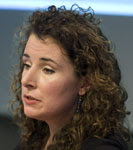
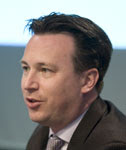
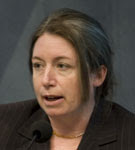
›March 5, 2009 // By Will Rogers “There are political and economic vulnerabilities that are in fact more important—or seem more important—to the participants of conflict than the physical vulnerability to climate change,” said Clionadh Raleigh at the February 19, 2009, event, “Climate Security Roundtable: U.S. and EU Research and Policy.” Raleigh, a lecturer at Trinity College Dublin, was joined by Nick Mabey, founding director and chief executive of E3G, and Sharon Burke, a senior fellow at the Center for a New American Security, to discuss climate change’s impact on conflict and how the United States and European Union (EU) have begun to adapt their foreign and security policies to the threat of climate change.
Ecological Change, Migration, and Conflict: A Complex Story
“The lack of access to power for certain communities, certain ethnic groups in sub-Saharan Africa, and basic access to resources among the most vulnerable populations has led to people misinterpreting the relationship that ecological change plays in their decision to either participate in conflict or to migrate,” Raleigh said. Although Raleigh’s research, which examined civil conflicts from 1990 to 2004, found that population density and growth were related to higher risks of conflict, “environmental pressures were not more likely to cause conflict in poor states—and not more likely during periods of instability,” she concluded. “Social, political, and economic factors are the most important determinants of civil war within developing countries,” she emphasized. “Poverty and unequal development come up time and time again.”
According to Raleigh, fears of mass international migration in response to climate change are overplayed. “Individuals and communities have quite a lot of coping mechanisms to deal with ecological difficulty,” including migration from rural to urban areas in the same country, she explained. Most migration, including labor and distress migration, “is temporary, internal, and circular,” she emphasized. “There is very little to no evidence that there will be an increase in international migration” in response to ecological change, although “there is evidence that there will be an increase in internal migration.”
Climate Change and Security: Perspectives from the EU“Climate change is serious,” emphasized Mabey. “It’s a threat multiplier, it will make unstable places less stable—it’s going to change strategic interests, alliances, borders, threats, economic relationships, comparative advantages, the nature of international relations, and the legitimacy of the UN.” In the future, “security policy will need to get more preventive and risk-based because climate change just injects a huge bolt of uncertainty into the future,” said Mabey. He urged the expansion of forward-looking information systems that provide policymakers with the data they need to make decisions at the geopolitical, strategic, and operations levels. He also said security experts should strive to communicate the potential consequences of climate change to decisionmakers.
The EU has taken steps to integrate climate change into its security strategy; Great Britain, Germany, and Denmark have taken the lead. The Arctic has been a particular focus, with security experts examining trade routes, maritime zones, and new access to resources. Climate change “is not all about instability” in fragile, impoverished states, Mabey explained. “The Arctic is by far the most important climate security issue in the minds of traditional foreign-policy types in Europe.”
Environmental Security Gets a New Tool: The Climate War GameLast year, Burke helped conduct a climate change war game based on a scenario of extreme weather events like droughts, wildfires, and cyclones. “Every country sort of hewed to what you would expect,” said Burke of the high-profile participants from China, India, Europe, and the United States. “The EU team spent the first two hours debating whether they could really be a country; the Indian team instantly came up with a negotiating strategy that sounded cooperative and brilliant but was completely impossible to execute; the Chinese team was, ‘No, we’re not going to do anything unless you pay us’; and the American team was keen to lead, only nobody was following.” One of the key lessons from the game, Burke explained, was that “everything comes down to what China is prepared to do.”
In developing the game, Burke and her colleagues discovered “that there’s a vast poverty of the kinds of information that you need to make decisions.” As Burke explained, policymakers need specific data “to obligate large amounts of money and personnel,” and the game revealed that “policymakers don’t have the information they need to make decisions.”
Photos: From top to bottom, Clionadh Raleigh, Nick Mabey, and Sharon Burke. Courtesy of Dave Hawxhurst and the Woodrow Wilson Center. -
VIDEO: From Report 13 – Christian Leuprecht on Migration as the Demographic Wild Card in Civil Conflict
›March 3, 2009 // By Wilson Center StaffContrary to what many people might think, most migration is within the developing world—“among countries that already face enormous challenges in terms of provisions for their populations, but also ethnic conflict,” says Christian Leuprecht in this short video preview of his article, “Migration as the Demographic Wild Card in Civil Conflict: Mauritius and Fiji,” now appearing in the 13th issue of Environmental Change and Security Program Report.
“So if you have particular ethnic groups, religious groups, or linguistic groups then spilling over borders, there’s a good chance they might destabilize the neighboring country; not just because of carrying capacity and provision of services within that country, but also because it changes the population dynamics and group dynamics within that particular country,” says Leuprecht.
Leuprecht, an assistant professor at the Royal Military College of Canada, and six other demographic experts analyze the links connecting population and environmental dynamics to conflict in a set of commentaries on “New Directions in Demographic Security.” -
In Land Grab, Food Is Not the Only Consideration
›March 3, 2009 // By Will RogersGlobal cereal production – including stable items like wheat, coarse grains, and rice – is projected to shrink in 2009 due to drought and adverse weather in the world’s major producers. With shrinking food stocks, a growing demand for biofuels, and a need for cheaper sources of raw materials like rubber and other natural resources, governments and corporations in many developed countries are seeking to secure access to these coveted commodities by leasing large tracts of land in developing countries.
In Indonesia, PT Daewoo Logistics Indonesia, a subsidiary of South Korea’s Daewoo Logistics Corporation, and Cheil Jedang Samsung recently announced a partnership to invest US $50 million to grow and process energy crops on the islands of Buru and Samba. The two companies will produce 30,000 tons of corn grain a year on 24,000 hectares and will export their entire production back to South Korea. The announcement comes on the heels of a report from the International Food Policy Research Institute, The Challenge of Hunger: The 2008 Global Hunger Index, that raises concerns about Indonesia’s already precarious food security.
Meanwhile, Saudi investors have been lobbying government officials in the Philippines to grow and export “basmati rice, corn, cassava, sugar, animal fodder, fisheries, red meat, Philippine bananas and mangoes,” reports Neil Morales in BusinessWorld. Philippine officials are hoping to leverage Saudi Arabia’s growing demand for food against the harsh economic climate to boost much-needed foreign direct investment. “Tell me an item that the whole world needs regardless of the economic situation, it is food,” said Peter Favila, the Philippine Trade Secretary, in an interview with BusinessWorld.
But securing food stocks is not the only motive behind the massive leasing of land in developing countries. A surging demand for biofuels to meet energy needs, as well as access to new sources of raw materials for manufacturing goods, appears to be driving recent land grabs. Recently, Sinopec and The Chinese National Overseas Oil Corporation, two state-owned oil giants, made investments of US $5 billion and $5.5 billion, respectively, in Indonesia to grow and process corn into biofuel to be exported to China.
Meanwhile, several Chinese companies have secured deals in Southeast Asia to grow rubber trees so that they can process and export the sap to meet China’s rising manufacturing demands (China is expected to consume 30 percent of the world’s rubber by 2020). In Cambodia, domestic rice fields have been cleared to make way for rubber trees, with nearly all the sap to be exported to China. And in Burma – which according to the UN’s Food and Agriculture Organization is plagued by severe localized food insecurity – concessions have been made to lease land to two Chinese companies to establish rubber plantations. According to Agweek, Burmese “troops are forcibly evicting farmers to make way for rubber plantations.”
Governments in these developing countries should exercise caution when granting land concessions to foreign governments and corporations. Despite the short-term investments, most – if not all – of the production will be exported, making the long-term food security situation even worse in these host countries. And according to a recent report from the U.N. Environment Programme, From Conflict to Peacebuilding: The Role Natural Resources and the Environment, environmental conditions – like severe food insecurity – linked with these poor government policies and claims of “neo-colonialism” could exacerbate existing trends and tensions in the host countries and spark violent conflict.
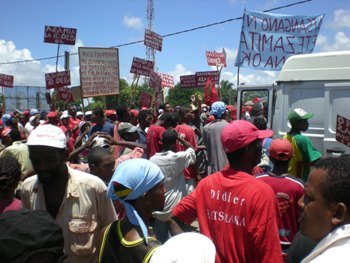
A recent attempt by South Korea’s Daewoo Logistics Corporation to negotiate a 99-year lease on 3.2 million hectares of farmland in Madagascar has stalled due to severe domestic outcry. Since mid-January, the country has been in a state of emergency; riots have erupted throughout the capital city of Antananarivo, killing, by some estimates, close to 100 and injuring more than 200; and Madagascar’s President Marc Ravalomanana is struggling to maintain power amidst fierce criticism by opposition leaders like Antananarivo Mayor Andry Rajoelina for even considering the deal.
Even with the prospect of political unrest, however, current economic woes will likely dictate policymaking in these developing countries, with short-term payoffs eclipsing the long-term political, social, economic and security consequences.
Photo: In the northeastern coastal city of Tamatave, political unrest has stirred since mid-January over negotiations between the Malagasy government and South Korea’s Daewoo Logistics Corporation to lease nearly half the country’s arable farmland to the company to grow and export food to South Korea. Courtesy of flickr user foko_madagascar.
-
Reading Radar — A Weekly Roundup
›February 27, 2009 // By Wilson Center StaffA new study published in Conservation Biology (abstract) calculates that more than 80 percent of major armed conflicts from 1950-2000 have taken place in one of the world’s 34 biodiversity hotspots. “The fact that so many conflicts have occurred in areas of high biodiversity loss and natural resource degradation warrants much further investigation as to the underlying causes, and strongly highlights the importance of these areas for global security,” says coauthor Russell A. Mittermeier. He and lead author Thor Hansen argue that protecting nature during war can help recovery, and call for integrating conservation “into military, reconstruction and humanitarian programs in the world’s conflict zones.”
The Bixby Forum, “World in 2050: A Scientific Investigation of the Impact of Global Population Changes on a Divided Planet” included panels on population’s links to war, climate change, and the environment. Malcolm Potts, the chair of the University of California, Berkeley’s Bixby Center for Population Health and Sustainability recently spoke at the Wilson Center about his latest book, Sex and War.
In Troubled Waters: Climate Change, Hydropolitics, and Transboundary Resources from the Henry L. Stimson Center, experts from South Asia, Southeast Asia, and the Middle East “examine the environmental dangers and policy dilemmas confronting the sustainable management of shared water resources in a warming world”—including the potential for conflict. In the concluding chapter, David Micheli finds that climate change is unlikely to lead to full-scale “water wars,” but warns that “rising climatic stresses on common waters will put new and perhaps unprecedented strains on cooperative governance institutions at the local, national, and international levels.”
Rampant logging fueled Cambodia’s decades-long civil war. Now a new report from transparency watchdogs Global Witness, Country for Sale, claims that the country’s emerging oil and mineral sectors may pose a similar threat. Says Gavin Hayman, “The same political elite that pillaged the country’s timber resources has now gained control of its mineral and petroleum wealth. Unless this is changed, there is a real risk that the opportunity to lift a whole generation out of poverty will be squandered.”
Thirty-three countries have been named “highly vulnerable” to the impact of climate change on their fisheries by a new study published in Fish and Fisheries. In these countries, two-thirds of which are in tropical Africa, fish accounts for 27 percent or more of daily protein intake, compared to 13 percent in non-vulnerable nations. InterPress examines the impact of acidification and rising surface temperatures on the fish stocks of coastal South Africa.
Photo: Fish-dependent people of Bangladesh could see their coastal catch reduced as a result of predicted increases in the frequency and intensity of tropical storms. Bangladesh is one of the nations identified as highly dependent on fisheries along with Cambodia, DR Congo, Madagascar, Sierra Leone, Tanzania, and Uganda. Photo credit: Mark Prein, courtesy of WorldFish Center. -
PODCAST – A Discussion on Climate Change and Security: Arctic Links and U.S. Intelligence Community Responses
›February 24, 2009 // By Wilson Center Staff“The climate issue also very clearly illustrates the whole complexity of the security issue,” says Henrik Selin. “Arctic melting is a national security issue in the traditional national security kind of way.” In this podcast from the Environmental Change and Security Program, Selin, assistant professor of international relations at Boston University, and Stacy VanDeveer, associate professor of political science at the University of New Hampshire, sat down with ECSP Director Geoff Dabelko to discuss the resonance of climate change in the U.S. security community.
VanDeveer and Selin were in Washington to speak at a January 12 event, “Governing the Climate: Lessons From the National Conference on Climate Governance.” VanDeveer has frequently coauthored articles with Dabelko, including “It’s Capacity, Stupid: International Assistance and National Implementation” in Global Governance, “European Insecurities: Can’t Live With ’Em, Can’t Shoot ‘Em” in Security Dialogue, and “Environmental Cooperation and Regional Peace: Baltic Politics, Programs, and Prospects” in Environmental Peacemaking. -
Weekly Reading
›From Conflict to Peacebuilding: The Role of Natural Resources and the Environment, based on the work of the UN Environment Programme’s Expert Advisory Group on Environment, Conflict and Peacebuilding, summarizes the links between the environment, conflict, and peacebuilding, and includes 14 case studies of how natural resources affect—or are affected by—conflict.
The authors of “On Population Growth Near Protected Areas” come to an opposite conclusion from Wittemyer et al., who found a pattern of higher population growth near protected areas in Africa and Latin America. “To understand the disagreement, we re-analyzed the protected areas in Wittemyer et al.’s paper. Their results are simply artifacts of mixing two incompatible datasets,” write the authors. “Protected areas may experience unusual population pressures near their edges; indeed, individual case studies provide examples. There is no evidence, however, of a general pattern of disproportionate population growth near protected areas.”
“The President and I agreed to a new initiative that will further cross-border cooperation on environmental protection and environmental security,” said Canadian Prime Minister Stephen Harper yesterday, announcing plans for a U.S.-Canada Clean Energy Dialogue.
Scientists at Purdue University have teamed up with Google Earth to create an interactive map of U.S. CO2 emissions.
Mark Weston, who writes for the Global Dashboard blog, posted an edited version of a recent talk he gave on West African demography and security.
 “There are political and economic vulnerabilities that are in fact more important—or seem more important—to the participants of conflict than the physical vulnerability to climate change,” said Clionadh Raleigh at the February 19, 2009, event, “
 “Climate change is serious,” emphasized Mabey. “It’s a threat multiplier, it will make unstable places less stable—it’s going to change strategic interests, alliances, borders, threats, economic relationships, comparative advantages, the nature of international relations, and the legitimacy of the UN.” In the future, “security policy will need to get more preventive and risk-based because climate change just injects a huge bolt of uncertainty into the future,” said Mabey. He urged the expansion of forward-looking information systems that provide policymakers with the data they need to make decisions at the geopolitical, strategic, and operations levels. He also said security experts should strive to communicate the potential consequences of climate change to decisionmakers.
 Last year, Burke helped conduct a
  Global cereal production – including stable items like wheat, coarse grains, and rice – is


