-
From Dakar: Explaining Population Growth and Family Planning to Environmentalists
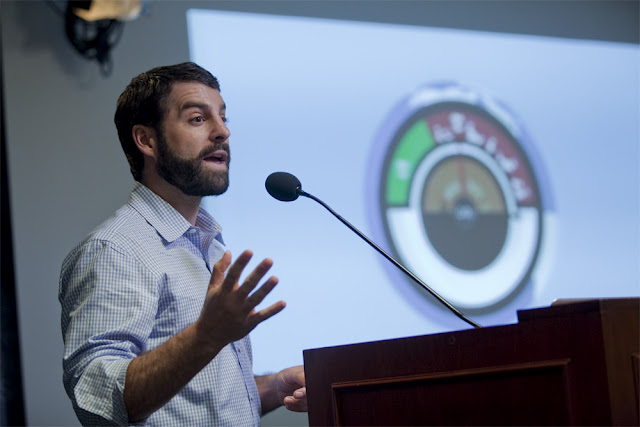
›December 19, 2011 // By Sandeep Bathala“There is a growing recognition that population is a key driver of environmental, development, governance, and security challenges; however, family planning is not a traditional tool, nor is it often considered an ‘appropriate’ one, for responding to food, water, climate, or conflict,” said Roger-Mark De Souza at a November 30 panel discussion at the 2011 International Conference on Family Planning in Dakar, Senegal. “This presents a challenge for us: How can we change perceptions of family planning so that it becomes part of the solution to wider problems, including natural resource scarcity, lack of economic development, gender inequity, and instability?”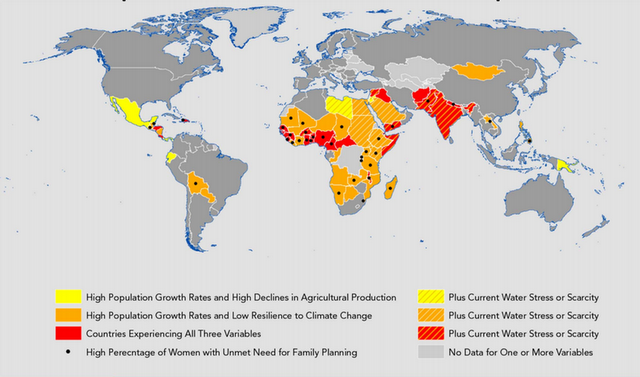
De Souza, vice president of research and director of the climate program at Population Action International (PAI), was joined by Sandeep Bathala, program associate with the Wilson Center’s Environmental Change and Security Program; Robert Engelman, president of Worldwatch Institute; and Daisy Magaña, fellow with the GoJoven Program, for a session on “Reaching Out at Rio: Explaining Population Growth and Family Planning to Environmentalists.”
Population Dynamics Part of Climate Vulnerability
“Advocates…need to communicate that empowering women to make their own reproductive choices will improve both their individual well-being and our collective environment,” said Engelman. According to research conducted on behalf of Americans for UNFPA, messages that focus on women – their health or empowerment – resonate well with American environmentalists, as they do with broader audiences.
PAI’s interactive mapping website shows that high levels of unmet need for family planning and rapid population growth rates are common in countries with low levels of resilience to climate change and high levels of projected decline in agricultural production, said De Souza. “Family planning services can be one element of a multi-pronged strategy to reduce especially women’s vulnerability to these interlocking vulnerabilities,” he said.
“Currently, population growth is viewed as a challenge to addressing climate change-related vulnerabilities, but family planning services are commonly left out of conversations about ways to reduce these vulnerabilities.” This is a lost opportunity, said De Souza: “We can integrate family planning into wider environmental, development, and peace-building efforts.”
At the recent UN Climate Change Conference in Durban, a side event on reproductive health and climate was well-attended. However, as panelist Esther Agbarakwe of the Africa Youth Initiative on Climate Change noted, population was not part of the conference‘s official discussion, due to lack of knowledge and fears of population control. PAI is currently working with UNFPA to produce a series of training modules on population and climate change that will help environmentalists, climate change activists, and researchers better understand and explore these connections.
Tapping the Youth Base
Bathala, formerly the Sierra Club’s Global Population and Environment Program director, discussed how the Sierra Club, one of the only major grassroots conservation organizations with a population program, uses youth outreach to raise awareness on the links between the environment, reproductive health, and women’s rights.
Because young people constitute over half of the world’s population, the Sierra Club focuses on empowering youth leaders to make the connection between environmental issues and sexual and reproductive health and rights. The Population and Environment Program reaches youth directly by organizing summits and multi-state campus tours featuring young people from around the world sharing compelling stories with their peers.
“The program provides youth and adult activists with materials, communication strategies, and leadership training,” Bathala said. “With these tools, the activists then educate their community members, campus, and decision-makers about the need for measures that increase access to family planning while addressing poverty, women’s empowerment, and environmental protection.”
In April, fellow panel member and Belize-native Daisy Magaña joined one of the Sierra Club’s U.S. tours to discuss the GoJoven program, which convenes and support youth reproductive health champions throughout Latin America. Through GoJoven, Magaña has worked to expand adolescent reproductive and sexual health choices, services, policies, and programs in Belize.
In a blog post, Magaña discussed how her message was simple: Don’t give up. “If you think being active on environmental and sexual rights issues is hard to do here, imagine doing it in a deeply conservative [Catholic] country like mine,” she told U.S. students.
Sierra Club also leads story tours to functioning population, health, and environment programs in the field, including a 2009 trip to Guatemala and Belize in conjunction with GoJoven. Through visits to 10 project sites, two U.S.-based youth advocates witnessed first-hand the challenges and opportunities associated with community-based sexual and reproductive health programs, significantly enhancing their ability to be pro-active messengers in their own communities. The tour helped the Sierra Club build an international network of young people committed to social and policy change in their countries.
Looking Forward: Finding Ways To Highlight Integration
While recognition of the connections between population growth and environmental impacts is growing, the experience of the panelists shows that it takes innovative methods to reach both the environmental and family planning communities. A similar panel later this winter at the Wilson Center will include representatives of Americans for UNFPA discussing their research on talking to environmentalists about reproductive health and population growth.
With the UN Conference on Sustainable Development (Rio+20) coming in June of next year, highlighting successful strategies is crucial in order to pave the way for better integration in the future.
Event ResourcesImage Credit: Roger-Mark De Souza/Population Action International. -
Gender, Family Planning Should Be Part of Climate Discussions, Says Mary Robinson
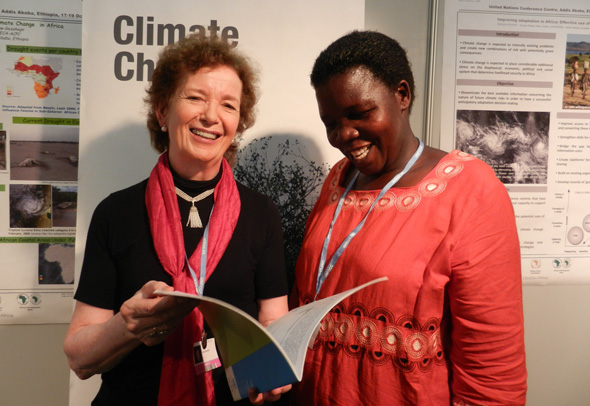
›December 6, 2011 // By Brenda ZuluSpeaking at a side event on “Healthy Women, Healthy Planet” in Durban, South Africa, Mary Robinson, chair of the Global Leaders Council for Reproductive Health, said they were seeing more female leadership at this year’s UN climate change conference (COP-17).
But Robinson, who is also chair of the Mary Robinson Foundation – Climate Justice, said there needs to be more explicit gender language in the COP-17 text to ensure that green climate funds support gender equity and money gets to women on the ground for adaptation.
“Our foundation has been helping to bring out women’s leadership at the top level in this conference to match women’s leadership at the community level,” explained Robinson, pointing out that the heads of the last three COPs are women.
Though the role of gender in climate adaptation and mitigation will likely not be prominently discussed on the floor at COP-17, Robinson said she looked forward to side conversations about a stronger focus on these issues.
Family planning, she argued, should also play a larger role. “There have been so many attempts to deflect from commitments and get into other kinds of issues that bring about some kind of stigma in this area,” said Robinson. But “those of us on the Global Leaders Council on Reproductive Health fundamentally believe in the central role played by reproductive health, access to knowledge about how to space children, and having choices about number of children.”
There are about 215 million women in the world who do not want to get pregnant but are not using modern contraception. Family planning and reproductive health services help build up a woman’s resilience to climate changes, Robinson explained.
These services are vital to improving women’s health and enable women to seek educational and work opportunities, unleashing their potential to help solve problems associated with climate change.
Brenda Zulu is a member of Women’s Edition for Population Reference Bureau and a freelance writer based in Zambia. Her reporting from the COP-17 meeting in Durban (see the “From Durban” series on New Security Beat) is part of a joint effort by the Aspen Institute, Population Action International, and the Wilson Center.
Sources: World Health Organization.
Image Credit: “Mary Robinson and Constance Okollet” at COP-17, used with permission courtesy of the Mary Robinson Foundation – Climate Justice (MRFCJ). -
Jeanne Nyirakamana, PHE Champion
Reaching Rural Rwandans With Integrated Health and Livelihood Messages
›This PHE Champion profile was produced by the BALANCED Project.
Rwanda is one of the most densely populated countries on the planet, with more than 11 million people in one of Africa’s smallest countries, most of whom depend on the land as subsistence farmers. The country has diverse mountain, lake, and savannah landscapes, and the Virunga Mountain chain in the northwest part of the country is home to one-third of the world’s threatened mountain gorilla population. At the same time, the population throughout the country suffers from high rates of unmet need for contraception, and three percent of the adult population lives with HIV/AIDS. In a land under such intense pressure on natural resources, rural livelihood initiatives are critical to ensuring people have options for meeting their daily health and well-being needs.
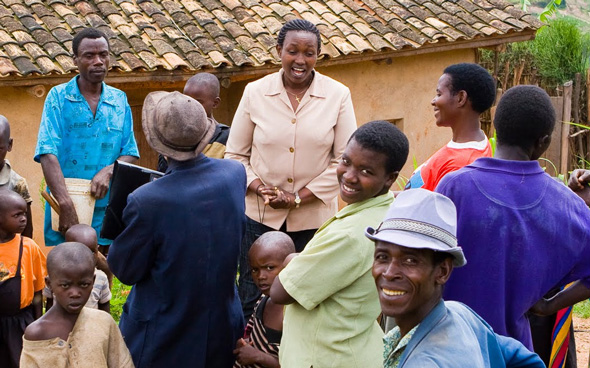
For the past three years, Jeanne Nyirakamana has served as head of the health program for the Sustaining Partnerships to Enhance Rural Enterprise and Agribusiness Development (SPREAD) Project. Supported by the U.S. Agency for International Development through Texas A&M; University, the SPREAD Project is integrating a dynamic coffee production and quality improvement program in Rwanda with health outreach to improve community well-being. The health component works to improve the lives of coffee farmers and cooperative members by providing them with health information and services related to family planning, maternal and child health, prevention of sexually-transmitted infections (including HIV), and water and sanitation.
Training Peer Educators
Working closely with the coffee program, Nyirakamana’s team has trained more than 540 men, women, and youth peer educators who have reached more than 95,000 coffee farmers with education and services. Key communication messages highlight the links between sound decision-making and health-seeking behaviors, productive farms and agribusinesses, and strong and healthy families.
The program also leverages and supports local health resources through referrals to existing public health services, organization of mobile clinics, and community-based distribution of a socially marketed water purification solution (Sur Eau) and condoms (Prudence). According to Nyirakamana, one of the project’s greatest successes is the increased acceptance of family planning by farmers and their families and the more than 7,500 farmers who have been tested for HIV. In order to draw in as many coffee farmers as possible, many of the health and livelihood activities take place at the stations where the coffee beans are washed, at other buildings used by the coffee farmer cooperative, or during combined community meetings or home visits. At the washing stations, Nyirakamana’s team supports local health center staff to provide voluntary counseling and testing (VCT) and de-worming services while at the same time SPREAD-trained peer educators and coffee/health extension agents disseminate family planning information.
The cooperatives’ buildings have clean water, hand-washing stations, and small kiosks where condoms and Sur Eau are sold. These community health agents work with SPREAD to ensure that the greater community, not just the coffee farmers, has access to health knowledge and services. They learn how to teach the community about a range of health issues and each month they submit reports showing how many people they reached and with what kinds of messages. They are also becoming increasingly engaged in coffee and agribusiness activities. Through the success of their health activities, these agents are seen as vital community resources.
Integrated Results
By implementing this integrated population, health and environment (PHE) approach, the SPREAD Project staff is ensuring the health of the people and environment and success of the agribusiness. “You cannot care for the environment without first caring for the people who live and use that environment, so when you transmit dual messages [agriculture and health] you are able to hit two birds with one stone,” said Nyirakamana.
According to a 2010 evaluation of the project, farmers and their families reported improvements in personal and household hygiene; an increase in understanding and acceptance of family planning; uptake of HIV and VCT services; and use of condoms and other local health services. As well, they noted shifts in gender norms affecting household revenue use, alcohol, and reproductive health. The agribusiness stakeholders value the integrated approach as a means to more holistically meet farmers’ goals of increased incomes and improved lives and livelihoods.
This PHE Champion profile was produced by the BALANCED Project. A PDF version can be downloaded from the PHE Toolkit. PHE Champion profiles highlight people working on the ground to improve health and conservation in areas where biodiversity is critically endangered.
Photo Credit: BALANCED Project. -
STATcompiler: Visualizing Population and Health Trends
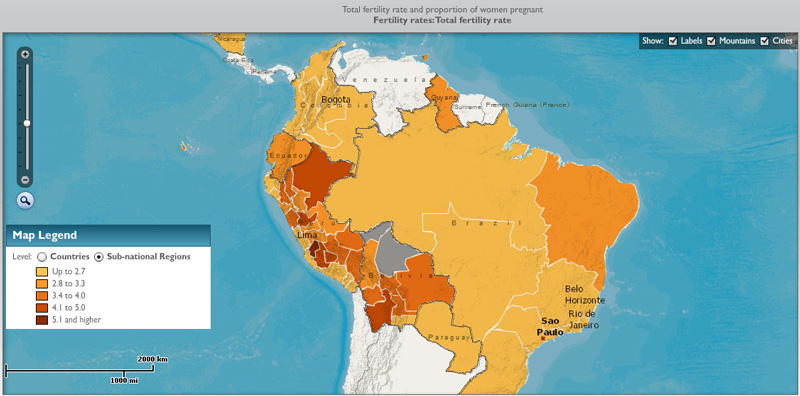
›World population is growing – earlier this week, the global community symbolically marked the arrival of the seven billionth person. But the unprecedented growth in global population over the last few decades has not affected everyone equally – in 1950, 68 percent of the world’s population lived in developing regions; today that number is 82 percent. MEASURE’s latest version of their STATcompiler tool helps visually highlight areas simultaneously experiencing the most demographic change and poor health indicators.
The revised STATcompiler – released in September – provides new ways for users to visualize data by generating custom data tables, line graphs, column charts, maps, and scatter plots based on demographic and health indicators for more than 70 countries. Users can select countries or regions of interest, and relevant indicators, including for family planning, fertility, infant mortality, and nutrition. Tables can be further customized to view indicators over time, across countries, and by background characteristics, such as rural or urban residence, household wealth, or education. In some cases, sub-national data is available. User-created tables and images are then exportable so that they may be easily used in papers or presentations.
Since STATcompiler is still in active development, certain functions are still being added. HIV data has not yet been integrated into the program, nor has the express viewer function, with customizable, ready-made tables for quick access. Additionally, updated information is not available for all countries, in all categories – for instance, the most recent data available for Mexico comes from a 1987 survey. If preferred, the legacy version remains available to users in the meantime.
MEASURE DHS – the Monitoring and Evaluation to Assess and Use Results Demographic and Health Surveys project – provides technical assistance for data collection on health and population trends in developing countries. Their demographic and health surveys, funded by USAID, provide data for a wide range of monitoring and impact evaluation indicators at the household level in the areas of population, health, and nutrition. They have become a staple data source for researchers, and the addition of better analysis functions and dissemination tools, via STATcompiler, will hopefully help advance understanding of demographic and health trends.
Image Credit: Map from STATcompiler, arranged by Schuyler Null. -
Sajeda Amin on Population Growth, Urbanization, and Gender Rights in Bangladesh
›“One of the reasons why population grows very rapidly in Bangladesh is women get married very early and have children very early,” the Population Council’s Sajeda Amin told ECSP in a recent interview. “So even though they are only having two children, they are having them at an average age of around 20. As demographers would say, women ‘replace’ themselves very rapidly.”
Largely through the promotion of contraceptive use, family planning programs implemented over the past 35 years by the Bangladeshi government and a variety of NGOs have helped lower the country’s total fertility rate to 2.7 from 6.5 in the mid-1970s. To build on this progress, the Population Council has joined a consortium of other organizations – including the Bangladesh Legal Aid and Services Trust, Marie Stopes International, and We Can End All Violence Against Women – to launch the Growing Up Safe and Healthy (SAFE) project in Amin’s native Dhaka and other Bangladeshi cities.
Currently nearing the completion of its first year, the four-year initiative has several aims, among them increasing access to reproductive healthcare services for adolescent girls and young women and bolstering social services to protect those populations from (and offer treatment for) gender-based violence. The project also looks to strengthen laws designed to reduce the prevalence of child marriage – a long-standing Bangladeshi institution that keeps population growth rates high while denying many young women the opportunity to pursue economic and educational advancement.
A Focus on Gender and Climate
Amin says the SAFE project boasts several qualities that collectively set the initiative apart from similar-minded programs in Bangladesh dealing with gender and poverty. These include a strong research component incorporating quantitative and qualitative analysis; the holistic nature of the program, which incorporates educational outreach, livelihood development, and legal empowerment; a commitment to working with both male and female populations; and an emphasis on interventions targeting young people, with the hope that such efforts will allow adolescents to make better-informed decisions about future relationships and reproductive health, thus reducing the likelihood of gender-based violence.
Finally, while many existing gender-based programs focus exclusively on rural communities, Amin points out that the SAFE project also stands apart because of its focus on the country’s rapidly expanding urban areas. To date, the initiative is focusing many of its early interventions in a Dhaka slum that has seen an influx of rural migrants in recent years due to climate-change impacts in the country’s low-lying coastal areas.
“A lot of the big problems in Bangladesh now are climate-driven in the sense of creating mass movements out of areas that are particularly vulnerable or have been hit by a major storm,” Amin said. “Usually these are people who, once they lose their homes and their livelihoods, will have no choice but to move to urban areas, and that’s a process that is kind of a big outstanding issue in Bangladesh now.”
By building programming around girls and young women in such communities, the SAFE project is looking to spark change from the bottom up, prioritizing the unmet health and social needs of some of Bangladesh’s most vulnerable populations.
The “Pop Audio” series is also available as podcasts on iTunes.
Sources: Global Post, Ministry of Health and Family Welfare (Bangladesh), Shaikh and Becker (1985). -
Watch: Demographic Security 101 With Elizabeth Leahy Madsen
›June 27, 2011 // By Schuyler Null“Today we are in an era of unprecedented demographic divergence, with population trends moving simultaneously in different directions. Some countries are beginning to experience population decline, while others continue to grow rapidly,” says Elizabeth Leahy Madsen, formerly the senior research associate at Population Action International (PAI). In this primer video from ECSP, Madsen explains how global demographic trends affect economic development, national security, and foreign policy.
-
Enhancing Public Engagement in Climate Change: The 2011 Climate Change Communicators of the Year
›“Excellence in climate communication has to do with public engagement – communication that expands the portion of the public that is engaged in this issue and enhances their degree of engagement,” said Edward Maibach, director of the Center for Climate Change Communication at George Mason University. “Enhancing Public Engagement in Climate Change: The 2011 Climate Change Communicators of the Year,” was held jointly by the Environmental Change and Security Program (ECSP) and George Mason University on June 8 to present awards for excellence in climate change communication by Naomi Oreskes and the Alliance for Climate Education.
-
Watch: Elizabeth Leahy Madsen Explains the Demography-Civil Conflict Interface in Less Than Two Minutes
›April 12, 2011 // By Schuyler Null“We know that historically, as well as in the present, countries that have very young age structures – those that have youthful and rapidly growing populations – have been the most vulnerable to outbreaks in civil conflict,” said Elizabeth Leahy Madsen, senior research associate at Population Action International, in an interview with ECSP. “It’s not a simple cause and effect relationship, but we think that demographic trends and pressures can exacerbate underlying conditions.”
Showing posts from category education.