

Showing posts from category economics.
-
Half the Sky, All the Promise: The Personal is Political in NYT Special Issue
›“The world is awakening to a powerful truth: Women and girls aren’t the problem; they’re the solution,” write Nicholas Kristof and Sheryl WuDunn in the lead article of this Sunday’s The New York Times Magazine.
In this special issue devoted to “Saving the World’s Women,” five articles document global failures and personal horrors, but also offer forward-looking solutions from the individual to the institutional. As the subtitle says—“changing the lives of women and girls in the developing world can change everything”— this vital effort can help us not only improve the lives of women, but meet larger goals including international security, global health, and economic development.
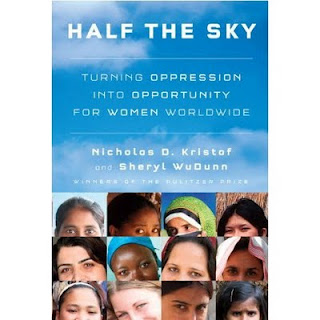
In “The Women’s Crusade,” Pulitzer Prize-winners Kristof and WuDunn, whose new book Half the Sky will be published on September 8, outline the ways in which the world’s women and girls are abused, neglected, and overlooked. They use devastating data to detail how women around the world suffer from lack of education, maternal mortality, sexual violence, trafficking, and economic and political oppression, and then bring these figures to life with women’s personal stories.
They argue that elevating women is not a “soft” issue, but rather has the power to transform economies and address security threats—a point echoed in an interview with Hillary Clinton, in which she calls women and girls “a core factor in our foreign policy.”
“I happen to believe that the transformation of women’s roles is the last great impediment to universal progress,” says Clinton, long an informed and passionate advocate for global women’s issues. She encouraged President Obama to create a new ambassadorship for global women’s issues, and filled the opening with Melanne Verveer, a respected activist and former head of the Vital Voices Global Partnership.
Clinton most strongly emphasizes the connection between women’s issues and national security, calling it “an absolute link”: “If you look at where we are fighting terrorism, there is a connection to groups that are making a stand against modernity, and that is most evident in their treatment of women.” She goes so far as to agree that spending taxpayer money on education and healthcare for girls and women in Pakistan would be more effective than military aid to the country.
“A woman who is safe enough in her own life to invest in her children and see them go to school is not going to have as many children. The resource battles over water and land will be diminished,” she says. “And it’s an issue of how we take hard power and soft power, so called, and use it to advance not just American ends but, in advancing global progress, we are making the world safer for our own children.”
Also in the magazine:
The New York Times’ website adds a slide show of Katy Grannan’s portraits of women in South Asia and Africa, and launches a contest soliciting personal stories from the field. Submit your photos and blog posts to Kristof’s blog by September 19.- Dexter Filkins investigates the acid attacks on girl students in Afghanistan in the horrifyingly vivid storytelling he displayed in his best-seller, The Forever War.
- Lisa Belkin takes note of an emerging generation of female philanthropists using their money to “deliberately and systematically to aid women in need,” spurred by the Hunt sisters’ “Women Moving Millions” campaign.
- Tina Rosenberg describes how sex-selective abortion and inadequate health care for young girls has led to a “daughter deficit” in China and India, where, somewhat paradoxically, “development can worsen, not improve, traditional discrimination.”
- Africa’s first female President, Liberia’s Ellen Johnson-Sirleaf, tells NYT that if women ran the world, it would be “better, safer and more productive.”
To me, such vital voices are the most powerful, proving that the personal is political. The quotes in the lead article from academic studies, local NGO personnel, and women themselves map the way forward:- “When women command greater power, child health and nutrition improves” – Esther Duflo of MIT, on micro-finance.
- “Girls are just as good as boys” – An unidentified man who once beat his wife for not having sons, but changed his mind when a micro-loan turned her into the family breadwinner.
- “Gender inequality hurts economic growth” – Goldman Sachs, Global Economics Paper, 2008
- “I can’t talk about my children’s education when I’m not educated myself … If I educate myself, then I can educate my children” – Terarai Trent, a Zimbabwean woman now completing a PhD in the United States.
-
Climate Engineering is Untested and Dangerous
›The famous mathematician John von Neumann called climate engineering a “thoroughly ‘abnormal’ industry,” arguing that large-scale interventions, including solar radiation management, were not necessarily rational undertakings and could have “rather fantastic effects” on a scale difficult to imagine. Tinkering with the Earth’s heat budget or the atmosphere’s general circulation, he said, “will merge each nation’s affairs with those of every other, more thoroughly than the threat of a nuclear or any other war may already have done”—and possibly leading to “forms of climatic warfare as yet unimagined.” -
9.2 Billion Carbon Copies: The Impact of Demography on Climate Change
›July 21, 2009 // By Gib ClarkeAs the number of contributing factors to (and potential solutions for) climate change grows, one—population growth—is conspicuously absent from most discussions. For obvious reasons: After finally prevailing over climate change “skeptics,” why would U.S. climate advocates court more controversy by adding population, and thus family planning and even abortion, to the mix?
Because it could be an important—perhaps significant—and definitely cheap part of solving the climate crisis, argued David Wheeler of the Center for Global Development (CGD) at an ambitious June 23rd event in the CGD series on “Demographics and Development.” Covering both climate change and population issues, he offered a compelling economic analysis of the effectiveness of family planning and female education programs at addressing climate change. Equally impressive was Wheeler’s engaging style, including graphics and animations that could make Gapminder guru Hans Rosling blush.
Describing Pacala and Socolow’s oft-cited “wedge” theory of stabilizing emissions, Wheeler pointed out that slowing population growth is rarely discussed, compared to the more popular—and more costly—wedges related to reduced deforestation, energy efficiency and conservation, renewable electricity and fuels, and carbon capture and storage.
Wheeler argued that slowing population growth has great potential for reduce emissions at a lower cost. As population increases, so do emissions. As a country develops, its per-capita emissions increase, so population increases in more developed countries are especially important. As the middle class in the BRIC and other large developing nations grows, this sizable group of “New Americans” (to use Thomas Friedman’s term) will contribute more and more emissions.
Two interventions will contribute the most to slowing population growth: family planning and female education, said Wheeler. According to his calculations, a $10 billion increase in female education in the developing world would lead to a change in population growth substantial enough to achieve one of the stabilization wedges. Wheeler found that family planning and female education are among the most cost-effective strategies, as evidenced by their placement on the far left side of slides 22 and 25.
Though an economist by training, Wheeler did not make only financial arguments: He emphasized throughout his presentation that family planning and female education are worthy and necessary programs in their own right. And he pointed out the most glaring injustice of climate change: While people in developed countries have the largest carbon footprints, people in developing countries will disproportionately suffer the impacts. (Suzanne Petroni makes similar points in her ECSP Report 13 article, “An Ethical Approach to Population and Climate Change.”)
Tim Wirth, the president of the UN Foundation and the Better World Fund, called for more political and financial support for this link. Funding for family planning has fallen and support for female education is not as high as it should be. Reaching the unmet need of the world’s women would cost about $20 billion, and the U.S. “share” is $1 billion, an amount that many U.S. family planning leaders are advocating.
As CGD’s Rachel Nugent noted in her introduction, demography and climate are classic cases of long-term issues: difficult to understand and address. It is ironic and important, she said, that two such long-term issues are simultaneously at critical moments. The work of David Wheeler on population and climate change, along with that of Leiwen Jiang of Population Action International and Brian O’Neill of the National Center for Atmospheric Research, may help us find an important and inexpensive piece of an elusive and otherwise expensive pie.
More data is needed to confirm these initial findings. However, the devil may not be in the details but in the debate: convincing weary and wary climate warriors to take on a bit more controversy.
 The famous mathematician

