-
Pop at Rio+20: Reproductive Rights Missing From Outcome Document – Assessing the Disappointment
›June 22, 2012 // By Sandeep Bathala
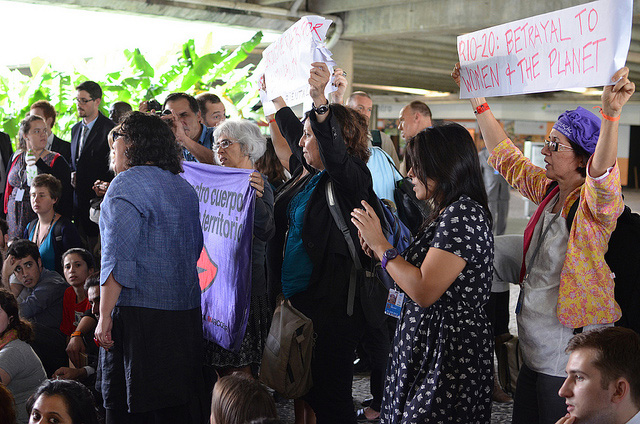
As heads of state get ready to sign on to the outcome document here in Rio, all eyes are on next steps – especially for the reproductive health and integrated development communities, which have seen their hopes of mainstreaming their issues with the sustainable development agenda dashed.
The final outcome document can be found here. USA Today reports that opposition from a group of countries in the 11th hour stripped the text of critical reproductive rights language:An initial draft of this conference’s outcome document stated, “We are committed to ensure the equal access of women and girls to education, basic services, economic opportunities, and health care services, including addressing women’s sexual and reproductive health and their reproductive rights.”
Absent entirely is any explicit connection between reproductive rights, population dynamics, and sustainable development.
In the final draft, the stronger wording “We are committed to ensure the equal access” was switched to the weaker “We are committed to promote the equal access.” The reference to reproductive rights was deleted altogether, after opposition from the G-77, a negotiating bloc of developing countries at the United Nations, and the Holy See.
But others, as we have heard repeatedly throughout the conference, insist that gender issues and reproductive rights have a strong and vital connection to sustainable development. Yesterday, USAID, the Aspen Institute, and the Center for Environment and Population held a discussion in the U.S. tent on this very issue, titled “Making Population Matter: The Demographic Dividend and Sustainable Development.”
As Vicky Markham of the Center for Environment and Population reports on RH Reality Check, the side-event aimed to demonstrate the effects of population dynamics, both positive and negative:We have the largest youth demographic ever in the history of the world, and most developing nations have a “youth bulge.” This can be seen as a challenge, or opportunity, particularly if the focus is on providing development programs for child survival, family planning, reproductive health, and education. The importance of women’s empowerment was also central. But it’s not a given; it’s an opportunity only if we pay attention to these issues to increase the benefits of the “demographic dividend.”
The demographic dividend, as described by USAID Deputy Administrator and panelist Donald Steinberg in blog post earlier this week, “is an opportunity that arises when a country transitions from high to low rates of fertility and child and infant mortality.” But it’s not just about ensuring access to family planning and reproductive health; youth-focused economic and education policies are also needed: “Maximizing the dividend requires social and economic policies that reinforce inclusion, equity, and opportunity across the entire population,” he writes. USAID is making a point of creating youth-focused policies for this reason, he said in Rio.
Carmen Barroso, regional director of the International Planned Parenthood Federation’s Western Hemisphere Region, pointed out that Latin American countries could not take advantage of the demographic dividend before recent societal changes occurred, including decreased fertility, increased urbanization (which leads to smaller families), and greater schooling and employment of women.
Seventy percent of world population growth is likely to be generated by Africa this century, said Eliya Msiyaphazi Zulu, executive director of the African Institute for Development Policy – and it is the only continent projected to continue to grow in the next century, he said. He called for redefining growth as more than GDP as that measure does not consider environmental degradation and its costs: “We must have other means to measure development.”
As heads of state and negotiators consider their positions at this conference – which many were hoping would make a much stronger statement – they might do well to ponder today’s comments from Secretary of State Hillary Clinton:While I am very pleased that this year’s outcome document endorses sexual and reproductive health and universal access to family planning, to reach our goals in sustainable development we also have to ensure women’s reproductive rights. Women must be empowered to make decisions about whether and when to have children. And the United States will continue to work to ensure that those rights are respected in international agreements.
Sources: RH Reality Check, UN, U.S. Department of State, USA Today, USAID.
Now none of this is an abstract discussion. There is just too much at stake, too much still to be done. And many of you visited the U.S. Center here in Rio and saw practical solutions related to some of the work I’ve discussed and other goals we hold in common. We believe solutions require action by all of us. Governments, yes; let’s do our part. Let’s do more than our part.
Photo Credit: YouthPolicy.org. -
African Nations Pioneer Natural Resource Accounting With ‘Gaborone Declaration’
›June 20, 2012 // By Graham NorwoodIn a move with potentially substantial ramifications for future sustainable development, 10 African nations have agreed to begin assigning monetary value to the benefits provided by non-commodity natural resources, including ecosystems such as forests, grasslands, and coral reefs.
Botswana, Gabon, Ghana, Kenya, Liberia, Mozambique, Namibia, Rwanda, South Africa, and Tanzania each affirmed their support for the “Gaborone Declaration” during last month’s Summit for Sustainability in Africa, co-hosted by Conservation International and the government of Botswana. The goal, according to Botswanan President Ian Khama, is to include these new valuations in national accounting, providing policymakers a clear perspective on the costs and benefits associated with the development or conservation of their natural resources for the first time.
Coming just prior to the Rio+20 conference, the signatories said they hoped assigning calculable costs to resource usage would encourage more sustainable development by bringing hitherto “invisible” costs and externalities into the open and onto the balance sheet.
Though the challenges of properly assessing the values of various ecosystem services are understandably many, the potential benefits of natural capital accounting are substantial.
According to SciDev.Net, the World Bank’s Vice President for Sustainable Development Rachel Kyte spoke in support of the declaration at the summit. She pointed out, for example, the advantage of knowing that a hectare of mangrove trees in a certain region of Thailand has been calculated to provide approximately $16,000 of flood protection when considering whether to clear-cut and sell the raw wood (worth about $850), convert the region into a shrimp farm ($9,000), or preserve it.
Such accounting may be particularly beneficial to the Gaborone signatories and other African nations, given growing concern among experts about foreign investment in land, natural resources, and even water on the continent.
But the declaration – and the very idea of natural capital accounting – is not without controversy.
Some argue that commodifying such resources will actually encourage their destruction rather than protect them by ascribing monetary values to previously free and shared resources, thus advantaging richer stakeholders and nations at the expense of poorer ones. As Hannah Griffiths of the UK-based World Development Movement recently wrote in The Guardian, “the result [of natural resource accounting] would be the further privatisation of essential elements of our planet to which we all share rights and have responsibilities.”
Along these lines, Nigerian environmental activist and chair of Friends of the Earth International, Nnimmo Bassey, has voiced his strenuous opposition to the plan made at the summit. “This declaration is blind to the fact that the bait of revenue from natural capital is simply a cover for continued rape of African natural resources,” he said in SciDev.
However, the signatories of the Gaborone Declaration dismissed these concerns and pointed to the value of natural resource accounting for sustainable development.
“Africa is where sustained and sustainable economic growth and stewardship of natural wealth become one and the same thing,” said Kyte at the summit. “By endorsing natural capital accounting as a tool for delivering on more inclusive green growth, Africa is showing the way for the rest of the world.”
Conservation International CEO and Chairman Peter Seligmann agreed, calling the declaration “a very big deal, a very big moment, and a big step forward.” He connected it to the imminent Rio+20 conference as well, saying the pledge is “truly a beacon on the hill for the rest of societies” and that “it will be held up on top of that hill in Rio de Janeiro.”
Indeed, the World Bank has listed natural capital accounting as one of six key issues for Rio+20, and in a report last month titled Inclusive Green Growth: The Pathway to Sustainable Development, noted that “it is vital that economic values for environmental assets be comparable to other economic values.”
The World Bank has already made significant progress in promoting the practice through its Wealth Accounting and the Valuation of Ecosystem Services (WAVES) global partnership, encouraging at least 24 countries to use some form of natural resource accounting to date. WAVES aims to sign up 50 more nations and 50 private corporations beginning at Rio+20, as a part of its “50:50 Campaign.”
WAVES and the Gaborone Declaration show that natural capital accounting is gaining momentum as a means to incentivize more sustainable development. The international news media is beginning to take notice as well. The results of the Rio+20 conference will be a good opportunity to gauge just how far the idea has come and what the extent of its future application might be.
Sources: Conservation International, The Guardian, SciDev.Net, World Bank.
Photo Credit: “Saving the Sacred Rock,” courtesy of flickr user isurusen (Isuru Senevi); video: The World Bank. -
Comparing Urban Governance and Citizen Rights in China and India
›Today, according to Xuefei Ren, 129 cities in China and 45 in India have populations of over a million people. Such large-scale urbanization has created major governance challenges. Speaking at a May 23 Asia Program event co-sponsored with the Kissinger Institute on China, United States Studies, and the Comparative Urban Studies Project, Ren, a Wilson Center Fellow, examined two case studies of urbanization-driven governance in China and India and their effect on citizen rights.
Her first case study involved housing demolitions and urban re-development in Shanghai and Mumbai. In Shanghai, nearly a million households were relocated between 1995 and 2008 to make way for hotels, airports, and luxury apartments. City regulations in 1991 and 2001 legalized forced demolitions, and no prior consent from residents was needed.
However, Ren noted that displaced residents “are not quite powerless.” She highlighted the case of a woman who sued the city government after being relocated and was eventually granted the compensation she had requested. In 2003, China’s central government ordered a freeze on large-scale demolitions. Several years later, it passed a “landmark” property rights law.
Meanwhile, in Mumbai, local officials in the early 2000s had their own re-development plans. The Indian city is rife with overcrowded, low-income housing; slums are populated by seven million citizens (40 percent of the city’s total population), and comprise up to 10 percent of Mumbai’s total land area.
In 2004, aware that most of the slums were located in desirable areas – near airports or in central business districts – city planners recognized a major development opportunity. Over the next two years, officials launched a demolition campaign that left 400,000 people homeless. According to Ren, certain categories of residents were theoretically entitled to compensation, but with “legal protections carrying little weight,” most of them received nothing.
Yet, as in Shanghai, Mumbai’s city dwellers successfully fought back. Housing activists staged acts of “direct agitation,” including a series of street protests and road blockages. Such tactics, said Ren, were “disruptive but effective.” The Mumbai courts sided against the activists in 2006, but India’s Supreme Court later issued a ruling in their favor.
Fighting Land Acquisitions: A Comparison
Ren’s second case study compared land acquisition efforts outside the slums.
Last year, residents in Wukan, a village along China’s southeast coast in the province of Guangdong, launched a protest movement against land seizures. They alleged that government officials had sold their land to developers and failed to provide residents with appropriate compensation. The protestors made two demands: the return of their land and the holding of local elections.
Notably, Ren said, protestors in Wukan affirmed their support for the Communist Party, and never framed their movement as an anti-government effort. In March 2012, local elections were in fact held, with two leaders of the protest movement voted into office (one as village chief, the other as his deputy).
Ren also discussed an attempt by India’s Tata Motors corporation to acquire land in Singur, a village about 100 miles from Calcutta in the state of West Bengal. The company wanted to use this land to construct a factory for the Nano, a small, cheap car marketed to India’s urban middle class. In 2005, the West Bengal government, which had been controlled by the Communist Party of India-Marxist (CPI-M) for nearly 30 years, actively wooed the firm. State authorities “went overboard” in offering Tata Motors subsidies and highly fertile land, said Ren. Small landowners were obliged to surrender their plots at low prices, and in 2006 the corporation formally took over the land (nearly 1,000 acres altogether), despite heavy opposition from peasants.
However, violent protests continued and after several months, Tata Motors was forced to pull out of West Bengal. Then, in a state election in May 2011, the Trinomool Congress Party, led by the populist leader Mamata Banerjee, swept the CPI-M from power. Banerjee had run her campaign on a promise to restore the land to Singur’s farmers.
Just weeks after the new government assumed power, West Bengal passed a law that would allow for about 400 acres from the Tata Motors project to be returned to farmers who had refused government compensation for their land.
Ren acknowledged that in both countries, citizenship rights are not enjoyed by all and tend to be unevenly distributed across social groups. Still, she concluded, Chinese and Indian cities “have become strategic sites for reassembling citizen rights.” By asserting their land and housing rights, city denizens “are becoming active citizens.”
Michael Kugelman is a program associate with the Wilson Center’s Asia Program. He can be reached at michael.kugelman@wilsoncenter.org and on Twitter @michaelkugelman.
Photo Credit: Mumbai pipes, courtesy of flickr user lenskap. -
Poor Land Tenure: A Key Component to Why Nations Fail
›The murder of five land rights campaigners during the last two months – one in Colombia, three in Brazil, and one in Cambodia – have not captured many headlines, but they are a reminder of the central role land tenure plays not just in rural economic development but also in sparking broadly distributed economic gains throughout a society.
-
Valerie Hudson and Chad Emmett: Women’s Well-Being Is the Best Predictor of State Stability
›May 22, 2012 // By Kate Diamond“The best predictor of a state’s stability and security is the level of violence against women in society,” said Texas A&M University’s Valerie Hudson in this interview with ECSP. That link is “based on rigorous empirical analysis,” she said. “There’s something to it. It’s not just political correctness.”
-
The Global Water Security Assessment and U.S. National Security Implications
›“Water security is about much more than access to H2O,” said Jane Harman, director, president, and CEO of the Wilson Center at the May 9 meeting, “Global Water Security: The Intelligence Community Assessment.” The event – part of the Wilson Center’s National Conversation Series – brought together a number of experts to discuss a recently released intelligence community assessment of global water security. [Video Below]
-
Nigeria Beyond the Headlines: Environment and Security [Part Two]
›In the coming years, Nigeria’s cohort of unemployed youth has equal potential to “be converted into either a religious or a regional clash, as certain youths get opportunities and other youths do not,” said Pauline Baker, President Emeritus of the Fund for Peace, during the day-long “Nigeria Behind the Headlines” event at the Wilson Center on the April 25 (read part one here). [Video Below]
-
Nigeria Beyond the Headlines: Demography and Health [Part One]
›“Nigeria is a country of marginalized people. Every group you talk to, from the Ijaws to the Hausas, will tell you they are marginalized,” said Peter Lewis, director of the African Studies Program at the Johns Hopkins University School of Advanced International Studies. Lewis spoke at an April 25 conference on Nigeria, co-hosted by ECSP and the Wilson Center’s Africa Program, assessing the country’s opportunities for development given its demographic, governance, natural resource, health, and security challenges. [Video Below]
Showing posts from category economics.