

-
Grassroots Efforts Help Achieve Population, Health, and Environment Goals in Nepal
›April 1, 2009 // By Will Rogers “If you want to bring about conservation of these big, iconic species that need lots of area to roam, you have to work with the people that are living there,” said Jon Miceler at a March 19, 2009, event, “Population, Health, and Environment in Nepal.” Miceler, managing director for the World Wildlife Fund’s (WWF) Eastern Himalayas program, and Rishi Bastakoti, director and co-founder of Resource Identification and Management Society Nepal (RIMS Nepal), discussed their ongoing work on population, health, and environment (PHE) programs in Nepal.
Protecting Tigers in the Terai
To protect endangered Bengal tigers in Nepal, WWF seeks to simultaneously protect the ecosystem and support sustainable livelihoods in the Terai Arc Landscape (TAL), a biodiverse region that spans the India-Nepal border. Environmental threats to the Terai include:- Conversion of forest into farmland;
- Overgrazing;
- Forest fires;
- Excessive extraction of timber and fuelwood;
- Poaching;
- Human-wildlife conflict; and
- Population growth.
“By protecting a tiger—which is what we call an ‘umbrella species’—you’re actually protecting a whole host of species below that, and a whole host of ecosystems that are connected with the tigers,” said Miceler.
Piloting PHE in Khata
In the Khata corridor, a region of the TAL, WWF worked with local leaders and community forest user groups to create a “permanent community-managed health clinic with basic clinical tools,” Miceler said. In addition, the program:- Distributed 172 arsenic filters to remove naturally occurring arsenic from the groundwater, as well as 44 hand pumps to provide clean drinking water;
- Improved access to family planning services and increased the contraceptive prevalence rate from 43 percent to 73 percent in two years; and
- Provided 136 biogas plants with attached toilets and 100 improved cookstoves, reducing the need for fuelwood, which in turn decreased deforestation and the number of acute respiratory infections.
WWF will be “taking results from the successes we’ve had in the Khata corridor and lessons learned from other PHE projects in other countries to scale them up in other areas of the Terai,” said Miceler.
PHE at the Grassroots Level
“The average fertility rate in Nepal is 3.1,” said Bastakoti of the Nepalese NGO RIMS Nepal. “But it is much higher among the ethnic communities living in the remote areas with low education.”
RIMS Nepal works with 82 community forest user groups in Dhading to improve livelihoods, health, and environmental conservation. Since 2006, the project has:- Increased the contraceptive prevalence rate from 44 percent to 63.1 percent; and
- Distributed biogas and other improved cookstoves, helping reduce the incidence of acute respiratory illness from 55.5 percent to 5 percent and saving 1,178 metric tons of firewood each year.
RIMS Nepal trained 375 people to be peer educators and community-based distributors of contraceptives. “Local volunteers are key for the success of PHE,” Bastakoti explained. “They become role models for behavioral change.”
In addition, with RIMS Nepal’s help, 24 community forest user groups incorporated PHE activities, including family planning, into their operational plans. The “integration of family planning and health brings added value to conservation, poverty reduction, and livelihood improvement,” said Bastakoti, calling community forest user groups “one of the greatest grassroots-level institutions”—and key to advocating for the PHE approach at the national level.Photo: Rishi Bastakoti. Courtesy of the Woodrow Wilson Center.
-
Weekly Reading
›“A New Military Mission: Clean Energy,” part of the Center for American Progress’ “It’s Easy Being Green” series, highlights the military’s attempts to become more energy-efficient. Read more about the U.S. military’s environmental initiatives.
Simon Dalby, a professor at Carleton College, discusses the evolution of environmental security with John Tessitore, executive editor of the Carnegie Council, in a video interview (transcript available).
Climate Change, Food Security, and the Right to Adequate Food examines climate change’s expected impact on food production, with a special focus on Africa and Asia.
The BDA Foundation, a Canadian charity, and PharmAfrica, a pharmaceutical company, are working to create a medicinal plants industry that will lift local people out of poverty in the Democratic Republic of the Congo. -
Rwanda: More Than Mountain Gorillas
›February 27, 2009 // By Rachel WeisshaarIf you’ve visited
Destination Nyungwe Project (DNP), which I visited yesterday with the leaders of the East Africa PHE Network, is trying to change all that. It envisions
Nyungwe has a lot to offer; as the largest montane rainforest in
As these larger projects are constructed, DNP—which is funded by the U.S. Agency for International Development and implemented by International Resources Group, Family Health International, and the Wildlife Conservation Society—is also working to improve the health, livelihoods, and environmental management of the local communities. A health coordinator works with local clinics to improve maternal and child health, family planning and reproductive health, and hygiene. Health and family-planning activities are key to ensuring the park’s survival because high population growth, and the resulting demand for land, is one of the key threats to the park, says Munanura. A small-grants program provides micro-loans to local people for sustainable livelihoods, such as setting up cultural tourism attractions or producing soap, lotion, and oils from forest products.
Nyungwe National Park still struggles to attract tourists, as it lacks the luxury accommodations offered at
Rachel Weisshaar is attending the meeting of the East Africa PHE Network in Kigali,
Photo: Nyungwe National Park, Rwanda. Courtesy of Rachel Weisshaar. -
East Africa PHE Network: Translating Strong Results Into Informed Policies
›February 24, 2009 // By Rachel Weisshaar“The road to inaction is paved with research reports,” said Marya Khan, our Population Reference Bureau facilitator, opening today’s East Africa Population-Health-Environment (PHE) Network workshop on bridging the research-to-policy gap.
At the Environmental Change and Security Program, we know all too well that even the best program or most dramatic research findings don’t stand a chance of being implemented unless they are communicated to policymakers in succinct, persuasive formats. Yet researchers often neglect to convey their results to decision makers and donors, assuming they won’t be interested or won’t appreciate their methodologies, explained Khan. Furthermore, researchers are often hesitant to draw out the policy implications of their findings, believing this is policymakers’ responsibility, while policymakers tend to think this is researchers’ duty—so these critical implications are often never explored.
Today’s sessions aimed to empower the PHE working groups from Rwanda, Uganda, Ethiopia, and Kenya to develop their own strategies to bridge the research-to-policy gap. The groups brainstormed policy communications objectives they wished to achieve—such as officially launching their country PHE network—as well as concrete outcomes that would contribute to accomplishing those objectives—such as convincing representatives from various national government ministries to join their network.
Rachel Weisshaar is attending the meeting of the East Africa PHE Network in Kigali, Rwanda. She will be posting daily updates on the New Security Beat throughout the week (see yesterday’s post).
Photo: Members of the Kenya PHE Working Group discuss communications strategies. Courtesy of Rachel Weisshaar. -
East Africa Population-Health-Environment Conference Kicks Off in Kigali
›February 23, 2009 // By Rachel WeisshaarRwandan Minister of Natural Resources Stanislas Kamanzi officially launched the meeting of the East Africa PHE Network this morning, stating that Rwanda’s highest-in-Africa population density of 365 people per square kilometer—which he argued leads to environmental degradation and poor human health in both rural and urban areas—compels an integrated approach to development. Kamanzi said that Rwanda’s National Environment Policy and national development plan, Vision 2020, both recognize population-health-environment (PHE) links, and he expressed Rwanda’s commitment to implementing the recommendations of the First Inter-ministerial Conference on Health and Environment in Africa, which was co-hosted by the World Health Programme and the UN Environment Programme in Gabon in August 2008. -
In Kashmir, No Refuge for Wildlife
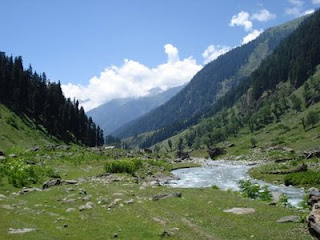
›February 20, 2009 // By Will Rogers“Human-animal conflicts have assumed alarming proportions in the region,” Asghar Inayati, a regional wildlife warden in Kashmir, recently told Inter Press Service (IPS) News. Since India and Pakistan gained independence in 1949, both sides have fought for control of the territory. Not only has the decades-long conflict claimed 100,000 lives (by some estimates), it has also displaced animals from their natural habitats, sparking violent encounters with local people and threatening many species’ survival. -
Weekly Reading
›An article in Conservation Letters examining the effect of war on wildlife in Cambodia finds that “the legacy of conflict for wildlife can be profound and destructive. To address post-conflict challenges more effectively, conservation must be integrated within broader peacebuilding processes, including disarmament, demobilization, and reintegration of combatants.”
New York Times environmental reporter Andrew Revkin shares a recent nightmare on his blog, Dot Earth: If human beings achieve inexpensive, renewable energy, will this spur environmentally destructive population growth and consumption?
“Today, one-third of the world’s population has to contend with water scarcity, and there are ominous signs that this proportion could quickly increase,” writes the International Water Management Institute’s David Molden in the BBC’s Green Room. “Up to twice as much water will be required to provide enough food to eliminate hunger and feed the additional 2.5 billion people that will soon join our ranks. The demands will be particularly overwhelming as a wealthier, urbanised population demands a richer diet of more meat, fish, and milk.”
“Climate Wars” is a three-part podcast series by the Canadian Broadcasting Corporation.
Circle of Blue has launched the online radio series “5 in 15”; one episode features water expert Peter Gleick, head of the Pacific Institute, while another highlights Mark Turrell, CEO of technology company Imaginatik. -
Watch: Peter Gleick on Peak Water
›February 5, 2009 // By Wilson Center Staff“The concept of ‘peak water’ is very analogous to peak oil…we’re using fossil groundwater. That is, we’re pumping groundwater faster than nature naturally recharges it,” says Peter Gleick in this short expert analysis from the Environmental Change and Security Program. Gleick, president and co-founder of the Pacific Institute and author of the newest edition of The World’s Water, explains the new concept of peak water.
Showing posts from category conservation.
 “If you want to bring about conservation of these big, iconic species that need lots of area to roam, you have to work with the people that are living there,” said Jon Miceler at a March 19, 2009, event, “
 If you’ve visited
 Rwandan Minister of Natural Resources
  “
“

