-
New Research on Climate and Conflict Links Shows Challenges for the Field
›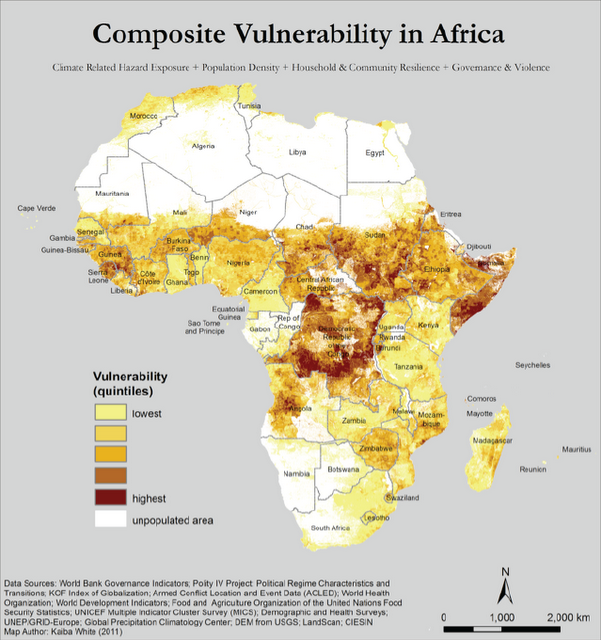
“We know that there will be more conflicts in the future as a result of climate change than there would have been in a hypothetic world without climate change,” said Marc Levy, deputy director of the Center for International Earth Science Information Network (CIESIN) at Columbia University’s Earth Institute, although existing data and methodologies cannot predict how many additional conflicts there will be, or which causal factors will matter most. [Video Below]
-
Marc Sommers, Woodrow Wilson Center
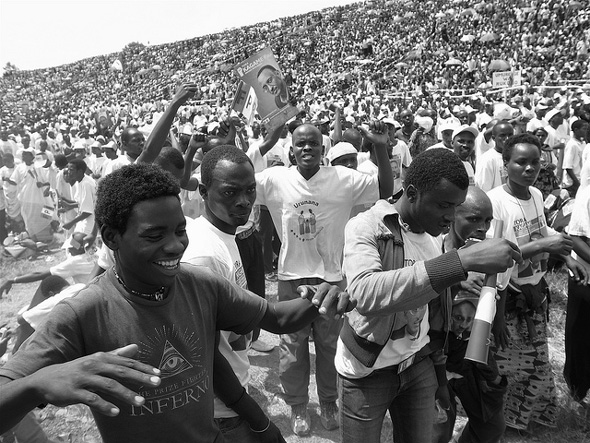
Assessing Africa’s Youth Bulge
›January 9, 2012 // By Wilson Center StaffThe original version of “Governance, Security, and Culture: Assessing Africa’s Youth Bulge,” by Marc Sommers, first appeared in the International Journal of Conflict and Violence, Vol. 5 (2), 2011.
Although Africa has a youth-dominated population, African government policies are often not youth-centered and African governments and their international supporters are frequently under-informed about the priorities of most youth. Reliance on the “youth bulge and instability thesis” leads to distorted assessments of everyday realities. Examination of the lives, priorities, and cultural contexts of African youth, and the cases of youth in Rwanda and Burundi in particular, shows that the nature of relations between the state and massive populations of young, marginalized, and alienated citizens directly impacts the governance, security, and development prospects of African nations.
Learning from Liberia
If ever there was a youth-dominated conflict in modern times, it was Liberia’s long and grueling civil war (1989-1996 and again in 2000-2003). Ignited by Charles Taylor’s Christmas Eve incursion from neighboring Côte d’Ivoire late in 1989, together with perhaps one hundred other men, the conflict soon took the form of youth-led chaos. “What initially was seen as a revolution…fought with sticks and cutlasses,” Mats Utas writes, “was eventually transformed into a war of terror where young people started fighting each other” (2005: 55). In fact, some youth continued to view the war as their revolution, for as long as they were able to take advantage of the opportunity that armed conflict afforded. The civil war provided them with “a chance to become someone in a national system that had marginalized them, but also a chance to get rid of the load of work and expectations that the parental generation had laid on them” (65). Some of the more successful young soldiers, sometimes goaded by their girlfriends, “felt so affluent that they could wash their cars in beer – a beverage most could not even afford to drink prior to the war – and that they could drive a car until it ran out of gasoline and then just dump it for another one” (66). The result was a war that wreaked colossal destruction. By 1997, civil war had already left a nation of perhaps two and a half million with up to 200,000 dead, 700,000 refugees, and much of the remaining population internally displaced (Utas 2008: 113).
The region of sub-Saharan Africa has the most youthful population in the world. Of the 46 countries and territories where at least 70 percent of the population is under the age of 30, only seven are not in sub-Saharan Africa. With this in mind, one of the most striking aspects of contemporary Africa is how male African youth have so frequently been viewed as threats to their own societies. However, the view from below differs dramatically from the largely quantitative analyses from above and from outside the continent. Again, the Liberian example is illuminating. A nation long renowned for grasping leaders and withered government institutions has more recently provided truly upbeat signs of forward movement. That said, most youth continue to be left far, far behind. Fieldwork in rural Liberia uncovered a widespread fear of “rebel behavior youth” – youth who had assumed the attitudes of wartime combatants and became socially sidelined. Liberia’s post-war youth unemployment has been estimated at the astonishing rate of 88 percent. Taking all of this into account – a widespread sense of estrangement and social distance felt by many youth and an economic recovery that is passing most of them by – one could certainly argue that Liberian youth are among the world’s most peaceful populations.
Continue reading in the International Journal of Conflict and Violence.
Marc Sommers is a fellow with the Woodrow Wilson Center’s Africa Program and visiting researcher at Boston University’s African Studies Center.
Sources: Government of Liberia, Population Action International, Sommers (2007), Utas (2005 and 2008).
Photo Credit: “RPF rally in Gicumbi, Rwanda,” courtesy of flickr user noodlepie (Graham Holliday). -
Migration and Environmental Change, Minority Land Rights and Livelihoods
›Migration and Global Environmental Change: Future Challenges and Opportunities, from the UK Government Office for Science’s Foresight Programme, looks at how environmental change, including climate change, land degradation, and the degradation of coastal and marine ecosystems, over the next 50 years will affect migration trends. The report emphasizes that migration is a complex and multi-causal phenomenon, which makes it difficult to differentiate environmental migrants as a distinct group. Nevertheless, research suggests that global environmental changes will affect the drivers of migration, particularly economic forces, such as rural wages and agricultural productivity.
Though Foresight finds that many will use migration as an adaptation strategy that improves resilience to environmental change, they also point out that some affected individuals may become “trapped” in vulnerable situations, lacking the financial capacity to respond to environmental changes, while others may be able to move but will inadvertently enter more exposed areas, particularly, at risk urban centers. For recommendations, they stress the importance of strategic, long-term urban planning, and recognition within adaptation and development policies that migration can be part of the solution.A study, released on December 5 by Minority Rights Group International, finds that minority communities in Kenya, Uganda, and South Sudan face significant challenges around access to and control of critical natural resources. The report, Land, Livelihoods, and Identities: Inter-Community Conflicts in East Africa, shows how rapid population growth, climate change, and globalization are increasing competition for land, water, and forest and mineral resources in territories traditionally occupied by minority groups. These pressures can undermine livelihoods and trigger multiple and overlapping conflicts, especially where ownership has not been formalized in law. The study also notes that women are doubly vulnerable as their access to land and resources is frequently mediated through customary law, which depends on their communities retaining control over traditional territory. Although the report makes national-level legal and policy recommendations, the authors note that some of the most effective resource management and conflict resolution strategies adapt traditional cultural practices to the current circumstances of communities. -
Famine and Food Insecurity in the Horn of Africa: A Man-Made Disaster?
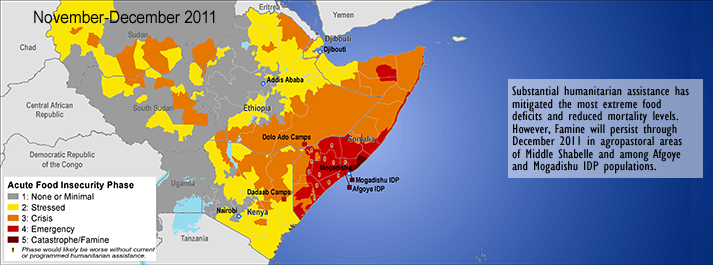
›This year’s drought in the Horn of Africa has been the region’s worst in decades and has exploded into a humanitarian catastrophe affecting millions. In Somalia, where the drought is layered on top of two decades of conflict and an extremely weak state, the impact of the drought has been most damaging. Somalia is the only country in the region where the UN has declared famine zones. And, even though the UN recently upgraded three of Somalia’s six famine areas to “lesser emergencies,” four million Somalis – more than half the country’s population – remain in urgent need of food and general humanitarian aid.
The drought may have been what sparked the current crisis, but other, longer-term factors, like a sustained lack of agricultural development, extreme rural poverty, and changing weather patterns, not to mention Somalia’s lack of functioning government, set the stage.
A Long-Term Crisis in the Making
“Lack of rainfall over several seasons is the most immediate and most visible cause of the current humanitarian crisis in the Horn of Africa,” said Jim Hansen of the Consultative Group on International Agricultural Research (CGIAR) in a brief video produced this summer by the International Research Institute for Climate and Society at Columbia University (watch above). Much of the Horn’s population “depends on rain-fed agriculture and pastoralism for their livelihoods and sustenance,” said Hansen. Already “quite poor and…locked in poverty for quite a long time,” environmental and resource degradation, paired with rapid population growth, have compounded their vulnerability to extreme events, he said.
Throughout the region, resilience to crises like the current drought has been weakened by decades of poor agricultural planning, “driven more by shifts in ideology than any real evidence among some of the key international development organizations,” said Hansen. That poor planning has made communities more dependent on humanitarian aid when poor weather hits, which in turn forces aid groups to redirect resources away from longer-term development and towards short-term disaster relief instead, Hansen said.
While these problems exist across the Horn of Africa, Hansen points out that the crisis has been most damaging in Somalia, which he attributes to the country’s weak governance and to international aid groups’ limited ability to operate in the country.
“Northern Kenya, southern Ethiopia, and Somalia have similar severity of drought, but the humanitarian crisis is much more severe – the loss of livelihood and life is greater in Somalia largely because the government is weaker,” he said.
The Government’s Role
Owen Barder, a senior fellow at the Center for Global Development, draws a more direct line between governance and famine in the Horn. “In Somalia…there’s a complete breakdown of government, and the consequence is the famine that we’re seeing,” said Barder during a Center for Global Development podcast. The country has been without a functioning government since 1991, when civil war broke out. It has since become “the most food-insecure nation in the world” and, as described by Foreign Policy, “the international community’s longest-running failure.”
Barder raised two points about the government’s role in famine. One, that access to information – in this case an early warning system monitoring drought conditions – can minimize the humanitarian impact of any given natural disaster; and two, that a country’s government must be able to translate that information into action in order for it to actually make a difference.
Barder is not alone in emphasizing the state’s role as a driver of the famine. Edward Carr, a AAAS science fellow with USAID, wrote in July, when the UN first declared famine in Somalia, that attributing the famine solely to drought is “a horrible abdication of responsibility for the human causes of this tragedy.”
Charles Kenny, also a senior fellow at the Center for Global Development, went even further on Foreign Policy, arguing that famine, or “mass starvation as an intentional act of governance,” should be categorized as a crime and prosecutable at the International Criminal Court.
Al Shabab and the Months AheadAs of late November, the United Nations estimated that tens of thousands had died in Somalia alone since drought began this spring. Though USAID’s Famine Early Warning Systems Network (FEWSNET) reports that famine has now subsided in three of the six southern regions it initially struck, a quarter of a million Somalis remain at risk of “imminent starvation,” according to the UN.
According to FEWSNET, famine should not reappear in the foreseeable future, assuming aid groups can maintain current distribution levels – a key caveat. Ten days after FEWSNET issued its analysis, however, Al Shabab, the Al Qaeda-linked militant organization that controls much of southern Somalia, banned 16 aid groups, including UNICEF and the World Health Organization, from operating in the areas under its control. UNICEF spokesman Jaya Murthy told the BBC that the move would put “about 160,000 severely malnourished children…at imminent risk of death.”
Fighting in southern Somalia between Al Shabab and Kenyan and Ethiopian forces is adding another layer to the country’s humanitarian crisis. The UN Office of the High Commissioner for Refugees reported that, as of late November, the fighting had become the primary driver of internal displacement, replacing drought and famine as the key drivers during the first three quarters of the year. The UNHCR estimated that, between the drought and the conflict, 1.46 million Somalis have been displaced.
Meanwhile, the rainy season is picking up, and although that’s good news for farmers and pastoralists, it also means that Somalis will be vulnerable to diseases like measles, typhoid, and cholera, which can spread quickly through overcrowded, under-supplied IDP camps. Somalis still living under Al Shabab’s control are prohibited from getting vaccinations, amplifying their vulnerability to disease in the coming months.
These latest developments offer strong evidence that policy decisions can exacerbate the human toll of natural disasters. From Barder’s perspective, that is reason for optimism. “We have the information, we have the capacity to prevent it from happening,” he said.
For more on Somalia’s underlying demographic issues, see Elizabeth Leahy Madsen’s post “In Somalia, Beyond the Immediate Crises, Demography Reveals a Long-Term Challenge.”
Sources: AlertNet, Associated Press, BBC, Famine Early Warning Systems Network, Foreign Policy, Huffington Post, The New York Times, UNHCR, UN News Centre, Voice of America.
Video Credit: “Jim Hansen on Food Security in East Africa,” courtesy of the International Research Institute for Climate and Society on vimeo; image credit: FEWSNET/USAID. -
Climate Change, Uncertainty, and Conflict in the Niger River Basin
›New research on the Niger River Basin finds that the effects of climate change in the region are pervasive and that “latent conflict” between groups – disagreements and disputes over damage to farmland and restricted access to water, but not physical violence – is common.
“You’ve got vulnerable people, vulnerable households, vulnerable communities living within…fragile systems – governance systems [and] environmental systems,” said Phil Vernon, International Alert’s director of programs for Africa and peacebuilding issues, at “Climate Change, Water, and Conflict in the Niger River Basin,” an event hosted by the Wilson Center on November 17. [Video Below]
Together with his colleagues Lulsegged Abebe and Marisa Goulden of the University of Anglia, Vernon examined how communities in Mali, Nigeria, and Niger have been impacted by climate change, how they have adapted to those impacts, and whether these changes spurred conflict.
Competition Over Dwindling Resources
Climate change destabilizes communities by adding uncertainty and stress, Vernon said, and when a community is already vulnerable, the impacts of those uncertainties and stresses are amplified and the potential for conflict is greater. In every community examined in the study, climate-induced vulnerability led to some kind of conflict. More often than not, however, that conflict took the form of disagreements, or “latent conflict,” rather than violent conflict – a reason for optimism in the face of dire predictions that an era of climate wars is upon us.
Throughout the basin, river flows and rainfall have been decreasing since the 1970s, said Goulden, creating tension between two of the major communities living in the basin – farmers and pastoralists. Pastoralists are forced to travel farther to bring their herds to water, while farmers are expanding their cropland to feed growing populations, reducing the pathways available to herders and their livestock.
Unfortunately, poor policy decisions have made tensions worse in some places. In Lokoja, Nigeria, for example, the government began dredging the Niger River in 2009 to improve commercial shipping. Officials said the dredging would reduce flooding, but in 2010, farmers suffered immensely from floods. The government’s false promises increased the farmers’ vulnerability, said Goulden, because, expecting to be protected from flooding, they were not adequately prepared, making the damage worse.
As a result, farmers are now building homes and developing cropland further away from the river, reducing land available to pastoralists and increasing the potential for conflict between the two communities.
Increased Resilience Is a “No-Brainer”
Climate in the Niger River Basin is marked by a high degree of variability – rainfall, river flows, and temperature already fluctuate a great deal and could become even more variable in the future, said Goulden.
That uncertainty has important implications for how people think about responding to climate change, said Abebe. “Development and adaptation policies must be flexible enough to cope with extreme variability both in the wetter and the dry conditions in the Niger River Basin,” he said.
Boosting resilience will be key to ensuring that vulnerable communities have the flexibility they need to respond to future crises, Vernon said.
“If the interaction of stress and vulnerability is the problem…it’s somewhat of a no-brainer that increased resilience is part of the answer,” said Vernon. And decisions on how to increase resilience “should be made at the lowest appropriate level…from high policy down to household and individual decisions.”
Different People, Different Levels of Resilience
Vernon’s emphasis on making decisions at the “lowest appropriate level” reflects the reality that various communities – and individual community members – experience climate change in different ways. Fostering adaptation strategies that take these variations into consideration will be an essential strategy for avoiding climate-driven conflict in the future.
In Mali, the Niger River flooded downstream of the Selingué Dam in 2001 and 2010, and in each case, researchers found divergent responses to the crises.
In the lead-up to the 2001 flood, dam operators had been intentionally keeping reservoir levels high in anticipation of increased demand for hydroelectric power during an upcoming soccer championship match. When heavy rains hit the area, though, the operators were forced to release huge amounts of water over a short period of time, causing massive flooding downstream.
In the flood’s aftermath, downstream farmers were able to successfully sue the power company for their losses, but downstream pastoralists had no comparable option. The pastoralists were therefore more vulnerable to the flood’s long-term impacts.
Responses differed within communities as well, often breaking down along gender lines. In 2010, when floods hit Mali again, men “were trying to help people move away from the flood water, and then afterward with rebuilding of homes,” said Goulden, “whilst women are concerned with finding shelter, cooking, and caring for the sick, elderly, and children.”
No “Massive Risk of Violence” in the Near Future
Policymakers are left with an urgent crisis – climate change – and a solution that is inherently time-intensive: building resilience in vulnerable communities down to the individual level, said Vernon.
“There is a risk of undermining the elements of resilience which exist already in responding too rapidly and too urgently based on the anxieties we have to the problem of climate change and insecurity,” he cautioned.
Fortunately, although the threat of climate change is urgent, Vernon said that the risk of that threat spilling over into violent conflict is still a long way off. “I think policymakers have got to be thinking about where might this lead,” he said, “but at the moment, in terms of this research, there was no evidence that there’s a massive risk of violence happening any time soon.”
Event Resources
Sources: AlertNet, BBC, International Alert.
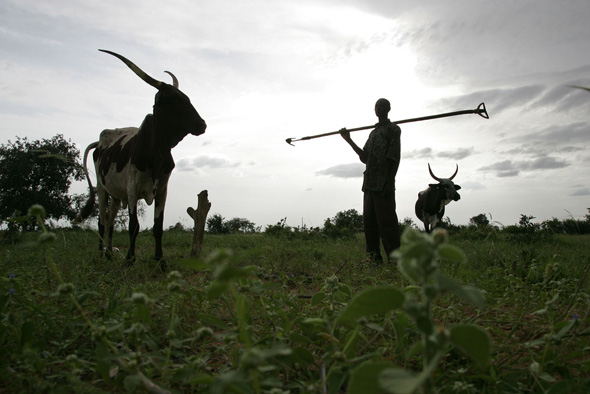
Photo Credit: “Cattle manure millet field in Niger,” courtesy of flickr user ILRI (International Livestock Research Institute). -
Michael Kugelman, Ahmad Rafay Alam, and Gitanjali Bakshi for Foreign Policy
Why South Asia Needs a Kabul Water Treaty
›December 12, 2011 // By Wilson Center StaffPakistan is once again accusing India of water hegemony. This time, however, the accusation refers not to Indian damming of the Western Rivers in the disputed regions of Jammu and Kashmir, but to Indian support for Afghan development projects along the Kabul River. This accusation indulges in conspiratorial thinking, and distracts from a factual understanding of the water issues between the two countries.
-
Book Preview: In ‘War and Conflict in Africa’, GWU Scholar Skeptical That Natural Resources Play a Leading Role
›November 30, 2011 // By Elizabeth Leahy MadsenWhile there is widespread agreement that the incidence of conflict in Africa is high, scholars and development agencies alike debate its driving forces and how to move toward solutions. Paul Williams, associate professor in the Elliott School of International Affairs at George Washington University and collaborator with the Wilson Center’s Africa Program, recently published a book that aims to both quantify African conflicts and devise a framework of their causes. In War and Conflict in Africa, Williams evaluates which factors explain the frequency of conflict in Africa during the post-Cold War era and how the international community has tried to build peace and prevent future conflict.
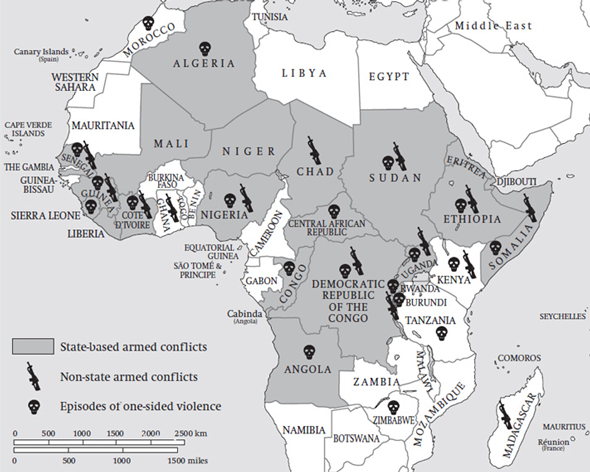
Although there have been promising trends toward establishing peace and democracy in some African countries, the continent still accounts for about one-third of all armed conflicts annually – more than Europe, the Middle East, and the Americas combined. International responses to these events range from focused humanitarian and conflict resolution efforts, to new regional organizations and global strategic and defense partnerships.
Seven of the 16 current UN peacekeeping missions operate in Africa, more than any other continent. The UK government has elected to spend nearly one-third of its development assistance in conflict-affected areas, and more than half of its “focus” countries are in Africa. In 2008, the Department of Defense created the U.S. Africa Command (AFRICOM), whose commander, General Carter Ham, in a speech to Congress earlier this year, described “an insidious cycle of instability, conflict, environmental degradation, and disease that erodes confidence in national institutions and governing capacity,” as motivation for American military attention. “This in turn often creates the conditions for the emergence of a wide range of transnational security threats,” he said.
Evaluating the Ingredients of Conflict
Williams rejects earlier theses that attribute conflict across the continent to a single factor, such as the boundary legacies of colonialism, greed, or ethnicity. Instead, he characterizes African conflicts as “recipes” composed of case-specific mixes of factors, many of which are underlying and only some of which are sufficient triggers for conflict. “Collier is wrong,” Williams explained in an email interview. “Governance structures are always an important part of the buildup to war.”
Five “ingredients” of conflict are examined in-depth: neo-patrimonial governance structures; natural and human resources; sovereignty and self-determination; ethnicity; and religion. Among these, the book presents a fairly skeptical view of resources, ethnicity, and religion as immediate drivers of conflict. This assessment that environmental and identity issues are not sufficient to generate conflict on their own aligns with the book’s overarching argument: The decisions of political actors can instigate conflict or motivate peace from virtually any context, manipulating factors such as ethnicity and religion for their own advantage.
Effects of Natural Resources Are “Open-Ended”
A widely publicized thread of peace and conflict studies posits that resources, either when scarce or abundant, have an important role in triggering wars. A 2009 UN Environment Programme report found that 40 percent of all internal conflicts since 1950 “have a link to natural resources.” Recent peer-reviewed research has suggested that certain environmental changes increase the likelihood of civil conflicts or are directly responsible for it. Yet the question remains a source of much debate. For his part, Williams asserts that natural resources alone are insufficient to cause conflict.
War and Conflict in Africa presents several reasons that researchers and policymakers should avoid linking resources directly to conflict without considering the influence of intervening factors. Chief among them is that the value of any resource is socially constructed – no stone or river carries worth until humans decide so. Therefore, Williams argues that “it is political systems, not resources per se, that are the crucial factor in elevating the risk of armed conflict.”
The book suggests that two extant theories successfully demonstrate the connection between resources and conflict. The first body of research finds that conflict is more likely in regions that face a combination of resource abundance and a high degree of social deprivation. The second theory suggests that the link between resources and conflict lies in bad governance, whether exploitative or unstable. Both theories have explanatory power for Williams’s central line of thinking: Resources can be either a blessing or a curse, depending on leadership.
“Inserted into a context where corrupt autocrats have the advantage, resources will strengthen their hand and generate grievances,” he writes (p. 93). “Inserted into a stable democratic system, they will enhance the opportunities for leaders to promote national prosperity.”
Population and the Environment
Williams does accede that particular resource factors – land and demography, for example – may play a more significant role than others in conflict, but calls for more research. In a brief discussion of population age structure, the book suggests that there is no single relationship between demography and conflict but multiple ways that the two can relate. Williams mentions the theory that “large pools of disaffected youth” with few opportunities can raise the risk of volatility. However, he then notes other research showing that the most marginalized members of certain African societies are less likely to participate in political protests and more likely to tolerate authoritarian rule than those who are better off.
“The most marginalized from society are the truly destitute without patrons and suffering from severe poverty. They may well be inclined to join an insurgency movement once it begins to snowball but they will not usually play a key role in establishing the rebel group in the first place,” Williams said. However, “any time there are large pools of poor and unemployed youth there is the potential for leaders to manipulate them.”
On environmental resources, the book argues that land should be a central feature of quantitative research on the relationship between resources and conflict. Most African economies continue to rely on agriculture, and Williams observes that land has been “at the heart” of many conflicts in the region through a variety of governance-related mechanisms relating to its management and control. He places less emphasis on water scarcity as a potential factor in conflict, noting that the 145 water-related treaties signed around the world in the past decade auger well for cooperation rather than competition.
Williams is also dubious of emerging arguments that climate change could directly increase the incidence of conflict, either through changing weather patterns or climate-induced migration.
“Because armed conflicts are, by definition, the result of groups choosing to fight one another, any process, including climate change, can never be a sufficient condition for armed conflict to occur,” he argued. “Armed conflicts result from the conscious decisions of actors which might be informed by the weather but are never simply caused by it.”
No Simple Formula
Williams is not the only observer to find the narrative that resource shortage (or abundance) precipitates conflict too simplistic. His message to policymakers is a common refrain from academics and analysts seeking to counteract policymakers’ quest for simple formulas: We need more data.
“When deciding how to spend our money, we need to spend more of it on developing systems which deliver accurate knowledge about what is happening on the ground, often in very localized settings,” Williams said. War and Conflict in Africa contributes to a more complex understanding of the political actors and systems that catalyze or prevent conflict and offers a cautionary tale to those who seek only proven, easy predictions.
Elizabeth Leahy Madsen is a consultant on political demography for the Wilson Center’s Environmental Change and Security Program and senior technical advisor at Futures Group. She was previously a senior research associate at Population Action International. Full disclosure: She was a graduate student of Paul Williams’ in 2007.
Sources: DFID, Englebert and Ron (2004), Ham (2011), Hsiang et al (2011), Kahl (1998), Leysens (2006),Østby et al (2009), Radelet (2010), Themnér and Wallensteen (2011), UNEP (2009), UN Peacekeeping, Williams (2011)
Image Credit: Conflicts in Africa 2000-09, reprinted with permission courtesy of P.D. Williams, War and Conflict in Africa (Williams, 2011), p.3. -
UNiTE To End Violence Against Women
›November 25, 2011 // By Schuyler NullToday is the International Day to End Violence Against Women, an awareness and advocacy campaign organized by a host of UN agencies and offices “to galvanize action across the UN system to prevent and punish violence against women.”
Gender equity and inequity play a role in a myriad of international development, health, security, and even environmental issues, from rape as a weapon of war; demography’s effects on political stability; maternal health and its impact on child development; women’s rights as a social stability issue; and the disproportionate effect of climate change on rural women.
The numbers around gender-based violence are staggering. According to the UN:
Here are some of New Security Beat’s posts on gender-based violence and inequity and their intersection with development, the environment, and security:- 70 percent of women experience physical or sexual violence from men in their lifetime.
- Approximately 250,000 to 500,000 women and girls were raped in the 1994 Rwandan genocide, and in the eastern Democratic Republic of Congo (DRC), at least 200,000 cases of sexual violence, mostly involving women and girls, have been documented since 1996, though the actual numbers are considered to be much higher.
- In the United States, one-third of women murdered each year are killed by intimate partners; in South Africa, a woman is killed every six hours by an intimate partner; in India, 22 women were killed each day in dowry-related murders in 2007; and in Guatemala, two women are murdered, on average, each day.
- Over 60 million girls worldwide are child brides, married before the age of 18, primarily in South Asia (31.1 million) and sub-Saharan Africa (14.1 million).
Gender-Based Violence in the DRC: Research Findings and Programmatic Implications:
Dr. Lynn Lawry, senior health stability and humanitarian assistance specialist at the U.S. Department of Defense, presented findings from the first cross-sectional, randomized cluster study on gender-based violence in the DRC at the Wilson Center this year. The first of its kind in the region, the population-based, quantitative study covered three districts in the DRC and a total of 5.2 million adults, comprehensively assessing gender-based violence, including its prevalence, circumstances, perpetrators, and physical and mental health impacts.
Pop Audio: Judith Bruce on Empowering Adolescent Girls in Post-Earthquake Haiti: “The most striking thing about post-conflict and post-disaster environments is that what lurks there is also this extraordinary opportunity,” said Judith Bruce, a senior associate and policy analyst with the Population Council. Bruce spent time last year working with the Haiti Adolescent Girls Network, a coalition of humanitarian groups conducting workshops focused on the educational, health, and security needs of the country’s vulnerable female youth population.
The Walk to Water in Conflict-Affected Areas: Constituting a majority of the world’s poor and at the same time bearing responsibility for half the world’s food production and most family health and nutrition needs, women and girls regularly bear the burden of procuring water for multiple household and agricultural uses. When water is not readily accessible, they become a highly vulnerable group. Where access to water is limited, the walk to water is too often accompanied by the threat of attack and violence.
Weathering Change: New Film Links Climate Adaptation and Family Planning: “Our planet is changing. Our population is growing. Each one of us is impacting the environment…but not equally. Each one of us will be affected…but not equally,” asserts the new documentary, Weathering Change, launched at the Wilson Center in September. The film, produced by Population Action International, explores the devastating impacts of climate change on the lives of women in developing countries through personal stories from Ethiopia, Nepal, and Peru.
Sajeda Amin on Population Growth, Urbanization, and Gender Rights in Bangladesh:
The Population Council’s Sajeda Amin describes the Growing Up Safe and Healthy (SAFE) project, launched in Dhaka and other Bangladeshi cities last. The initiative aims, to increase access to reproductive healthcare services for adolescent girls and young women, bolstering social services to protect those populations from (and offer treatment for) gender-based violence, and strengthen laws designed to reduce the prevalence of child marriage – a long-standing Bangladeshi institution that keeps population growth rates high while denying many young women the opportunity to pursue economic and educational advancement.
No Peace Without Women: On October 31, 2000, the UN Security Council adopted Resolution 1325, which called for women’s equal participation in all efforts to maintain and promote peace and security; however, little progress has been made over these last 10 years and women remain on the periphery when it comes to post-conflict reconstruction and development. A report from the humanitarian organization CARE concedes that “much of the action remains declarative rather than operational.”
Addressing Gender-Based Violence to Curb HIV: At last year’s International AIDS Conference in Vienna an astonishing development in the campaign to stem the spread of HIV/AIDS was unveiled – a microbicide with the ability to reduce the risk of transmission of HIV. This welcome development coincides with an intensified focus on women’s health and security needs among donors, especially the United States.
The Future of Women in the MENA Region: A Tunisian and Egyptian Perspective: Lilia Labidi, minister of women’s affairs for the Republic of Tunisia and former Wilson Center fellow, joined Moushira Khattab, former minister of family and population for Egypt, this summer at the Wilson Center to discuss the role and expectations of women in the Egyptian and Tunisian revolutions, as well as issues to consider as these two countries move forward.
Sources: UN Secretary-General’s Office.
Showing posts from category conflict.